
Telecommuniculturey

High- and low-brow cultural goings-on in the Second City, brought to you by a roving microtechnoanthropologist

My Photo
Name:
Location: Chicago, Illinois, United States

This is fiber optic cable, which is the future. This is culture, which is delicious.

Wednesday, July 13, 2011

Thugnificient: Attack the Block

Won some passes from Hollywood Chicago for an advance screening of Attack the Block at Landmark Century Centre tonight.

And OMG OMG OMG! I am sooo glad we did.

This was released in the UK back in May. It'll have a limited US release starting July 29. (And since that slashfilm link already goes there, let me just say that Super 8, which was fine, is not fit to sift through Attack the Block's poo. In fact, I said to the ZK as we came out of the theater, "And THAT's how you do Goonies in 2011.")

I can't think of a single thing I didn't love about this movie. (Oh, wait. There's the dog. Hrumph.) The cast is wonderful. The script has exactly the right balance of humor, horror, character development, and a nice story arc. The pacing is excellent, and the exposition is flawless. A car that's destroyed in the first scene is later revealed to belong to a supporting character; a British flag visible in every exterior shot of the block . . . well, that would be telling.

The "block" in question is estate housing in South London (roughly equivalent to housing projects in the US). Moses is the leader of a group from the block that's just on the verge of graduating to gang. In fact, the movie opens with them mugging a young nurse (Sam, who is later revealed to also live in the block).

Baby's first mugging (later revealed to have been carefully planned by the group to minimize their chances of pissing themselves) is interrupted by a ball of fire from the sky, destroying the aforementioned car. When they go to investigate, Moses is attacked by something mysterious. He puffs himself up and vows to hunt it down. They do (in grisly, foley-tastic fashion) and drag their trophy back to the block, where they decide to hide it in Ron's weed room ("It's a room. And it's full of weed. And it's Ron's.") until they decide how best to make a profit from it.

At Ron's (beautifully, disgustingly played by Nick Frost in a deeply, deeply wrong leather jumpsuit), we meet High-Hatz, the local gang boss (or the Moses of Christmas Future, if you'd like to rock the Judeo-Christian-Dickensian canon). High-Hatz decides that it's time to accelerate Moses along his career path and hands off some product to him, specifying how much profit he expects. Moses is elated, terrified, and uncertain all at the same time, but doesn't neglect to swagger for his ecstatic followers.

Just then, though, they notice more and more great balls of fire streaking to earth. Although none of the "grown ups" believes them, they recognize the situation as a full-blown invasion. There's a lovely series of scenes of each member of the group turning back into the little boy he is as he gathers weapons and makes excuses to his family, pleads for 10 more minutes, or gets stuck taking the dog out. We pointedly do not see the inside of Moses's home until a very nicely done scene late in the movie. That scene is understated, but conveys a wealth of information about how Moses has gotten to the tipping point we see at the beginning of the movie.

I don't need to do a blow-by-blow plot synoosis, because I KNOW YOU ARE ALL GOING TO SEE THIS, but it just unfolds beautifully. Having seen what Moses is on the road to becoming in High-Hatz, we also see what he was or might have been in "Probs" and "Mayhem," the would-be gangstas with their cap pistols and supersoakers. And as the group gets into deeper and deeper shit along the way, we get to see how race, class, gender, circumstance, and yes, personal responsibility contribute to their highly localized apocalypse.

Ok, I know I ragged on Super 8 above, so that bears some comment. It's true, I lack some, but not all, critical J.J. Abrams receptors: Thought Cloverfield was a boring-ass piece of shit. You can see for yourself what I thought of Star Trek. On the other hand, I enjoyed many things about Lost, and I absolutely love Fringe (granted, I refer to it as the All-Denethor Comedy Power Hour). I liked Super 8 ok, or at least the first 2/3 of it. And I certainly was impressed that they'd assembled a cast of really solid young actors.

What. Ever. The cast of Attack the Block blows them away. John Boyega is just outstanding as Moses. Alex Esmail and Luke Treadaway are the pinnacle of comic relief as Little Stoner (Pest) and Big Stoner (Brewis). As Sam, the victim-turned-ally-turned-White-Street-Cred-With-The-Po-Po, Jodie Whittaker gets to be profane, bitchy, concerned, brave, selfish . . . . you know, a real human being. (Although it's worth noting that the movie probably passes the Bechdel-Wallace test, but only just, thanks to a conversation between Sam and a helpful neighbor just after she's mugged.) The female counterparts of Moses et al. also get to try their hand at saving themselves, saving the blokes, and leaving the blokes behind because their tired of the trouble they bring.

Love. Just lots of love for this movie. Might be the best horror movie I've seen since The Host.

Labels: , , ,

Saturday, May 07, 2011

Monsters, Boobies, and OCD: Danny Boyle's Frankenstein at the National Theatre

Sadly, we are not in the UK, but we did just return from The Music Box Theatre where we saw the last show they're broadcasting there. The title is the ZK's review.


This has been getting rave reviews, lines around the block for day-of tickets, and so on. In many ways, the production deserves that and more. I liked it, but did not love it.

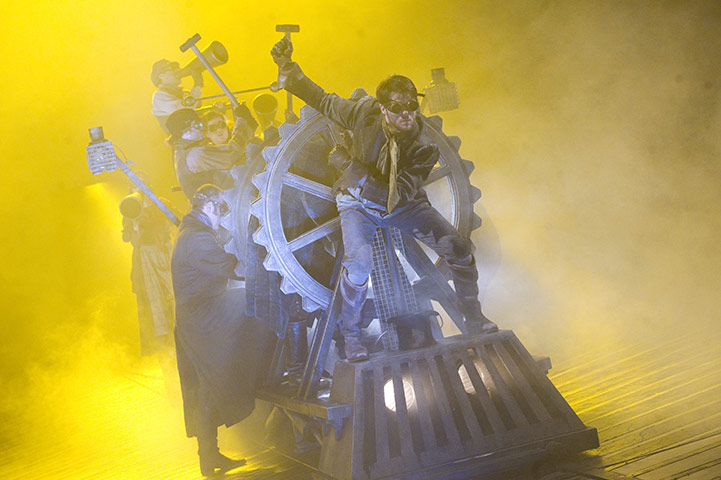
Every element of the design and staging is incredible. The stage is round with a central revolve, and overhead, there's a fixture comprising hundreds of lightbulbs. They're gathered in bunches, hung at different lengths, and it's at once oozing and organic and cold and artificial, evoking forges, power plants, and circuses. To represent the creature's first stumble into a town, there's this gliding platform topped with huge gears that rotate. Extras hang from the front and sides, jerking, slamming, writhing, and do-si-do-ing to something too clanging and brittle to be music, too patterned and hypnotic not to be. It's like Steampunk and German Expressionism had a Marxist-informed Baby.

The blind scholar's hut is represented by four scrimmed walls with a few natural elements stenciled on them; the Frankenstein home is all stiff, stuffy windows and shadow, but it churns up from beneath the stage and sits at a subtle angle. Victor's hut in Scotland has an appropriately claustrophobic, subterranean feel.

The monster is scarred, sutured, scabby, and oozing. The development of his movement, command of language, and command of . . . consciousness and self-awareness . . . are all stunning. The production we saw had Jonny Lee Miller as the Creature and Benedict Cumberbatch as Victor (the two leads swap roles each night). Both occupied their roles in a way that signals and excellent director and a creative process that's hard to achieve where actor and character are constantly growing and stretching. Really fantastic.

Oh, look! It's my "but" face. Charitably, Nick Dear's script is uneven, which is not to say that there aren't brilliant parts of it where Mary Shelley's text is illuminated, enlarged, and brought to life by the adaptation. But then there are parts that are just . . . clunky as shit: Felix and Agatha (the blind scholar's son and daughter-in-law) have awkward Tolstovian orgasms about having cleared all the rocks from their field; the Scots resurrectionists have painfully stilted attempts at Shakespearian comic relief; and Elizabeth lectures Victor on the God-given, societally approved power of her uterus. No, really.

Elizabeth, in general, is a nightmare. Boyle casts all the Frankensteins, save Victor, as actors of color for no reason that is particularly apparent (which is not at all to say that I think the actors ought to have been all white in some misguided attempt at authenticity, but Victor's whiteness becomes pointed). George Harris was simply not very good as Victor's father, although I wonder if his wooden delivery was directed that way, so that we remain entirely within the mind of Victor/The Creature.

Naomie Harris's portrayal of Elizabeth is almost beside the point as a performance. Her character is the victim of the worst of the script and a choice that came within a hair of ruining the whole shebang for me. As through the vast majority of the play, the action stays with the Creature, who springs from Elizabeth's bridal bed and has a conversation with her that, at times, almost salvages an otherwise dreadful scene. Then, unlike the book in which Victor hears a scream and comes across Elizabeth's lifeless body, Dear/Boyle have Victor burst into the room, revolver drawn (if you will) only to flail around on the floor for no apparent reason while the creature rapes Elizabeth, achieves orgasm, snaps her neck, and declares, "Now I am a man."

W.
T.
F?

Extra special bonus points not just for going to the "Women Exist For Men to Use in Their Attempts to Exert Power Over Other Men" Well, but going the extra mile and making the woman non-White. Seriously, just what the fuck?

But other than that, Mrs. Lincoln, it really, truly is a magnificent creative endeavor beautifully brought to life. But I'd consider nipping out for popcorn at strategic moments.

Labels: , , , , , , , , , , , , ,

Friday, March 04, 2011

Songwriter's Navel: Week 08, Live From the Archives

Hoping that WXRT doesn't have that phrase copyrighted.

So this is the first week of the new session at the Old Town School of Folk Music, which means that I did not have an assignment last week. I had thought about what I might do this week, given that I suck at writing without an assignment.

Naturally, taking the week off was the first thing that occurred to me. The second thing that occurred to me was putting up recordings of the songs I'd done for the showcase, which usually would have been last Sunday. When I knew that the showcase had been moved to this coming Sunday, I thought I'd perhaps just talk about the songs I'd decided on and perhaps how arrangements of them had developed. The problem is that I still haven't really decided and given that I have a cold I probably should save any singing (or singing-adjacent) voice in the hopes of being well enough on Sunday.

As I've mentioned before, taking time off is sure to lead to the total collapse of this endeavor, so I decided to go with something from the archives. I don't have all that many recordings of when I've performed with the exception of the first time that I did a slot of my own at the Acoustic Explosion. In a moment of panic, I'd promised my mother a video recording of that show as her Christmas gift. Nothing has ever been more painful than editing that video and audio. It took me 7 months. (That is literal, not exaggeration for comedic effect.)

I led off with this song on a shaky premise. Its unofficial title is "Laffy Taffy Hanukkah." I was also doing a cover of "Hard Candy Christmas" at that show because I'd promised myself that I would if I ever played out and because the show was very close to Christmas. Thus, I thought ALSO playing "Laffy Taffy Hanukkah" was hilarious inside my head. Ahem.

Why, you might ask, is the song called "Laffy Taffy Hanukkah," even unofficially? Well, we'd been given the assignment to write a "character" song along the lines of Patty Griffin's "Sweet Lorraine," Paul Simon's "Duncan," and so on. I seem to remember that I ended up working on this song over 2 weeks. I'd showed up with only one verse and part of a chorus and volunteered to skip performing it in class until the next week when we ran out of time.

I'd had a hard time deliberately writing in the direction of a character, not because I don't know some great ones about whom I'd like to write a song, and not because my brain isn't occupied by a bunch of fictional crazies who would be great subjects. I think it boiled down to trying too hard to be clever or profound.

At this time, I was reading Tom Robbins' Fierce Invalids Home from Hot Climates and having a hard time with it, as I increasingly do with Mr. Robbins. I love—venerate, even—Jitterbug Perfume and Skinny Legs and All, and the repulsiveness of his other novels offends me on the behalf of the wonderful heroines from those two.

Annnnyyyway. I got to thinking about characters that deserve better authors, and we'd just gotten around to hanging some of the art that we'd bought from the set of the Strange Tree Group's production of Mr. Spacky, the Man Who Was Continuously Followed by Wolves. That production, its artwork, and underwritten female characters naturally brings to mind Dickens and particularly poor Rosa Bud of The Mystery of Edwin Drood.

Dickens, of course, died while writing TMoED, and I thought how that was liberating for his characters, who were not trapped by his hackery. So I started to run with this idea lyrically and the first verse came out as sort of an admonishment of the author, leading into a chorus where the narrator gets to write herself.


[G] In these pages I have [C] sung just [C/B] like a bird [Am]
I have [Fmaj7] blushed and bloomed and [D] paled
As you [C] set down every word [G]
I’ve [G]sighed and sulked and simpered [C] and all [C/B] but disappeared [Am]
Your [F] pen left me an [Dsus2] afterthought
Bereft [C] of voice and [G] tears


One of the strange things to me about this song is that the music came to me . . . well, easily is not the right word. Very specifically and as a whole. In the verse, that first instance of an F chord (which implies the song is in C) was very definitely an Fmaj7, leaving the high E string ringing. And it was very definitely followed by a D-major chord, which contradicts the F by implying that the song is in G. In contrast, the second F was definitely an F and the second D was definitely a Dsus2.

This continued into the chorus where the G changed to a "Big G" (four-finger G chord where you play [from high to low] G-D-G-D-B-G), which theoretically sounds so much like a G played with two Bs, rather than two Ds, that people use them interchangeably all the time. Mr. Crankypants Music was having none of this: It was a 3-finger G in the verse and a 4-finger G in the chorus. This not-quite-descending bass line in the chorus was also very specific. It goes G-F#-C-B-C-B-D-E over the G to Cadd9 to A7sus4 progression.

It's also worth noting that this song insisted on being fingerpicked. At the time I wrote it I sucked at fingerpicking even more than I do now.


I am [G] more than a [Cadd9] painted rose, [A7sus4] more than a tale untold
Your [Am] pen cannot [Fmaj7] imagine all the [D] things I’m bound to [Dsus2] be
I am [G] fierce and I am [Cadd9] reckless, I have [A7sus4] dreams both dark and wild
Your [Fmaj7] story ends, here [D] I begin, and I’ll [C] be nobody’s [G]child


Oh, I was talking about the secret title. In trying to write the second verse, I'd sort of been promising my brain that it would get to insert the "great ideas" it had been coming p with into that verse, because they kept not quite making it into Verse 1 and the Chorus. I was certain at the time that the second verse would end up being all about what the narrator would do now that she was able to write herself. So I had a bunch of "I can/I will" statements in my notebook. At some point, I wrote the phrase "Laffy Taffy Hanukkah" in the margin to remind myself that Carol Hall had already gone to the trouble of writing "Hard Candy Christmas." Et voila! Incidentally, the Kernel hated (and presumably still hates) this title something fierce.

My brain ended up getting no satisfaction in the second verse, which became about how the author wrote his male characters:


Your men you make of dust, and to dust they shall return
Your pen breathes life into their minds
Inside a fire burns
Though you gave them feet of clay
They tread a path that’s all their own
You arm them well with words and will
In flesh and blood and bone


Oh, the clunky phrasing and awkward images! But what are you going to do? Write a third verse, I suppose . . . . But no. Both the verses and the chorus are rather long, the lyrics are dense, and everyone is like "For the love of god, please stop now!"

Anyway, here's the recording. There's actually video, too, but I'll spare myself that.

Labels: , , , , , , , ,

Thursday, January 27, 2011

Songwriter's Navel: Week 03, In Which I Kill And Eat My Young For The Greater Good

The Gra'er Gude!

I really ought to have been writing this entry before I tried to record the song, because I have just spent about 4 hours creating something totally awful and in the course of doing so, I have come to hate, loathe, and despise this song. I wasn't in love with it before, but probably it doesn't quite deserve my utter contempt.

Let me try to think about how I wrote this.

Ok, assignment first: The harmonic criteria were to have an A part and a B part and to use a major key for one part and its parallel minor for the other. The lyrical prompt was violence: To think about how routinely violence occurs today and use that as a jumping off point for the song.

Class is on Tuesday nights, and then I volunteer at OTSFM on Wednesday nights. To get back to my car, I can either take a long bus ride or take one train to another. I'd decided on the train route on the grounds that the bus just has a higher weirdness/drama ratio than the train as a rule.

So assume that karma is on the job. I get on the Brown line (the LEAST drama-prone line in all Chicago), and there is a man who is screaming—no, really SCREAMING—into his phone at a woman. He seemed to be trying to get her to put money in his account. And he was just absolutely vile to her. Calling her "fucking bitch" in every single sentence. Telling her to "stop her fucking whining and make it happen." Then he got on the phone with someone else—a male friend, I think, from context—and explained that because of that "fucking cunt" he was screwed. And that he had "stopped fucking her, so she's frustrated," and on and on.

On the one hand, there's obviously nothing I could do. On the other, it's impossible not to think about what I might, could, should, or shouldn't have done if the woman had been there with him. And the answer is, most likely, nothing. For good reasons and bad ones and ones that are inarguable.

So. Yeah.

I started trying to wrangle this into song form on Sunday night. I think I came away with nothing more than the first two lines of verse 1 and a vague idea that I wanted to make reference to Clem Snide's "Moment in the Sun", not because it was playing, but because I'm a hack. I worked on the lyrics on the Metra the next morning and a night of percolation, apparently, was fruitful, because I came away with, more or less, the first verse:


[A] Backward through the city
Tracing [D] flowers in my breath
I am alone*
With a [Em] song about a [G] moment in the [A] sun
The [A] fury winds around me
Flicks its [D] tongue against my skin
I turn to [Bm] stone
I stop my [G] ears I close my eyes**


*I'd started out with a G chord on "alone" in the third line, but I was singing an odd note against the chord. Although I kind of liked it, the consensus was that I needed to support the melody note in the chord, so I changed it to a C#m7(b5). I admit that now I like that chord choice better, though it sounded hella weird when I first used it.

**I was having real trouble shifting into the parallel minor. Despite the downer content, the song kept feeling very melodically up. I realized that I was probably going to want to start on an F chord. For no particularly good reason, I ended the verse on Em. The Kernel advised going to C there (although that's not in the original key of D, and I went to Catholic school . . .). In any case, C it was. That meant changing the melody note, and as is obvious in the recording.

The chorus and second verse come from other images drawn from riding the train (not the same train ride, I don't think). When the Brown line goes around the Loop, it's parallel with about the 3rd floor of a number of buildings. Through one window, I saw a room full of easels with works in progress on them. I liked both the sense of looking through 2 windows at once and the idea of art interrupted that would be continued. A few moments later, I was looking into an empty, dark cafeteria, and the sight of all those tables without people sharing food around them struck me as very sad.

The chorus fought me terribly. I got down "Through a window, through a window," and two things happened immediately: I decided that I really hated that line and it completely killed what I was trying to capture, and I could not expunge it from the song no matter how I tried.

I experimented with a couple of lines related to the easels/art. I ended up with "beauty" being the word encapsulating the image. I also decided I hated that. It also wouldn't leave. I tried out "Beauty interrupted," "Beauty in progress," and ended up with "Beauty yet to be."

Then the thing started to get bloated and impossible. The image about the tables kept trying to get in there. So did the word "easels." I eventually had to hack it down to just two lines. Two terrible, repetitive lines.


Through the [F] window, through the [Gm] window
There is [Am] beauty yet to be, yet to [Dm] be [Am] [Em]


Yes, a terribly awkward transition from Dm back into D. Oh, I'd also forgotten that the Kernel suggested "taking a Powter" (meaning do 2 verses before the chorus), which undoubtedly would have sounded better and kept me from having to sing the chorus more than twice.

The only good part about disemboweling the chorus is that I was able to move the table imagery into verse 2. Of course the image is a hard one to wrangle. I kept coming back to wanting to say something about friendship, sharing meals and so on, and decided on "breaking bread." If there's anything that I don't hate completely in the song, it's that line in this verse (my feeling about it is merely ASYMPTOTIC to hate; chords are the same as over verse 1):


A hundred empty tables
Where the future breaks its bread
Without a sound
And the anguish falls like embers to the ground
Casting paint upon the canvas
Sinking fingertips in clay
I break the vow
To stop my ears to close my eyes


The third, fourth and seventh lines gave me a lot of problems. Despite the fact that the third and fourth lines in the first verse don't really rhyme, they're sonically similar. And my ear would not accept just any old word at the end of line 4. And that made the need for the rhyme with line 7 even more dire. To fill out the verse, I wanted art images. Not wild about the paint on canvas line, but I kind of like the visceral nature of the fingertips in clay line. Mostly out of self preservation (given that the verses are rather long I kept the final line of the verse as a variation on a theme.

The last verse came the easiest, I suppose, because there was, by then, very limited room for me to screw with it. I'd thought that I wanted something about polaris/the north star. I had my new little nephew in mind (I drove up to Wisconsin last week to meet him) and the kind of world we want to leave for those yet to come and so on. Rather generic sentiment, unfortunately:


Contrails from the streetlights
Tease the raindrops on the glass
And taste the moon
An outline in my breath on darkest blue
By the north star like a promise
With tomorrow closing in
I think of you
And my eyes are open wide


End on the chorus with a few Canadian tragipop repeats of "yet to be" modulating between Dm and D, with a cheater C major thrown in for good measure.

As previously mentioned, recording this very nearly killed me. I had decided to try playing it on the nylon string as it's fingerpicked, and the wider neck is sometimes more forgiving. Of course he wider neck and less practice on that guitar meant that I screwed things up over and over. I ended up using my regular guitar and opting for Garage Band's "shimmer" effect to mute the sound of my sucking. I also recorded my vocals with the basic effects for female vocals. I'd started to add a second vocal track with some ornamentation and echoing, but I'm so freaking inconsistent with my pitch, I UGGGH!

Ok, the self loathing is boring me perhaps more than anyone (I know, reader: FAT CHANCE!), so here it is.

Labels: , , , , ,

Tuesday, October 20, 2009

Review: Ma Rainey's Black Bottom at Court Theatre

My review for EDGE Chicago. Terrific production.

Labels: , , , , , ,

Tuesday, July 07, 2009

De Trop: Transformers 2—Revenge of The Fallen

There's really so little point in my attempting to review Transformers 2: Revenge of The Fallen, first because it is not really a movie, as such, second, because you can't top Topless Robot. But when have I ever left it at that?

In some ways, T2:RotF (hmmm, is that a 533kr1t message in the title's acronym?) is more successful than the first movie, because it does not make the mistake of shorting you, the viewer, on the Giant Robots Kicking The Asses Of Other Giant Robots front as the first "film" did. Even Optimus Prime's stabby, stabby swordfist makes a very early appearance in Shanghai.

Speaking of Shanghai . . . oh, damn, I was about deploy my Home Movies–based "shooting day-for-night, like Truffaut" joke ('cause the helpful War Games-era computer-y text at the bottom of the screen says "Shanghai, 22:15," but it's bright daylight), but I just realized that this could be a time-zone thing. Alas. Can I still quibble about the movie's deep confusion regarding to which branch of the military Josh Duhamel (still pretty, still charming) belongs? Can I note that I appreciate Rainn Wilson in . . . an opera cape? . . . as much as the next gal , but I have never, in my whole born life, been to a huge lecture class attended by "the Dean" or even "a Dean"? Yes, I think I can.

I'm not even going to have a go at this plot, because, really "Michael Bay does not understand what a robot is" and "Because... because FUCK YOU, that's why" pretty much sum it up. I'm not sure that these statements are any less true of the first movie, by which, you will recall, I was pretty charmed. I was not charmed by Transformers 2.

Despite the aforementioned stabby, stabby swordfist, despite the fact that Devastator is pretty freaking cool, despite the complete absence of the demented Australian Black Canary rip off from the first movie, and despite the fact that Michael Bay clearly stopped creaming himself long enough while watching The Incredible Hulk to write in a car boxing gloves scene of his own, I was really not charmed. Why?

Well, you've seen the trailer, right? So you, like everyone else in America, are qualified to comment on Megan Fox's pelvic health, courtesy of the scene of her dry humping the motorcycle. If that struck you as a bit much, let me tell you that the scene in the movie would have required lights, gels, and make-up for her freaking fallopian tubes. It is that extended and invasive. Even if I didn't think less than nothing of Megan Fox, to say that this is creepy doesn't begin to describe this sequence.

Of course, Fox has competition this time in the form of Isabel Lucas, the human-form Deceptislut planted at Sam's college for God Knows Why. At first, it simply seems that "Alice" is simply the most frequently objectified blip on the radar of Sam's web entrepreneurial roommate (I do have to be grateful to Michael Bay for NOT exploring the purpose of the serial killer wall of photos of young women in the cyberden). You see, women go to college to walk the hallways with washcloths wrapped around them, and Alice excels at fitting into this environment. But then she enters upon her campaign to show Sam that MF knows exactly jack about dry humping.

I find that here I really must pause—and I apologize, because I know you're excited about the humping—to address a "plot" element not covered in the Topless Robot FAQ. So Sam lives in LA, right? And it's mentioned several times that he is going to college "On the East Coast." There's a whole baked scene at his natal home with them all packing up the minivan before the appliances come to life in a scene that I'm pretty sure is just doctored footage from Gremlins.

(Here I pause in my pause to, once again, thank Michael Bay for NOT including one of Sam's mother's sex toys among the appliances come [so to speak] to life. Given your rock-bottom opinion of women, Michael, it must have KILLED you to skip the "ZOMG! Middle-aged women like sex! HOW GROSS IS THAT?" joke.)

ANYWAY. LA to East Coast, presumably by minivan. Except that all members of the Witwicky clan are wearing exactly the same things when they arrive at the college as they were when they left LA. Fine, whatever, they were loading up the minivan to head to the airport to pay another $40K in extra-baggage charges, rather than driving cross-country. BUT THEN Bumblebee, who was cruelly left behind by Cool!CollegeBound!Sam in move that smacks of Act III of any nerd-based 1980s classic, shows up on Sam's first night of college. Can he, like Jetfire, inexfuckingplicably teleport? AND WHY DO I CARE?

In truth, I do not. I want to get back to the Deceptislut for a moment. So Sam, who is having the world's least convincing quasi-epileptic episodes, courtesy of the Hellraiser shard, initially tries to fend off her advances. Bumblebee, like a true nerd!friend, is determined to save Sam and his relationship from Sam himself, so he drives up on the hedge of the fraternity house. Sam beats feet out of there, and Deceptislut calls shotgun. She starts talking car!pr0n to him, and Bumblebee deploys the possessed radio gag, beginning with "Your Cheatin' Heart." Funny! He then switches to "Superfreak." Still funny! And then he whips the passenger seat forward, slamming Alice's face into the dashboard. HILARIOUS, right?

You can certainly feel free to call me a hypocrite, because I enjoy violence-laden action movies. So what is it about this that really chaps my hide? It's a passing moment in a comic relief scene. It's hilarious that Sam is such an over-caffeinated boob! It's touchingly funny that Bumblebee is so devoted Sam, despite the fact that Sam has spent their time together in this movie being a complete prick, that he will totally put that bitch out of commission to protect Sam. So he—I have to say it again—slams her face into the dashboard for comic relief purposes. And, yes, I know she's a Bad Guy! (although Sam doesn't know that, and his reaction is so underwhelming that that's a huge part of what's disturbing about the scene).

Moving on. With all my sensitive girly worrying about misogyny here, I'd certainly be remiss if I did not give a WTF?!? shout out to racism in the movie as well. Recall, this is from the same director who included a scene of unbelievably old school racism with a human in the first movie, BUT STILL. Skidz and Mudflap both have giant, sticking out ears and buck teeth. Their dialogue out-Jar-Jars Jar-Jar by a loooong shot. Also, please note the gold pimp tooth. That's Klassy with a K, Mr. Bay.

Overall, the movie is just without charm. It's just as baked (literally in this case, and I'm with Topless Robot in wondering what the hell they were thinking with the pot brownie scene) and nonsensical as the first one, but there's very little that's fun about it. John Turturro seems sort of pissed off and slightly bitter. Also, though I love him, I did not need to see his butt crack being flossed by a Sector 7 thong (although that provided postproduction hilarity when the ZK asked me, "Did he say I wear it when I fuck?" No. No. he did not. He said, "I wear it when I'm in a funk.") The EBIL GOBERNMENT subplot makes no sense at all. The attempts to inject emotion into the relationships Sam has with MF and his parents were a tragic mistake.

This thing is One Hundred And Fifty Minutes Long. There is no excuse for that in a well-ordered society. A lot of the dead weight that the movie is carrying seems to be 12-year-old boy-directed humor. I do not begrudge my up-and-coming tween nerds their dumb comedy, but there has to be 20 minutes of ill-advised scenes like Johnny 5 or whatever the hell his name is humping MF's calf, and every one of those 20 minutes was met with dead silence in our theater, which was heavily populated with the presumed target demographic.

So I have to ask myself, as you should be asking yourself: At what price more hot robot-on-robot violence?

Labels: , , , , ,

Wednesday, June 10, 2009

Review: Once On This Island at Porchlight Theatre

For EDGE Chicago

Labels: , , , , , ,

Thursday, May 14, 2009

Welcome to the Bridge of the USS Crap You Already Knew: Star Trek

First, everyone either looooooved or haaaaaateed Watchmen, and I thought it was ok at best. And now Star Trek—this would be the same Star Trek that has a 96% at Rotten Tomatoes—well, it was ok.

I mean are we getting the subpar Midwestern cuts?

I suppose I should begin by praising casting: They certainly prepared me to watch Chris Pine for a couple of hours by casting two astonishingly ugly people as his father and as his younger self. On the other hand, is wholly unbelievable that these eyebrows, this blank stare sprang forth from the loins of Jennifer Morrison, who is quite gorgeous. I'm not sure I'll ever feel the same about Cameron again, though.

We'll be kind and leave the aberration of casting Winona Ryder in any role for any reason and say that casting really did quite a good job.

  • Zachary Quinto as Spock is rather a no-brainer. I do wonder how many times daily they had to stop filming to remove his 11 o'clock, 11:15, 11:27, etc., supraorbital shadow. Also, the back of my mind kept screaming that Kirk had obviously stolen Sylar's eyebrows.
  • Zoë Saldana was a good Uhura, and she had a promising start in the movie. Actually, I'll reserve my reservations (ha, do you see what I did there?) on this front for later.
  • I like Anton Yelchin. Have liked him since !Huff, although he took a while to grow on me. Sadly, all Chekov is to Abrams is an ambulatory accent joke that, in retrospect, is kind of a slam on Walter Koenig.
  • I was not feeling the love for John Cho as Sulu. I didn't dislike him or anything about his performance, it was just kind of a void. And, yes, it bothers me that he's Korean not Japanese.
  • Simon Pegg was completely flawless and wonderful for the 8 minutes that he is actually in the movie.
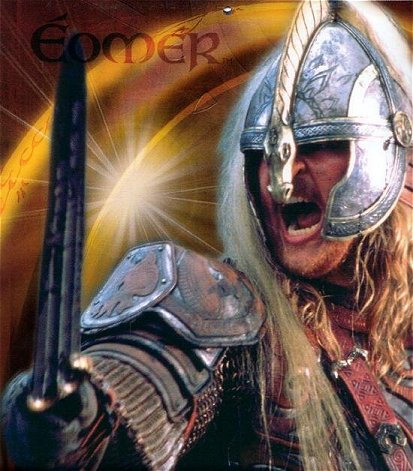
  • Karl Urban. I can't remember if it was an Onion joke or something from Peter Sagal or others on the WWDTM crew, but I chuckled in my usual sophisticated manner at the thought of Karl Urban losing it and lapsing into Eomer. Whoever it was appears to have been joking on the square. Ok, so he wasn't Eomer in the scene where he and Kirk meet, but he was like some awful DeForest Kelley impersonator. Certainly he was better later, but I don't know what kind of director yells "Cut! Print! GOLDEN!" after those shenanigans. Oh, wait: I do.
  • Bruce Greenwood's good. He even manages to sell the line about Kirk being the only "genius-level repeat offender in the Midwest" while looking into the terrifyingly blank eyes of Chris Pine.
  • Pine. Other than cheap shots about how unattractive I think he is, how was his performance? Kind of irrelevant. Abrams' approach is to catapult Kirk through a series of masturbatory Adventure!Scenes! Really, a crash-test dummy could have played Kirk, so there's not a lot to judge Pine's performance by. I will say that most of the cast managed to have at least one moment of emotional reality, despite Abrams. Not Pine. Not even with Nimoy on Hoth the M-class planet near Vulcan.
  • Bana's Nero was exactly what I imagine they wanted. He outgrowls Bale in The Dark Knight; He yells SPOOOOOCKKK presumably until the entire crew reaches climax; he wears the prosthetics well. I thought maybe there would turn out to be something interesting about his relationship with Ayel (and you should totally go see Clifton Collins, Jr., in Sunshine Cleaning, by the way), but . . . no, they're really just two Romulan miners displaced from time hoping . . . well, I really have a better idea of what the Decepticons' goals were, I guess, because I was thinking that they deserved a trip to Disneyland after getting not one but two Spocks to witness the destruction of Vulcan.


I really should have liked the whole movie more, because the casting really was very good. Unfortunately, the script and direction weren't. Last fall, my sister, my niece, and I went to see the stage version of Dirty Dancing. It was a very strange experience. Not unenjoyable, but strange. The leads were made too look as much like Jennifer Grey and Patrick Swayze as possible. They were very good dancers. But other than a strange and misguided attempt to inject some more Civil Rights–Era weight into the script, it's basically a stage reenactment of the movie.

The dancer (I deliberately refrain from calling him an actor) playing Johnny had an extremely strange and heavy accent. I remember being very surprised that he was supposedly from Australia, because his delivery strongly suggested that he had learned his lines phonetically. This mattered not a whit. The crowd still went wild when he declared, "Nobody puts Baby in the corner." It's fortunate that this comes near the end, otherwise one senses that the place would have emptied faster than Springfield's Ghery-designed Concert Hall.

The script for Star Trek resembles nothing so much as a series of post-it notes, each with a "must-have" moment scribbled on it. You have the heavy-handed establishment of the "Bones" moniker in Urban's painfully unchecked DeForest Kelley impersonation, and later the mandatory "Dammit, Jim!" You have "I have been, and always will be, your friend," and I admit that Nimoy, as always, pulls it off despite Pine's resemblance to the world's most mentally challenged cocker spaniel. You have the tragically underused Simon Pegg "Givin' it all she's got!" You have the audience fairly shouting "Say it! Say it! Say it!" for Chekov's "Wictor Wictor" and later "Wessels."

I suppose sticking to the well-known territory was all for the best. From early on, when the script tried to be a script for the movie in progress, it was filled with "Wait, what now?" moments. It's true that I often have to consult my spousal unit to clarify certain issues about Trek. So when a Romulan shows up on screen and no one on the Kelvin has any reaction whatsoever to what I gather is supposed to be the first-ever sighting of a Romulan in this shiny new timeline, I figured I was misunderstanding something, but it seems not.

When big-handed Kirk (ok, I admit that I got deep satisfaction from McCoy chasing Kirk around and jabbing him in the neck repeatedly) busts on to the bridge and makes his big reveal to Pike, well correct me if I'm wrong here, but our Young Turk has just bust in and said Shit. That Everyone. Already. Knows. The only thing that he even arguably reveals is the transmission that Uhura intercepted, a little fact that would've been common knowledge if Abrams—as every watcher of Lost knows—didn't have some deep fear of periodic staff meetings in which information is added to the common pool.

As the ZK pointed out, I guess Kirk gets Pike to raise the shields before dropping out of warp (which, call me crazy, if I'm flying blind into a distress call–driven situation with no further information, I'm all about the shields). Starfleet really has lowered the bar if that's enough to get you bumped to first officer.

The ZK inadvertently preyed on my shaky Trek knowledge when he started flipping out about Spock's mother dying. I, for one, supporting killing Winona Ryder as often as possible on screen, particularly when she has been inexplicably mummified with half a pony keg over the front of her torso. (In general, my feeling is a giant WTF? about the costuming; nice slash-pocket Dockers on all the boys!) PLUS, I was all "Why is he worried about messing with the fact that Spock's mother is supposed to be alive and well when I am worried about the fact that, as far as I know, VULCAN has never been blowed up real good." But the ZK's Trek priorities, like Tim Conway, defy augury.

It's a shame that the script is such a shambles, because I don't think it had to be. I really like it being anchored in the extraordinary relationship between Kirk and Spock. (I liked it better before the unnecessary scene with Nimoy and Quinto that spelled this out, not because I begrudge either of these two screen time, but because it shattered my last hope for any kind of delicacy in this movie.) But I don't think that centering the movie on that relationship should involve sacrificing your other characters to campy "TCB now! No New Crap!" cameos." And if that IS the center of your movie, then maybe spend a little less time on the Wet Dream Adventures of James Tiberius Kirk and a little more time on WHY that relationship is important (and why it's crucial that Spock be the "bottom" in it).

Let's now talk completely extraneous crap:

  • Hoth the M-class planet near Vulcan? In addition to being silly, what the hell's up with having Kirk climb out of the pod's crater in his Academy jammies? Couldn't help thinking that this looks like the kind of planet where exposure = death in seconds. Also, totally gratuitous use of Cloverfield leftovers. I would like to invite Mr. Abrams to get over himself.
  • I'm willing to give Abrams a pass on the "Why do we even have that cavernous central pit?" for the Romulan ship, because it's de rigeur for all space-faring movies at this point. But seriously, a ship designed entirely around catwalks?
  • I honestly don't know if the Uhura/Spock relationship is extraneous. Sadly, Uhura is practically extraneous, which is made worse by a promising start for the character. I don't particularly object to the relationship (although I don't buy them macking in plain sight on the transporter pad for a minute), but it highlights Star Trek's gender fail. I appreciate that the movie is stuck with a lot of the baggage of the 60s series (especially the costuming, and both the ZK and I agreed that female crew's uniforms were an area where the costuming succeeded pretty well), but I don't get the feeling it was a priority to work their way free of that baggage. I mean, seriously: A "Hope this hick isn't bothering you!" bar fight? Serial "lingually gifted" jokes? I liked the chemistry between Saldana and Quinto. I liked that she is supremely uninterested in Kirk. But it chafes that making her the girlfriend is all they could think to do with her.
  • The scene with the convertible—and again, I feel I must point out the incredibly ugly child.
  • Abrams' directorial "style." Bad bad bad bad bad bad bad and again BAD. Step away from the shakier-than-thou hand-held nonsense. And I SWEAR TO BA'AL if you dolly in and swing 270 degrees around a character's GIANT NOSTRIL HAIRS just one more time, I am going to give you such a pinch. Oddly enough, I had some hopes early on that he'd toned down some things. In retrospect, the directorial moments I didn't hate seem to have been cribbed from Battlestar Galactica.


I suppose that's about it. I could rant about the IMPLIED VIOLENCE AGAINST BEAGLES! But then I would never stop. I could spend some time on "It's a big red ball. I can't wait to tell my friends. None of them has a red ball this big." I could chide Abrams for stealing the Fire Swamp's Flame Spurt gag from The Princess Bride. But that would be piling on, now wouldn't it?

Labels: , , , , ,

Wednesday, March 25, 2009

So Say . . . Well, I . . . Because "We All" Said So Some TIme Ago

A handful of thoughts on the ending of Battlestar Galactica. 5p01l3rz, obviously!

I really liked Battlestar Galctica a lot, although I don't think I ever loved it. Just when I might've gotten to that point, the first season ended with the "1 Year Later" bullshit. I never quite got over that, which is unlike me. (I am, generally speaking, a very adaptable TV viewer.)

We were well behind in BSG viewing pretty much all season. I don't think I got spoiled for much of anything, which has a lot more to do with being out of the fandom than good behavior on anyone's part.

My interest really dipped to a low in "Revelations," as the nuked Earth seemed so very obvious. The byzantine explanation of the final five and their place in human–cylon history was not helping. When we picked back up "Sometimes a Great Notion," I was frustrated with all the shortcuts taken to Dee's end.

It isn't that I find a suicide at that time unbelievable. It isn't even that I didn't buy that Dee would take her own life. In fact, I pretty much knew from the moment we saw Dee's reaction shot on Earth that she was done for (didn't necessarily know it would be such an overt suicide). But her whole story line takes place against a kind of emotional green screen. By the time we have the bizarre scene with her romping with Hera, Helo, and Athena, I wondered if the problem wasn't Dee, but that everyone else in the main cast had suffered some kind of head injury that prevented them from seeing that she'd snapped. And, well, the best thing I can say about that episode is that Lucy freakin' Lawless and her nightmare hair finally got left behind.

I liked "The Oath" and "Blood on the Scales." It was good to have Gaeta finally do something—some culmination of behavior that had been bizarre and erratic since he served as President frakking Baltar's aide de camp. There was plenty of fury to go around on both sides. Zarek's slaughter of the quorum could be viewed as annoyingly directive (LOOK! LOOK! HE'S THE BAD GUY! DON'T ROOT FOR HIM!), but that gun was on the mantel when Zarek was introduced: Whether he's a guerrilla or a freedom fighter in today's paper, his tactics will always be brutal and uncompromising. Oh, and I loved the return of Starbuck—MY Starbuck, devoid of emo and bubblegum.

Unfortunately, "No Exit" killed any momentum that had been built, at least for me. Talky, talky. Obvious. Boring. Stale metaphors. Yes, I have couch trauma related to No Exit, specifically, but I don't think it was all in my head. "Deadlock" didn't do a great deal to pick up the pace, either. Part of the problem was poor Ellen's schizophrenia.

I've no idea when they decided that she was the final cylon, but boy was that decision covered in phlebotenum. I don't fault Kate Vernon, who did very well occupying an entirely new character we'd never seen before. I fault the whipsaw writing that tried to reconcile her as the real brains of the five with her long-running, completely-toxic-but-somehow-a-great-love relationship with Tigh.

But then I loved almost all of "Someone to Watch Over Me." Ok, I loved about half of "StWOM." Ok, I loved the Starbuck parts. The crushing monotony of the briefings. The sudden memory that the more fucked up things get, the funnier she gets.

But then there's Chief. What. the. Fuck? In addition to not buying for a frakking second that he is so completely undone by Boomer's reappearance that he can't think straight, I found it staggering that the script for the episode barely acknowledges the fact that Chief presumably beats another 8 unconscious to make the substitution in Boomer's cell. When we then add in the torture porn of inherent in juxtaposing the Boomer/Helo sex to the bruised, bloody, and bound Athena in the closet . . . UGH. Please, writers, work out your own mommy/woman-who-done-you-wrong issues on your own time.

I'm just going to skip "Islanded in a Stream of Stars." Honestly, I can't remember much about it, and the Boomer Beating/Beat Off material of "StWOM" leads pretty well into what I liked and disliked about "Daybreak."

The flashbacks to before the fall could have gone wrong, but on balance, I liked them and appreciated the pieces of characters that they slotted into place. On a technical note, using long shots in most of these flashbacks caused me a lot of "Is that Lee or is that Anders?" confusion.

I know there's a lot of dissatisfaction with the Kara/Lee nookie close encounter, and I appreciate and get the criticisms. However, it kind of worked for me. I buy the fact that Kara loved Zak in her fucked up, damaged way. But I also buy that Kara is and always has been exceptional, in both positive and negative ways, and so is Lee. In contrast, Zak is a nice guy, but plodding. Ordinary. Mediocre.

It's not particularly admirable in either Kara or Lee that in the moment, they'd forget about the little people (and it's a pretty tired, ethically suspect convention) but I believed it. Anders' monologue about perfection shed more light on both Kara and Lee than it did on him. (That's my bias, certainly. Michael Trucco's performance never elevated Anders to anything more than a Lee also-ran as far as I'm concerned.) Plus, I'm sorry, but no one's chemistry comes close to rivaling that off Bamber/Sackoff. I am shallow.

Beyond that, most of my likes/dislikes are bullet-pointable, and so I shall bullet-point:

  • Nice of the writers to leave Chief completely out of "Islanded in a Stream of Stars," and then casually reveal, "Oh yeah, Chief's complicity with Boomer? We knew about that." Um, what?
  • Hated Kara-as-Angel. Hated the Angels in general. Hate hate hate the tired SciFi (SyFy, syphilitic) trope of postcorporeality being the ultimate stage in unilinear human evolution.
  • Poor Cally's kid! (Does he even have a name?) Everyone forgets until the last moment that his mom got airlocked My Two Dads both go off on the suicide mission.
  • And speaking of our belated recall that Cally got airlocked. . . . I've been hating on Tory for a good long while for a variety of reasons, Cally's quickly forgotten death being chief amongst them, but I hate that her end came Tyrol's hands, given the events of "StWOM." Nice that Boomer buys it for her sins, Tory buys it for her sins, Dee buys it for . . . well, I don't especially know why Dee drew the suicide card, and Tyrol gets to finish the series with a manly act of violence against his former lover. In general, the clumsy inattention to gender in the last few episodes really annoyed me.
  • WTF? on Cavil deep throating his own gun.
  • Yes, I know that President Badger made no sense whatsofrakkin' ever, but it made me laugh. Plus the dog makes it, which means I don't have to hunt down and kill every last person associated with the show. A domesticated dog in the mix 150,000 years ago probably shouldn't screw with the timeline of animal domestication TOO much, and dogs do come first.
  • Not that anyone but me cares, but the setting of the fleet's arrival on Earth 150,000 years ago means that we might attribute the successful diaspora of anatomically modern humans at the expense of archaic Homo sapiens to interbreeding with the fleet. That's a pretty punk-ass unifactorial explanation. The ZK, at 1:26 into "Daybreak," paused the TiVo, put his hand on my shoulder, and said, "This may be hard for you." It's fortunate that the script didn't go too far down that road.
  • Mary McDonnell is such a star. I just loved her performance at every single moment in the series, even when the writing for her was shit. Like everyone else, I was completely undone by her scene with Cottle, and I just love her.
  • I'm glad that Helo survived, even though I'm not sure how he did. Helo may be the one character whose moral compass remained more or less intact through the whole series.


And that's about the it.

Labels: , , , ,

Wednesday, March 18, 2009

Please, I go through *everyone's* trash: Watchmen

Saw Watchmen last night. This is probably going to be terse. For me, I mean:
It was ok.

It starts out well, in fact. The murder of the Comedian establishes the visual style that will dominate for most of the movie, and it seems like a good balance between honoring the artwork of the graphic novel and realizing that a movie can't be panels strung together.

The credits are fantastic, and the opening scene looks even better in comparison. In the retelling of the story of the Minutemen in a series of snapshots and headlines, the colors are brighter and the lighting is designed to make the scenes flatter and less realistic. The good times of the past are more romantic, the bad times more lurid. The recreation of historic events in the credits is also more successful, in part because Zack Snyder almost always does something that breaks the fourth wall, signaling movement into a new scene. All very nice.

Everything about Rorschach is perfect. The costume is great. The shifting effect of the mask was done very well. It was only near the end of the movie when I was deep in "Why am I here? Why is anyone in this movie doing the things they are doing? Why did some terrible, but not life-threatening accident not befall Malin Akerman in childhood, saving us all from this 'performance'?" mode that I wondered why it does shift. (IMDB's trivia notes that the material for the mask had been intended for a dress ordered by Kitty Genovese, which is an interesting detail, but sheds no light on the effect.)

Jackie Earle Haley is magnificent as Rorschach. Perhaps even more important, Haley is magnificent as Walter Kovacs, and so often things go whizzing down legs when the mask comes off.

On our drive back down to LA, the ZK and I were listening to the Filmspotting podcast that includes their Watchmen review, and they compare his performance with Heath Ledger's Joker. I concur, and although it might seem to be picking on the dead guy to do so, I'd give Haley the edge if I were required to choose the better performance, mostly because the writing for the Joker is perfect, whereas the writing for Rorschach is merely the best writing in a pretty terrible screenplay.

Ok, if I'm going to have to talk about the screenplay, and I assume I must, I guess I have to nitpick one thing about Rorschach: The presentation of his origin story deflated my enthusiasm for the character. Worse still, the poor work on the origin story made me think about a facet of his characterization throughout the movie that is not done well. Most of his origin story is spun well. The case that kills the last of Kovacs and gives birth to Rorschach is compelling (although I think Snyder veers too much into torture porn at the end of it).

But poor widdle Walter's mommy was a prostitute and not nice to him? Please. What a half-assed, trite, misogynist piece of boo hoo. Probably I have Alan Moore to blame for the original sentiment, but neither screenwriters David Hayter and Alex Tse nor Snyder do anything to elevate the moment. By the time the events in the hallway are spelled out, we've already seen those events several times. WE GET IT.

In addition to finding the director's lack of faith in the audience disturbing, spelling out this element of Rorschach's story also calls attention to his Puritanical-bordering-on-phobic distaste for sex. The world that's represented isn't exactly crawling with sexual debauchery (with the exception of a scene where Rorschach is pursued by an aggressive prostitute). I guess we're supposed to attribute the recurring theme in his voice overs to his sociopathic misperception, but as the most memorable instances of it are directed at the first Silk Spectre and at Silhouette, it comes off, once again, as simple misogyny. Yawn.

But the screenplay has more dire problems. There is very little in the way of through narrative. Again, that might be the fault of Moore and the graphic novel originally, but it behooves the screenwriters and director to show some attention to the translation from one medium to the other. Character-establishing sidestreets and character-building interactions in the present seem to have been flung down randomly on the timeline.

The Filmspotting blokes were critical of the long digression into Dr. Manhattan's history. They were ultimately of the opinion that we didn't need to see it at all. I can't agree, though, because Dr. Manhattan is so poorly integrated into the story to begin with, I feel that if I knew even less about him, it would have been impossible to regard him as anything more than the deus ex machina inappropriately placed on the mantel in Act I. The poor exploration of Dr. Manhattan left me wondering about things like why his execution method ends up so gory. On the one hand, I appreciate making death look like death, when violence is too often rendered beautifully and lovingly. On the other, if there were ever a killer whose method would be neat without fuss or nasty clean-up, it seems like that killer would be Dr. Manhattan.

I also wanted more Dr. Manhattan, because I really liked Billy Crudup's performance both in and out of the magical light suit. I do agree that the origin story is both too long and placed far too late in the film. It might have worked better if it had been interspersed in the story as flashes of memory or reflection on Dr. Manhattan's part. In contrast, I think Dr. Manhattan's yogic sojourn to Mars went on far too, long. In particular, his 9-minute monologue about the miracle that is Silk Spectre II rang, shall we say, false in my ears.

I'd argue that the handling of Veidt/Ozymandias is a cautionary tale of how much worse things could have been on the Dr. Manhattan front. I mean no disrespect to Matthew Goode, whose performance I also liked. I really loved the precision of his speech and the fact that the smartest man in the world visibly struggles with talking in Slow. Loud. English. to the rest of us. But Ozymandias is a disaster.

The ZK asked me if I figured out early on that he was the villain. "Figured out" is probably inaccurate. There were no options other than Ozymandias presented (Nixon or Kissinger, I suppose). I assumed he was the villain about 4 seconds into his Annie Leibovitz shoot, but doubted myself on the grounds that his plot makes no sense at all. That's ok, plots often don't make sense to the outside observer, but I know virtually nothing about Ozymandias (except that he apparently missed the irony in the Shelley poem), so I don't know why it makes sense to him, and that's a big problem. I'm not sure what the scene with him and the '80s vintage robber barons is meant to accomplish. It certainly doesn't give the character any depth, the ruse with the assassin is laughably transparent, and YES LISA, WE ALREADY FIGURED OUT THAT HE SHOVED THE CYANIDE CAPSULE IN THE GUY'S MOUTH, WHICH HE WAS HOLDING CLOSED EVEN AS HE DEMANDED TO KNOW WHO'D SENT THE DAMNED ASSASSIN IN THE FIRST PLACE.

Ahem. Moving on. The Filmspotting guys took issue with Patrick Wilson as a schlumpy loser who can only get it up in his owl head high above the city. It is utterly unfair of me to attribute the fact that I had no problem buying him him as a complete loser whose face seriously needed murdering to Patrick WIlson at all. I actually liked Patrick Wilson as Raoul in the horrible Schumacher Phantom of the Opera, thus ensuring that my and Ebert's opposition would be completely diametric.

Nonetheless, the sad truth is that poor Patrick Wilson as Nite Owl II is so persistently saddled with Malin Akerman as Silk Spectre II that I can barely think about him and his chin butt without throwing up in my mouth a little. Akerman is certainly the worst tragedy to befall this actor and this character, but the screenplay is doing him no favors, either. His monologue in the riot scene is horrible. His tushy in the Owl!Cave is sad. His pathetic thrusting is cringe-worthy, and his cuddling in Archie's eye socket made me want to auger out my own eye sockets.

But I should back up to the prenookie fire rescue. (1) What part of "The roof is starting to cave in" inspires Nite Owl to knock a water tower over on to said roof? (2) Given that it is 1985, not 1885, why is your primary weapon some kind of Gatling gun? (3) Leaving aside issue (2), if all you have is a perforating gun, why not shoot a big hole in the water tower itself, rather than delicately shooting out the supporting struts?

I just don't think I can talk about Malin Akerman directly. It's probably best to let Madeline Kahn do the talking. (So true, so often.)

What. the hell. were they thinking?

The trivia in IMDB for the movie counters every possible argument for her casting and every possible argument that might temper any criticism of her performance. She is only 7 years older than the many-times-hotter Carla Gugino. She is actually older than Laura Mennell, who plays Janey Slater, the "older woman" that Dr. Manhattan leaves for Silk Spectre II. And the generous speculation of the Filmspotting guys that she might've had to act opposite a tennis ball in her scenes with Dr. Manhattan is negated by this: "Billy Crudup simultaneously provided Manhattan's placeholder and motion capture on set. Crudup wore a specially-designed motion capture suit and face markers, and was constantly filmed by at least two cameras, one for all-over movement and another trained on his face to follow his expressions. This way, his on-set performance as the placeholder could be used directly in creating the CGI character."

If I must say something nice, I'll say that Akerman's performance has the presumably unintended result of boosting my estimation of Natalie Portman in V for Vendetta.

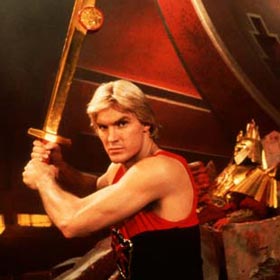
It's probably right around the time of owl-head nookie that I think the movie falls completely off the cliff. Even the look of it disintegrates. Yes, I understand that it's set in 1985, so I have to live through the fashion and hair choices of that era. I do not, however, understand why Ozymandias appears to have stolen the building materials for Karnak II from the set of Flash Gordon. Seriously, when he hurls his throne through the air and Nite Owl uses his Colecovision controller to saw the leg off, I thought, "Does your mother know that you stole her faux French Provincial chair AND took off the plastic slipcover?"

It's just . . . arrrruguuguuhhh.

I really did like big chunks of the movie, so I'll try to end on a smattering of positive notes. Matt Frewer's supporting role as Moloch is wonderful, and it was a gift to give him and Haley that much time together on screen. (But the flashback to the Comedian's tearful night-time visit was terrible.) Everything from the moment that Rorschach says, "I have to use to the men's room" to his rejoining Nite Owl and Silk Spectre II is gold. Shooting the scene through the swinging door was beautifully done. (But Snyder just HAS to go back to the cheezy shot of the blood running out from under the door.)

The movie had real potential, and it realized some of it. Perhaps it's best to be grateful for that, given the fact that a movie version has been in development for something like 15 years. But I stand by my original assessment: It was ok.

Labels: , , , , , , , ,

Thursday, February 26, 2009

Outta My Way, Nerdlingers: South Water Kitchen & Coraline 3-D

So my sweet boo-boo and I were apart for Commercial Love Holiday this year because I was giving a Darwin Day talk at not!church in Jesus Central, Real America. (This represents a substantial improvement over Commerical Love Holiday last year when we were together, but the ZK was mostly dead.) Anyway, we had a belated VD celebration last Friday when we went to South Water Kitchen for dinner and thence to River East for a showing of Coraline in 3-D. Which I liked, but didn't love. Please stop shooting me, Gaiman devotees!

Meal at South Water was terrific, which is good, because I was spitting mad when I got there. Traffic was a nightmare (bite me, Chicago Auto Show, have you heard about this little thing called a recession?), and furiously blinking cars were 9 deep at the Hotel Monaco with nary a valet in sight. Presumably the valets were attending to the complimentary fishies.

But! Screenwipe! New Scene! Dinner was marvelous. Every dinner is improved by the Jesus!Phone, which not only distracts from what would otherwise be awkward silences between this old married couple (Kidding, Kidding. Please recall, we often have other couples inching away from us when we are out or Certified Romantic Evenings, because our conversations are nonstop and strange), but also enables me to marinate all my food in the virutal tears of wire monkey mother's envy.

Twitterstream dutifully reproduced:
ZK begins with a trio of whiskey & orange cocktails. Shooting star blue franc for me.
ZK belatedly remembers that he isn't a fan of goat cheese. More flatbread for me.
Scallops with chanterelles & homemade bacon. Trayflicious! [NB: Mushrooms were simply "wild mushrooms, not chanterelles; also forgot the sunchoke puree. YUM!]
ZK's duck confit salad is good - very good - but tragically lacks homemade bacon
Entrees: sturgeon with yet more fabulous chanterelles, plus whole roasted & smashed baby reds. Ironically earthy fish, but fabulous!
Entrée for ZK: pork chop with cheese grits & creamed brussel sprouts + homemade bacon FTW!
For dessert: bittersweet chocolate cake with salted caramel and malted vanilla gelato. Cake edges a teeny bit dry, but lovely under gelato.
ZK's dessert: deep dish apple pie & toasted almond gelato. Also good, but sadly lacking in chocolate.
And they comped our dessert, which alleviates parking rage.

We weren't actually sure why the comped our dessert. The service was maybe a touch slow, but we weren't fussed by it. I took it as karmic repayment for the parking debacle.

So anyway, Coraline. Theater was completely packed. We weren't prepared for that and had to sit in the front row. (Other movies I've seen from the front row: JFK, Branagh's Hamlet.)
Visually, the movie is wonderful, and it is certainly true that it makes wonderful use of 3-D, rather than throwing gratuitous pick-axes at you. (Although as an avid Dead Rising fan, I am generally pro–pick axe.)

Continuing on the visual here's something deeply appealing about the way Selick renders human motion. It's sinuous without being at all fluid, and it feels like a loving homage to Rank-Bass, Harryhausen, and every other stop motion giant. But it's also not simply more of the same from The Nightmare Before Christmas, at least not when real people in the real world are being rendered.

It's a good thing that I didn't look to closely at the voice casting before going in. In fact, I only knew that Hodgman was the Father and Al Swearengen, now with 100% fewer references to snatch, was involved somehow. I am surprised to find that I hated War of the Worlds so much that I was comparatively speechless about it. (As anyone who has ever met me, literally or virtually, can tell you, hate usually makes me wax eloquent.) My entire review:
There is nothing to enjoy in War of the Worlds. It's two hours of riding on Tom Cruise's back while he trudges slowly from one special effects disaster to another, many of which seem not to have been edited down from the original prolific bad!fic version. There is no plot to speak of. It's the least suspenseful, least interesting Apocalypse on record (and I include The Nonsensical Mission-Statement-less, Highly Localized, Be-Platformed Shoed The Beast from Angel, Season 4 in that). The ending is not only ridiculous, it's a giant Republican "fuck you" to the scabby, the poor, and the ethnic as our clean-scrubbed Boston Brahmins emerge from their pristine brownstone, intact, coiffed, and manicured, giving their blue collar ex-son-in-law /ex-husband/subpar sperm donor a grateful elbow-elbow-wrist-wrist-wrist wave from an appropriate distance.


Do you see that? Not a SINGLE mention of how Dakota Fanning's character needed to die more than any annoying child in any movie ever—including Pia Zadora in Santa Claus Conquers the Martians—needed to die. But I can assure you that is true. So, no, I would not have cast Dakota Fanning. And let us not speak of Teri Hatcher, whose only enjoyable role ever has been as a corpse 15 minutes into Tomorrow Never Dies.

Wow, that was a little vehement, wasn't it? So you can see why not having paid close attention to casting was a good idea for me. As it turns out, Fanning was better than I expected. Hatcher was not quite as bad as I expected, although the performance deteriorates just when the movie most needs her to step up.

Hodgman was amazing, and I am not simply saying that because he had the good grace not to run screaming from the signing table when I brought him a giant stack of More Information Than You Require to sign. His Father was distinctly NOT Hodgman the minor television personality, and his Other Father was magnificent in its mix of chipper and creepy. McShane, French, and Saunders were likewise absolute gold, and the scenes of their performances in the Other World were easily the highlights of the movie. (Along with Coraline's ride over the garden on Hodgman's Magical Steampunk Machine.) Keith David? Well is it any surprise that Keith David rocks as the cat? Everybody wants to be a cat.

Before getting into why I liked it, but didn't love it, I should admit that I haven't yet read the book. That's unusual for me, as I am a neurotic spoilerphobe who doesn't even read book jackets. But the fact of the matter is I seem to be missing some crucial Gaiman receptors. I'm not trying to be too-cool-for-school by disdaining a popular-to-the-point-of-inspiring-fanatacism author. I don't hate him, I just . . . don't get the fuss. I've read American Gods (and I still think that SOMETHING should eventually happen in a 400-page book), Anansi Boys (better than AG, but its appeal for me was pretty superficial), and Good Omens (which I love, but one has to factor in Pratchett), so maybe I just haven't hit the sweet spot yet.

But I haven't read the book, it's true, so I am unsure whether to lay the things that left me cold at its feet or the feet of the screenplay and/or editing-room floor. The fact that Coraline the character starts off as rather a pill and is eventually revealed to have some frighteningly sociopathic tendencies (giving the forcibly muted Wybie the the thumbs up springs to mind, but her mean-spirited attitude toward her eccentric neighbors goes well beyond childish self-absorption into real cruelty) certainly seems to be a problem with the original text. I'm less sure whether Coraline's eventual face-turn-amid-the-rotting-vegetables is so pat and shallow in the book, or if the reasons she realizes that she'd rather embrace her life in the real world (as opposed to simply escaping from the scary button-eyed world) are better communicated in the original and were poorly translated to the screen. I have no problem with main characters that aren't all sweetness and light (in fact, Diana Wynne Jones and Terry Pratchett, two of my favorite authors, are masters at somewhat unlikable characters with whom one can emphathize), but it takes a defter hand than is evident in Coraline.

I wonder if the ZK will have more to say about the British fascination with truly horrible parents, but the Senior Joneses are truly horrible, narcissitic, VW-Bug-Driving poseur greenies. It's really no wonder that Coraline herself is such a beast, given that her parents are prone to foist her off on the neighbors for whom they have such ill-concealed contempt. Certainly I can see the eye-buttoning process as a strong motivator to get the hell out of the Other World, but it's not as though Coraline's real parents have anything to induce genuine, active longing to be reunited with them.

The Other Mother/Belle Dame was yet another problem for me. Perhaps it's just that Teri Hatcher always sounds like a complete raging bitch to me, but there seemed to be no appreciable reason to be attracted on one incarnation of the Raging Bitch over the other. Given that OM/BD's hedonism goes to 11 from the start, Coraline falling for it leads one to worry about head injuries. If there is anything that sells the sinister attraction of the Other world, it is Hodgman's performance as the Other Father. He's genuinely fun and affectionate, and yet the slight slow slur in his speech has warning bells clanging in the distance.

Unfortunately, the OF being a victim (or a tool? he seems to have been raised from a pumpkin? this also raises the question of who the hell is muted Wybie? How does the OM/BD create/control the Others in her world?), rather than an accomplice, gave the story a distincly misogynistic tinge in my opinion. Yes, it ties the story more closely to Keats' poem, but associating the OM/BD with the original Belle Dame Sans Merci, as well as the more generic Hansel & Gretl witch/Snow Queen/Shelob, etc. ends up feeling like piling on. Yes, we get it, she's an Evil Spiderwoman constructed from evil parts that look like Coraline's mother designed to do evil. We get it. I'm not doing a great job at articulating why the OF's enslavement changes the equation, but for me it did, and changed it for the worse.

Some of the disjointedness in the story may be attributable to lack of editing fu. For example, when Coraline soliloquizes about Mr. Bobinsky, she notes that Wybie, the story's only character who is even arguably sympathetic and narratively reliable, has been talking trash about Mr. Bobinsky being crazy. As far as I can recall, that conversation didn't make it into the dialogue, and it seems out of character and out of storyline for Wybie (after all, he isn't allowd in the Pink Palace). And speaking of Wybie, he's pretty poorly integrated into the story (again, at least the story we see on screen), and it feels like he could have/should have been important.

When I brought up the putative editing error to the ZK, he said he had the impression that we were not seeing all of a continuous stream of time, so there would have been conversations taking place off screen. (He cited Mother Jones knowing the downstairs neighbors well enough to snark about them before unloading her little shit on to them.) I, in contrast, felt that the story was pretty dependent on us following Coraline constantly for a couple of days in a row. Not adhering to the Aristotelian unities isn't exactly a deal breaker in a movie based on a children's book, but I think the lack of decisiveness about time contributed to the jerkiness of the plot, which kept me at least from understanding and being fully invested in the emotional forward progress in the story.

There are things that I did like about the story, even though I sound like a giant, sulking curmudgeon. Coraline has the potential to be a great, punky heroine, and there are moments when that shines through. Her "I like it" upon seeing Wybie with his sewn-up mouth, though, just left her dead to me. I love the unflinching attitude toward the terrifying in the story. I will say for Gaiman that he gives kids more credit for being able to handle an emotional roller coaster than they seem to get from most these days. The tone of the movie is exactly that of movies that both attracted and terrified me as a kid, and I think the world needs less milquetoast in it. Strangely enough, if it weren't for the absolute beauty of the art and the wonderful elements of the story, I probably would have been less discontented with the weaker elements of plot and acting.

There you have it. I liked it. I may have even like liked it. But I didn't love it. Commence evisceration sequence.

Labels: , , , , , , , ,

Sunday, January 04, 2009

Follow-Up Reading Recommendation: Scott Lynch's Red Seas Under Red Skies

So, a little while back, I noted that I'd really enjoyed this author's first book, The Lies of Locke Lamora. I've just finished the sequel, Red Seas Under Red Skies, and Lynch continues to defy expectations.


Brace yourselves: I am about to speak favorably about the dread Boys'N'Boats genre.

Ranking two data points is more than a bit silly, but if forced to do so, I'd have to say I liked the first better. However, most of my reasoning has more to do with chronology, first exposure, and the possibilities native to the first novel in a new universe than with any real flaws or gaps in the second book.

As with The Lies of Lock Lamora, Lynch structures Red Seas Under Red Skies intelligently. In the former, Lynch uses two timelines simultaneously: One to tell us how the characters came to be the people they are, the other to show us what that means. Lynch seems to have taken great pleasure in constructing his characters' back stories, but having done such a thorough job in Book 1, there's little need for it in Book 2. In admiring Lynch's gift for structure and pacing, I appreciate the wisdom of not returning to the well of Locke and Jean's past; having really loved those vignettes, I missed them.

In the case of RSuRS, Lynch takes advantage of the device of those parallel time lines to propel the reader directly into a long con in progress as the initial hook, and still honor the toll the events of the first book have taken on the characters by showing the reader the long, ugly path they've taken to get back into the game. About a third of the way into the book, though, the timelines converge (in fact, there is a chapter bearing the heading "Final Reminisce"), and the narrative is more or less linear from there on out.

As I was reading RSuRS, I kept telling M that it seemed more complicated than the first, but of course the first book also takes a large left plot turn at Albuquerque. In the case of TLoLL, though, it's more a noirish plot complication, whereas RSuRS ventures into entirely new plot and character space once the timelines converge. In the interests of rapidly sketching that space, Lynch plays much more with point of view in RSuRS, whereas TLoLL stayed almost entirely with Locke. As a result, a handful of scenes and plot elements are left hanging for a bit, although everything is ultimately tied up.

As with his narrative techniques, Lynch seems to have a great sense about what character elements to leave intact and where he can and must make his characters grow and change. There is no mistaking Locke and Jean, and no doubt about why we grew so fond of them in the first place, but they are not unchanged, and neither the characters themselves nor the reader can always tell whether they'll behave as we expect them to. (On that note, one standing complaint with RSuRS is that it opens with a rather cheap mislead.)

The newly introduced characters are very well done for the most part. Lynch does stray into ridiculously overpowered villain territory once again, and we spend more time with the villain of RSuRS than we did with the Gray King, so the cheese grows a little ranker a little sooner in this book, but the other additions are so good that they make up for a lot of it.

One of the issues I had with TLoLL was the invisibility of women in the book's setting. That's far from the case in RSuRS, which features a number of women in well-done lead and supporting characters.He makes good on the device established in the first book, namely that women are well represented in almost all professions, and draws them out into the narrative without having to draw attention to gender. His leading and supporting women are 3-dimensional and well-drawn, and Lynch doesn't spend pages telling us how hot they all are or what they're wearing at any given moment (Jim Butcher, I'm looking at you). There's a certain amount of gooeyness associated with one of the leads, who becomes a love interest, but it's not dire. Moreover, he *gasp* implies that not everyone is heterosexual without at all fetishizing non-hetero relationships.

For me, personally, as a reader, the real marvel of RSuRS is that fully 2/3 of the book is about sailing, and I did not want to flash freeze and chip out my own eyeballs even once. I hate Boys 'N' Boats books. Really, truly hate them. Thought The Hunt for Red October contained about 100% too much submarine. Could have really gotten into Polar Star if were, say, set on a Dude Ranch. HATE THEM. But this one was cool. Check it out.

Please note that I am also bloody annoyed that (a) I have to wait until the end of February for the next book and (b) I'll apparently be buying the hardcover.

Labels: , , , ,

Monday, November 24, 2008

Reading Recommendation: Scott Lynch's The Lies of Locke Lamora

Just branefarted the author's name as 'Stephen Lynch.' With all due respect to Scott Lynch, I would very much like to receive the newsletter of Stephen Lynch's fantasy novel.

I have a million things to do, so naturally I am not sleeping. Not sleeping leads to reading in the bathroom in an attempt to render myself sleepy. This, in turn, leads to finishing a very long book at an odd hour and feeling compelled to pen a review IMMEDIATELY. Although I suppressed that urge last night, editing really doesn't stand a chance against a quick review of a book I really liked.

This is another novel that passed through the one-way barrier between me and the M. (I can't think of a single thing he's read at my recommendation, but I frequently assert my right to our common property by reading things he's bought.) Truthfully, both the title and the cover would have put me off. I'm calling the title a fair cop (maybe it's decades of watching General Hospital, but the L overkill says "Romance novel!" to me), but the crappy cover on ours looks even crappier in comparison to the one on the author's website.

The blurb on the back describes it as "One part 'Robin Hood,' one part Ocean's Eleven," which is sort of off-putting, too. I loves me some RH, and Ocean's Eleven was the first movie that made Brad Pitt seem remotely appealing to me, but that sentence just smacks of smarmy elevator pitch. But it has a point: TLoLL is fantasy, mostly in an incidental way (the universe just happens to have alchemy mixed into its technology, and just happens to be politically organized and culturally reminiscent of the pre-modern Mediterranean). But really, it's a caper novel.

Regardless of genre or setting, it's worth noting that Lynch does a lot of things right that have been done wrong in so many creative ways. For example, the narrative is nonlinear. It cuts from the characters' present to their past, and from the novel's world's present to its past. The time shifts are frequent, but very nearly flawless. In a 600+-page book, I can only think of one instance where the device went wrong (the chapter flashes back to the very recent past, presenting the current-day "action" out of sequence and left me wondering of there were two night-time visits).

But as a rule, the trips to the past build the characters, set the scene for important plot developments, and generally lend texture to the story. What's more, Lynch doesn't sacrifice the pace of the plot to the back-and-forth timeline device. In many cases, I was on the edge of my seat in the story's present, yet still eager to get at the back story.

The plot is ambitious, but well executed. The characters are well drawn. (Although there is a pivotal scene late in the book in which Lynch came very close to losing my capacity to give a shit about the main characters; M, for the record, didn't especially object to the scene on the grounds of characterization, but did see it as emanating from a poorly executed Phlebotenum in Jar C.) In the case of both plot and characterization, Lynch does occasionally beg the reader's patience through long, complex sections, but the payoff is well worth it. Furthermore, once I was past the first 50 pages or so, I was only aware of the length of the book when the ZK called attention to it.

Praise duly and deservedly bestowed, it's not perfect.

One potential downside of the "fantasy lite" approach is in the dialogue. I certainly appreciate Lynch's restrained approached to coinage, jargonization, and deployment of faux-Victorian linguistic crusty-ness. However, I'm not sure that the liberal application of "real world" profanity works as well as Lynch wants it to. (And I say this as cocksucking devotee of Deadwood who was never bothered for a fucking instant by the anachronistic goddamned nature of some of the finest fucking dialogue ever penned.)

As is all-too-common in geek-dom, the sisters are underrepresented on Lynch's canvas. Yes, there are two (and a half) major players who happen to be women, but they are major players in the plot sense, rather than the characterization sense. A third character is introduced early and never appears in this novel (although clearly she is meant to have great significance in future books). I don't object to placing a character on the board in advance, but in this case, she is mentioned so early and so consistently that I was preoccupied with trying to figure out as whom she might be disguised. (That sentence, right there, might just be the kind of pedantry up with which no one should put, and yet I cannot bring myself to end it with "as.")

To give Lynch some XX-equity cred, he does include an interesting chapter in which he does not engage in the fantasy/scifi-obligatory romanticization of prostitution, and throughout his landscape, it's clear that men and women are equally likely to hold any given job or be any given type of character, good or bad, young or old, etc.

Anyway, it's very good fun, and I found myself exceptionally pleased that there's already another book in the series for me to pick up, and another on the way early next year.

Labels: , , , , ,

Wednesday, November 05, 2008

November 4, 2008, Chicago

Spring here is really little more than a rumor. In some ways, though, it's all the more impressive watching taut bundles of life cling to their branches through the frost, ice storms, and of course wind for which we are famous. (In Peru, revealing that I am from Chicago is always met with a grave, knowing nod, "Mucho viento.")

Spring here is muddy and often grey. And cold, although most of us are prone to sartorial denial about this. We move, heads down, necks pulled into the inadequate collars of our useless spring jackets, declaring the weather "Brisk!" to one another through chattering teeth.

I'm not a fan of spring, or of summer for that matter, but I can't help but get a little rush of excitement the first time we have that distinctive chalkboard smell after a rain. I can't help admiring that bonnie blue spring sky. And when those stubborn little buds eventually uncoil and leaves stretch out to one another, when there's a solid canopy of green interrupted only by a road map of veins, it's beautiful.

But honestly, even I—I who have so much green in my wardrobe that I try not to leave the house without performing what I call the "cabbage check"—get tired of all that uniformity. I love fall for its short days. I love it for its dry, crackling smells. I love its overcast afternoons and howling wind. But what I really love is how the relentless green gives way to an incredibly diverse palette as each species, each tree makes a separate peace wth its own cyclical death.

November 4, 2008, was a beautiful day in Chicago. And I took pictures. Partly to keep from going insane, of course, but partly because I really wasn't convinced that Wednesday wouldn't bring another disappointment, and I felt an urgent need to preserve that beauty and have something that would remind me of that feeling of hope, of possibility, of progress.

November 4, 2008, was a beautiful day in Chicago, but it was also a day that brought disappointments—terrible and important disappointments in California, Arkansas, Arizona, Florida. I think those losses are attributable in part to ambitions for what we can be that withered as we watched ourselves become something terrible. But there is beauty, there is possibility, there can be progress. And I have pretty pictures of trees to prove it.


More here, including Hound Pr0n for those not into fall foliage pr0n.

Labels: , , , , , , , ,

Tuesday, November 04, 2008

Vote!

We don't get fancy stickers here.


I suspect a certain editrix of paying off the election judge to tell me that I have excellent penmanship.

The soundtrack to my voting:
"Rock and Roll," Velvet Underground
"Once in a Lifetime," Talking Heads
"Heavy Metal Drummer," Wilco
"Long Snake Moan," Flatlanders

(No, I don't have any explanation for that last one either.)


Labels: , , , , , , ,

Tuesday, July 15, 2008

Red vs. Blue: Hellboy II, the Golden Army

It's time, once again, to remind everyone that Guillermo del Toro did not direct King Arthur. And once again, I apologize profusely for even thinking such a thing.

I was put in an extremely good, pro-movie frame of mind at the outset, because we saw the trailer for Death Race (that link is, naturally, completely hellish, but it does have the trailer: Jason Statham, Joan Allen, and Ian Fucking McShane? Oh yes, I will be there.

It's possible that I was so caught up in, metaphorically, having just heard of a place where humans do battle in a ring of jell-o that my critical faculties were blunted during Golden Army. I absolutely enjoyed it, and I will stand by my immediate judgement that it continues the trend of solid superhero/comic book movies for the summer. However, M was quicker to bring up some of the flaws in the story line, and I can't really disagree with most of them, even though I think that almost every individual scene works pretty beautifully.

Oddly enough, given my dewy-eyed resistance to seeing anything wrong with the movie, I certainly thought the opening scene was a bit of a mixed bag. The opening scene, you understand, not the opening explanatory text, which ended with "He loves TV and candy" and was completely brilliant. I am all for the feeblest of excuses to have John Hurt in the movie, even though his character is technically dead (which is the best kind of dead), and the excuse isn't feeble in this case, as it concisely uses bedtime story as back story. (M, THE ZOMBIE KING, of all people, claims that John Hurt needs to find some bedtime stories that don't involve mutual slaughter. I say, "Where is your pod, spouse of mine?")

As Hurt narrates, the story of the war between humans and the "Children of the Earth" plays out in gorgeous fashion. It's wooden puppets filmed in stop motion, and it's the best of Burton and Harryhausen combined. So given the Hurt-y, puppet-y goodness, what am I complaining about? Young Hellboy, I'm afraid. I'm not sure if IMDB's crediting make-up artist Montse Ribé as playing him indicates that they've been hitting the funny brownies a little hard or what, but something unpleasant was going on: Whoever was under the make-up and prosthetic teeth clearly could not speak through it, and the overdubbing was slightly less skilled than that in Santa Claus. Don't you "Nooooo, Lupita!" me, people, it was that bad.

I can't think of anywhere else in the film where a technical cock-up compromises the visual deliciousness, but I must admit that there are times when the pretty is shiny to overcome shortcomings of the script, at least in the moment.

But there are good things about the script, too. The Red/Liz romance is in progress in this movie, and it's unfortunately a really difficult romance to depict with live actors. To del Toro's credit, the depiction of gay men on television (lots of meaningful hugs, kissing one another chastely on the forehead between the horns, you know what I'm talking about) hardly ever came to mind, partly because there's a fair amount of exposition, rather than depiction.

For example, the scene that opens the present-day action has Abe and Manning walking through the halls of the BPRD while a Liz/Red fight rages, drowning out the wailings and lamentations of the BPRD agents who can be glimpsed wrangling Cthulhoid monsters in various rooms as they stroll by. (Very Buffy/Spike/Rocket Launcher in "Him," and thus very much WIN.) The whole scene is visually great, and it covers a lot of expository ground with two characters who are, by nature, very talky. As good and skillful as that opening is, though, playing out the heart of the two romances in a drunk buddy cop scene set to a Manilow soundtrack is nothing short of genius. Most needful Manilow EVAR. (In general, the soundtrack is great, but as it contains Eels, I would say that, wouldn't I?)

Another good thing, at least in my opinion, about the structure of the script is del Toro's insistence on relying on his visuals as the strongest storytelling device at his disposal. In contrast to the seizure-inducing pace and editing of Transformers, for example, del Toro lingers when the take-home message of the scene requires lingering in a wonderfully non-American way. The best example I can think of is after Hellboy kills the forest god/elemental, and the streets, buildings, etc., are overrun with moss and beautifully blooming greenery, del Toro takes us and the characters on a walk through the scene, rather than rushing immediately into the crowd's backlash against the team.

I'll also argue that the overall tone of the script is remarkable in the balance it strikes between humor and horror, absurdity and gravity. More than anything, it reminded me of the Princess Bride. But, it's the PB with But Face. Hellboy II has an unfortunate tendency toward writing narrative checks that it can't cash, and it tends to write them in unfortunately grandiose dialogue that lends itself to sound bytery. You may recall from the trailer, for example, the elf prince declaring that he will call on all the children of the earth, "The good, the bad—and the worst!" Stirring, to be sure!

Unfortunately, by the time he utters this line, we've seen the back side of the tooth fairies, which are, admittedly, the perfect combination of creepy and cute. Assuming that the eponymous Golden Army comprise "the worst," the only other representatives of "the bad," seem to be one troll (but you have to give it up for a retractable projectile fist that [and it nigh kills me to say this] beats Green Arrow's boxing glove arrow all to hell) and the aforementioned elemental. So, a less than impressive showing.

I wouldn't say the script is exactly plagued with "why don't they look?" issues, but it's got something of an acne outbreak with them. Why does anyone, let alone a team of presumably experienced agents, think that going after miniature, arachnid flesh eaters that swarm with handguns is a good idea? And as much as we enjoy comic, legless Irish goblin manufacturers as much as the next people, are we really to believe that his guilt about making the damned army in the first place never moved him to try to dismantle the damned things? And believe me when I say when M is asking what happened to all the other elves, you've got storyline problems.

On a more serious and depressing note, the two female characters are so underused that it seems clear "female power" is a complete oxymoron here. Through the entire fight with the golden army, we were both itching for, you know, FIRE to enter into the equation, but not so much. And then the script underscores its own gender fail by having Liz melt the crown down. As for the big moment of Hellboy challenging the Prince, I understand that this is Red's barbecue, and I wouldn't have it any other way. Still, given that the princess is, you know, unambiguously of the royal blood that traditionally commanded the golden army, any little bit of dialogue explaining why she doesn't offer a challenge would've been welcome.

Having devoted the bulk of this to script nitpicking, I'd like to get back around to the fact that the whole movie is visually stunning from start to finish. Whether del Toro is waking the supernatural Irish landscape, deploying the slapstick in the locker routine, out-Mos Eisley-ing Mos Eisley, or scaring the bejeezus out of you with the angel of death, it's all oozing with style. As gorgeous as everything is, it's never just pretty for the sake of pretty. Every time a visual element draws attention to itself, it figures in the action: the mangle that eventually undoes Wink, the blue aura that the golden soldier takes on when Krauss inhabits it (in pointed contrast to the red red glow of the rest of the army), the goggles that allow the team to see things as they really are (revealing the shocking truth that Hellboy IS Carrot!).

In addition to being a sucker for (a) del Toro's considerable style, (b) Ron Perlman, (c) and Hellboy in general, I think I had patience with some of the script's clunking because it feels very much like the second movie in a trilogy. (Yes, yes, I know that kind of thinking led me into madness with PotC: Dead Man's Chest.) It feels like everyone involved is interested in building up to a story that really digs into Hellboy qua Hellboy, and there needed to be set up in this movie. Given that there needs to be a third movie, it's a relief to learn that no one's hanging up the horns until Ron Perlman's tired of playing Hellboy, and Ron Perlman shows no signs of any such thing.

Labels: , , ,