
Telecommuniculturey

High- and low-brow cultural goings-on in the Second City, brought to you by a roving microtechnoanthropologist

My Photo
Name:
Location: Chicago, Illinois, United States

This is fiber optic cable, which is the future. This is culture, which is delicious.

Saturday, May 07, 2011

Monsters, Boobies, and OCD: Danny Boyle's Frankenstein at the National Theatre

Sadly, we are not in the UK, but we did just return from The Music Box Theatre where we saw the last show they're broadcasting there. The title is the ZK's review.


This has been getting rave reviews, lines around the block for day-of tickets, and so on. In many ways, the production deserves that and more. I liked it, but did not love it.

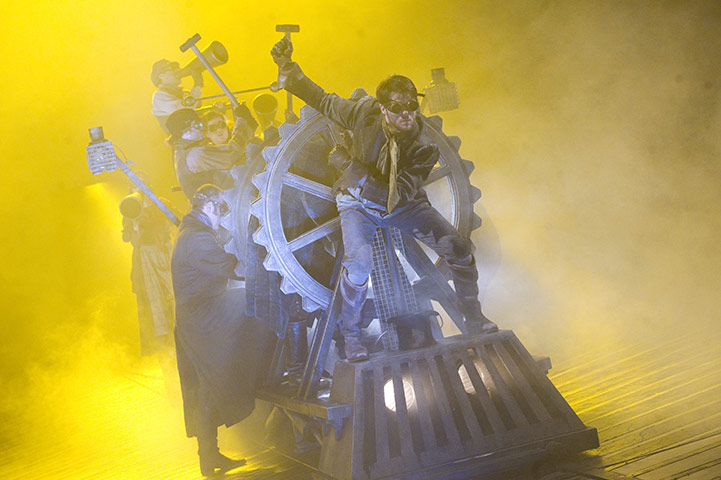
Every element of the design and staging is incredible. The stage is round with a central revolve, and overhead, there's a fixture comprising hundreds of lightbulbs. They're gathered in bunches, hung at different lengths, and it's at once oozing and organic and cold and artificial, evoking forges, power plants, and circuses. To represent the creature's first stumble into a town, there's this gliding platform topped with huge gears that rotate. Extras hang from the front and sides, jerking, slamming, writhing, and do-si-do-ing to something too clanging and brittle to be music, too patterned and hypnotic not to be. It's like Steampunk and German Expressionism had a Marxist-informed Baby.

The blind scholar's hut is represented by four scrimmed walls with a few natural elements stenciled on them; the Frankenstein home is all stiff, stuffy windows and shadow, but it churns up from beneath the stage and sits at a subtle angle. Victor's hut in Scotland has an appropriately claustrophobic, subterranean feel.

The monster is scarred, sutured, scabby, and oozing. The development of his movement, command of language, and command of . . . consciousness and self-awareness . . . are all stunning. The production we saw had Jonny Lee Miller as the Creature and Benedict Cumberbatch as Victor (the two leads swap roles each night). Both occupied their roles in a way that signals and excellent director and a creative process that's hard to achieve where actor and character are constantly growing and stretching. Really fantastic.

Oh, look! It's my "but" face. Charitably, Nick Dear's script is uneven, which is not to say that there aren't brilliant parts of it where Mary Shelley's text is illuminated, enlarged, and brought to life by the adaptation. But then there are parts that are just . . . clunky as shit: Felix and Agatha (the blind scholar's son and daughter-in-law) have awkward Tolstovian orgasms about having cleared all the rocks from their field; the Scots resurrectionists have painfully stilted attempts at Shakespearian comic relief; and Elizabeth lectures Victor on the God-given, societally approved power of her uterus. No, really.

Elizabeth, in general, is a nightmare. Boyle casts all the Frankensteins, save Victor, as actors of color for no reason that is particularly apparent (which is not at all to say that I think the actors ought to have been all white in some misguided attempt at authenticity, but Victor's whiteness becomes pointed). George Harris was simply not very good as Victor's father, although I wonder if his wooden delivery was directed that way, so that we remain entirely within the mind of Victor/The Creature.

Naomie Harris's portrayal of Elizabeth is almost beside the point as a performance. Her character is the victim of the worst of the script and a choice that came within a hair of ruining the whole shebang for me. As through the vast majority of the play, the action stays with the Creature, who springs from Elizabeth's bridal bed and has a conversation with her that, at times, almost salvages an otherwise dreadful scene. Then, unlike the book in which Victor hears a scream and comes across Elizabeth's lifeless body, Dear/Boyle have Victor burst into the room, revolver drawn (if you will) only to flail around on the floor for no apparent reason while the creature rapes Elizabeth, achieves orgasm, snaps her neck, and declares, "Now I am a man."

W.
T.
F?

Extra special bonus points not just for going to the "Women Exist For Men to Use in Their Attempts to Exert Power Over Other Men" Well, but going the extra mile and making the woman non-White. Seriously, just what the fuck?

But other than that, Mrs. Lincoln, it really, truly is a magnificent creative endeavor beautifully brought to life. But I'd consider nipping out for popcorn at strategic moments.

Labels: , , , , , , , , , , , , ,

Friday, March 04, 2011

Songwriter's Navel: Week 08, Live From the Archives

Hoping that WXRT doesn't have that phrase copyrighted.

So this is the first week of the new session at the Old Town School of Folk Music, which means that I did not have an assignment last week. I had thought about what I might do this week, given that I suck at writing without an assignment.

Naturally, taking the week off was the first thing that occurred to me. The second thing that occurred to me was putting up recordings of the songs I'd done for the showcase, which usually would have been last Sunday. When I knew that the showcase had been moved to this coming Sunday, I thought I'd perhaps just talk about the songs I'd decided on and perhaps how arrangements of them had developed. The problem is that I still haven't really decided and given that I have a cold I probably should save any singing (or singing-adjacent) voice in the hopes of being well enough on Sunday.

As I've mentioned before, taking time off is sure to lead to the total collapse of this endeavor, so I decided to go with something from the archives. I don't have all that many recordings of when I've performed with the exception of the first time that I did a slot of my own at the Acoustic Explosion. In a moment of panic, I'd promised my mother a video recording of that show as her Christmas gift. Nothing has ever been more painful than editing that video and audio. It took me 7 months. (That is literal, not exaggeration for comedic effect.)

I led off with this song on a shaky premise. Its unofficial title is "Laffy Taffy Hanukkah." I was also doing a cover of "Hard Candy Christmas" at that show because I'd promised myself that I would if I ever played out and because the show was very close to Christmas. Thus, I thought ALSO playing "Laffy Taffy Hanukkah" was hilarious inside my head. Ahem.

Why, you might ask, is the song called "Laffy Taffy Hanukkah," even unofficially? Well, we'd been given the assignment to write a "character" song along the lines of Patty Griffin's "Sweet Lorraine," Paul Simon's "Duncan," and so on. I seem to remember that I ended up working on this song over 2 weeks. I'd showed up with only one verse and part of a chorus and volunteered to skip performing it in class until the next week when we ran out of time.

I'd had a hard time deliberately writing in the direction of a character, not because I don't know some great ones about whom I'd like to write a song, and not because my brain isn't occupied by a bunch of fictional crazies who would be great subjects. I think it boiled down to trying too hard to be clever or profound.

At this time, I was reading Tom Robbins' Fierce Invalids Home from Hot Climates and having a hard time with it, as I increasingly do with Mr. Robbins. I love—venerate, even—Jitterbug Perfume and Skinny Legs and All, and the repulsiveness of his other novels offends me on the behalf of the wonderful heroines from those two.

Annnnyyyway. I got to thinking about characters that deserve better authors, and we'd just gotten around to hanging some of the art that we'd bought from the set of the Strange Tree Group's production of Mr. Spacky, the Man Who Was Continuously Followed by Wolves. That production, its artwork, and underwritten female characters naturally brings to mind Dickens and particularly poor Rosa Bud of The Mystery of Edwin Drood.

Dickens, of course, died while writing TMoED, and I thought how that was liberating for his characters, who were not trapped by his hackery. So I started to run with this idea lyrically and the first verse came out as sort of an admonishment of the author, leading into a chorus where the narrator gets to write herself.


[G] In these pages I have [C] sung just [C/B] like a bird [Am]
I have [Fmaj7] blushed and bloomed and [D] paled
As you [C] set down every word [G]
I’ve [G]sighed and sulked and simpered [C] and all [C/B] but disappeared [Am]
Your [F] pen left me an [Dsus2] afterthought
Bereft [C] of voice and [G] tears


One of the strange things to me about this song is that the music came to me . . . well, easily is not the right word. Very specifically and as a whole. In the verse, that first instance of an F chord (which implies the song is in C) was very definitely an Fmaj7, leaving the high E string ringing. And it was very definitely followed by a D-major chord, which contradicts the F by implying that the song is in G. In contrast, the second F was definitely an F and the second D was definitely a Dsus2.

This continued into the chorus where the G changed to a "Big G" (four-finger G chord where you play [from high to low] G-D-G-D-B-G), which theoretically sounds so much like a G played with two Bs, rather than two Ds, that people use them interchangeably all the time. Mr. Crankypants Music was having none of this: It was a 3-finger G in the verse and a 4-finger G in the chorus. This not-quite-descending bass line in the chorus was also very specific. It goes G-F#-C-B-C-B-D-E over the G to Cadd9 to A7sus4 progression.

It's also worth noting that this song insisted on being fingerpicked. At the time I wrote it I sucked at fingerpicking even more than I do now.


I am [G] more than a [Cadd9] painted rose, [A7sus4] more than a tale untold
Your [Am] pen cannot [Fmaj7] imagine all the [D] things I’m bound to [Dsus2] be
I am [G] fierce and I am [Cadd9] reckless, I have [A7sus4] dreams both dark and wild
Your [Fmaj7] story ends, here [D] I begin, and I’ll [C] be nobody’s [G]child


Oh, I was talking about the secret title. In trying to write the second verse, I'd sort of been promising my brain that it would get to insert the "great ideas" it had been coming p with into that verse, because they kept not quite making it into Verse 1 and the Chorus. I was certain at the time that the second verse would end up being all about what the narrator would do now that she was able to write herself. So I had a bunch of "I can/I will" statements in my notebook. At some point, I wrote the phrase "Laffy Taffy Hanukkah" in the margin to remind myself that Carol Hall had already gone to the trouble of writing "Hard Candy Christmas." Et voila! Incidentally, the Kernel hated (and presumably still hates) this title something fierce.

My brain ended up getting no satisfaction in the second verse, which became about how the author wrote his male characters:


Your men you make of dust, and to dust they shall return
Your pen breathes life into their minds
Inside a fire burns
Though you gave them feet of clay
They tread a path that’s all their own
You arm them well with words and will
In flesh and blood and bone


Oh, the clunky phrasing and awkward images! But what are you going to do? Write a third verse, I suppose . . . . But no. Both the verses and the chorus are rather long, the lyrics are dense, and everyone is like "For the love of god, please stop now!"

Anyway, here's the recording. There's actually video, too, but I'll spare myself that.

Labels: , , , , , , , ,

Saturday, February 12, 2011

Songwriter's Navel: Week 05, Mediocrity in Less Than 2 Minutes Or Your Money Back

Coulton's Thing a Week Redux this week resonates.

Jeepers: writing hurts. It sucks and I hate it. That’s not completely true, I love it looking back on it, and in particular the day I just spent in the studio recording them was extremely fun and rewarding. But the time leading up to writing, and most of the time the writing itself, feels terrible. You get these moments of glory along the way, but they are against a background of pain and self-loathing. Jeez, that sounds terrible. But since I’m still so close to the process I just went through, I can tell you that it is in fact, ABSOLUTELY TERRIBLE. Maybe some of you disagree, but that’s how it feels to me most of the time.


Well, it does and it doesn't. Writing really does hurt a ton of the time. I'm really fortunate in having the structure of my songwriting class and UNSPEAKABLY fortunate to have the class itself. I need the accountability and structure for sure, but I also need the support and perspective of other people whose work I like and respect. Otherwise it would be all infanticide all the time chez me. Case in point to follow.

Despite the fact that we did not meet last week, courtesy of #SNOMG, the Kernel e-mailed us all an assignment to write a "straight up classic country song":
1. 3 or 4 chords
2. economy of language
3. short verses

What I do write tends to be country-ish, but with few or none of the strengths of classic country songs. Merle Haggard is at the top of my "Die Happy" list (i.e., "If I could write a Merle Haggard song, I could die happy.") I have written two pretty straight-up country songs: One for the ZK called "Never Get to Nashville" and a jokey one called "Ode to Chris Matthews." Both are AABA with the A sections ending with a refrain and the B section being a bridge that introduces some new chords.

As I was digging out the car last week, I was thinking about the assignment and suddenly the phrase "Close Enough" occurred to me, and I thought, "Ooh, that's a good country song," in the same vein as "It's Not Love (But It's Not Bad)." (It's just possible that I have an unhealthy Merle fixation.)

On Saturday, though, we were watching American Masters—Jeff Bridges: The Dude Abides, and someone (Karen Allen, I think as I'm pretty sure this was in reference to Starman) said: "He's not afraid to play the fool." All songwriters are thieves and I thought that a variation on that line would be good steal for a 6/8-y songwriter-y country song instead.

When I sat down to write after the Superbowl, despite having two separate ideas (or maybe BECAUSE had two), nothing was happening immediately. I spent a little time "researching" the examples the Kernel had suggested:
Patsy doing "I Fall to Pieces"
Buck's "My Heart Skips a Beat" (The headstock on that 12 string is so comically large! It looks like it was lifted from a Hitchcock set.) and
Skeeter Davis doing "The End of the World" (Oh, how I want that hair!)
among a few others.

I sort of had my first verse done by the end of Sunday night. I say "sort of" because I was having a really hard time nailing down the rhyme and rhythmic structure of the verse. I knew that "Close Enough" would be an end refrain, and I was hoping that I could set it up so that I was not doomed to rhyming "enough" each time. I spent a lot of time on "I Fall To Pieces," which pulls this off, but no dice!

Early on, the phrase "Cracking wise, knocking back" made it on to the notebook page. I like the comedy Ks (who doesn't), and that gave me a hint on tone as well as some direction on the content of verses. Even if the structure was still fighting me, it seemed like I'd be setting a bar scene. The word "clock" suggested itself on the comedy K grounds, so I thought, "Ah ha, the first verse is about the moment that the subject of the song comes in."

Not sure why "10" presented itself, but the first line became some variant on: "Just as the clock was striking 10, you stumbled in." Obviously that doesn't work as a lyric because it sets up a rhyme and the second half is too short. "Your reputation stumbled in" worked syllabically and I liked the idea of playing with "Your reputation proceeds you." I then slipped something lame along the lines of "There was no doubt in my mind, you'd stumble in a step behind" to fill out the verse.

Trying to move on to the second verse, I spent some time circling the drain of other bar-related images like barmaids and jukeboxes. At some point, there was also something about either "Always on my Mind" or "Georgia on my Mind." But ultimately when I steal, I like to steal from the best, and one of the best bar-related songs is, of course, "Looking for the Heart of Saturday Night" by Tom Waits:

Is it the crack of the pool balls, neon buzzin'
Telephone ringin', it's your second cousin
Is it the barmaid that's smilin' from the corner of her eye?
Magic of the melancholy tear in your eye


I became obsessed with "Buzzing" "Busted" and "Neon sign." I also realized it was already the second verse and the dude hadn't even gotten in the door yet. Hurray! It's a problem that I also struggle with in prose: I get fixated on describing something and end up with paragraphs describing how, exactly, someone unfolds a napkin. (Actually, one of the things I find satisfying about songwriting is that the form is demanding about being pared down and forces you to chuck your pet images over your shoulder.) I eventually realized that the neon sign was not what happened in the second verse, but in the first.

So Sunday night, I at least had one verse:

Just as the [A] clock was striking ten, your repu- [G] tation sidled in
Cracking [D] wise, kicking back and acting [A] tough
Like a [A] busted neon sign, you buzzed on [G] in a step behind
And I [D] said to myself, that's close [A] enough


On the train the next morning, without benefit of guitar, I had second thoughts about a 4-line verse and wondered if I could just do an AAB, ending on a non-rhyming "Close Enough." I think I was resisting having to rhyme "enough" in each verse and ended up taking two steps back and a dubious step diagonally. I got a feel for the B section with "Close enough for comfort" and "Close enough for government work." Then I felt all brilliant because I was SURE that I could somehow work in "Horseshoes and hand grenades" as well.

Monday night, of course the song was all like, "Bitch, please. That is not happening." The first problem that presented itself was how to get in to the B section (and later how to get back out of it). I was not too proud to deviate from the "stick to 3 or 4 chords" criterion, but I did spend a lot of time cursing Harlan Howard and Hank Cochran over chord sheets for "I Fall to Pieces" asking myself how the hell they get a completely different tone and color out of the same freaking chords just in a different progression.

In addition to not being Harlan or Hank (or, as aforementioned, Merle), I was having a problem that is not infrequent with me: The astute reader will note that the chords in verse 1 are D, G, and A. Superficially, this puts the song in the key of D—D is the I chord, G is the IV, and A is the V. But A is the I. The A is TOTALLY the I. So D is actually the IV and G is . . . a flat VII? I don't know what the hell the G is, frankly, but I'll tell you what. Those Gs would not—WOULD NOT—turn into Es so that the song could just be in A. I ended up settling for getting the lines to the B section down on the page and moving on to trying to write another verse.


Yeah that's [D] close enough for comfort
Close en- [G] ough for government work
This ain't [D] horseshoes, this ain't [D] hand grenades
Believe me when I [G] say
That's close [A] enough


At this point, I thought that the song was still going to wind up with the narrator eventually settling for the doofus who is the subject of the song with the punch line being very similar to a certain Mr. Haggard's song. In that vein, I thought the second verse would be the narrator telling the doof that she had his number and, no, this was not happening. By the end of Monday night I had:


Don't you know I know your kind, could get a dozen for a dime
Every single one a diamond in the rough
Every one misunderstood, every one just no damned good
So I'm telling you right now, that's close enough


I sort of liked the play on "dime a dozen," because I like playing with clichés and metaphors (and I love songs that do that), but my satisfaction with it is probably overinflated. I spent a long time trying to figure out how to parlay "I'm on to you/I know your type" into a verse.

Class is, of course, Tuesday night. My brain was riddled with anxiety over having only 2 verses, a B section that did not work, and several aspects of the lyrics that Did Not Work for me, namely "sidled" and the "ain'ts." Believe it or not, I don't really care about grammar in others' songs, nor am I usually concerned about vetting authenticity. But I feel like there are some things I have no business trying to pull off. Sidled and ain't come to mind, for example.

Chicago is still dealing with the sequelae of #SNOMG, so I didn't get up to OTSFM until a bit later than usual, eating into my time to finish up the song. My evil inner sloth kept whispering that it was no big deal, I had a song from last week, and so on. But I plowed on through. I got the B section into plausible shape by messing with the melody so that that I could hang out on D for most of it, and sort of push against that chord melodically.

Then, all of a sudden, I realized that the second verse was actually the third. I felt really stupid, because it was so obvious. The epiphany was all well and good, but this left me with a big hole before the B section. I had no idea what should happen in the second verse other than realizing that the doofus needed to approach the narrator or vice versa. After a long time discarding all kinds of words about selection, pursuit, making picks, a dark time with a thesaurus and the super-sexy idea of culling the herd, I finally came up with "called your shot."

At first I didn't really like rhyming that with "on the dot," but I think it works ok, conveying more of that sense of "Loser with unwarranted self confidence." Also, not crazy about "called your bluff," because it kind of comes out of nowhere. But, hell, it rhymes with enough. I like the third line ok, I guess. This verse is not a lyrical masterpiece, but hallelujah, it actually moves the "plot" along.


Ten oh one the dot, you caught my eye, you called your shot
I stared you down, I held my ground, I called your bluff
Don't wanna dance, don't need a drink, sure don't need no time to think
I'm telling you right now, that's close enough


A couple final notes on the actual writing of this. I think part of the reason that I was clinging to the idea that the two characters would end up in a pathetic "close enough" situation is a "write what you know" thing. Hanging on to a half-assed, sad relationship on "better than nothing" grounds? Oh yeah. Shutting down some loser trying to hit on me? Alien concept. People don't hit on me. Or if they do or did, I am/was too obtuse to realize it. So that throws yet another log on the inauthentic fire.

(True story: I was at Hopleaf with a [male] friend, and we were trading off buying rounds. At some point, I said, "What the heck? The bartender hasn't charged me for like 3 rounds!" My friend gave me a look usually reserved for those who've suffered recent head trauma and said, "He's hitting on you." "Nuh uh!" I scoffed. The bar tender turned around and gave me the same look my friend had and said, "I was TOTALLY hitting on you.")

I copied out the song into my notebook to make copies for class. It's sort of telling that I also made a point of copying out the song from last week. I played both songs for my guitar/voice teacher, and I was more nervous than usual. I am always ALWAYS nervous playing in front of others, even my songwriting compatriots, who are the world's best and most supportive audience, but this was bad. By the time my turn was about to come up in class, I was very much considering not playing anything at all.

I did a lousy job performing in class for multiple reasons: The authenticity beast, I'd changed my capo position at the last moment, I didn't go until near the end of the class, so anxiety had a chance to build. As always I got some good feedback, including a way to eliminate at least one ain't from K (in the recording, I do 2 ain'ts on one pass through the B section, and just 1 the second time; I do like the 1 ain't better, not just for authenticity, either).

The Kernel had a particularly brilliant suggestion, which is to funk the guitar part up, so that it's less Carter family and more Bobbie Gentry. He played a bit of it this way, and it sounds 1000 times cooler. I said I'd never be able to play that, unfortunately, and he pooh-poohed this. All morning yesterday, I recovered from writing an e-mail to my mother by watching Bobbie (what—WHAT I ask you—is going on behind her in that video?) and various other videos on the YouTube. My brain gets how to do this. My fingers simply will not. But I'm motivated to make them do so. Current plan is to talk to guitar/voice teacher about how to work on this.

Recording is just Carter family strum with the "Heavy Funk" effect in Garage Band. I'm trying not to be paranoid about the fact that the Male Vocal effects seem to work better on my voice. I think I still used one of the Female Vocal effects on this? Or maybe the Live Performance.

Anyway, boring recording of a song that is probably for someone else.

Labels: , , , , ,

Sunday, February 21, 2010

Pizza. French Fry. Pizza. French Fry. Stripper Pole? Damnation of Faust at Lyric Opera

So, Damnation of Faust (Berlioz) wasn't in my opera season, but Faust (Gounod) was. Not exactly sure why, as I saw the latter a few years back. Which isn't to say that this year's rendition wasn't lovely, but new material is always nice. And boy howdy was THIS new.


First of all, let's talk about Berlioz: Martian, time traveler, or what? Nineteen scenes born of his obsession with Goethe's characters, heavenly vocal pieces strung together with even better orchestral passages. Sir Andrew and the orchestra were absolutely superb.

This is the first time Lyric has staged Damnation, the production is new, and tonight was opening night. Being spoiler-phobic (yes, even when the source material is 160 years old), I have no idea what buzz, if any, there is surrounding this, but I'm going to make a prediction that there'll be praise for the performers and white-hot, searing hatred for the production.

I'll start from the top: The blacker-than-black stage curtains retract in multiple directions to unveil Faust's study, which is a square about 1/6 the size of the stage in the three-dimensional center of the field (i.e., the floor is raised above the stage's floor). The study is stark white and rigidly bounded by the masking curtains as well as walls flown in upstage of the curtain. It evokes snapping on an old tube television and waiting for its pinpoint of light to expand to the corners of the screen. And Berlioz's music, for all the world, has suggests the hum of it warming up.

Faust is hunched over a small computer cart, typing, writing, writing, typing, until suddenly the white walls confining him erupt with text—hand written notes, overlapped with monospaced computer fonts, sliding, scrolling, spilling out from him and over him to the audience as he darts around in the cramped space, scrawling on paper, typing madly.

A for effort on the part of Stage Director Stephen Langridge, but unfortunately Cish in execution: The computer cart is about 10x too crowded with what appears to be an Apple IIe, and a clamp-on desk lamp. Faust's stool is several inches taller than the cart (and has wheels), so when he's meant to be sitting on it, he looks for all the world like he's hovering over a gas station toilet seat. There's no space to write on the desk, so Paul Groves is forced to doodle against his own thigh. And thus the awesome mood was partially squandered.

Until scene 2! Because the curtains draw back entirely, and Faust's study is suspended in midair over an army clones hell-bent on picnicking. No, wait! It's very cool!

First, just the curtains draw back, and the only lighting for the chorus was the projections, which by now were shapes and pulses of light. But then Faust's study begins to descend, and eventually he is on the ground, surrounded by these groups, each of which has an older woman in a pale green 2-piece suit, a youngish man in a sport coat and tie, and a youngish woman in a skirt and twin set. Each group unfurled a red-and-white checked picnic blanket and settled on to the ground.

Around the margins, some of the skirt/twinset women were, instead, passionately kissing soldiers about to go off to war. (The soldiers, alas, were in some motley camouflage and would be undetectable only in my grandmother's living room, I think.)

Later, these women are pushing prams through the picnickers, then children of various ages appear and chase one another through the scene. Occasionally, another woman pushes one of the older women across the stage in a wheel chair. Eventually, the unattached women serve as flag bearers, and the projection across the whole stage becomes a German-adjacent flag (red, gold, and black, but with a complex A-based emblem in the center; I think it was made up, but my ignorance may be showing).

All the while, Faust is in the thick of the scene, yet wholly apart. The design, the blocking, choreography, everything contributes to the eternal, absolute sense of his isolation. And still, there is nothing about the use of the chorus that relegates them to propping up the main character: Despite their absolute identity with one another, they are people forming relationships, taking risks, making mistakes, loving, going to war, aging, maturing, not maturing. Exceptionalism and universalism together. Neat.

In the fourth scene, we're briefly returned to Faust's study where he contemplates his own navel and decides to end it all. As usual, some old time church music stays the killing hand. But as the curtains retract again, the hymn is not quite what you expect: At stage left is a series of flag-draped caskets with the funeral congregation at stage right.

The reveal is effective, but again some problematic design elements crept in during this scene. First of all, although I think the flags were the same color and design as those in the previous scene, under the lighting at the top of scene 4, they read as orange, yellow, and white, and I don't think they were going for candy corns.

But a bigger problem presented itself. From the ceiling a wall-to-wall beam was flown in. Based on further developments, I think that the beam itself was covered in reflective material so that its color could be changed with lighting alone. However, at this point it was bright yellow and it looked like a french fry. THEN a floor-to-ceiling pole was lowered in, intersecting the french fry close to the stage right proscenium, and I thought, "Oh dear, it's a stripper pole." For the first 10 minutes or so that these elements were on set—until they were flooded with yellow—I really didn't get that they were supposed to represent the cross inside the church.

So hold the french-fry-intersecting-stripper-pole in mind for just a moment. Perhaps you're eagerly awaiting the arrival of Mephistopheles on the scene? Fear not: This is where he comes in. The reveal and costuming here, I'm afraid to say, were disappointing. It turns out, of course, that he's the priest officiating at the mass funeral. When he reveals himself (umm . . . ok, I'll leave it) to Faust, he tears off his collar and doffs his cassock to reveal—a shiny royal blue/purple suit and black turtleneck?

I get that this is well-tread ground. I get that you don't want to go cliché (although what, I ask you, is ZOMG! DEVIL AS PRIEST!) I get that you don't want to put him in bright red. (For what it's worth, my annoyingly chatty neighbor INSISTED not only on bright red, she wanted a tail and horns.) But the shiny suit just made him look like he shops Liberace cast-offs.

So back to the french fry–stripper pole nexus. As Méphistophélès begins his seduction of Faust, his attention is drawn inexorably to the stripper pole and, well, he pretty much gives it a hand job. Remember, at this point, I am still thinking this is a tragic design accident, so I am basically in the shoes of Emma Thompson in the Tall Guy as she's watching Elephant! unfold.

But it's intentional. Because scene 6 is set in a strip club. The single yellow french fry is flown out and lo! The ACTUAL stripper pole is left behind. Vertically staggered neon-pink french fries are flown in to provide a sparkly backdrop, and strippers in corset-based rat costumes tumble out of two of the coffins.

COME BACK! It was actually really neat!

Ok, I admit that I cannot stop laughing when I think about the design meetings and the uphill battle, the passionate arguments in favor of, the decision to die on the hill of the stripper pole. But still, I was absolutely delighted at the way they handled the transition.

It's in this scene that we meet the only other major character in the opera, Brander, who enters into a "Devil Went Down In Georgia"-esque singing contest with Méphistophélès. As much as I (ultimately) loved the devotion-to-debauchery transition, though, I am wondering who, other than me, is paying attention to two—admittedly rockstar—bass-baritones and their dick-waving competition when they are AT A STRIP CLUB?

To compound this logistical flaw in the design, there is no getting around the fact that Branden's make-up and costume design goes well beyond homage and into plagiarism. Plagiarism of Riff Raff. Apparently neither strippers, nor songs about vermin, nor even the Rocky Horror Picture Show can satisfy Faust, who insists they leave.

Marguerite, of course, is the next trick up Méphistophélèseses's sleeve. As he and Faust wander through a field of roses and canoodling lovers, the upstage wall parts slightly to reveal Marguerite's bedroom, which is straight out of a 1950s sitcom: A chest of drawers, a bedside lamp, and a narrow twin bed with a crucifix hanging over it. As Méphistophélès lures Faust into the dream, Marguerite—who we now recognize as the woman pushing the wheelchair in earlier scenes—repeatedly enters and leaves the scene, each time curling, fully clothed, on the very edge of the bed.

So we've gotten to intermission without actually meeting Marguerite. And when Marguerite is Susan Graham, you have to sort of resent that, because she just gets better and better. But resentment aside, the set for Marguerite's home and the staging therein are wonderful. The bedroom set turns out to be the center of three panels. At stage right, the bedroom opens on to a patio with a cafe table and chairs. At stage left, Marguerite's mother sits in an armchair, facing an upstage television. Her folded wheelchair leans against the wall next to the door.

Méphistophélès urges Faust to hide under the bed as Marguerite serially attends to her mother, enters her bedroom and wearily sheds her coat, and slips out on the patio to enjoy an illicit cigarette. She sings about a legend of unending love and her dreams of Faust.

As her simply gorgeous ballad (through almost all of which the guy behind me was coughing, a guy up and to my left was coughing, and my annoyingly chatty neighbor decided that the way to remedy the coughing was to dig through a GIANT HOBO BAG APPARENTLY FILLED WITH SILVERWARE AND BROKEN GLASS to find a cough drop, which she then unwrapped as loudly as possible, then loudly and rudely offered it to the guy behind us, WHO HAD ALREADY UNWRAPPED HIS OWN COUGH DROP [and who was really making a heroic effort to suppress the coughing]) gives way to orchestral music, doubles for Marguerite enter and exit the various areas of her house, repeating her earlier actions. Soon, these are joined by Faust doubles and the pace accelerates into a cascade of mundane domestic scenes and tantalizing foreplay. As with the opening scenes, it's breathtaking the way the staging plays with time, despair, sparks of connection. And oh! The magnificent line it treads between farce and tragedy! Just lovely.

As with the earlier scenes, the design, although effective, isn't perfect. While Faust is infiltrating Marguerite's reality as thoroughly as he has infiltrated her dreams, Méphistophélès and his spirits are providing seductive backup. Marguerite's house, like Faust's study, is elevated above the stage floor, and the spirits appear in male–female, soldier–twinset pairs on the apron. The choreography echoes, but doesn't faithfully mimic the movements playing out above. Not that I yearn for rigid logical cohesion, but this element just ended up being confused and not especially seductive.

Just as Marguerite and Faust get down to business, Méphistophélès, King of Cock Blockers, arrives to announce the gathering mob. This time, the whole chorus appears from doors below the house. The men are in wife beaters and suspenders, wielding cleavers, axes, and hammers, while the women sport aprons and rolling pins, beating down the romance with the weight of parochial domesticity. It's nice, but everyone's wearing blue rubber gloves. So I'm thinking that either George Souglides (set and costume designer) is either a big cult SciFi fan, or the victim of an unfortunate series of pop culture coincidences.

Marguerite's fallen status and eventual imprisonment are signaled by a costume change: Rather than the dull-patterned wrap dress of filial duty, she wears a peignoir. Initially, we see only her severely framed bedroom as she obsesses about Faust. Eventually the curtains draw back to reveal her mother's sheet-draped body on the living room floor as uniformed investigators collect evidence from the scene. On the patio, a female jailer stands by.

From here, the story demands a return to Faust's study, the expected blood contract, a hell-bent ride through a forest of demons to save Marguerite, the damnation of the former and redemption of the latter. Faust signs a square of floor with end-of-broadcast snow projected on to it, scrawling barely recognizable letters into a broad jet of red. To signal the ride, the rat/strippers return to kind of tie him to his lab chair and put . . . goggles? . . . on him? Not my favorite narrative choice, especially as a series of blue french fries descends in a kind of pick-up-stix formation to suggest a forest canopy. As Faust descends into a narrow trench in the center of the stage, the chorus of demons sets down their hammers, which was a little too on-the-nose Communism.

But Marguerite's redemption was beautiful, despite multi-colored french fries and the return of the stripper-pole cross. It's the same old set from the earlier funerals, but this time the chorus is arranged on either side of an aisle, facing the audience. Marguerite herself sits on a set of upstage stairs, observing. The adult chorus is joined by children attired in an array of patterns that are remarkable after army-of-clones approach that deliberately dominated the costume design up to this point.

As the heavenly chorus calls to Marguerite, she makes her way downstage to the splash of Faust's blood. She lays a single rose on it, then turns to—ok, I guess you have to do it—walk into the light.

If I haven't mentioned the performers (other than Graham) it is not meant as any kind of slight. Groves (Faust), Relyea (Méphistophélès), and Van Horn (Brander), are magnificent individually and in concert. The chorus is stupendous.

Hmmm . . . I guess I'm pretty critical at points here, but make no mistake: With all its flaws, I really loved this production. It's such a wonderful canvas for Berlioz's music. It underscores how unlike anything contemporary this work is, musically, formally, and conceptually. And I would rather see a dozen fresh, ambitious, insightful productions like this than that dusty-ass old Tosca. And strangely enough, the same audience that walked out of The Cunning Little Vixen (seriously, your loss, assholes) stayed to the end and applauded wildly for this. Yes, I heard some boos when the design team came out, but they were far outnumbered by the sighs, laughter, and appreciative noises I heard throughout, to say nothing of the thunderous applause for the performers.

Labels: , , , ,

Monday, October 26, 2009

Review: Rosencrantz & Guildenstern Are Dead at Writer's Theatre

My review for EDGE Chicago.

Labels: , , ,

Tuesday, October 20, 2009

Review: Ma Rainey's Black Bottom at Court Theatre

My review for EDGE Chicago. Terrific production.

Labels: , , , , , ,

Tuesday, October 06, 2009

Review: Richard III at Chicago Shakespeare Theater

My review for EDGE Chicago is here.

Labels: , ,

Saturday, October 03, 2009

Review: Big Fan + Q & A with Robert Siegel and Patton Oswalt

EATA: Awesome! Video of the Q & A.

ETA: Oops, I butchered the spelling of the director's name in my original post title. Sorry, Mr. Siegel, wherever you are!

I'm not defensive about being a Twitter user, but if I were I would defend it by pointing out the fact that I wouldn't have known that Patton was scheduled to be at yesterday's second showing of Big Fan at the Music Box Theatre. So THERE, STOOPID HEADS?!?! I AM EATING TWINKIES! LOLZ!

I actually didn't know much about the movie at all before we were standing in line for our 9:40 showing. Some of the promotional materials pointed out that Siegel (who wrote and directed this) was the writer of The Wrestler. The ZK then commented that he'd heard this wasn't a "Ha ha!" comedy, but I knew that like Apocalypse Now, BIg Fan was bound to be a gay romp.

Paul, played by Oswalt, is a fan boy. In many ways, the object of his desire seems irrelevant at first: He lives with his mother, has a sad sack job as an attendant in a parking garage. His entire social world comprises a single friend who is nearly as sad as he (Sal, played by the great Kevin Corrigan) and the listening audience of a local late-night sports radio program.

See how I slipped that in there? Anyone familiar with Oswalt and his comedy is probably inclined to call shenanigans at the thought of him as a sad, rabid sports fan. As he put it himself in the post-Q&A "I'm not a sports-waching mouth breather, I'm a Green-Lantern-shirt-wearing mouth breather." So in some sense, it certainly matters that sports is the character's obsession, and specifically that football is where he vicariously lives out his life.

After the Q&A the ZK and I both wished we'd asked how Oswalt had become attached to the project. Certainly sports makes Oswalt at once the perfect choice for the role and a very strange choice for it. On the perfect front, if you've never seen him, have a look. He is built on the Little Teapot model, short and stout. In his stand-up and last night, he's referred to himself as "hobbit," "troll," and so on. Physically juxtaposing him to his hero of heroes, a defensive lineman named Quantrell Davis, is visually hilarious and sad by turns.

On the strange front, as a comedian, writer, and actor, Oswalt is incredibly articulate, obviously a nerd, and if I'd been called on to do so, I'd have bet large wadges of cash against him being any kind of sports fan. Not, I might add, that I think it's impossible to be a nerd AND a rabid, foul-mouthed sports fan, as the significant sideways glances the ZK was shooting me throughout the movie demonstrate.

After the Q&A the ZK and I both wished we'd asked how Oswalt had become attached to the project. It may be that his total lack of affinity for sports is what slotted him perfectly into the role. (And make no mistake, he is perfect for it, and he gives a great performance. Not great for a comedian. Not great with any qualifications. It's a straight-up great performance.)

Not to go all Sapir-Whorf on the performance, but it's just possible that Oswalt's complete lack of vocabulary for the subject acted as a substantial aid to his performance. In the Q&A, there were the inevitable questions about how much of the script was improvised. I have the sense that some actors, particularly those coming from comedy, have a tendency to downplay those silly writer people and claim that they are brilliantly making things up on the fly. Siegel was actually fairly sanguine about the questions (which I've gotta imagine are annoying), saying that Patton was free to improvise when he liked, but both acknowledged that it was pretty much a disaster when he tried in Big Fan, as he'd either launch into something witty and articulate that was totally at odds with the character, or the scene would require sports chatter, and both he and Kevin Corrigan (also not a sports fan) would come up completely empty.

So Big Fan isn't the movie for those seeking out wacky Patton. Although very funny at times it's a pretty seriously dark movie. It's also quite quiet, depending heavily on location shoots in Staten Island as well as visual shorthand in his supporting cast. Siegel, a Long Islander, admitted that he'd always found the other boroughs and their denizens exotic. When accused of stereotyping in this movie, he claimed that Staten Island natives laughed at how well he'd captured them, whereas his own landsmen were offended on behalf of the defenseless white trash. Or something.

I tend to be on Seigel's side in the white stereotype debate, but I admit that there were things about the QB character that chafed a bit. On the one hand, it doesn't matter that he's black, as he's readily recognizable as any given high-profile athlete on a self-destructive binge. On the other hand, he didn't have to be black. On the gripping hand, particularly the handful of brief "fantasy sequences" that feature Jonathan Hamm looking manfully, somewhat homoerotically sportsy have a different cast to them, given his blackness and Paul's whiteness. Probably I'm overthinking it in my white, privileged way, but I also think Siegel was underthinking it in his white, privileged way.

As far as bromancery goes, it's not really the point of the movie. But that doesn't mean that the movie doesn't capitalize on the great work that Oswalt and Corrigan do together. In fact, the final scene between them is quite brilliant, not just because they play off one another beautifully, but because it's the ideal capstone (I won't say resolution, because that's also not what the movie is about) to a story that in retrospect could have ended with a giant fizzle.

For me, the evening DID end on a tragically indignant note, as Capone outed Patton as Neill Cumpston. I don't read Ain't It Cool News with any kind of regularity, but I had an epiphany as soon as Patton started to talk about the birth of this alter ego as he watched two 13-year-old boys so pumped by Blade 2 that they were physically beating on one another as they told each other how cool it was: He had perpetrated the infamous I totally camed in my pants review of Sin City. What can I say, except PATTON OSWALT, I TRUSTED YOU!

And while we're airing our dirty laundry, Mr. Oswalt, I do have to tell you that I was very touched when you talked about how Robert Ebert taught you that you didn't have to hate things to be cool, and how much his positive review meant to you. Sincerely, I may have wiped away a tear last night. But it's important to note that no one looks cool when they are enabling Joel Schumacher.

Ahem.

In conclusion: Big Fan is really good. Patton Oswalt is really good in it, and you should go see it and ensure that this movie has legs.

Labels: , , ,

Friday, September 25, 2009

Review: Man of La Mancha At Ridgewood Arts' Theater at the Center.

My review for EDGE Chicago.

Labels: , , , ,

Wednesday, June 10, 2009

Review: Once On This Island at Porchlight Theatre

For EDGE Chicago

Labels: , , , , , ,

Wednesday, March 25, 2009

So Say . . . Well, I . . . Because "We All" Said So Some TIme Ago

A handful of thoughts on the ending of Battlestar Galactica. 5p01l3rz, obviously!

I really liked Battlestar Galctica a lot, although I don't think I ever loved it. Just when I might've gotten to that point, the first season ended with the "1 Year Later" bullshit. I never quite got over that, which is unlike me. (I am, generally speaking, a very adaptable TV viewer.)

We were well behind in BSG viewing pretty much all season. I don't think I got spoiled for much of anything, which has a lot more to do with being out of the fandom than good behavior on anyone's part.

My interest really dipped to a low in "Revelations," as the nuked Earth seemed so very obvious. The byzantine explanation of the final five and their place in human–cylon history was not helping. When we picked back up "Sometimes a Great Notion," I was frustrated with all the shortcuts taken to Dee's end.

It isn't that I find a suicide at that time unbelievable. It isn't even that I didn't buy that Dee would take her own life. In fact, I pretty much knew from the moment we saw Dee's reaction shot on Earth that she was done for (didn't necessarily know it would be such an overt suicide). But her whole story line takes place against a kind of emotional green screen. By the time we have the bizarre scene with her romping with Hera, Helo, and Athena, I wondered if the problem wasn't Dee, but that everyone else in the main cast had suffered some kind of head injury that prevented them from seeing that she'd snapped. And, well, the best thing I can say about that episode is that Lucy freakin' Lawless and her nightmare hair finally got left behind.

I liked "The Oath" and "Blood on the Scales." It was good to have Gaeta finally do something—some culmination of behavior that had been bizarre and erratic since he served as President frakking Baltar's aide de camp. There was plenty of fury to go around on both sides. Zarek's slaughter of the quorum could be viewed as annoyingly directive (LOOK! LOOK! HE'S THE BAD GUY! DON'T ROOT FOR HIM!), but that gun was on the mantel when Zarek was introduced: Whether he's a guerrilla or a freedom fighter in today's paper, his tactics will always be brutal and uncompromising. Oh, and I loved the return of Starbuck—MY Starbuck, devoid of emo and bubblegum.

Unfortunately, "No Exit" killed any momentum that had been built, at least for me. Talky, talky. Obvious. Boring. Stale metaphors. Yes, I have couch trauma related to No Exit, specifically, but I don't think it was all in my head. "Deadlock" didn't do a great deal to pick up the pace, either. Part of the problem was poor Ellen's schizophrenia.

I've no idea when they decided that she was the final cylon, but boy was that decision covered in phlebotenum. I don't fault Kate Vernon, who did very well occupying an entirely new character we'd never seen before. I fault the whipsaw writing that tried to reconcile her as the real brains of the five with her long-running, completely-toxic-but-somehow-a-great-love relationship with Tigh.

But then I loved almost all of "Someone to Watch Over Me." Ok, I loved about half of "StWOM." Ok, I loved the Starbuck parts. The crushing monotony of the briefings. The sudden memory that the more fucked up things get, the funnier she gets.

But then there's Chief. What. the. Fuck? In addition to not buying for a frakking second that he is so completely undone by Boomer's reappearance that he can't think straight, I found it staggering that the script for the episode barely acknowledges the fact that Chief presumably beats another 8 unconscious to make the substitution in Boomer's cell. When we then add in the torture porn of inherent in juxtaposing the Boomer/Helo sex to the bruised, bloody, and bound Athena in the closet . . . UGH. Please, writers, work out your own mommy/woman-who-done-you-wrong issues on your own time.

I'm just going to skip "Islanded in a Stream of Stars." Honestly, I can't remember much about it, and the Boomer Beating/Beat Off material of "StWOM" leads pretty well into what I liked and disliked about "Daybreak."

The flashbacks to before the fall could have gone wrong, but on balance, I liked them and appreciated the pieces of characters that they slotted into place. On a technical note, using long shots in most of these flashbacks caused me a lot of "Is that Lee or is that Anders?" confusion.

I know there's a lot of dissatisfaction with the Kara/Lee nookie close encounter, and I appreciate and get the criticisms. However, it kind of worked for me. I buy the fact that Kara loved Zak in her fucked up, damaged way. But I also buy that Kara is and always has been exceptional, in both positive and negative ways, and so is Lee. In contrast, Zak is a nice guy, but plodding. Ordinary. Mediocre.

It's not particularly admirable in either Kara or Lee that in the moment, they'd forget about the little people (and it's a pretty tired, ethically suspect convention) but I believed it. Anders' monologue about perfection shed more light on both Kara and Lee than it did on him. (That's my bias, certainly. Michael Trucco's performance never elevated Anders to anything more than a Lee also-ran as far as I'm concerned.) Plus, I'm sorry, but no one's chemistry comes close to rivaling that off Bamber/Sackoff. I am shallow.

Beyond that, most of my likes/dislikes are bullet-pointable, and so I shall bullet-point:

  • Nice of the writers to leave Chief completely out of "Islanded in a Stream of Stars," and then casually reveal, "Oh yeah, Chief's complicity with Boomer? We knew about that." Um, what?
  • Hated Kara-as-Angel. Hated the Angels in general. Hate hate hate the tired SciFi (SyFy, syphilitic) trope of postcorporeality being the ultimate stage in unilinear human evolution.
  • Poor Cally's kid! (Does he even have a name?) Everyone forgets until the last moment that his mom got airlocked My Two Dads both go off on the suicide mission.
  • And speaking of our belated recall that Cally got airlocked. . . . I've been hating on Tory for a good long while for a variety of reasons, Cally's quickly forgotten death being chief amongst them, but I hate that her end came Tyrol's hands, given the events of "StWOM." Nice that Boomer buys it for her sins, Tory buys it for her sins, Dee buys it for . . . well, I don't especially know why Dee drew the suicide card, and Tyrol gets to finish the series with a manly act of violence against his former lover. In general, the clumsy inattention to gender in the last few episodes really annoyed me.
  • WTF? on Cavil deep throating his own gun.
  • Yes, I know that President Badger made no sense whatsofrakkin' ever, but it made me laugh. Plus the dog makes it, which means I don't have to hunt down and kill every last person associated with the show. A domesticated dog in the mix 150,000 years ago probably shouldn't screw with the timeline of animal domestication TOO much, and dogs do come first.
  • Not that anyone but me cares, but the setting of the fleet's arrival on Earth 150,000 years ago means that we might attribute the successful diaspora of anatomically modern humans at the expense of archaic Homo sapiens to interbreeding with the fleet. That's a pretty punk-ass unifactorial explanation. The ZK, at 1:26 into "Daybreak," paused the TiVo, put his hand on my shoulder, and said, "This may be hard for you." It's fortunate that the script didn't go too far down that road.
  • Mary McDonnell is such a star. I just loved her performance at every single moment in the series, even when the writing for her was shit. Like everyone else, I was completely undone by her scene with Cottle, and I just love her.
  • I'm glad that Helo survived, even though I'm not sure how he did. Helo may be the one character whose moral compass remained more or less intact through the whole series.


And that's about the it.

Labels: , , , ,

Wednesday, March 18, 2009

Please, I go through *everyone's* trash: Watchmen

Saw Watchmen last night. This is probably going to be terse. For me, I mean:
It was ok.

It starts out well, in fact. The murder of the Comedian establishes the visual style that will dominate for most of the movie, and it seems like a good balance between honoring the artwork of the graphic novel and realizing that a movie can't be panels strung together.

The credits are fantastic, and the opening scene looks even better in comparison. In the retelling of the story of the Minutemen in a series of snapshots and headlines, the colors are brighter and the lighting is designed to make the scenes flatter and less realistic. The good times of the past are more romantic, the bad times more lurid. The recreation of historic events in the credits is also more successful, in part because Zack Snyder almost always does something that breaks the fourth wall, signaling movement into a new scene. All very nice.

Everything about Rorschach is perfect. The costume is great. The shifting effect of the mask was done very well. It was only near the end of the movie when I was deep in "Why am I here? Why is anyone in this movie doing the things they are doing? Why did some terrible, but not life-threatening accident not befall Malin Akerman in childhood, saving us all from this 'performance'?" mode that I wondered why it does shift. (IMDB's trivia notes that the material for the mask had been intended for a dress ordered by Kitty Genovese, which is an interesting detail, but sheds no light on the effect.)

Jackie Earle Haley is magnificent as Rorschach. Perhaps even more important, Haley is magnificent as Walter Kovacs, and so often things go whizzing down legs when the mask comes off.

On our drive back down to LA, the ZK and I were listening to the Filmspotting podcast that includes their Watchmen review, and they compare his performance with Heath Ledger's Joker. I concur, and although it might seem to be picking on the dead guy to do so, I'd give Haley the edge if I were required to choose the better performance, mostly because the writing for the Joker is perfect, whereas the writing for Rorschach is merely the best writing in a pretty terrible screenplay.

Ok, if I'm going to have to talk about the screenplay, and I assume I must, I guess I have to nitpick one thing about Rorschach: The presentation of his origin story deflated my enthusiasm for the character. Worse still, the poor work on the origin story made me think about a facet of his characterization throughout the movie that is not done well. Most of his origin story is spun well. The case that kills the last of Kovacs and gives birth to Rorschach is compelling (although I think Snyder veers too much into torture porn at the end of it).

But poor widdle Walter's mommy was a prostitute and not nice to him? Please. What a half-assed, trite, misogynist piece of boo hoo. Probably I have Alan Moore to blame for the original sentiment, but neither screenwriters David Hayter and Alex Tse nor Snyder do anything to elevate the moment. By the time the events in the hallway are spelled out, we've already seen those events several times. WE GET IT.

In addition to finding the director's lack of faith in the audience disturbing, spelling out this element of Rorschach's story also calls attention to his Puritanical-bordering-on-phobic distaste for sex. The world that's represented isn't exactly crawling with sexual debauchery (with the exception of a scene where Rorschach is pursued by an aggressive prostitute). I guess we're supposed to attribute the recurring theme in his voice overs to his sociopathic misperception, but as the most memorable instances of it are directed at the first Silk Spectre and at Silhouette, it comes off, once again, as simple misogyny. Yawn.

But the screenplay has more dire problems. There is very little in the way of through narrative. Again, that might be the fault of Moore and the graphic novel originally, but it behooves the screenwriters and director to show some attention to the translation from one medium to the other. Character-establishing sidestreets and character-building interactions in the present seem to have been flung down randomly on the timeline.

The Filmspotting blokes were critical of the long digression into Dr. Manhattan's history. They were ultimately of the opinion that we didn't need to see it at all. I can't agree, though, because Dr. Manhattan is so poorly integrated into the story to begin with, I feel that if I knew even less about him, it would have been impossible to regard him as anything more than the deus ex machina inappropriately placed on the mantel in Act I. The poor exploration of Dr. Manhattan left me wondering about things like why his execution method ends up so gory. On the one hand, I appreciate making death look like death, when violence is too often rendered beautifully and lovingly. On the other, if there were ever a killer whose method would be neat without fuss or nasty clean-up, it seems like that killer would be Dr. Manhattan.

I also wanted more Dr. Manhattan, because I really liked Billy Crudup's performance both in and out of the magical light suit. I do agree that the origin story is both too long and placed far too late in the film. It might have worked better if it had been interspersed in the story as flashes of memory or reflection on Dr. Manhattan's part. In contrast, I think Dr. Manhattan's yogic sojourn to Mars went on far too, long. In particular, his 9-minute monologue about the miracle that is Silk Spectre II rang, shall we say, false in my ears.

I'd argue that the handling of Veidt/Ozymandias is a cautionary tale of how much worse things could have been on the Dr. Manhattan front. I mean no disrespect to Matthew Goode, whose performance I also liked. I really loved the precision of his speech and the fact that the smartest man in the world visibly struggles with talking in Slow. Loud. English. to the rest of us. But Ozymandias is a disaster.

The ZK asked me if I figured out early on that he was the villain. "Figured out" is probably inaccurate. There were no options other than Ozymandias presented (Nixon or Kissinger, I suppose). I assumed he was the villain about 4 seconds into his Annie Leibovitz shoot, but doubted myself on the grounds that his plot makes no sense at all. That's ok, plots often don't make sense to the outside observer, but I know virtually nothing about Ozymandias (except that he apparently missed the irony in the Shelley poem), so I don't know why it makes sense to him, and that's a big problem. I'm not sure what the scene with him and the '80s vintage robber barons is meant to accomplish. It certainly doesn't give the character any depth, the ruse with the assassin is laughably transparent, and YES LISA, WE ALREADY FIGURED OUT THAT HE SHOVED THE CYANIDE CAPSULE IN THE GUY'S MOUTH, WHICH HE WAS HOLDING CLOSED EVEN AS HE DEMANDED TO KNOW WHO'D SENT THE DAMNED ASSASSIN IN THE FIRST PLACE.

Ahem. Moving on. The Filmspotting guys took issue with Patrick Wilson as a schlumpy loser who can only get it up in his owl head high above the city. It is utterly unfair of me to attribute the fact that I had no problem buying him him as a complete loser whose face seriously needed murdering to Patrick WIlson at all. I actually liked Patrick Wilson as Raoul in the horrible Schumacher Phantom of the Opera, thus ensuring that my and Ebert's opposition would be completely diametric.

Nonetheless, the sad truth is that poor Patrick Wilson as Nite Owl II is so persistently saddled with Malin Akerman as Silk Spectre II that I can barely think about him and his chin butt without throwing up in my mouth a little. Akerman is certainly the worst tragedy to befall this actor and this character, but the screenplay is doing him no favors, either. His monologue in the riot scene is horrible. His tushy in the Owl!Cave is sad. His pathetic thrusting is cringe-worthy, and his cuddling in Archie's eye socket made me want to auger out my own eye sockets.

But I should back up to the prenookie fire rescue. (1) What part of "The roof is starting to cave in" inspires Nite Owl to knock a water tower over on to said roof? (2) Given that it is 1985, not 1885, why is your primary weapon some kind of Gatling gun? (3) Leaving aside issue (2), if all you have is a perforating gun, why not shoot a big hole in the water tower itself, rather than delicately shooting out the supporting struts?

I just don't think I can talk about Malin Akerman directly. It's probably best to let Madeline Kahn do the talking. (So true, so often.)

What. the hell. were they thinking?

The trivia in IMDB for the movie counters every possible argument for her casting and every possible argument that might temper any criticism of her performance. She is only 7 years older than the many-times-hotter Carla Gugino. She is actually older than Laura Mennell, who plays Janey Slater, the "older woman" that Dr. Manhattan leaves for Silk Spectre II. And the generous speculation of the Filmspotting guys that she might've had to act opposite a tennis ball in her scenes with Dr. Manhattan is negated by this: "Billy Crudup simultaneously provided Manhattan's placeholder and motion capture on set. Crudup wore a specially-designed motion capture suit and face markers, and was constantly filmed by at least two cameras, one for all-over movement and another trained on his face to follow his expressions. This way, his on-set performance as the placeholder could be used directly in creating the CGI character."

If I must say something nice, I'll say that Akerman's performance has the presumably unintended result of boosting my estimation of Natalie Portman in V for Vendetta.

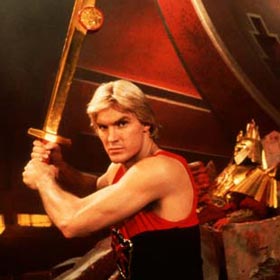
It's probably right around the time of owl-head nookie that I think the movie falls completely off the cliff. Even the look of it disintegrates. Yes, I understand that it's set in 1985, so I have to live through the fashion and hair choices of that era. I do not, however, understand why Ozymandias appears to have stolen the building materials for Karnak II from the set of Flash Gordon. Seriously, when he hurls his throne through the air and Nite Owl uses his Colecovision controller to saw the leg off, I thought, "Does your mother know that you stole her faux French Provincial chair AND took off the plastic slipcover?"

It's just . . . arrrruguuguuhhh.

I really did like big chunks of the movie, so I'll try to end on a smattering of positive notes. Matt Frewer's supporting role as Moloch is wonderful, and it was a gift to give him and Haley that much time together on screen. (But the flashback to the Comedian's tearful night-time visit was terrible.) Everything from the moment that Rorschach says, "I have to use to the men's room" to his rejoining Nite Owl and Silk Spectre II is gold. Shooting the scene through the swinging door was beautifully done. (But Snyder just HAS to go back to the cheezy shot of the blood running out from under the door.)

The movie had real potential, and it realized some of it. Perhaps it's best to be grateful for that, given the fact that a movie version has been in development for something like 15 years. But I stand by my original assessment: It was ok.

Labels: , , , , , , , ,

Friday, February 20, 2009

Unravel Me . . . .

So yesterday my friend, the bunnyfaced one, sent me a link to this knitting blog entry to a supercool exhibit at my very place of employment. (Well, one of them, anyway.)

The pointer was just in the nick of time, as the exhibit closes on Saturday. I managed to subvert my usual slothful tendencies and get there today before my evening class. That's the good news. The bad news is the Sullivan galleries were hosting a benefit for the Ox-Bow School of the Arts.

Ok, so classifying that as bad news is totally narcissitic. But when I got up to the 7th floor, clearly security was on the look-out for slovenly hangers on (like yours truly), and the guard at the desk was totally baffled when I asked for the Redress exhibit. In fact, I had to make knitting motions before I could get her to understand what I was asking about. There is nothing sadder than a mime miming knitting.

The second barrier was the general bustle in the galleries themselves. There were big signs for "BENEFACTORS" to check in. Some people reporting for the caterers were sent around to the non-BENEFACTORS door (which, one assumes, was smaller, out of the way, and generally more scabby). In between me and Redress were tables for ticketholders to check in. The handful of folks milling around them were youngish and had the look of volunteers about them. I asked if it was ok for me to go into the exhibit and they looked at one another in confusion. One said, "Are the galleries open?" I told her that the website said they were open until 6, but I hadn't known the benefit was there . . . so . . . As is fairly typical in my experience, indicating that I didn't want to cause trouble or be an inconvenience won the day, and they thanked me for asking before barging in.

From the photos at Panopticon, I'd been thinking the exhibit was a bit bigger than it was. It's probably about 10 x 10, and I was a little at a loss for where to stash my stuff (eventually settled on tucking it into a corner. I also felt more self-conscious than I had anticipated, ironically because I was the only one there except for those engrossed in setting up for the benefit. Nonetheless, I'd come to knit and knit I would!

There are seven stations set up. On one side of the space, the bicycle wheels are mounted upside down on two stacked wooden pallets. The working strand of yarn is wound several times around the rim, then goes up through a hook above the wheel, swags across the center of the space, goes through another hook above the hanging row of sweaters, and descends along the wall behind the "seats." In front of each wheel is a neatly folded piece of fabric which I assume is a remnant of the garment from which the yarn has been harvested. Next to each wheel is also a small ball of the same yarn, wound. In addition to the pendant sweaters, there are more piled in the corner.

Opposite each wheel is, of course, a station with a piece in progress. There are bits o' pallets for sitting, and needles for each piece. I found myself dithering about yarn to sit down by. None is particularly pretty or soft, which isn't particularly surprising: You can pry my favorite sweaters out of my cold, dead hands, after all.

Finally I settled on a rainbow-colored, chunky yarn. This, of course, turned out to be the one station where the yarn had gotten completely fucked up in coming off the wheel. Furthermore, my dumb cracker mind was, of course, too befuddled to figure out how to right the situation. Plus, I felt weirdly anxious about trying to fix it, as though it was a violation of the imaginary velvet rope that always exists around art in the mind of someone as profoundly unartistic as I am. Although that piece had, at one point, been quite wide, it was decreased to a narrow strap by the time I got a hold of it. I did a few rows of seed stitch on it, then played around with k2togs and kfbs before I just couldn't deal with the lack of slack anymore.

Being fundamentally lazy, as well as nonartistic, I simply picked up the tweedy dark grey piece to my right. This one was more satisfying to me, as it was wider, and I could really play with stitches across its length. Also, I could reach up and give a big tug to the strand and get the pleasant, productive-sounding clicky noise (made by a thin piece of metal arranged to hit the spokes—I rather wished it had been a clothespinned playing card!) as the wheel turned to release more yarn.

I'm jealous of Franklin's experience, as mine was missing the sociability of knitting. Not only was I there alone, I felt in the way because of the prep for the benefit. And to cap the experience, I was rereading an article on female genital mutilation in Sudan in preparation for my class. In other words, circumstances conspired to keep me from my happy art-brain place, which I'm usually so ready to go to. I did have some of the same out-of-context, disjointed, disconnected thoughts he mentions. At one point, I stared down at the next row in the seed stitch I was going to do an I literally could not remember if seed stitch was purling the knits and knitting the purls or maintaining the stitch type across rows. I then suddenly couldn't tell reliably if a stitch had been knit or purled on the previous row. Unfortunately, rather than it being a sort of cognitive sorbet, I just felt frazzled, frustrated, and weirdly alone.

Oh! Another weird thing. I had my Jesus!Phone out to take a few pictures (again, I felt self-conscious and invasive even though I'd seen pictures on Panopticon). The phone rang, or rather, the "Lai-dai-dai, lai-dai-dai, lai-dai-dai-dai-dai-dai-dai" part of Janis Joplin's "Me And Bobby McGee" sounded, revealing the caller to be the bunnyfaced one herself. Without thinking, I answered it. But a few seconds later we got disconnected, and I suddenly thought, "ZOMG! YOU JUST ANSWERED YOUR PHONE IN AN ART GALLERY! YOU ARE LIKE A LEVENTY-SIZED ASSHOLE!" So when she called back, I didn't answer and was all anxious about not answering. (We did eventually have a conversation, the first part of which revealed just how freakin' LOUD downtown Chicago is.)

Anyway, it was a cool and interesting exhibit. I wish I'd been more in the right headspace and/or hit on a more convenient time to see it, though. I won't even bother with my iPhone pictures (I mostly took them for Twittering purposes) as Franklin's are much better. Sorry to not have reported on this sooner for the convenience of my Chicago knitting peeps!

Labels: , , , ,

Monday, November 17, 2008

Radio . . . off? High Tea @ 103 and Radio Macbeth @ Court Theater

I recently inherited a very fancy Franklin Covey day planner from my sinister sweetie, who ditched the big 3-ring arrangement in favor of the spiral bound incarnation. Since I've begun to use it, I've double booked myself at least 3 times. And yet my gänger has remained stubbornly undöppeled.

The worst part of my double booking yesterday morning was the fact that I didn't feel like going anywhere at all. I recently incurred the rage of the karmic keepers of migraines by telling my doctor (at my long-overdue annual visit) that I hadn't had one in a long while. She didn't rewrite me a prescription for my medication, and thus I have had at least 2 since then, one of them yesterday.

Despite feeling pretty awful, and despite the fact that I should have been attending my song-writing class, I was determined to attend the high tea at Cafe 103, which had been arranged by the superexcellent owner of my beloved, doggie-friendly local yarn shop, My Sister's Knits.

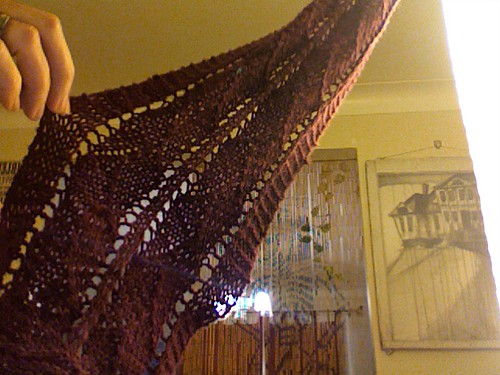
As I was pondering my wardrobe for such an occasion on Twitter (I suppose it is possible to clothe oneself without recourse to cannabis [so far removed from Texas THC am I that it took me 4 tries to spell that correctly], government hand outs, and Twitter, but I don't recommend it), pointed out that high tea was definitely a hat-wearing occasion. I located the MPage Memorial Hat and finished it off with a skirt, tights (which definitely squish), my insaneoid (but oh-so-cute and oh-so-conveniently-mammoth-calf-fitting) boots, a black top, and my newly blocked dragon-scales scarf, and dived into my trusty Corolla with about 5 minutes to get me to the tea on time.

Foolishly considering the Bears' interception of the ball deep in their own territory to be some kind of good omen, I headed in and slotted myself into the Matilda axis. (The Cafe can seat 30, 3 of us were named Matilda, and we happened to be sitting next to one another.) My hat was widely complimented until someone turned up in a tiara. (Let the record show that I, of course, HAVE a tiara, but I had not gotten the memo that this was a tiara-wearing occasion.)

The tea was lovely. We started with a basket of miniature scones and various breads and cakes (lemon-poppyseed, pound cake, etc.) served with jams, lemon curd, and so on. Next up were mimosas (Carol providing the champagne) and the first course of finger sandwiches, which included open-faced cucumber-dill on rye, turkey with an apple-cranberry chutney on a whole-grain pita, and something else my sleep-deprived brain cannot recall at the moment. The second course of sandwiches included spinach-walnut minitarts in phyllo, classic egg salad on white roles, and chicken salad with smoked grapes and walnuts on a croissant. I was a huge fan of everything, despite the fact that both the chutney and the chicken salad are things I normally would have shied away from trying.

There were various door prizes from the shop. Winning seemed to be a function of proximity to her majesty with the tiara (although the last person picked her own name out!). In addition to the prizes Carol had arranged, the owner of Cafe 103 (who, as usual, had on perfectly beautiful jewelry) announced that everyone should check the bottom of her saucer, because one person at each table would find a sticker indicating that she had won the centerpiece, which was a lovely antique cup and saucer filled with unique and gorgeous arrangements from the Blossom Boys, the super-excellent florist's shop (and more) just 2 doors down from MSK.

Before we could to anywhere, there was, of course dessert. First up, both by choice and necessity, was ethereally delicious orange mousse served in a chocolate tulip cup: One million times better than the average dreamsicle in part because of the spot-on evocation of all aspects of the dreamsicle experience. Next I tried the caramel-apple square, which was a little over-cinnamony for my tastes (almost any cinnamon at all has this effect on me, though, so take that in context). The chocolate walnut brownie was a marvel of brownieosity: Chocolatey, rich, and wonderful without being at all overly sugary. I kept telling myself that it was so rich I could only eat a tiny portion, and yet the whole thing disappeared. The final dessert had (presumably in error) described to us as something strawberry based. It was, in fact, a kind of chocolate cream cheese brownie. The slightly sour topping was in perfect balance with the chocolatey goodness underneath. Oh, there was a lemon bar in there, too, and I am a failure because I did not try it.

They owners opened the Beverly pantry to us as well, and I did lumber over there briefly. (My crazy!boots proved to be particularly ill suited to conveying my post-tea bulk around a shop filled with fragile and expensive things.) Many of us headed back to Carol's shop, which she was opening to us for an hour after the tea. Of course in our eagerness to get some food-coma-combatting fresh air, we arrived at the shop well ahead of her. I had parked in front of the Blossom Boys shop and noticed that they had a picture of Barack and Michelle Obama on their door (a specific picture of the two of them going to or coming from the kids' parent-teacher conference right after the election), and I stopped to examine it. (Turns out that the lovely arrangement that Michelle is holding in the picture is one of theirs.)

In my food-induced haze, I failed to note that there was someone inside the shop, even though it was close. Naturally, my mug pressed to the screen door was sufficiently alarming that he came to see what was up. He immediately recognized our gaggle as having been at the tea and invited us to come in until Carol arrived to open her shop. I narrowly escaped buying a number of pieces of jewelry and some other things. I did not escape buying yarn, however.

In the car on the way home, I discovered the awful truth about the Bears game. We have no wish to discuss it.

In the evening, we were scheduled to have dinner chez Editrix, as she was eager to cook dinner in her new and improved kitchen, and thence repair to the theatre to see Radio Macbeth. We were of the impression that RM was not, you know, The Scottish Play, given the different title and all. In fact, we were under the impression that it was a play about a group doing a radio version of TSP, which would be interesting. Sadly, it is not. Not about a group doing a radio version of TSP and, really, not interesting.

It's important to note that the performance was by a group called SITI. Although this seems once to have stood for Saratoga International Theater Institute, it seems now to be SITI forevermore. SITI is dedicated to training actors in a combination of the Suzuki Method of Actor Training (which, apparently, has no relationship to the Suzuki Method of Musical Instrument training, although I think a foot-based approach to musical instruments will soon be sweeping the globe) and the Viewpoints method .

It is further important to note that Kate Bredeson, the dramaturg for RM says:

In the world of SIT, the Scottish play is a 1940s radio drama in rehearsal . . . the company tells the story of the play through the ebbs and flows of sound. As in the most masterful classic radio dramas, the focus on sound in lieu of sight creates a world in which chatter is heightened and screams are more devastating — a world where silence creeps and menaces. In this stylish take on Shakespeare's tragedy, SITI gives us a full, albeit subdued visual terrain as well. The resulting crash of sight, sound, and a classic, iconic text is pure SITI: grounded, full, stylish, smart, raw."

Um. Sure.

There's almost no set for the show. Which is fine. The black cinderblock wall is exposed from floor to ceiling, except where a single, paint-splattered white drape descends from the ceiling to puddle on the floor up left. An upright piano is against the back wall up right. Other than that, at the top of the play, a small table is down left with two folding chairs in front of a microphone upstage between it and the aforementioned drape. A long boardroom table is set diagonally, running from down right to up center, and a handful of mismatched folding chairs are around it.

As the audience filtered in, a lone individual was visible slumped in a folding chair at about center stage. As a crowd of people was heard off stage left, he jumped up and ran off stage as the lights went completely down.

Four people seemed to enter in the dark with only a lighter's flame to guide them. As the lights came back up, two women were revealed. One was a young Japanese woman in black plastic-framed glasses and a convincing 40s-era skirt suit, another was a young woman in high-waisted, wide-legged trousers and a blouse and scarf. The former bustled around helpfully, the latter sat at the small table, seeming to concentrated on spiral-bound script. Also on stage from the moment the lights came up was a small, dark man in an argyle sweater.

Shortly, a man (apparently the one with the lighter) entered from the right-hand wings, presumably having been responsible for getting the lights working. He wore a cap and flannel shirt and had a pencil tucked behind his ear. This group was soon followed by a man and woman, also entering from the right, who were altogether more flashily dressed. The man had a pin-striped suit, the woman a red wrap dress, very 40s hat, and a fur coat.

Probably close to 5 minutes elapsed during which the Japanese woman continued to bustle, the woman in the red dress stalked about giving people the hairy eyeball, the woman in the trousers continued to focus on her script, and the men seemed to wander around whispering to one another and making "whaddaya gonna do?" gestures at one another.

It did seem as though relationships among these people were being subtly established during this time. For example, it seemed to me that Trouser!Woman and Red!Dress Woman were being contrasted: T!W was clearly a METHOD! actor, whereas R!D was a soap opera diva type who relied on histrionics. The Japanese woman was a Girl Friday type intent on convincing everyone of her indispensibility. There wasn't much to go on with the men other than perhaps a class difference between the two men who had entered first and the man who entered later with R!D.

With little obvious impetus, W!T launched into "When shall we three meet again?" reading all parts with very little differentiation between them. She moved more into characterization as Macbeth (the richly dressed man in the pin-striped suit) and Banquo (the guy in the newsie cap) entered the scene. From there it seemed as though the players were established: Pinstripe = Macbeth; R!d = Lady Macbeth; W!T = witches (and later the Porter, Lady Macduff, and Lady Macbeth's maid); Newsie guy = Banquo, Malcolm, and a handful of other characters; Argyle guy = miscellaneous characters; Japanese skirt-suited woman (who turned out to have a very heavy Japanese accent) = Various characters.

EXCEPT!

Right around Act I, scene iv, when we see Duncan for the first time, the pinstripe guy started to read the part, pulling out one cheek and doing a very distinct voice for him.

AND THEN!

When Macbeth is next set to speak, the guy who was on stage before the lights when down appears at the top of the house left audience, starts to say Macbeth's lines over pinstripe guy, and does some directors' notes type dialogue about what the play is about.

So, thought I, we are finally, after four scenes, getting into what this play is about! Sort of a leisurely pace for self assertion, but now we're cooking.

Yeah, not really. The second guy just read Macbeth for the rest of the play, while pinstripe guy moved into playing Duncan and then Macduff, and no attention was ever paid again to this godforsaken mid-performance improv freeze tag. In fact, there seemed to be no further acknowledgment of any other identity for or interactions among these players. They just . . . did an abridged staged reading of the play. And lo! We were mightily confused in an apathetic way.

Certainly, they used those mics to good effects sometimes! There were person-created storms. To be sure, there were a handful of radio foley techniques—slapping the big table with a piece of 2 x 4 to simulate the knocking at the gate before Duncan's murder is discovered, for example. Yes, there were some coffee moments among the players, but they seemed reducible to nothing more than a minimalist way to stage the various banquets. But other than that it was just sort of Speed!Macbeth. Why the 40s? Doesn't matter. Why the markedly different styles of dress? Who knows? WHY GOD WHY DO WE HAVE 2 MACBETHS? This question is as elusive as the truth about the number of licks it takes to get to the center of a Tootsie Pop.

The performances weren't bad. In fact, I thought Barney O'Hanlon (newsie cap guy) was quite good in particular, and once I realized that nothing interesting in the way of interpretation was going to happen, I clung to hope that I'd at least get to see some of his Macbeth. The Editrix did forcefully question whether Elizabethan English is really the best medium for a non-native speaker with a very heavy accent. M and I were divided on whether Akiko Aizawa's accent was real or part of her character-not-really-within-a-character. (I gave up on this idea toward the end, but the ZK still thought he'd heard her making some accentless witch contributions.)

In terms of the text presented . . . I'm not sure why one would include the bulk of the extended witches scene that most agree was not written by Shakespeare and not performed by the company in his lifetime, especially if one is going to cut "Tomorrow and tomorrow and tomorrow" down to about five lines, delivered in painfully flat style that cashes in on none of the possible readings of that speech.

Don't get me wrong, I'm not at all a Bard purist, but the shaved down play, as presented, did little to make me think. The additions, which included random stage directions (more frequent toward the end), the aforementioned replacement!Macbeth entrance music and pyrotechnics, and W!T ending the Macduff/Macbeth confrontation with a whimper as she yelled "Enough!" (This last was particularly snicker-inducing for M and me, as the two men were facing one another with folding chairs raised in menacing fashion. Been there, done that, bought the Luchador mask.)

RM would probably have been disappointing to us on the grounds that it was not at all what we thought it would be, and I think that SITI bears some responsibility for creating those expectations and not delivering. Observe:

“A great ghost story is best heard in the dark or by the shadows of flickering candle light. Darkness plays tricks on the mind and the ear; the smallest rattle will make our imagination churn. Macbeth—in my mind the ultimate ghost story.”
–Co-Director Darron L. West


But despite being doomed to disappoint, it needn't have . . . bored . . . to the extent that it did. Perhaps if we'd arrived a little earlier (we were enjoying QUITE TASTY chicken with potatoes and kale chez editrix until sauntering theatre-ward quite late), the boredom would have been prophesied in this from the OTHER director:

In the heat of the shared theatrical experience, an audience becomes its own society. You are here with a roomful of other people. Can you handle that? We are a community of people dealing with one another and challenging one another. The theater is about social systems and how individuals in communities function in concert. Can the planet be shared or does it just belong to me?


Why I do believe those are the second worst director's notes I ever did see. I'd have said they were the worst, but I presume that they are directed toward agoraphobic virgin theater-goers from Mars, rather than, you know, normal people like us.

Labels: , , , , , ,

Wednesday, November 05, 2008

November 4, 2008, Chicago

Spring here is really little more than a rumor. In some ways, though, it's all the more impressive watching taut bundles of life cling to their branches through the frost, ice storms, and of course wind for which we are famous. (In Peru, revealing that I am from Chicago is always met with a grave, knowing nod, "Mucho viento.")

Spring here is muddy and often grey. And cold, although most of us are prone to sartorial denial about this. We move, heads down, necks pulled into the inadequate collars of our useless spring jackets, declaring the weather "Brisk!" to one another through chattering teeth.

I'm not a fan of spring, or of summer for that matter, but I can't help but get a little rush of excitement the first time we have that distinctive chalkboard smell after a rain. I can't help admiring that bonnie blue spring sky. And when those stubborn little buds eventually uncoil and leaves stretch out to one another, when there's a solid canopy of green interrupted only by a road map of veins, it's beautiful.

But honestly, even I—I who have so much green in my wardrobe that I try not to leave the house without performing what I call the "cabbage check"—get tired of all that uniformity. I love fall for its short days. I love it for its dry, crackling smells. I love its overcast afternoons and howling wind. But what I really love is how the relentless green gives way to an incredibly diverse palette as each species, each tree makes a separate peace wth its own cyclical death.

November 4, 2008, was a beautiful day in Chicago. And I took pictures. Partly to keep from going insane, of course, but partly because I really wasn't convinced that Wednesday wouldn't bring another disappointment, and I felt an urgent need to preserve that beauty and have something that would remind me of that feeling of hope, of possibility, of progress.

November 4, 2008, was a beautiful day in Chicago, but it was also a day that brought disappointments—terrible and important disappointments in California, Arkansas, Arizona, Florida. I think those losses are attributable in part to ambitions for what we can be that withered as we watched ourselves become something terrible. But there is beauty, there is possibility, there can be progress. And I have pretty pictures of trees to prove it.


More here, including Hound Pr0n for those not into fall foliage pr0n.

Labels: , , , , , , , ,