
Telecommuniculturey

High- and low-brow cultural goings-on in the Second City, brought to you by a roving microtechnoanthropologist

My Photo
Name:
Location: Chicago, Illinois, United States

This is fiber optic cable, which is the future. This is culture, which is delicious.

Thursday, August 11, 2011

Re-Seduced: Minnesota Fringe Festival, Day 2.

On Sunday, we once again rearranged dinner plans slightly to accommodate our theatre schedule. Also, Saturday was just a leeettle overindulgent on the food and booze front, so a later dinner was not a bad idea.

First up, Steampunk! Anyone who knows anything about me knows that a show called Robot Lincoln: The Revengeance (The Musical) is like crack tailored to my specific nerd receptors, so that was our first show on Saturday, back at the Thrust (STOLL!) stage at the Rarig Center. (See previous entry for bitching about the building, but liking the actual space.) As we waited in the traditional second of 2 lines, I tweeted gleefully about the warning sign outside the theatre (guns, strobe lights, adult language, and violence), and broke the rules about no photography (only realized that I was breaking a rule in retrospect; also I'm not sure taking a picture of my program counts as rule breaking, even though I was in the theatre) to capture the Best. Dramatis. Personae. Evar.


Sadly, the show itself was pretty disappointing. The "plot" was convoluted and there wasn't much in the way of fun dialogue. The performers were singing to taped music, which led to a lot of problems. (I feel like an utter shit mentioning that—my homeless, underfunded theatre group had to do the same with a production of Mother Courage and Her Children, and it was a nightmare.) On the plus side, the group seems to have paid a lot of attention to the design, and that paid off. Robot Lincoln's costume was terrific, and there were a number of other great visual touches.

The "love duet" between Booth and Robot Lincoln was everything I think the show could have been with more time and stability for the production. Jason Garton was terrific as Booth, and Libby Slater was hilarious as Mary Todd Lincoln (less so as "Uncle Samantha," but that character was a very sketchy).

From the Rarig Center we were off to the Gremlin Theatre in St. Paul for The Duties and Responsibilities of Being a Sidekick by The Barkada Theatre Project. Other than being a sucker for superhero stuff, we hadn't chosen this show for any particular reason, but I'm so glad we did. The show was really well written (an interesting, compact story—no mean feat with a maximum of 60 minutes), had great fight choreography, and the cast (featuring Randy Reyes, whom we'd loved in Brain Fighters on Saturday) was just great from top to bottom. Also, great pre-show and entr'acte music, even if they DID cut us off on the theme from The Greatest American Hero just when we were taking it to the bridge.

From the Gremlin back to Theatre Garage for Those Were the Days by Blue Umbrella Productions. TV themes arranged swing-choir style with a minimal, but well-done framing story? Yes please! Really great arrangements, great ensemble and solo work from the whole cast (I forgive the mishap with the Jem theme, though it is dear to my heart), fun choreography. I'm not sure I would have done the whole Eight is Enough theme, but it's not my show, now is it? Shutting up, sir.

And finally, back to the Thrust at the Rarig Center for The Smothers Brothers Grimm., by Comedy Suitcase. This was the show we'd rearranged our dinner plans for. It had some great highlights, especially the closing "silent film," but the whole show was uneven.

The framing premise involves Milton, a young boy (wonderful work by Andrew Moy) who has recently lost his comedy-obsessed grandfather, and whose parents are convinced that he is not dealing with the loss. The parents try to get him to sleep by telling fairy tales, but Milton insists on "punching them up like grandpa would." We get Hansel & Gretel as told by Laurel & Hardy. Our group was divided on this. I mostly liked it, but felt it went on a bit long (then again, it's Laurel & Hardy . . .). Next was Rapunzel a la I Love Lucy, which just felt awkward and as if there weren't a lot of there there. Bob Newhart responding to the 911 call from the Three Bears, suffered from not enough Bob Newharty goodness. Some of the interstitial stuff with the parents and lovable drunk uncle were really good, and some fell a bit flat. The epic silent Sleeping Beauty segment was epic.

I was hit really hard by the realization that my fun at Fringe was over. I'm still trying to talk myself off the ledge of crazy renewal of my involvement in theatre.


Labels: , , , , ,

Saturday, May 07, 2011

Monsters, Boobies, and OCD: Danny Boyle's Frankenstein at the National Theatre

Sadly, we are not in the UK, but we did just return from The Music Box Theatre where we saw the last show they're broadcasting there. The title is the ZK's review.


This has been getting rave reviews, lines around the block for day-of tickets, and so on. In many ways, the production deserves that and more. I liked it, but did not love it.

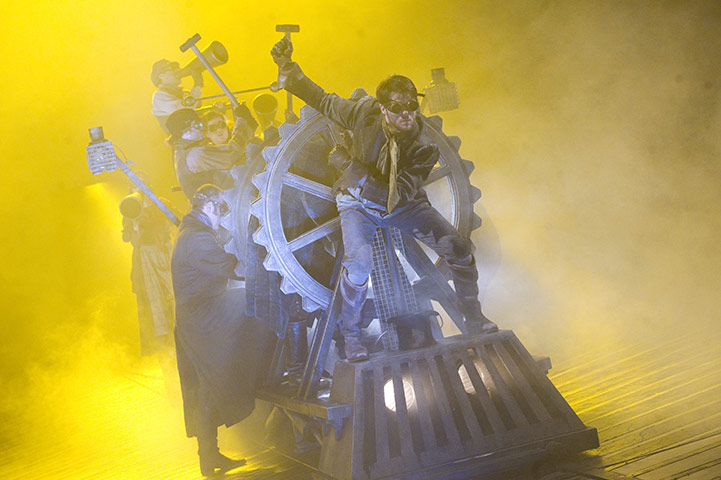
Every element of the design and staging is incredible. The stage is round with a central revolve, and overhead, there's a fixture comprising hundreds of lightbulbs. They're gathered in bunches, hung at different lengths, and it's at once oozing and organic and cold and artificial, evoking forges, power plants, and circuses. To represent the creature's first stumble into a town, there's this gliding platform topped with huge gears that rotate. Extras hang from the front and sides, jerking, slamming, writhing, and do-si-do-ing to something too clanging and brittle to be music, too patterned and hypnotic not to be. It's like Steampunk and German Expressionism had a Marxist-informed Baby.

The blind scholar's hut is represented by four scrimmed walls with a few natural elements stenciled on them; the Frankenstein home is all stiff, stuffy windows and shadow, but it churns up from beneath the stage and sits at a subtle angle. Victor's hut in Scotland has an appropriately claustrophobic, subterranean feel.

The monster is scarred, sutured, scabby, and oozing. The development of his movement, command of language, and command of . . . consciousness and self-awareness . . . are all stunning. The production we saw had Jonny Lee Miller as the Creature and Benedict Cumberbatch as Victor (the two leads swap roles each night). Both occupied their roles in a way that signals and excellent director and a creative process that's hard to achieve where actor and character are constantly growing and stretching. Really fantastic.

Oh, look! It's my "but" face. Charitably, Nick Dear's script is uneven, which is not to say that there aren't brilliant parts of it where Mary Shelley's text is illuminated, enlarged, and brought to life by the adaptation. But then there are parts that are just . . . clunky as shit: Felix and Agatha (the blind scholar's son and daughter-in-law) have awkward Tolstovian orgasms about having cleared all the rocks from their field; the Scots resurrectionists have painfully stilted attempts at Shakespearian comic relief; and Elizabeth lectures Victor on the God-given, societally approved power of her uterus. No, really.

Elizabeth, in general, is a nightmare. Boyle casts all the Frankensteins, save Victor, as actors of color for no reason that is particularly apparent (which is not at all to say that I think the actors ought to have been all white in some misguided attempt at authenticity, but Victor's whiteness becomes pointed). George Harris was simply not very good as Victor's father, although I wonder if his wooden delivery was directed that way, so that we remain entirely within the mind of Victor/The Creature.

Naomie Harris's portrayal of Elizabeth is almost beside the point as a performance. Her character is the victim of the worst of the script and a choice that came within a hair of ruining the whole shebang for me. As through the vast majority of the play, the action stays with the Creature, who springs from Elizabeth's bridal bed and has a conversation with her that, at times, almost salvages an otherwise dreadful scene. Then, unlike the book in which Victor hears a scream and comes across Elizabeth's lifeless body, Dear/Boyle have Victor burst into the room, revolver drawn (if you will) only to flail around on the floor for no apparent reason while the creature rapes Elizabeth, achieves orgasm, snaps her neck, and declares, "Now I am a man."

W.
T.
F?

Extra special bonus points not just for going to the "Women Exist For Men to Use in Their Attempts to Exert Power Over Other Men" Well, but going the extra mile and making the woman non-White. Seriously, just what the fuck?

But other than that, Mrs. Lincoln, it really, truly is a magnificent creative endeavor beautifully brought to life. But I'd consider nipping out for popcorn at strategic moments.

Labels: , , , , , , , , , , , , ,

Wednesday, March 18, 2009

Please, I go through *everyone's* trash: Watchmen

Saw Watchmen last night. This is probably going to be terse. For me, I mean:
It was ok.

It starts out well, in fact. The murder of the Comedian establishes the visual style that will dominate for most of the movie, and it seems like a good balance between honoring the artwork of the graphic novel and realizing that a movie can't be panels strung together.

The credits are fantastic, and the opening scene looks even better in comparison. In the retelling of the story of the Minutemen in a series of snapshots and headlines, the colors are brighter and the lighting is designed to make the scenes flatter and less realistic. The good times of the past are more romantic, the bad times more lurid. The recreation of historic events in the credits is also more successful, in part because Zack Snyder almost always does something that breaks the fourth wall, signaling movement into a new scene. All very nice.

Everything about Rorschach is perfect. The costume is great. The shifting effect of the mask was done very well. It was only near the end of the movie when I was deep in "Why am I here? Why is anyone in this movie doing the things they are doing? Why did some terrible, but not life-threatening accident not befall Malin Akerman in childhood, saving us all from this 'performance'?" mode that I wondered why it does shift. (IMDB's trivia notes that the material for the mask had been intended for a dress ordered by Kitty Genovese, which is an interesting detail, but sheds no light on the effect.)

Jackie Earle Haley is magnificent as Rorschach. Perhaps even more important, Haley is magnificent as Walter Kovacs, and so often things go whizzing down legs when the mask comes off.

On our drive back down to LA, the ZK and I were listening to the Filmspotting podcast that includes their Watchmen review, and they compare his performance with Heath Ledger's Joker. I concur, and although it might seem to be picking on the dead guy to do so, I'd give Haley the edge if I were required to choose the better performance, mostly because the writing for the Joker is perfect, whereas the writing for Rorschach is merely the best writing in a pretty terrible screenplay.

Ok, if I'm going to have to talk about the screenplay, and I assume I must, I guess I have to nitpick one thing about Rorschach: The presentation of his origin story deflated my enthusiasm for the character. Worse still, the poor work on the origin story made me think about a facet of his characterization throughout the movie that is not done well. Most of his origin story is spun well. The case that kills the last of Kovacs and gives birth to Rorschach is compelling (although I think Snyder veers too much into torture porn at the end of it).

But poor widdle Walter's mommy was a prostitute and not nice to him? Please. What a half-assed, trite, misogynist piece of boo hoo. Probably I have Alan Moore to blame for the original sentiment, but neither screenwriters David Hayter and Alex Tse nor Snyder do anything to elevate the moment. By the time the events in the hallway are spelled out, we've already seen those events several times. WE GET IT.

In addition to finding the director's lack of faith in the audience disturbing, spelling out this element of Rorschach's story also calls attention to his Puritanical-bordering-on-phobic distaste for sex. The world that's represented isn't exactly crawling with sexual debauchery (with the exception of a scene where Rorschach is pursued by an aggressive prostitute). I guess we're supposed to attribute the recurring theme in his voice overs to his sociopathic misperception, but as the most memorable instances of it are directed at the first Silk Spectre and at Silhouette, it comes off, once again, as simple misogyny. Yawn.

But the screenplay has more dire problems. There is very little in the way of through narrative. Again, that might be the fault of Moore and the graphic novel originally, but it behooves the screenwriters and director to show some attention to the translation from one medium to the other. Character-establishing sidestreets and character-building interactions in the present seem to have been flung down randomly on the timeline.

The Filmspotting blokes were critical of the long digression into Dr. Manhattan's history. They were ultimately of the opinion that we didn't need to see it at all. I can't agree, though, because Dr. Manhattan is so poorly integrated into the story to begin with, I feel that if I knew even less about him, it would have been impossible to regard him as anything more than the deus ex machina inappropriately placed on the mantel in Act I. The poor exploration of Dr. Manhattan left me wondering about things like why his execution method ends up so gory. On the one hand, I appreciate making death look like death, when violence is too often rendered beautifully and lovingly. On the other, if there were ever a killer whose method would be neat without fuss or nasty clean-up, it seems like that killer would be Dr. Manhattan.

I also wanted more Dr. Manhattan, because I really liked Billy Crudup's performance both in and out of the magical light suit. I do agree that the origin story is both too long and placed far too late in the film. It might have worked better if it had been interspersed in the story as flashes of memory or reflection on Dr. Manhattan's part. In contrast, I think Dr. Manhattan's yogic sojourn to Mars went on far too, long. In particular, his 9-minute monologue about the miracle that is Silk Spectre II rang, shall we say, false in my ears.

I'd argue that the handling of Veidt/Ozymandias is a cautionary tale of how much worse things could have been on the Dr. Manhattan front. I mean no disrespect to Matthew Goode, whose performance I also liked. I really loved the precision of his speech and the fact that the smartest man in the world visibly struggles with talking in Slow. Loud. English. to the rest of us. But Ozymandias is a disaster.

The ZK asked me if I figured out early on that he was the villain. "Figured out" is probably inaccurate. There were no options other than Ozymandias presented (Nixon or Kissinger, I suppose). I assumed he was the villain about 4 seconds into his Annie Leibovitz shoot, but doubted myself on the grounds that his plot makes no sense at all. That's ok, plots often don't make sense to the outside observer, but I know virtually nothing about Ozymandias (except that he apparently missed the irony in the Shelley poem), so I don't know why it makes sense to him, and that's a big problem. I'm not sure what the scene with him and the '80s vintage robber barons is meant to accomplish. It certainly doesn't give the character any depth, the ruse with the assassin is laughably transparent, and YES LISA, WE ALREADY FIGURED OUT THAT HE SHOVED THE CYANIDE CAPSULE IN THE GUY'S MOUTH, WHICH HE WAS HOLDING CLOSED EVEN AS HE DEMANDED TO KNOW WHO'D SENT THE DAMNED ASSASSIN IN THE FIRST PLACE.

Ahem. Moving on. The Filmspotting guys took issue with Patrick Wilson as a schlumpy loser who can only get it up in his owl head high above the city. It is utterly unfair of me to attribute the fact that I had no problem buying him him as a complete loser whose face seriously needed murdering to Patrick WIlson at all. I actually liked Patrick Wilson as Raoul in the horrible Schumacher Phantom of the Opera, thus ensuring that my and Ebert's opposition would be completely diametric.

Nonetheless, the sad truth is that poor Patrick Wilson as Nite Owl II is so persistently saddled with Malin Akerman as Silk Spectre II that I can barely think about him and his chin butt without throwing up in my mouth a little. Akerman is certainly the worst tragedy to befall this actor and this character, but the screenplay is doing him no favors, either. His monologue in the riot scene is horrible. His tushy in the Owl!Cave is sad. His pathetic thrusting is cringe-worthy, and his cuddling in Archie's eye socket made me want to auger out my own eye sockets.

But I should back up to the prenookie fire rescue. (1) What part of "The roof is starting to cave in" inspires Nite Owl to knock a water tower over on to said roof? (2) Given that it is 1985, not 1885, why is your primary weapon some kind of Gatling gun? (3) Leaving aside issue (2), if all you have is a perforating gun, why not shoot a big hole in the water tower itself, rather than delicately shooting out the supporting struts?

I just don't think I can talk about Malin Akerman directly. It's probably best to let Madeline Kahn do the talking. (So true, so often.)

What. the hell. were they thinking?

The trivia in IMDB for the movie counters every possible argument for her casting and every possible argument that might temper any criticism of her performance. She is only 7 years older than the many-times-hotter Carla Gugino. She is actually older than Laura Mennell, who plays Janey Slater, the "older woman" that Dr. Manhattan leaves for Silk Spectre II. And the generous speculation of the Filmspotting guys that she might've had to act opposite a tennis ball in her scenes with Dr. Manhattan is negated by this: "Billy Crudup simultaneously provided Manhattan's placeholder and motion capture on set. Crudup wore a specially-designed motion capture suit and face markers, and was constantly filmed by at least two cameras, one for all-over movement and another trained on his face to follow his expressions. This way, his on-set performance as the placeholder could be used directly in creating the CGI character."

If I must say something nice, I'll say that Akerman's performance has the presumably unintended result of boosting my estimation of Natalie Portman in V for Vendetta.

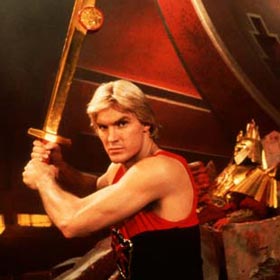
It's probably right around the time of owl-head nookie that I think the movie falls completely off the cliff. Even the look of it disintegrates. Yes, I understand that it's set in 1985, so I have to live through the fashion and hair choices of that era. I do not, however, understand why Ozymandias appears to have stolen the building materials for Karnak II from the set of Flash Gordon. Seriously, when he hurls his throne through the air and Nite Owl uses his Colecovision controller to saw the leg off, I thought, "Does your mother know that you stole her faux French Provincial chair AND took off the plastic slipcover?"

It's just . . . arrrruguuguuhhh.

I really did like big chunks of the movie, so I'll try to end on a smattering of positive notes. Matt Frewer's supporting role as Moloch is wonderful, and it was a gift to give him and Haley that much time together on screen. (But the flashback to the Comedian's tearful night-time visit was terrible.) Everything from the moment that Rorschach says, "I have to use to the men's room" to his rejoining Nite Owl and Silk Spectre II is gold. Shooting the scene through the swinging door was beautifully done. (But Snyder just HAS to go back to the cheezy shot of the blood running out from under the door.)

The movie had real potential, and it realized some of it. Perhaps it's best to be grateful for that, given the fact that a movie version has been in development for something like 15 years. But I stand by my original assessment: It was ok.

Labels: , , , , , , , ,

Wednesday, October 29, 2008

Penguins Are Assholes: John Hodgman and David Rees at Second City E.T.C.

Tonight I had the pleasure of joining about 200 of my closest fellow citizens for an evening filled with snifters filled with Jeppson's Malört.* You may revoke my Swede card now, for I had never heard of Malört before. I have, however, been drinking glögg made with grain alcohol since childhood.

I arrived at Second City E.T.C. at about 5:30, which was later than I'd planned. DO NOT BE ALARMED, my friends, because I had the most rockstar of rockstar parking: A spot not 15 feet from the door of Piper's Alley, meter needing to be fed until 6 PM, 32 minutes remaining on meter at 5:36. Contrary to my expectations, I was not eaten by a bear moments later.

There were probably about 15 people queued up outside the theater, and I sat down at the end of the line to do some reading for class. Someone from Second City came around and handed out tickets, letting us know that they guaranteed us entry, but not any particular seats. A little after six, a SWAT team from The Book Stall swept into action and assembled a retail operation to be reckoned with. Roughly 10 seconds later, I found myself in possession of several copies of More Information Than You Require and a copy of Get Your War On.

There was some instinctive sheep action shortly before 7 PM and this, fortunately, proved to not be too far ahead of them opening the doors. They seated people by party size, and I got an aisle seat next to a table. The slightly hyperactive microgeek on the other side of the table audibly gasped when I piled up my purchases in the course of rearranging my bag so that I could get at my knitting. I got through about two repeats of my pattern (Dragonscales in Shibui sock's mulberry colorway for those of you playing along at home) before the house lights went down and the Hodg-man himself came out in his RNC-provided tuxedo.

A bottle of Malört dangled carelessly from his elegant, Gatsby-esque fingers, and soon that very bottle was circulating through the audience (neither it nor the second bottle ever did make it to my section, though) as John introduced David Rees. David had apparently been promised $500 by the Hodgman if he were to drink an entire bottle of Malört. When he tried to claim a cold, John poured him an Irish coffee mug full (fill it to the rim! With Malört!) and retired to the green room to microwave it. Ravaged by illness, Rees gave way to Hodgman's insistence that he "Enjoy it hot!"

While Hodgman was preparing the toddy of the damned, Rees announced his intention to retire Get Your War on officially as of January 20, 2009. We were treated to an exciting preview of his next venture: Relationshapes. Allow me to say that it was like looking into an expertly shaded, geometric mirror. Having taken a bracing sip of hot buttered Malört ("That tastes like a forest fire"),
he then did GYWO in 9 min, 9 seconds (causal relationship between timing and Malört: indeterminate), and thus conclusively proved that Criswell had exactly JACK on Rees.

Hodgman took the stage again and immediately began flinging monkeys to the middle of the house and abusing lecterns. He then proceeded to borrow a copy of his book from the friend with whom he'd been sitting (and, of course, sharing Malört with) and demonstrated how it can be used as a page-a-day calendar. But most of the presentation was devoted to the trials and tribulations of a famous minor television personality. Without wishing to venture into the territory of what the kids call 5p01lerz, I will simply share the following phrases:

  • "Well done, Peter Berg, I wish I had a copy of Frank Herbert's Dune!"
  • "Pudgy. Portly. Round-faced."
  • "And I would fall asleep with Rachel Hunter's breath on my cheek. In the sky."
  • "It is perilously easy."
  • "Enervating."
  • "Or lamb sandwich."
  • "Thank you, Malört."
  • "Tarmac is from the Celtic for 'you're fucking stuck here'."
  • "I am tempted to talk about that terrible movie."
  • "The answer is cream pie. Over."
  • "Cheese it, it's the cops."
  • "Ira Glass wrote that to make me sound sympathetic."
  • "Though I had, in fact, leaned nothing against a fence."
  • "Shaved men and women roaming the countryside, dripping nutritive slime."
  • "A child. Taking a picture of me. While I sleep."
  • "Thank you, Malört, liqueur of digression."


I got to ask a question over the walkie talkie, and I was relieved that my stage-managing fu did not fail me in using the walkie talkie, unlike SOME audience members I could mention. I was also NOT the audience member attempting to bogart the walkie talkie at the end. The line for book signing extended down to the main floor and I got yet more knitting done. Both gentlemen were gracious and gentlemanly while signing. (If you recall from my encounter with Sarah Vowell, wherein I unsuccessfully attempted to employ a beard, I can't seem to embrace the notion that just because I've bought a stack of books, I have the right to enslave these individuals and monopolize their time.) Hodgman was even kind enough to express relief when I reassured him that I was NOT having him sign a book for a serial killer.


*Please note that this Flickrer is mistaken when sie claims Malört is the most repulsive spirit known to man. That honor goes to Chinese sorghum liquor. No. Srsly.

Labels: , , , , , , , , , ,

Monday, July 28, 2008

Husky Voices, Winning Smiles: Dark Knight

We finally got to see this on Saturday, after having given up delusions of IMAX. The theater was very crowded, but not completely full, and we did have to line up. However, we had good seats, and I did not have to kill the two 11-year-olds behind us as it looked as if I might have to throughout the trailers. Although perhaps I should have, if they were the ones surreptitiously sucking down Keystone in the bathrooms. I mean, Keystone! Really!

I'd seen the entire opening sequence for Dark Knight, strangely enough at the IMAX theater when we saw I Am Legend. It loses nothing on second viewing, and there was an added frisson seeing Heath Ledger for the first time and holding and holding for his fantastic first line. It's a kick-ass opening sequence on all fronts.

Having seen it in teaser form, it establishes the very different look of Gotham in this film. Well, very different for others. It could hardly be more familiar to me if it were my own back yard. It also establishes that the Joker is a kill in the daytime monster. The shot of the Joker's bus pulling out of the bank and into the convoy of school buses isn't just comedy gold, it prepares us for the complications the Batman (a nocturnal, cold-blooded jelly doughnut by nature) is about to experience in battling this particular foe.

What's impossible to appreciate from the teaser alone, though, is how important it is as the set up for the Joker's Mission Statement: It Just Takes a Little Push. Sure, he's talking about madness when he deploys that line, but when he does, it illuminates the long and winding road of dominoes that have been falling all the while: The little push of greed disposes of the Joker's cronies, leaving him the last clown standing and sending an unambiguous message to Gotham's lords of organized crime; the little push of desperation and disillusionment turns two in Gordon's trusted inner circle against him and his cause; and the little, persistent push of fear and certainty that each individual must do what is necessary, no matter how violent, evil, and unthinkable, to protect those closest to them, because society will not; Dent "makes his own luck" with a little pushing of his own; and, of course, you have the previously-pushed-for-your-convenience henchpersons, who are already enthusiastic recipients of the Joker's newsletter.

The Bat's opening scene is an admirable, deliberate mess in comparison. The TiVo recently picked up Tim Burton's Batman, which I haven't seen since its original theatrical release. I only watched the very opening, right up to the first appearance of Himself, and . . . well . . . it's pretty goofy isn't it? But you wait for it and you watch and you can't help getting at least a bit of a chill when you first spy those ears.

Giving the audience its first glimpse of the genuine article amidst a cavalcade of impostor ears is . . . hilarious. And as the movie wears on, poignant, tragic, and moving. (I recognize how manipulative-to-the-point-of-heavy-handed-and-soon-to-be-dated the Joker's "terrorist" video with the Bat-wannabe is, but damn if it didn't still get tome.) I was also completely thrilled with Cillian Murphy's cameo. I'm so glad that the Nolans thought of injecting that continuity between the two films, pleased that Murphy was up for it, and delighted with the value added to the crucial hero's opening scene and to the movie overall. The Scarecrow "pushed" with his fear homebrew and his high-brown insight into the psychology of fear. The Joker is a blue-collar, Everyman pusher and fear monger. Neat.

Heath Ledger's death is a shame and a tragedy in so many regards, but one of the shallower aspects of it is the fact that his and the Nolans' combined vision of the Joker can never be evaluated on its own merits. I know there's talk of posthumous Oscar, I know there are accusations of tackiness and opportunism in emphasizing the Joker in the movie's marketing. (For my money, I'm with Kel on that: I can't see making or marketing a movie that includes the Joker without being at least as much about the J man as it is about the Bat.)

I wouldn't dream of arguing that my perception of Ledger and this Joker are not influenced by his death. I will argue to the point of my own death that Ledger dead, Ledger alive, I think both the performance and the concept were fucking brilliant. The look I can honestly say I fell in love with from my first peek at it. Having now had an extended gander, I love it even more. I love that the make-up exaggerates every naturally occurring line on Ledger's face and that it's in those lines that the face he was born with and the face he gives himself meet (the creases are outlined in clown white, but the wrinkles themselves are flesh toned). I love that the rings of black around his eyes mirror the Bat's (and that the Bat's are meant to blend into the black of the cowl, the Joker's to make the white of his face starker).

I love Ledger's body language down to the last detail. I wanted to stand up and applaud his girly little flounce off the curb just before he blows Gotham General into oblivion. I wanted to conduct the note-perfect soundtrack accompanying his jaunty gunwork from the side of the semi as he goes after the armored car carrying "the Batman" to county. I wanted to be on the top of the tryout list when he snaps the pool cue and casually tosses it into the ring of abruptly ronin-ized mobsters, then struts out.

I also loved his vocal work: Jimmy Stewart, Cary Grant, and yes, even Nicholson. They're all there, and they're all carefully deployed for comedy, sincerity, insanity. He slips in and out of caricature and sincerest flattery of these unmistakable voices, but they're all built on the hard, jagged surface of something all his own. I don't think there was a single moment that led me to feel it was over- or underdone. His delivery of the "He completes me" line was the best non-parodic recognition of the thin line between hate and homoeroticism inherent in male-male relationships in action movies.

The highest praise I think I can offer to his performance, though, is that I believed—really believed wholeheartedly in the moment—every single bullshit origin story as he told it, down to really wanting shush up the Batman when he launches into another when he's hanging upside down. So my verdict is that it's unfortunate all evaluations and accolades of Ledger's Joker will be marred with the dread asterisk of his death, because it's a performance that stands up to the gimmicky moments as well as it does the character long haul. IMDB says that Christopher Nolan answered "Why Heath Ledger?" questions by saying "Because he's fearless." Ledger more than earns that response.

As unassailable as Ledger and the Nolans' Joker are, the screenplay certainly has chinks in its armor. I has a job of work before it, as it's really telling so many stories. Viewed from one angle, Bruce Wayne/the Batman is really the B-side of Harvey Dent/Two-Face's: Bruce's stalled romance with Rachel is withering on the vine as Rachel makes some believable, painful realizations about the two men in her life and comes to see Harvey as something more than a consolation prize or an also-ran; Bruce himself flirts with the heady possibility of hanging up the cowl thanks to the competence of the new sheriff in town; and, of course, Dent does the heroic thing (which ultimately results in Rachel's sea change in affections) by taking up the Bat mantle and taking himself out of the game so that Batman can do what Batman does best.

It's a brave take and an interesting one. Unfortunately, though, there are some aspects of the story that are problematically underwritten. We don't really get a sense why Bruce believes that Dent is the real deal or when he comes to that realization, given that the first meeting between Wayne and Dent is all classic dick-waving. It seems unlikely that we're supposed to think this is weariness, wishful thinking, and pining for Rachel on Bruce's part, but the story doesn't firmly establish that.

The biggest character problem, though, comes at the climax of the film (or one of them, which is something of a problem in and of itself). You have the Joker's interrogation scene. Not only am I not prepared to lodge any complaint about that, I will happily punk anyone who does. But! But! But! The Joker gives the Batman two addresses: Rachel is at one and about to be blowed up real good; Harvey is at the other and ditto. As the Batman races out, Gordon asks which one he's going after. With no hesitation, Batman answers, "Rachel."

Despite the classic visual misdirection that ensues as the Batman races toward Avenue X at Cicero and Gordon and his men race to 250 52nd Street, I'm not sure that we—or the Batman—are meant to be surprised that the Joker has lied about who is where. Rachel and Harvey are both so positive that he's for it and she'll be saved. Certainly, there's not a single moment's shock or hesitation when the Batman shows up and finds Dent. Worst of all, there isn't a moment's commentary on it at any point later in the film, not even in Bruce's heartbroken conversation with Alfred. (That's an unusual scene in a Nolan film: It's visually perfect but the content is just off. Caine and Bale are usually on 100% of the time and have great rapport, so my inclination is to blame the script.)

I'm all for not over-explaining plot points, but the audience very much needs to be sure that it was Bruce (who'd clearly choose Rachel) who made the decision about whom to save, not the Batman (who, less clearly but probably, would choose Dent). And we need to know what that choice means to Bruce Wayne. We especially need to know these things given the Batman's acceptance of the mantel of the Dark Knight—and responsibility for what Dent does after he's been "pushed" into his own alternate identity (incidentally, that's sloppy too: Gordon tells the Batman that Dent has killed 5 people, 2 of the cops, but we had a hard time figuring out who those were, especially the second cop)—at the end of the movie. No further reference to the switch is just sloppy, and I expect more of the Nolans.

Broader narrative problems may help to explain the specific slip-ups.The movie is nearly 3 hours long, and there are the storyline is dense. To name just a few of the major threads: Dent's mass prosecution of the mob, which is interwoven with the Gordon/Batman sponsored radioactive tagging of money (not really well explained); the mob's interactions with the Chinese (I, like the Batman, have never heard of Sky Hook, but its ideas intrigue me, and I'd like to receive its newsletter; also, I would not sacrificed one minute of the Hong Kong scenes, which were rife with the Nolans' spin on Woo-y goodness); the Joker's wanting to get the mob's attention (not particularly well explained); Harvey/Rachel; Bruce/Rachel; a pretty meaty supporting storyline for Gordon; local Gotham politics; the evil that does or does not lurk in the hearts of ferries full of convicts and ordinary joes; and the Wayne Industries employee's discovery of the Batman's true identity. That's a lot going on on top of a minor villain's origin (and apparent demise) and the story of the most major villain of them all. Things, perhaps unsurprisingly, feel cluttered at some points and superficial at others.

Most of these complaints need to be viewed in the context of the really high bar the Nolans' have set for themselves. They're very good writers and excellent filmmakers. I guess I've heard some minor whining about C. Nolan's proclamation that Chicago has always been Gotham in his mind. With my unholy love of my city, I'm unlikely to be among the balkers in the first place, but I think the whole tone, look, and feel of the movie is a more elegant defense of Nolan's statement than I could offer.

As heartbreakingly beautiful as I find Chicago to be every minute of my life, Dark Knight does for Chicago what Meet the Robinsons for William Joyce: It's a walk through a familiar landscape with someone who defies belief in showing you dark and beautiful and terrifying new things about it. There's no question this is the Joker's movie as much as it is Batman's, but it's Gotham's, too, and in being Gotham's it makes every citizen therein a heroes, villains, victims, and saviors. Without at all being dark and tangled as the Gotham of Batman Begins so wonderfully is, Dark Knight's Gotham is clotted, congested, slow, and sluggish, by day and by night. Without drawing attention to the device, Nolan is having some fun with how superheroes and villains can get a damned thing done when they're hung up in traffic or trying to get past the knot of morons having deep and meaningful conversations at the foot of the escalator.

I've given the lion's share of performance rumination to Ledger, which seems fair because, alive or dead, all eyes are and would have been on him. I'd say Bale's performance is maybe not quite up to Batman Begins, but I acknowledge that I really only "discovered" him in that, and everyone knows you can't go home again. It's just that there's less for him to do in the acting department this time, and there are the scripting missteps explored above. On a pretty petty note, both M and I wish they'd tone down the attempts to disguise the Batman's voice. The voice so husky it could pull a sled was pretty distracting at times, and Bale's more than good enough to inhabit and project two distinct characters.

Caine's good again, Freeman's excellent (although the Bat Sonar gag was visually goofy, conceptually muddled, and Bruce doing the 'right thing' by giving Lucius Fox the power to destroy it after it had been used to find the Joker was too predictable). I always love to see Bat Manuel getting work (I'm perhaps the only person on the globe still mourning the cancellation of Century City , and you can't top the fact that Nestor Carbonell always brings Eyeliner!Gate to the party. Gary Oldman: man I loves me some Gary Oldman, and Jim Gordon may be my favorite character of his. I continue to get a complete kick out of his utter lack of weirdness. He may be Nolan's most brilliant piece of casting.

Aaron Eckhart is very good as Harvey Dent and pretty good as Two-Face. The Two-Face look is entirely nauseating (and more importantly, not as anatomically implausible as these things normally are), and unfortunately the narrative demands that he go to 11 pretty much immediately. (Ok, that's not entirely fair to the Nolans' script: His potential for 11 is nicely explored when he takes the Joker's henchman hostage and it's the goddamn Batman who stops him from giving himself that little Joker push.)

Maggie Gyllenhaal is better than Katie Holmes, and Dark Knight's Rachel Dawes is better than that found in Batman Begins. Yes, some of her lawyering dialogue is hokey, but at least she gets to do some lawyering (and actual badass interrogation), some personal growth, and so on. But she's still a girl in a superhero movie, so there's some whining, some damsel-in-distressing, and ultimately, some getting blowed up real good being overshadowed by how the boys feel about her getting blowed up real good.

Overall, it's a more than stand-up second entry by the Nolans into the Batman mythos. Furthermore, the film's visuals and Ledger's performance, at least in my opinion, more than stand-up to the hype. Drink the Kool-Aid, people.

Labels: , , ,

Tuesday, July 15, 2008

Red vs. Blue: Hellboy II, the Golden Army

It's time, once again, to remind everyone that Guillermo del Toro did not direct King Arthur. And once again, I apologize profusely for even thinking such a thing.

I was put in an extremely good, pro-movie frame of mind at the outset, because we saw the trailer for Death Race (that link is, naturally, completely hellish, but it does have the trailer: Jason Statham, Joan Allen, and Ian Fucking McShane? Oh yes, I will be there.

It's possible that I was so caught up in, metaphorically, having just heard of a place where humans do battle in a ring of jell-o that my critical faculties were blunted during Golden Army. I absolutely enjoyed it, and I will stand by my immediate judgement that it continues the trend of solid superhero/comic book movies for the summer. However, M was quicker to bring up some of the flaws in the story line, and I can't really disagree with most of them, even though I think that almost every individual scene works pretty beautifully.

Oddly enough, given my dewy-eyed resistance to seeing anything wrong with the movie, I certainly thought the opening scene was a bit of a mixed bag. The opening scene, you understand, not the opening explanatory text, which ended with "He loves TV and candy" and was completely brilliant. I am all for the feeblest of excuses to have John Hurt in the movie, even though his character is technically dead (which is the best kind of dead), and the excuse isn't feeble in this case, as it concisely uses bedtime story as back story. (M, THE ZOMBIE KING, of all people, claims that John Hurt needs to find some bedtime stories that don't involve mutual slaughter. I say, "Where is your pod, spouse of mine?")

As Hurt narrates, the story of the war between humans and the "Children of the Earth" plays out in gorgeous fashion. It's wooden puppets filmed in stop motion, and it's the best of Burton and Harryhausen combined. So given the Hurt-y, puppet-y goodness, what am I complaining about? Young Hellboy, I'm afraid. I'm not sure if IMDB's crediting make-up artist Montse Ribé as playing him indicates that they've been hitting the funny brownies a little hard or what, but something unpleasant was going on: Whoever was under the make-up and prosthetic teeth clearly could not speak through it, and the overdubbing was slightly less skilled than that in Santa Claus. Don't you "Nooooo, Lupita!" me, people, it was that bad.

I can't think of anywhere else in the film where a technical cock-up compromises the visual deliciousness, but I must admit that there are times when the pretty is shiny to overcome shortcomings of the script, at least in the moment.

But there are good things about the script, too. The Red/Liz romance is in progress in this movie, and it's unfortunately a really difficult romance to depict with live actors. To del Toro's credit, the depiction of gay men on television (lots of meaningful hugs, kissing one another chastely on the forehead between the horns, you know what I'm talking about) hardly ever came to mind, partly because there's a fair amount of exposition, rather than depiction.

For example, the scene that opens the present-day action has Abe and Manning walking through the halls of the BPRD while a Liz/Red fight rages, drowning out the wailings and lamentations of the BPRD agents who can be glimpsed wrangling Cthulhoid monsters in various rooms as they stroll by. (Very Buffy/Spike/Rocket Launcher in "Him," and thus very much WIN.) The whole scene is visually great, and it covers a lot of expository ground with two characters who are, by nature, very talky. As good and skillful as that opening is, though, playing out the heart of the two romances in a drunk buddy cop scene set to a Manilow soundtrack is nothing short of genius. Most needful Manilow EVAR. (In general, the soundtrack is great, but as it contains Eels, I would say that, wouldn't I?)

Another good thing, at least in my opinion, about the structure of the script is del Toro's insistence on relying on his visuals as the strongest storytelling device at his disposal. In contrast to the seizure-inducing pace and editing of Transformers, for example, del Toro lingers when the take-home message of the scene requires lingering in a wonderfully non-American way. The best example I can think of is after Hellboy kills the forest god/elemental, and the streets, buildings, etc., are overrun with moss and beautifully blooming greenery, del Toro takes us and the characters on a walk through the scene, rather than rushing immediately into the crowd's backlash against the team.

I'll also argue that the overall tone of the script is remarkable in the balance it strikes between humor and horror, absurdity and gravity. More than anything, it reminded me of the Princess Bride. But, it's the PB with But Face. Hellboy II has an unfortunate tendency toward writing narrative checks that it can't cash, and it tends to write them in unfortunately grandiose dialogue that lends itself to sound bytery. You may recall from the trailer, for example, the elf prince declaring that he will call on all the children of the earth, "The good, the bad—and the worst!" Stirring, to be sure!

Unfortunately, by the time he utters this line, we've seen the back side of the tooth fairies, which are, admittedly, the perfect combination of creepy and cute. Assuming that the eponymous Golden Army comprise "the worst," the only other representatives of "the bad," seem to be one troll (but you have to give it up for a retractable projectile fist that [and it nigh kills me to say this] beats Green Arrow's boxing glove arrow all to hell) and the aforementioned elemental. So, a less than impressive showing.

I wouldn't say the script is exactly plagued with "why don't they look?" issues, but it's got something of an acne outbreak with them. Why does anyone, let alone a team of presumably experienced agents, think that going after miniature, arachnid flesh eaters that swarm with handguns is a good idea? And as much as we enjoy comic, legless Irish goblin manufacturers as much as the next people, are we really to believe that his guilt about making the damned army in the first place never moved him to try to dismantle the damned things? And believe me when I say when M is asking what happened to all the other elves, you've got storyline problems.

On a more serious and depressing note, the two female characters are so underused that it seems clear "female power" is a complete oxymoron here. Through the entire fight with the golden army, we were both itching for, you know, FIRE to enter into the equation, but not so much. And then the script underscores its own gender fail by having Liz melt the crown down. As for the big moment of Hellboy challenging the Prince, I understand that this is Red's barbecue, and I wouldn't have it any other way. Still, given that the princess is, you know, unambiguously of the royal blood that traditionally commanded the golden army, any little bit of dialogue explaining why she doesn't offer a challenge would've been welcome.

Having devoted the bulk of this to script nitpicking, I'd like to get back around to the fact that the whole movie is visually stunning from start to finish. Whether del Toro is waking the supernatural Irish landscape, deploying the slapstick in the locker routine, out-Mos Eisley-ing Mos Eisley, or scaring the bejeezus out of you with the angel of death, it's all oozing with style. As gorgeous as everything is, it's never just pretty for the sake of pretty. Every time a visual element draws attention to itself, it figures in the action: the mangle that eventually undoes Wink, the blue aura that the golden soldier takes on when Krauss inhabits it (in pointed contrast to the red red glow of the rest of the army), the goggles that allow the team to see things as they really are (revealing the shocking truth that Hellboy IS Carrot!).

In addition to being a sucker for (a) del Toro's considerable style, (b) Ron Perlman, (c) and Hellboy in general, I think I had patience with some of the script's clunking because it feels very much like the second movie in a trilogy. (Yes, yes, I know that kind of thinking led me into madness with PotC: Dead Man's Chest.) It feels like everyone involved is interested in building up to a story that really digs into Hellboy qua Hellboy, and there needed to be set up in this movie. Given that there needs to be a third movie, it's a relief to learn that no one's hanging up the horns until Ron Perlman's tired of playing Hellboy, and Ron Perlman shows no signs of any such thing.

Labels: , , ,

Saturday, June 21, 2008

Mas Stretchy: The Incredible Hulk

As I think I've mentioned before, we're pretty easy like a Sunday morning when it comes to superhero movies. Nonetheless, I had more than default excitement going into The Incredible Hulk: Edward Norton? Gooooood! Tim Roth? Gooooood! Louis Leterrier (ETA: ARTISTIC director of The Transporter, the director of The Transporter, of course, being Luc Besson)? Goood! Script by Zak Penn? Well, fortunately I didn't know that going in . . .

As I also think I've mentioned before, I didn't hate Ang Lee's Hulk, but this is certainly the better movie for a number of reasons. Zak Penn's numerous past sins notwithstanding, The Incredible Hulk makes some good calls about how to frame the story.

Most notably, the script assumes that if you've showed up to the Hulk Smash party, you know the Hulk Smash origin story and you'll be able to follow along without an overabundance of expository dialogue. Thus the movie, overall, zips along at a good pace. (It's also about 20 minutes shorter than Hulk.)

Not bogging things down with dialogue that's highly likely to be awkward (Zak Penn does not, shall we say, have a gift for writing interpersonal relationships) is also a good idea; however, as M pointed out, the fact that the movie isn't crammed with expository dialogue does mean that some of the "required" lines stand out even more (e.g., Sterns punching "Abomination," the Culver University student reporter punching "Hulk" [although, to their credit, they were so far from punching the fact that said student's name was Jack McGee that we both missed it]).

One of the reasons that I retain a fondness for Hulk is that Ang Lee makes really, really pretty movies. And I still think that Hulk represents the best integration of the style and feel static comic book panels into film, which, you know, moves. The Incredible Hulk doesn't really go there (M might argue that, instead, TIH draws too heavily on the television show, but such is a vulgar opinion).

The look is all Leterrier, and the movie cannily begins in the almost Escher-like Brazilian slums, which are ideal for establishing that look. The aerial shots are stunning, all the more because they're followed by the claustrophobia of Bruce trying to remain as physically apart as he is emotionally isolated. And to let Penn off the hook, there are some nice beats that establish his isolation: The fact that he doesn't magically know Portuguese, for example (and a number of authors and would-be authors would do well to note that brilliant scientist != brilliant linguist + there is nothing not funny about "You wouldn't like me when I'm hungry."); the revelation that he lives very near the woman from the factory who, it appears, would have gladly relieved that loneliness, yet Bruce doesn't capitalize on that knowledge until he needs it to get away. (And, really, there's a beautiful economy to that scene—a subtle gem of characterization buried in the heart of an extended, skillfully handled action sequence.)

Leterrier, needless to say, can bring the action. On the way home, M and I were discussing that TIH doesn't shy away from showing the damage that the Hulk does to "puny humans." (The very well done opening montage, in fact, prominently features a seriously injured Betty Ross, which allows us to shudder along with Bruce without actually having to care about Liv Tyler. Bonus!) It's not that TIH is particularly graphic, but without being graphic, it is peculiarly brutal. Just one example: When Abomination is tearing it up at the Apollo (seriously, Leterrier has some anger management issues of his own vis-à-vis the Apollo), a group of NYPD are shown advancing on him. Cut to a long shot from Hulk's perspective, and—rather incidentally—bodies can be seen flying through the air in the corner of the frame, and the hats flying off their heads pretty clearly identify them as the cops from the previous shot.

Probably there's someone out there who will argue that Edward Norton is not all that, and maybe even that Eric Bana is the better actor. That wouldn't be me. I've got nothing against Bana, but I may have arrived at the Edward Norton Love party late, but I arrived wholeheartedly. There's so much more Hulk than Banner in this movie that, immediately after leaving the theater, I felt like it was a shame that Norton didn't get to act more. But then I could immediately summon up at least a dozen moments in which he just knocked my socks off. (Again with the selling me on the notion that Bruce does not, in fact, feel lucky and well rid of Liv Tyler!)

M was having some issues with the Puny Bannerness of Norton, and certainly, let's face it: Eric Bana's face is kind of pre-Hulked for your convenience. I will admit that they were not nearly so successful in mapping Norton's emotional palette on to the Hulk here as they were in Hulk, despite the paradoxical fact that Edward Norton did the Hulk character reference here, and Eric Bana did not. They do pull it off in a couple of instances, most importantly when Abomination gets up for the final time and Hulk makes a patented "You've got to to be kidding me" face.

On the issue of punyness, rage, and believability, again M was having more problems than I did. He felt that Bana (and/or the script for Hulk) was more successful at showing Banner's innate rage-control issues, whereas he was having trouble feeling the force of Norton's Banner's pissed-offedness. I, in contrast, thought they were actually trying to build a foundation for a subtler relationship between Bruce Banner and the Hulk, first of all by showing us, right up until the very last shot of Norton in the movie, a Banner trying to control a separate entity, and largely succeeding, and second by having Bruce and Betty having a substantial disagreement about how much Banner and the Hulk bleed into one another. I don't really know much of anything about Abomination's character, but I thought that giving him command of language, completely without comment (and later giving Hulk very limited language, even this was really about getting in a wholly necessary HULK SMASH), added to the feeling that this movie is leaving the conversation open about the Banner/Hulk duality.

But what's that you say? There were actors other than Edward Norton? I didn't notice. Oh, fine. William Hurt is actually quite good as the general, but M and I both have 0 resistance vs. Sam Elliot, and we couldn't help but miss him. There's not a lot written for Tim Roth as Blonsky, his human incarnation, but I pretty much always think Roth is a good casting choice, and I think his slight build was a particularly good conceptual match for Norton's. Tim Blake Nelson was GREAT as Mr. Blue/Sterns/Leader-to-BE (and that reminds me: If I had written the script, I'd have somehow worked in a Mr. Orange joke for Roth).

Liv Tyler is not actively bad as Betty, but the role is, if possible, even more underwritten than Pepper Potts (not that you'll hear me complaining about seeing too little of Gwyneth Paltrow, as if such a thing were possible). I really wish I hadn't been spoiled for Tony Stark's appearance, but RDJ and William Hurt appeared to be having a ball with it.

Anyway, it's not the best superhero movie, even of this season (Iron Man was really good, what can I say?), but it's a solid and enjoyable entry, and certainly better than both X-Men movies written by Penn. Plus, you know, Hulk car boxing gloves!

Labels: , ,

Saturday, May 03, 2008

A Show With Everything AND Yul Brynner: Iron Man & The Runs at the Cascade Drive-In

I can't remember when we first saw the preview for Iron Man, but that was the moment that we commenced to drooling. Although we usually wait a few days after opening to see movies, particularly summer blockbusters (although, remember, we proved that even obscure Thai martial arts movies are not save to see on opening night), M is abandoning me for a week, so we wanted to see Iron Man ASAP. Fate cooperated with us for once and graced the Cascade Drive-in with a double feature: Iron Man and The Runs (no, that's not a typo: they were the ones who chose the irresponsible, unfortunate, illegible font for their movie title and they will live with the consequences). Paid for by Americans for Sensible Typography.

So I've never been to a drive-in before. When he could bring himself to stop pointing and laughing, M was pretty excited about exposing me to a vital part of American culture. We stopped off at a 7-Eleven to pick up some drinks and snacks, then trudged ever westward through a short-lived torrential downpour that gave way to awesome, dramatic skies as only the midwest can produce.

Although we were armed with snacks, we wanted to pick up sandwiches or something as well. We spied the Polka Deli in a strip mall. As we elbowed our way through the saloon doors, the piano player trailed off on a few dissonant notes as a heavy silence fell and all eyes turned to us. Ok, not really, but spiritually that's what happened. It was really more of a Polish grocery store with a meat counter than a deli. We determined that they did, in fact, do sandwiches for take out, but as their meat choices comprised head cheese and more head cheese, we eventually slunk out and escaped to the taqueria next door. (Very good burritos.)

We pulled into the Cascade just before 8 PM. It wasn't packed, but there was certainly a respectable and varied crowd. Next to us was a guy with two boys in the 11-14 range who were chasing each other around. On our other side, two teenagers. Later, a lovingly restored muscle car occupied by two teenagers or young twenty-somethings would pull up in front of us. (Said muscle car apparently had no radio, so it's fortunate that the Cascade has left the retro window speakers intact, even thought they also broadcast over the radio.)

Another family had taken advantage of the "pets welcome" policy. We'd considered bringing the drool monster, but he and stormy nights don't mix well. Given that it was cooling off and still sprinkling occasionally, most folks kept to their cars, but a few had brought lawn chairs and boom boxes. In the future, we'll be better prepared for picnicking, but for last night, we were comfortable and well fed in the familiar confines of the Forester.

There are a few draw-backs to the drive-in. Scenes with low lighting are especially hard to see, for example, and occasionally car speakers are not ideal for deciphering dialogue. Those fools who cannot stay for 2 seconds after the credits start rolling (or those wise individuals who left about 10 seconds into The Runs) are not always courteous about leaving their headlights off until they're out of the range of the screen. Also, my side of the windshield got pretty well fogged up by the end of Iron Man. (Ahem. Completely innocent fogging up, you understand.)

But the benefits outweigh these by far. It was great to be able to lean the car seat back and be comfortable. Not being air conditioned within an inch of my life was also pleasant. And, of course, no cell phones, no irritating teenagers, no one else's conversation intruding on us. (And, on the flip side, we were free to riff on The Runs without bothering anyone else.) AND BEST OF ALL, when a guy in an oversized pick up pulled into a spot in a row very close to the front (there are signs all over the place requesting that oversized vehicles use rows that are further back), an usher—an actual usher with a flashlight and a windbreaker identifying him as an employee—was at his window within SECONDS, politely directing him to the correct area. Nice!

So the Cascade gets a positive review, but what about the the movies?

Oh my goodness, how I loved Iron Man! I am surprised, but very pleased, that reviews seem to be almost universally positive, given that there's a lot of there there for a superhero movie. That's not fair: There's a lot of there there for any movie.

If I had to register my handful of complaints, Gwyneth Paltrow would be at the top. Pepper Potts is pretty much a feeble, dishwater role as Occasional Superheroine points out (for the record, though, I have exactly the opposite opinions about Vicki Vale and Lois Lane), and Paltrow does exactly squat to deepen or enhance the role. Moreover, she seriously bogs down the dialogue in the scenes at the Gehry Atrocity.

Independent of Paltrow, I wasn't wild about the hints toward a Tony/Pepper romance. As M said, it'd be nice if Pepper could be portrayed as a a strong, intelligent woman who might like and admire Stark, warts and all, but still see that sticking her hands (or more intimate parts) in that crazy is just a bad idea. Who knows, though, maybe I'd have been more sympathetic to the would-be romance, or more likely to see any chemistry between them if Pepper's introductory scene hadn't established her gleeful, sister-hating complicity in Stark's womanizing.

On a related note, I could have done without some of the overkill misogyny to establish Tony Stark's shallow and narcissistic nature. In particular, the midriff-baring, pole-dancing stewardesses, I could have done without. Then again, we live in a world where Niki is a going concern, so perhaps I'm barking up the wrong tree with that complaint.

But I'm still going to register it, because in all other regards, Stark's characterization is skillfully and economically handled. M pointed out that poor Ang Lee's Hulk (which we didn't hate nearly as much as everyone else did) was excoriated for its talkiness and dearth of action sequences. Why then is Iron Man, with only a handful of action sequences and one major fight to its name, turning out to be such a critical darling?

One difference is that there's certainly a lot more to Tony Stark than the is to Bruce Banner. Second, although I like Eric Bana just fine, it's advantage Robert Downey, Jr., as far as acting goes. But source material and actor are dead in the water without a screenplay that brings the character alive. This one does.

Stark the playboy charms more than he rankles (my personal exceptions noted above), but Favreau and the screenwriters (four of them, but you wouldn't know that) are confident enough in their story to imbue Stark with real edges and sincerely dark spots on his soul. While they're establishing just how contemptible he is, though, they beg the audience's patience through the other characters.

I completely agree that Terrence Howard is, overall, sadly underused as Rhodey. All the same, I had to admire how efficiently the movie establishes him as a genuinely stand-up, honorable character, then trades on that currency to assure the audience that there is something more to Stark, that Stark is man that Rhodes loves and admires even when Stark is at his worst.

Yinsen is more of a cipher, but largely in the . . . well, I was going to say in the Blondie sense, but it's really more in the Mary Poppins sense. Shane! Come Back! I have a totally pointy point! Really I do! We never know much about Yinsen, except that he's as much a captive of the Afghan warlords as Stark. All the same, we understand him to be a good and intelligent man.

In his facility with languages and the ease with which he grasps and aids in Stark's plan, he is established as Stark's intellectual equal. He doesn't harangue Stark or rail against him for his sins, he simply narrates Stark's journey with the Ghost of Christmas Present, in a calm, matter-of-fact manner, and thanks to the convergence of script, direction, and acting (Shaun Toub is excellent), his commentary reads as the better part of Stark emerging and frankly evaluating his life up to that point.

Yinsen isn't overexplained. He isn't beatified or celebrated as an inspiration or mentor. And he exits the story in one of the most beautifully underwritten scenes in recent memory: "Thank you for saving me." Nice.

But although this solid, skillfully handled characterization might strongly appeal to a (putative) grown up (and a woman to boot), the movie still might've been dead in the water without cool shit to look at. Iron Man might be light on fights (and cringe-worthily obvious video game tie-ins), but it more than delivers on cool, manly, science-y stuff. Stark and Yinsen smelt, forge, hammer, and weld.

Back in Malibu, at Xanadu-II (a bigger person than I might be able to resist adding Electric Boogaloo here), we see that Stark—and this is important—is fundamentally the same person he was before Afghanistan: He is the posterboy for short attention spans; he takes Rhodey and Pepper for granted; it never occurs to him that he could be outsmarted by the so-obviously-evil Obadiah Stane (and man, does The Dude ever rock that role). Stark's character continues to unfold, grow, and change amid sweet, sweet, fun-to-watch, whizz-bang technology.

The whole movie is masterpiece in multitasking. I can't think of a single scene, a single conversation, a single fx or action sequence that feels superfluous, nor a single scene that doesn't accomplish more than one goal. And the screenplay draws just enough attention to its own attention to pacing. As an example, during the climactic fight, Stark snaps at "Jarvis" to knock off the constant reminders of how much power they don't have.

I think it's also important that Iron Man is funny. Stark, of course, is funny in the ways emphasized in the trailer. But he's also funny in surprisingly doofus-y ways. I don't think I'll stop laughing over his first flight attempt any time soon. And the hand-free cell inside the suit? Comedy gold and blessed relief from what could have been a clunky plot complication. And Jeff Bridges is given crucial latitude to be funny once he's in the Iron Monger suit.

In general, there's just a refreshing, liberating amount of confidence evident in this movie. Favreau is confident in the screenplay, and he should be. Downey, Jr., is confident in the character and his directory, and he should be. And best of all, Favreau and the screenwriters are confident in the audience's intelligence and willingness to immerse themselves in the movie's world. Freed up from leaden exposition, over-explained jokes, and pointless technobabble, the movies snaps and pops along, right through the awesome post-credits bonus, and that's all I'll say about that.

This is bad news for The Runs, I'm afraid, because Iron Man is an incredibly tough movie to follow. M and I disagree whether this was better or worse than Cabin Fever. I still have the horror of CF's breast implants and random inclusion of stoner-friend-who-got-a-part-because-he-loaned-us-his-truck burned into my brain. M is focused on how badly he wanted to kill everyone in The Runs before the vines could get to them. I recently had my urge-to-kill meter recalibrated by Cloverfield and found these young, incredibly stupid scamps delightful by comparison.

I also can't help but feel like these crazy kids were trying. The tried to close up many of the silly plot holes. They tried to create individual characters and to set up interpersonal dynamics. I'm embarrassed by their aspiring to a Lifeboat vibe, and sad that they seem to have convinced people that might have achieved something. I still don't think it's as bad as Cabin Fever, but it's not much better.

Labels: , , , ,

Tuesday, September 11, 2007

Vigilante Comprehensive: Shoot 'Em Up, reviewed

Our movie-going options for the weekend were 3:10 to Yuma and Shoot 'Em Up (aka, according to M: "Paul Giamatti and Monica Belucci? Movie, have you been reading my diary?" Given the weekend box office numbers, we did well to see the latter. It does not bid fair to be around long, about which I have mixed feelings.

My feelings aside, I'm actually surprised by the combination of the surprisingly- respectable-for-that-kind-of-movie ratings (complete with a reversal of the usual Cream of the Crop-Unwashed Masses relationship: War has a 16%/27% to SEU's 64%/52%) and the incredibly poor box office showing: It made just a hair more than The Bourne Ultimatum in its 6th week and, perhaps more telling, Balls of Fury in its second.

As for my mixed feelings, well . . . . First of all I should admit that Shoot 'Em Up is the first time I've found Clive Owen likable. (I found him watchable and, in many ways, well cast in Children of Men, but that's not quite the same thing.) The character is downright allegorical: The name Smith is literal, as he continually makes physics his bitch throughout the movie, but Smith is also Blondie is The Stranger is Yuen is Ronin is Man, etc. But Owen hits all the right notes about Smith's comprehensive crankiness from the very first "Fuckin' hell." He hates asshole drivers and people who park in handicapped spaces and politicians who break their promises to finance the man-sized safes in their offices, designed to preserve their own decaying hides. My only Owen love sprung from his universal hate. Not surprising at all, I suppose, when you really think about it.

Moving on from Owen, Paul Giamatti is incredibly good fun, although his character is not especially well worked out. Early on, Hertz's (see? there's allegory enough to go around) uncanny ability to find Smith in a city of—well, I don't know how many: It's supposed to be somewhere in America, a line of dialogue indicates that it could be New York or DC, it's shot in Toronto, and it looks like none of the above, so let's say a big city—is born of the fact that he, too, grooves on Smith's hate. He's read the books, seen the movies, reviewed Joseph Campbell's thoughts on the theme, and burned the t-shirt: Of course he knows where Smith is going. Later on, though, there's less of the kind of fun, twisted quasi-romantic relationship that you get between Bond and his villains and Hertz becomes nothing more than an especially icky villain. Shame, that.

Monica Belucci, what to say? Of course, she's hot as hell, and one must give props to the casting department for giving this kind of role to a woman who is actually 3 days older than Clive Owen. And Belucci occasionally brings to Donna (yup, this is DEFINITELY AN ALLEGORY for those of you playing along at home) some moments of humor, innocence, and insight that make you laugh in surprised delight. Unfortunately, the character and the entire movie's take on women is a tragic, nauseating mess. Shoot 'Em Up fails the Bechdel-Wallace test more epically than any student has failed a test of mine. Yes, even the ones who think that telecommunicakery and zat'nit'kitel really are answers to something.

I know, I know, I should just accept that these movies aren't made for me and go back to my romances, right? Well, pardon me, but fuck that noise in general, and specifically fuck it right in the ear when you've decided to make your movie a pastiche of Westerns/General Frontier Stories/Dystopian Allegories, well, shit, even the women-folk get a seat at the table.

But Shoot 'Em Up has worse girlfriend problems than Crank and Ghost Rider combined. The reason that Smith ends up getting Donna involved in the whole thing? Why she's a lactating prostitute who works in a house that caters to fetishes, including infantilism, of course! Seriously: Lactating Prostitute Who Had a Stillborn Baby When Her Pimp Punched Her in the Stomach. Frank Miller wishes so bad that he'd thought of that.

And this plot element (although it is, in some ways, legitimately part of the plot and characterization) actually slaps another genre on the pastiche-ial fire: SEU is set, surprisingly, some kind of vegan utopia where even the male characters wouldn't dream of artificial feeding. But when Paul Giamatti starts calling for every "wet nurse and lactating prostitute in the city," it crossed my mind that this was not my beautiful pronursing PSA. If one can put the sweeping commodification/objectification of Belucci's character for just a moment (I know, I know, it's so diabolically thorough that this is almost impossible), there's just so much utterly gratuitous misogyny in Shoot 'Em Up.

Really, I don't have Crank on the brain. It's a movie I very rarely think about, other than the occasional, "Was it really as fucked up as I remember it being? Oh, yeah, it was!" sanity check. But comparisons between Crank and Shoot 'Em Up spring very naturally to mind. Crank was quite explicitly a movie emulation of the Jack-Thompson-bait type of video game. Its look, its characters, and its nonsensical rotolevered plot substitute were drawing on that "text." In that sense, the "role" that Eve (Amy Smart and another good allegorical name) plays is understandable. Excusable, probably not, but its origins are, at least, clear.

Shoot 'Em Up has many ways in which it's like a video game, too. Smith's Rube Goldbergian approach to life and its problems, hearken back to nothing so much as the old Infocom games lke Hitchhiker's Guide to the Galaxy (remember the precise and improbable-enough-to-keep-the-Heart-of-Gold-going-for-a-good-long-while sequence of events necessary to obtain the babelfish?). Given that vibe, it was not just appalling, but truly surprising to find the movie drawing on some tried-and-true, repugnant gaming tropes.

Long before one gained "health" by fucking a prostitute in GTA, there was a mostly text-based game called Friday the 13th (why is unclear, but I suppose it wasn't any less clear than why the TV series bore the name) in which one gained health by raping a nurse; right now, I'm playing Dead Rising, in which I can gain "erotica" points by taking cleavage and up-skirt shots of women, dead, undead, or alive. Shoot 'Em Up has similar misogyny-based "achievements." Hertz gets the Extrasuperdoublefudgey Villain Achievement for copping a feel off a dead woman. Smith, in contrast gets Extrasuperdoublefudgey Unexpected Hero Achievement not only for delivering the nameless-soon-to-be-dead woman's baby amid gunfire (and shooting the umbilical cord in two!), he has to rip her gown, exposing her breasts, and tell her to feed the baby (um, just so we're clear, that part is actually before she's dead).

Even if this all didn't feel so gratuitous and out of place for the sources on which the movie is drawing, in other ways, the movie knows better. It's smarter than that. I said above that Belucci's character, jaw-droppingly bizarre as it is, belongs in the story, which is rather about family values in the sense that The Simpsons is: Weird love is better than no love, and all that good stuff. (In fact, one of the more egregious violations of the spirit of the B-W rule, even while honoring the letter of it, is when Donna turns a trick in the alley, then has a conversation with the woman who runs the guns-n-ammo shop about how a bullet proof vest is a better investment than a crib.)

In another moment that makes me think it's worth my while to try to shame such a silly movie, Smith tells Donna that he's the Unabomber. Donna replies: "They caught him!" and Smith slyly says: "That's what they think." And he is rather a liberal, utopian, carrot-munching Unabomber. He's withdrawn from society, he grows his own food, he runs around munching carrots and teaching babies that the best safety a gun can have is the finger of the person who opts out of owning guns. Certainly that's all horribly mashed up with a predictable plot revelation that Smith lost his own wife and child to a shotgun-toting lunatic in a fast-food restaurant and ZOMG! HE SOLD HIM THE GUNS!

But for all that, it's a movie that can and should have been better than many of the repulsive misogynist moments that made no difference whatever to the plot or characterization. I know Paul Giamatti's evil: He doesn't have to threaten to rape Donna with his gun (and for that matter, Billy Zane didn't need to grab the baby to get in a lifeboat, we get it, ok?).

And now back to your regularly scheduled girl-appropriate blogging.

Labels: , , , , ,

Monday, August 20, 2007

Eminently Violable: Stardust

I am not a Neil Gaiman fan. Stop with the pelting already. I'm not not a Neil Gaiman fan, I just haven't drunk the kool-aid and, therefore, don't get what the big deal is. Also, in fairness, my not not state is based only on reading American Gods (which is a wonderful set of short stories and, in my opinion, a very lackluster novel; if I'd edited it, it would have been about 40% the size of the end product and, in all probability, 100% Shadow free, but I digress) and Anansi Boys (a great improvement, and enjoyable, but still didn't grab me). Anyway, that's apropos not much, except for the fact that it may utterly negate for you my feelings about Stardust.I guess validation is possible, just a lot less likely.

I feel bad about not liking Gaiman's writing more. I mean, Diana Wynne Jones, my absolute heroine and, as far as I'm concerned, the absolute pinnacle of fantasy writing, is fond enough of the writer to have "loaned" him the plot for American Gods (from Eight Days of Luke) and fond enough of the man to have immortalized him in the character of Nick Mallory, whom I love as I can only love a DWJ hero. Probably I should just read more, but, seriously American Gods took a lot out of me. And what it took out, it replaced with the cranky and very ready to find fault and be bored.

As to what bearing all that baggage has on Stardust . . . well, probably none. (If nothing else, I forgot completely until about 30 minutes in that Gaiman had anything at all to do with it.) I'm not sure where this movie was until about 3 weeks ago, when the marketing for it began, seemingly as an afterthought. As more facts about it came to light during that period, my unease grew: Robert DeNiro? Michelle Pfeiffer? Ricky Gervais? Claire Danes? Peter freakin' O'Toole (ok, I didn't know about him until we were in the theater, and even then, I didn't think it was really him, because he apparently has access to a time machine)? Based on a Neil Gaiman story (not that this was especially played up)? And no advertising? I smell Mists of Avalon.

But hey, we at the Telecommuniculturey support our local genre films.

And hey! I'm really glad we did. I'm not prepared to put a percentage to the "better than expectations," mostly because I had no expectations whatsoever, but it really was delightfully entertaining. M tells me that it was pitched as the Princess Bride meets Pirates of the Caribbean. I'll call shenanigans on that: It's more The Princess Bride: Newly Expanded with a True Account of What Happened to Westley During His Adventures as the Dread Pirate Roberts.

The story is as old as the hills: How do boys become men? And Gaiman tells that story from the shoulders of giants. The Captain of the lightning ship is the Dread Pirate Roberts, in this case nee Ryan (i.e., he of the infamous bedtime sign off, "Good night Westley. Good work. Sleep well. I'll most likely kill you in the morning"). But of course, as much as Gaiman is borrowing from Goldman, Goldman's having bummed a fiver of those who've gone before is acknowledged in the name the sky pirate takes as his own: Shakespeare. How do boys become men? They go from war to Messina, from Wittenberg to Denmark, to Shrewsbury to London to France, and back again (and, whether Gaiman intended this as pre-Tolkien fantasy or not [as, again, M's information suggests], they go There and Back Again). They make the journey, fight the war, set the wackiness to rights, rake in the chicks, and settle down to rule the kingdom.

One could argue that it's really the only story, so its derivative nature isn't worth talking about. But of course, it matters whether it's rip off or homage (I'm going with definite homage in this case), and it matters from whom one's doing the deriving. Goldman and the Bard are both aforementioned and foregone conclusions. It's hard to go wrong with either. Garth Nix is there, too, in style and content. (As you might suspect, that's a big hit with me.) And there is—and I don't say this lightly—Diana Wynne Jones herself.

Given the giants that Gaiman's chosen to form the base of his narrative pyramid, he's well-positioned to retell the only story ever told. I'd add that retelling it within the fantasy genre has its own peculiar charms. How boys become men is the story, but how men remain boys is vital to the telling of it. In Stardust, Gaiman's characters are irrepressible and forward moving.

They're not undaunted by their missteps and misfortunes, but they are rarely, if ever, paralyzed by them. There is—thank you axe-headed buddy Jeebus (man, I wanted a picture of that to link to, but searches "stardust" and "axe in head" turn up "kid friendly" dissections of the movie, which tragically, do not rate it on a scale of 1 to 10 boobies, but they ought to)—not an iota of emo in Tristan (I understand the name was changed from the more tongue twisting "Tristran" in Gaiman's original, but the nod to another story involving funny ears isn't bothersome if you have the luxury of not being a Gaiman purist) or Yvaine.

Tristan's job at the shop isn't feeding his 7 starveling brothers. He blows his money on a candlelight champagne picnic, and there's no implication that he's killed the cow and taken his first step on the long road to spousicide and capital punishment. He doesn't cross the wall into Stormhold to obtain the last of a rare blossom to save his consumptive mother. He's on a playful, romantic whim. In other words why does Tristan set off on the journey to become a man? To quote Jeremy Goodwin "It's for the same reason anybody does anything: to impress women." Which is rather circular, but so, I hear, is life. And the Tristan of the movie, at least, comes by this honestly: Why did his father go? Because the men who were busily photographing the moon couldn't see the other world right in their midst. He went because it was there.

Which is not to say that there's no peril, no anxiety, or nothing at stake in Stardust. All along, a net is closing around Tristan and Yvaine. The two of them matter quite deeply to the villains of the piece, who would win a kingdom, regain youth, and achieve immortality. And even they are having a good time about it. There's fratricide galore, but no hard feelings. There's remaining-star-heart bogarting, but everyone knows it has to be done and shares a hearty cackle.

Being the only story ever told, being fantasy, there's a core of bog standardness: Tristan is the real heir to the kingdom, his slave girl mother being the missing princess. He wastes the gifts given to him by his parents, and perseveres anyway. All hope is lost, and true love wins the day. It's entirely predictable for adults, and it's filled with surprise reveals and shocking discoveries for the youngsters. And what it's filled with hardly matters, because it's so charmingly told.

I think the secret to its charm is in the balance. For so silly a movie, it's scarier and Grimmer (caps intentional—think of the blood in the shoe!) than any recently told fairy tale (Pan's Labyrinth excepted, but that's another animal entirely): The witches divine with bona fide entrails of recently living critters; the princes off one another and other obstacles in sometimes grisly fashion (sadly not in grizzly fashion, despite the array of animals represented). There's dramatic music aplenty to honor these dark goings-on. But for every beat on the tympani, there's the tinkle of a bell. For every time Michelle Pfeiffer monologues, then magics an unwitting bystander, she gives herself a magical face lift that costs her a double boob droop. It's fun and it's funny and it knows exactly how seriously to take itself.

I'm kind of surprised to learn that this is only Matthew Vaughn's second time in the director's chair. Granted, his stable here is largely populated with self-jockeyed thoroughbreds (too many horse-racing plot lines in my junk TV lately), but it's not like being the newbie to your actors and their potential egos is a sinecure, either. But certainly the unified, exactly right tone of the movie has to be largely attributable to him. But every actor, almost every moment, palpably "got" the movie's vibe and understood its delicate balance.

Charlie Cox was simply wonderful as Tristan. Young, goobery, articulate, spazzing, nerdy, gallant, and thoroughly loveable. Although Nathaniel Parker's role as the elder Thorn is small, their father-son relationship is exceptionally well done and vital to why, exactly, Tristan charms. (And can I say that my heart went pitter pat when I spied the role of Gabriel Oak in Mr. Parker's IMDB credits?)

The sons of the King of Stronghold are side-splitting as a group and delectable as individual. Of course Mark Strong and Jason Flemyng are the only two who have any real material to work with, and yet the strong individual personalities are more than the just the product of their amusingly idiosyncratic corpses. (Seriously, the ghostly Waldorf and Statler Septet just cracked my shit up.)

Michelle Pfeiffer is bitchy and witchy, stupid and vain, threatening and ridiculous in almost exactly the right proportions, and Sarah Alexander and Joanna Scanlon are exceptional wrinkly back-up singers. DeNiro . . . well, he's quite often DeNiro, which is pretty much all he ever is. But he's a very silly DeNiro, and a bittersweet, aging queen DeNiro and that's . . . different (and not in the best taste from time to time, but if you'd described his role to me and told me how well, overall, it was pulled off, I'd have laughed in your face).

And the very minor supporting roles are cast with loving care. Jake Curran as the farmboy/goat and Olivia Grant as Bernard-as-Inn-Wench turned in just superb performances that could have been ham-handed comedy. Sienna Miller managed to give the snotty, vain Victoria just enough gold beneath the tarnish beneath the gold that we never had to fully despise Tristan for wanting her. Peter O'Toole? Do I really need to praise Peter O'Toole? Well, I've got to. He's got a bed-ridden 7-minute, exposition-laden scene and he rocks the fucking house.

My only reservation regarding the casting was, sadly, Claire Danes as Yvaine. Early on, she's entirely too one note. All haughty, more British than British (metaphorically in manner and literally in accent). All pain-in-the-ass, no gooey center. But it's never even near fatal, and she improves decidedly. I should also say that given how strongly evident I felt DWJ's influence to be, I was especially unlikely to be lenient about any lack of complexity in the female characters.

And in fairness to her, I have to say that there's some weakness in the source material (the screenplay, if not the original novella. Please to not be firebombing my house, Gaiman Brigade!): Notice that I've been all about boyz 2 men above. That's not just a sudden failure of torturous gender-neutral jargon.

This is a story about boys and men. While Tristan is learning to fence and to harvest lightning, Yvaine learns how to play the piano and to dance (and, presumably how to lace herself into a corset built for Robert DeNiro). When Tristan is reunited with his mother, she kisses his forehead (no lightning bolt scar, and thus no sounds of uncontrolled vomiting from this quarter), tells him to be the man she knows he is, and meekly complies with his order to wait outside.

True, it's Yvaine who ultimately saves the day (and the next tenants of Witchy Manor will be picking Michelle Pfeiffer out of the carpet for generations to come), but she "couldn't do it without [Tristan]," and somehow her womanly hug seems a bit standard-with-all-models rather than anything peculiar that our heroine picked up along the way. And, in short, although it honors the letter of the Bechdel-Wallace test (many women talking to many other women, and boys almost never come up) it rather egregiously violates its spirit (preoccupation with physical beauty gives entrails a run for their money in witchy conversational terms).

So it's not the girl-power vehicle of the year, but it's a lovely movie nonetheless. And apparently no one's seeing it.

Labels: , , , , , ,

Wednesday, May 16, 2007

Manly Men and Their Manifying Ways: Spider-Man 3

So it was more than a week before we got out to see Spider-Man 3, a far cry from our fanpersonish ways with Spidey 2. The delay was largely due to the fact that some people had the discourtesy to schedule their wedding on opening weekend. The Nerve!

ETA: There are spoilers, of course, and I've edited this and elaborated a bit since I first posted it.


As with a certain other sequel, the lag in seeing Spidey was an exercise in worry-making. I heard things like "This is the Phantom Menace entry, etc." With Pirates, the worry was pretty much for nought. I may have been the only one who was happy with it, but happy with it I was, particularly when viewing it in the Empire Strikes Back mindset.

With the Spider-Man franchise . . . well, I won't be needing my nought to store my worry. Spider-Man 3 is, by far, the weakest of the trilogy, although I won't be making any mean-spirited comparisons to certain episodes < 4 or even accusing Sam Raimi of directing King Arthur.

Because, you see, it's my fault that the third movie wasn't as good as it should have been, because I failed to worry about it. Spidey 2 was so good, I foolishly assumed that a groove had been hit. I forgot that under the rule hereinafter referred to as the Hot Fuzz Principle (I'd been about to write that under this principle I will begin worrying about Run, Fatboy Run immediately, but I've just noticed that it's directed by David Schwimmer and I'm contemplating abandoning all hope), I'd been really worried about the second movie. And so I offer my apology to all concerned. Should the actors, writers, and director choose to return for more films, I will worry like I've never worried before.

So what went wrong in Spider-Man 3? Although I rarely care so much, I thought the special fx were a success overall and a decided improvement over the already impressive work in the previous two movies. (For what it's worth, M concurred on that point, so I have testosterone back up.)

The work on the Venom suit was especially good, and I enjoyed the fact that the differences between Eddie Brock/Venom and Peter Parker/Venom were not just static visual differences, but entirely distinct ways in which each character interacts with the suit and the suit with the character. The clothes really do make the man.

The Sandman's fx were more mixed. Technically, they were great (again, in so far as I am able to judge such a thing). His origin scene, in particular, was done with care, attention to detail, and with concern that the technology serve the narrative. The fight in the armored car was a big hit with both the ZK and I, which makes me suspect that it's something that people are complaining about because of its "cartoony" nature (giant sledgehammer hand? Oh, talk dirty to us, baby!). But the final confrontation is pretty much "meh," technically impressive, maybe, but drawn out and tiresome.

I'm not sure I can point to any particular advances in the fx for the Webslinger himself, but they've been good from the start. We were happy to see web balls make their first appearance (um, web ball weapons, you understand). Some of the reflection shots were particularly impressive, and the mixed fx/live action with Peter emptying the sand from his "boots" (nice stirrup pants, by the way, Pete) was, I'm sure, a marvel.

The acting, for the most part, remained top notch. Tobey Maguire is less convincing as the conquering hero than he is as the boy rejecting his destiny, but I'm inclined to blame that on some over-the-top writing that was hell bent on 2-dimensionality. Kirsten Dunst has less to do in this movie than in probably any other, and again, the script has her harpy set to 11 through most of the movie. James Franco, surprisingly, gives his best performance in this movie once he's suffered his head injury. Before the bump on the noggin? PAINFUL. After he starts to recover his memory? IS IT IMPLACABLE VENGEANCE OR CHRONIC CONSTIPATION? But tabula rasa Harry Osborn? Quite charming in a dopey, Ferris-Bueller-cons-his-parents sort of way.

Like Dunst, J. K. Simmons is shamefully underused. His "big scene," which is very nearly the only scene he's in, is overly long and schticky. Furthermore, he's wasted acting up against just Ted Raimi and Elizabeth Banks in what is basically their only scene. What is it with current superhero movies and their complete lack of respect for hilarity in the newsroom?

On the flip side of supporting characters shoved in for the look of the thing, Rosemary Harris is either Rosencrantz or Guildenstern, but I wouldn't try asking her which. Peter drops by to see her. She drops by to see Peter. She and Peter drop by to see the police together. And Mary Jane drops by to see Peter on Aunt May's orders, because she is too old for all this running around. In the first two movies Aunt May is home and moral bedrock. In Spidey 3, she's a channel he flips by occasionally. That may be for the best, because rather than offering Peter anything useful in the way of advice for living in this world, she spouts confusing platitudes. I might buy Uncle Ben not wanting us to live one minute with revenge in our hearts (although I don't blame Harris for not especially selling this clunky line), but a man has to be ready to put his wife before him all his life? Huh?

As for the newcomers, this movie shows the usual knack for casting. Thomas Haden Church is great as both Flint Marko and the Sandman for all 9 minutes we get to see him act before he inexplicably turns into a giant, mindless refugee from the set of The Scorpion King (seriously, just because he's giant and made of sand, must he roar wordlessly?).

I find Topher Grace irresistibly likable; however, I wasn't sure he'd make a whole lot of Eddie Brock, given that he was cast as this character with utter disregard for canon. As for Venom, although Grace is good at bringing the earnest, I didn't know how he'd do delivering the evil. In some sense, casting someone so nearly identical to Tobey Maguire in terms of slight build and a tendency to sheepish charm may have been one of the few subtle touches in a movie that sorely needed them.

If Eddie is the big dumb jock of the comics, he's a less interesting foil for Peter when it comes to the different manifestations of Venom. Eddie as Jock and Evil-er Venom can easily be read as "Quarterback bad, Wimpy Boy Next Door good" nerd writer/director wish fulfillment. But if both "before" pictures reflect different aspects of the boy next door, then the suit is merely reflecting different degrees, rather than types, of aggression and violence inherent in those boys. Of course, that choice is undermined by the fact that Eddie's character is written as such a dick, such a professional fraud, and a downright incipient stalker that it's questionable whether Peter has anything at all to learn from that reflection of himself.

As for the other newcomers, Bryce Dallas Howard was unrecognizable and appropriately perky as Gwen Stacy. She and Gwen deserve better than a slick, techno-thumping modeling shoot for . . . photocopiers. I wish I were making that up, but she's incredibly poorly integrated into the story. I'd like to comment on the addition of James Cromwell to the cast as Gwen's father and the police chief, but I think I looked down to grab a handful of popcorn and missed him.

So, as is unfortunately typical in comic book movies, the problem with Spider-Man 3 seems to come down to the script. In some ways it feels like Raimi was trying to wrangle a movie and a half down into a single capstone. In others, the characters and relationships are given such short shrift that I wonder if the brothers Raimi ought never to have taken up the pen. I don't want to place too much stock in the fact that it's Sam and Ivan who appear "above the cut" as writers in the IMDB entry for 3, whereas Stan Lee and Steve Ditko, appropriately, get the honor for the first two, but it's not an inappropriate symbol of the difference in script quality.

I'm sympathetic to the fact that Raimi was less eager to include Venom in the story than Sony and the fans were. I'm also sympathetic to fan and Sony enthusiasm for Venom. (Really, how far can you go in Peter's story without getting to Venom.) Doing a 2-villain film is always tricky (in fact, I'd forgotten until I skimmed my entry about 2 how pasted on Harry was in that), and 3 is really a 3-villain film if we take into account Harry's desultory stalking. Sadly, I'm not even sure that the script adds up to a single respectably fleshed out villain if we add them all together.

I noticed the split attention early on as we moved from Peter on top of the world to Mary Jane about to tumble off to Harry's regrettable intestinal problems to a quite well done prologue and origin story for the Sand Man. But then oh! We totally have to tell you about Eddie's great love for Gwen, with whom he's had coffee exactly once! And remember Jonah? Audiences love J. Jonah! And Aunt May! Gotta remind people that Peter's a real regular guy! With quirky, strange-looking neighbors! Oh, and why should Peter really really care about the Sand Man, other than the fact that he's terrorizing the city Spidey has sworn to protect? I know! The Sand Man is the one who really killed Uncle Ben!

There simply is no center, chewy, creamy, or rock solid, to the story. Even when the characters are on ground that should be familiar (e.g., the brief reprise of Peter and Harry's boyish games in the mansion), their interactions are completely alien. It's not just Aunt May who's dropping by. Much of the film's nearly 2.5 hours are spent on missed phone calls and aborted meetings. Major plot threads get yanked on, forming unsightly holes.

Does Mary Jane know everything about the Osborn/Goblin connection? It seems like she should, given that Peter's confessed his "killing" of Uncle Ben's not!killer to her, yet she's baffled by the strained relationship between Pete and Harry. So if she doesn't know about that, why is she not completely freaked the fuck out by Harry/New Goblin's forcing her to break up with Pete? Does she or anyone else remember that she was about to marry someone else in the last movie? When did she remember that she had, at best, a borderline abusive childhood and how on earth are we supposed to buy that Peter completely blows it off when she remembers that?

And, seriously, what is the Sand Man's particular beef with Spider-Man? Is Venom just that persuasive that Marko doesn't think to question it when Venom assures him that he wants Spider-Man dead? And at what point does Marko stop caring that his daughter is dying and decide to let himself be dust in the wind?

Most importantly, why should I care about any of this? Mary Jane's falling star could have been moving if she didn't go to Relationship Defcon 1 at her earliest convenience and at every opportunity. Peter's stint as Venom could have been genuinely challenging if they'd capitalized on the points I mentioned above with regard to Eddie's Venom, but also if they'd followed through on some of the less slapstick notions in his "Venom montage." Notably, when he first hits the streets with his new "fuck it" evil attitude, women who would have walked into him as Peter Park are suddenly giving him an interested second glance. Initially it looks as if this might be a deliberate mislead, as if this is only Peter's venmous perception of how women are reacting to him. This could have been contrasted with the women's perspective as they back away from him and give him wide berth later in the montage (i.e., Peter/Venom sees women as universally wanting a piece of him, women are universally running far and fast from his aggressive vibe). Instead, the backing away is motivated by his bizarre Disco Stu moves, and a tired, gratuitous accidental smack of Mary Jane is the extent to which misogyny and violence against women is explored.

In terms of emotional failures, though the worst crime is on the forgiveness front. There is little grace or value in Harry's ultimate forgiveness of and reconciliation with Peter, motivated as it is by a totally pasted on corroboration of Peter's version of Norman's death from the freaking butler. And although Maguire does his best with Peter's version of this scene with Marko, it doesn't feel like a major point of personal growth that he's able to forgive the death of the most important man in his life because it was an accident.

Lest I end on too harsh a note, I reiterate that there's a lot to enjoy. The fight scenes are excellent, the best of the three. The defeat of Venom, at least is worlds better than quenching a nuclear reaction in the Hudson. Tobey Maguire is professionally cute. Bruce Campbell is professionally funny. Topher Grace has literal and figurative acting chops. Thomas Haden Church is the saddest experimental particle physics mutant evar. Flawed as the story is, it does hit some lovely bittersweet notes about success and destiny, hard work and coincidence, earning and taking.

But boy, could the Raimis have used a script doctor.

Labels: , ,