Telecommuniculturey

High- and low-brow cultural goings-on in the Second City, brought to you by a roving microtechnoanthropologist

My Photo
Name:
Location: Chicago, Illinois, United States

This is fiber optic cable, which is the future. This is culture, which is delicious.

Tuesday, November 04, 2008

Vote!

We don't get fancy stickers here.


I suspect a certain editrix of paying off the election judge to tell me that I have excellent penmanship.

The soundtrack to my voting:
"Rock and Roll," Velvet Underground
"Once in a Lifetime," Talking Heads
"Heavy Metal Drummer," Wilco
"Long Snake Moan," Flatlanders

(No, I don't have any explanation for that last one either.)


Labels: , , , , , , ,

Sunday, July 22, 2007

That Province . . . Took ADVANTAGE OF ME: The Halifax Report, Day 5, pt 1

Thursday was the last day of the conference, and it was really only a half day with the most appalling excuse for 'science' packed into it.

Truth be told, I spent most of the first morning session catching up on my e-mail. As I mentioned in my first report, the Lord Nelson's lone flaw was the lack of free wireless in the rooms; fortunately part of our conference schwag packet was a login and password for the Dalhousie wireless network. However, I'd been mostly too lazy to carry the New Hotness to campus most days.

Anyway, caught up during the first session so that I was able to devote full attention to the second. It had some hoity-toity title like "The Phenomenological Post-Kantian Repercussions of How Totally Awesome it Is to Be Human," which was not confidence inspiring. Fortunately, the chair, who was also the first speaker said, "I have no idea what's up with that title . . . but all the papers in this session kinda sorta deal with humans. Let's rock and roll." (I paraphrase.) Most were good, even one by a member of the legion of our sworn codon-model enemies. (Diabolically good, because convincingly presented and completely devoid of any of the criticisms we've been leveling, which amount to: "Yes, and? What the hell difference does this actually make to anything we're looking for?"

But there was a truly appalling paper in this session. Worse, it was a truly appalling NIH-funded paper. It had ridiculously hand-waving hypotheses, a good 20 years out of sync with current literature and thinking, that were not even being tested by the data collected. True crap and very disappointing to see it anywhere, let alone at an otherwise high-quality meeting. It was especially unfortunate that this was in the last session and left me with a bad taste in my mouth. A bad taste that could only be removed . . . by shopping.

Most of our walkabouts were at night, and most nonhospitality businesses were closed at that time. This had absolutely zero effect on my drooling over things in windows. Specifically, there was a small hosiery/lingerie shop that had a to-die-for grey scarf with a skull-and-crossbones motif. Had to have it. Also had to have some superfly skull laces for my Doc Martens as it turns out. Who knew?

While I was merrily shopping, J drew the unenviable task of not only shopping with me, but simultaneously trying to sort out why the hell we couldn't check in for our flight online. We had discovered this unfortunate fact just as we discovered that the Lord Nelson really is not very smart about these Intarwebs things. (Even in their business center [which comprises 2 PCs], they required that you call down to the desk for a 45-minute key to log in. Blegh!)

As we wandered away from the hosiery store and further down Spring Garden, J scored (a) a live person at United (SPIT!) Airlines and (b) a fabulous shirt befitting Puffy D (you probably don't want to ask). Still further down the street, there was a shoe store that, at first glance, I thought was called Ka/Ks. (It was, actually, Kas Footwear, which is weird enough, and if you know why, I either pity you or scorn you as one of our legion of sworn codon-model enemies.) Some Campers totally wanted me there, but I remained strong.

Continuing on, we decided that it was probably a good idea to fortify ourselves with at least a bit of lunch. We shared a tasty enough bagel sandwich and I recaffeinated. Always a good idea.

We soldiered on past the Commonwealth's most baked library. As we were heading down the diagonal path toward the store next to Mary Jane's Smoke Shop (not a smoke-shop, a hippy clothing/jewelry/fabric/tchotchke store; ah, thank you, google, it was called The Black Market ), J took my elbow, and stepped us off to the side of the path, muttering "Rickshaw." I was just on the verge of laughingly saying, "I'd have sworn you just said 'rickshaw'," when a man pulling a rickshaw passed us by. Though slackjawed, I was able to repeat, "Rickshaw?" And being Canadian, he politely offered us a ride. We did not, however, take him up on this.

I got a cute wrap skirt and a red belly-dancing top at the Black Market. Why a belly-dancing top, other than to make all who have seen me scream, "MY EYES! MY BRAIN! HOW COULD A SUPPOSEDLY BENEVOLENT GOD ALLOW THIS TO HAPPEN?" Well, (a) because it was $9, (b) because if I ever do get off my butt early enough, I want to take the Middle Eastern Belly Dancing class at OTSFM, and (c) because Puffy D was watching out for the interests of the ZK.

From the Black Market, we continued on along and down, passing the Press Gang 15 or 20 times as we made our way northeast. The most notable stop we made along the way was at Peep Show Girly Boutique (I have to tell you I loathe that article, which I'm glad I didn't see before we went in). Rather than being . . . well, anything at all like what that article purports it to be, was eerily like stepping back into the shopping fugue I experienced in New Orleans last fall. The staff were over-the-top friendly (even for Canadians), but were far from attempting the hard sell. Rather they kept urging us to have fun and look at things.

There were easily 7 different bags that I really, truly, needed to have. And dresses. And skirts. And kneesocks. And jewelry. And shoes. And then there was this completely awesome shirt that had a guy with giant mutton chops and the caption "I like boys in punk rock bands," (tragically, it did not fit). How I had the willpower to leave there with nothing more than a bright blue shaving kit decorated with the Warhol skull (I'll use it as a toiletry bag, which I honestly needed) I will never know. Probably inciting J to purchase items as gifts helped.

We'd sort of had a vague intention of going down to the maritime museum (and there just HAPPENED to be a store down there we wanted to pop into), so we headed waterfront-ward. At the store that just happened to be there, I picked up some neat little hexagonal hoop earrings and a necklace with an interesting brass pendant. We tried hard to get a luscious silk blouse for Wire Monkey Mother, but sadly, the sizers in this store were working on the "teeny, rackless" Asian sizing model and there was no room at the inn for The Girls. Pity, because that charcoal blouse was smokin'.

The outbreak of capitalism rather derailed our plans on the cultural front. By the time we got to the Maritime Museum, we realized that we'd only have 45 minutes or so to wander around. Now that might be enough to time to taken an exhibit called, simply, Pirates, but once you add in the exclamation mark, you're in for the whole day. We decided instead to walk up toward the Citadel.

There was a last gasp of running-dog-ism at a jewelry store (and I'm glad there was, as we found a great pendant for and I got a bit giftie for a friend) and then a real trek. You must remember that J and I are not used to topography at this point. It wasn't especially hot that day, but the sun was bright and the grade impressive.

We were puffing more than a little bit by the time we reached the level of the Clock Tower. WE rested a bit there on the pretense of reading the text, then made the big push up to Citadel Hill itself. We were destined to be completely culture free (there's also a charge to get into the Citadel proper, and the guards wear the fluffy hats of ultimate seriousness regarding their duty. But it was well worth the climb, as the view of the city and the harbor is absolutely breathtaking from that height.

We headed back to the Lord Nelson along a road just north of the gardens, which was not our usual route. That's how we discovered that the Highland Games were going to start without us. Curses! Back at the hotel, we cleaned up quickly and went to catch a cab for the Hydrostone Market, where we had dinner reservations at Rogi Orazio.

Our cab driver was a very chatty lebanese guy, and we bonded over pizza (he told us where to get the best pizza in Halifax and had a good handle on the fact that this was a local rendition of pizza, and a good one, rather than being any kind of attempt to imitate Pizza) and garlic. The restaurant just happened to be right next door to LK Yarns and we just happened to arrive with about 10 minutes to spare for yarn shopping. I yarn shopped, obtaining some lovely mohair in a lustrous navy color for something out of the Sublime Very Gorgeous Kid Mohair book, and another odd skein in a colorway I just couldn't resist.

Although it had felt hot during the day, by the time we sat down to dinner, it was breezy and lovely, so we sat outside. Have I mentioned that Halifax builds these boardwalks on to the fronts of their streets so that outdoor seating doesn't completely bugger up pedestrian traffic? Well they do. So as we sat enjoying champagne, a large number of extremely cute dogs walked by for the petting. We also realized while sitting there munching on awesome red pepper bruschetta and spicy, cornmeal crusted calamari (no, I'd have never thought of combining cornmeal with calamari, either, but it was fabulous) that I was staring at a wine supply store, and J was staring a brewery. Oh, and there was a massage therapist on the upper floor of the yarn shop's building. In a lesser city, this would have looked desperate.

I knew nothing about the Hydrostone Market, and J only knew that it was historic in some way, so we asked our server about it. As so many things are, the market is tied into the Halifax Explosion. The neighborhood was built on the Garden City plan as temporary housing after the explosion under the supervision of Thomas Adams. Our server thought that all the stone for the neighborhood actually came from Boston, but I can't seem to find confirmation of that, just indications that Boston and Massachusetts in general were of great help around the time, and Halifax still sends them their giant Christmas tree every year.


After appetizers, J had a soup and I had a salad, both quite luscious. For my entree, I had a fabulous mediterranean pasta dish with chicken, shrimp, bacon, sun-dried tomatoes, and olives, and J had something spicy (as a final safe indulgence in a context that would not kill his lovely wife). We had another very good bottle of wine and I could barely make a dent in my dessert, which was some kind of will-sappingly-scrumptious brownie concoction.

And then, suddenly, it was very nearly 8:30, and we needed to get back to the Lord Nelson, but quick, for our date with the pirate (who had actually called during dinner to confirm that the hike was a go for that evening). The hike and the pirate deserver their own entry, and this one's long enough, but I just have share our opening conversation with said pirate. He gathered folks up and handed out tickets, then said we'd wait a few more minutes, both to let it get a bit darker and to accommodate any stragglers. In the meantime, he said in an unmistakably Newfoundland accent, "I've got to get a coffee. I am useless on the tour without a coffee. Does anyone want one?"

Labels: , , , , , ,

Tuesday, July 17, 2007

Provincial Hipsters: The Halifax Report Day 4

So Wednesday was J's turn in the barrel. Although he'd been passionate about the possibility of another Tim Horton's breakfast sandwich in the afterglow of the donair, we skipped morning food and went straight to sessions, which turned out to be a poor decision, as fortification was definitely needed.

The earlier set of sessions was on primate populations genetics. It was not as exciting as I had hoped, although that speaks more to the fact that, by now, my standards were pretty high: If this had been at ASHG, with the exception of the one truly pointless, wrong, and terrible paper in this session (boy was the rage building for those horrible 15 minutes), I would have wept for joy. The final paper in this session was the exception to the rule of mediocrity. Rather than being about primates, per se, it was a very elegant experimental design to identify the sources of human food-borne infections. Furthermore, it actually had implications for public policy. Imagine, as Vince Noir would say, that!

Fortified with coffee and danish (Have I mentioned that the danish and other pastry things were, like, not just edible but actually good? All hail the SMBE organizers!), we headed for the very first time into the Ondaatje Auditorium for the all-math, all-the-time session (hiding under the guise of the Methods in Population Genetics session and fooling no one). This was pretty much the return to Texarkana for J and myself. We made it through the whole thing, but we were whimpering "Math hammer, don't hurt us!" by the end.

Oh! I've just remembered something that I think began on Tuesday. You see, Halifax is smoke free indoors, and that includes Dalhousie, of course. So, you have the usual ashtrays down by the street and the usual folks pushing the limits of the 15-feet-from-the-door rules. On Tuesday, when we were in the Methods in Comparative Genomics Session (and I was still in my suit and feeling cranky), I suddenly realized that my lungs were seizing up like mad. Before I'd even registered that I was having trouble breathing, I was in a state where it was an extremely bad idea to try to walk, particularly up the treacherous stairs of the theater in which the session was held. I realized the source of my trouble was the woman sitting in front of me: She was wearing this hideous multicolored sweater and she smelled like she'd been smoking inside a telephone booth for the last 25 years. For the rest of the conference, she was everywhere, wearing that same sweater and smelling and aggravating my asthma from incredible distances. Anyway, she was at the math!fest, so my brain AND my lungs were going all French on me.

We headed back to the hotel for lunch and decided that we'd neglected the Victory Arms Pub for far too long. You're probably thinking that this was just around the corner from the Lord Nelson, but you'd be tragically wrong in this instance: It's actually in the Lord Nelson. Neener. I had these sinfully good quesadillas, and I think J had a shepherd's pie. It was all so delicious and comforting that I didn't even care that I was being forced to watch tennis the whole while.

But we had to shake off the food coma, because it was show time for J. The session was a very good one, although it's probably inevitable that there will be some "does not, does too-ism" on the subject of selection on synonymous sites, how much difference it makes in the grand scheme of things, and other issues. Time ran a bit short on J, but he got to explain thoroughly the all-important multicolored quadrant slide.

The paper right after his was a very good one, and it was delivered by our aforementioned Gaius Baltar. He joined us along with the young woman from the previous day at the bar in the student union after the session. M (said young woman) showed us her presentation, which was quite good and, best of all, has some interesting jumping-off points for future research, should one desire to spend the rest of one's life buried in the Y chromosome.

After she departed for the banquet, J revealed to me Baltar's deep secret: He'd been working with the data from our paper and had managed to replicate the results. That might sound like no big deal, but given that it took us, 5 years of jumping through hoops to get that published, it was pretty freaking exciting for us. We had a fine time trying to decide how much Castle Dementedness we could comfortably reveal to Baltar in trying to communicate how pleased we were to hear about his results. This dance, of course, was enhanced greatly by the pitcher of beer we were consuming.

J and I learned our lesson about attending conference social events a few years back, so we were definitely skipping the banquet. In fact, we were dead set (so to speak) on doing the Haunted Hike that evening. Accordingly, we decided to have a drink and a snack before heading to the Burns statue. And, really, there was only so long that we could avoid a restaurant called Deco (we sat right under the Charnay poster), which was not just around the corner from the Lord Nelson. Goodness, it must have been at least a block and a half from there!

We had some dangerously cracklicious drinks and shared the mussels (a fabulous Thai-esque take on them, completely different from those at Tizi Melloul, but just as good) and the crab cakes. I still don't know how I had the willpower to walk out of there without the better part of their furnishings.

We dutifully arrived at the Burns statue around 8:15. There were various people waiting around, enjoying the goods from the Dairy Queen on the corner. These included an extremely cute greyhound (a rescued racer) named Samson, who must have been a very good dog indeed, because every single person there with ice cream shared some with him. He was a total sweetie pie, and I had to laugh when his person revealed that when she first adopted him, he used to shoulder check her when they were walking. She couldn't figure out why he was doing this until she looked into his racing history and realized that this is why he'd been a big winner.

We waited until about 8:45, but sadly, the square remained pirateless. We walked back over to Your Father's Moustache and checked the poster, which assured us that we had not been high in reading the specs. J put in a call and left a message. We then walked across to the gate to the gardens and asked the attendant if he knew anything about the Haunted Hike. He said that he knew the pirate well and, unfortunately, said pirate had been quite sick recently. Saddened by the lack of pirates and ghosts, we traveled water-ward again.

We made our stop in at Cows to obtain gifts for our loved ones and began to wander in search of a place to sit and have a drink. Our main requirement for said place was, basically, dark. In walking down the street we thought would contain the Economy Shoe Shop , we found that it did not, in fact, contain it. It did, however, contain The Argyle, which met our undemanding criterion. I had a G&T and noted that the Blue Jays have finally caught up with the hideous and tragic uniform trends of the 1980s.
Go Jays!

After glancing at a food menu and finding nothing especially promising (and not even a hint of oysters), we moved on, once again, in search of the ESS. Naturally, we wound up at The Press Gang. But we decided not to let it be the boss of us just yet. We turned back and really, really did try to find the Shoe Shop. But first we stumbled across Seven, a wine bar that was most definitely dark.

We had a very nice chat with the bartender, who turned out to have worked in seafood brokering for much of her life. She knew and spoke highly of DiCola's, my preferred seafood procurement facility. I had a New Zealand pinot noir that I can't really recommend, although it was drinkable enough to raise it well above the level of the best pinot noir to come out of MIchigan. J had some kind of vodka that might or might not have been blue.

There were some food items on Seven's menu that looked highly intriguing, but the kitchen was sadly closed. This was the first and most gentle chastisement we received for slutting around on the Press Gang. The worst was yet to come. In a final attempt to wind up at the ESS, we got lured into a basement bar called The Seahorse Tavern.
We really should have known better when we were charged a cover, but we pressed on. I was having trouble making up my mind on a drink and finally settled on a Black Russian. Oh, tragic, tragic mistake. The infant bartender dutifully mixed kahlua and vodka and then FILLED UP THE REST OF THE ROCKS GLASS WITH PEPSI AND ADDED A LIME WEDGE.

Thank the evil spirits that I hadn't ordered a White Russian. J was comparatively safe with his tequila, and we sequestered ourselves in the nook with the large round table that bore incredible and eerie resemblance to the book with the large round table at The Pub. Once ensconced in the nook, we had a chance to appreciate how very dire this place was. There was incredibly dire hip hop being "created" by very, very white Canadians with equipment far more expensive and sophisticated than their skill level merited. The space is absolutely fantastic (the pictures on their web page don't do it justice) and it was utterly wasted on . . . whatever it was trying to be.

We finished up our drinks but quick and dragged back into the Press Gang with our tails between our legs. S, the bartender, laughed at our travails. The owner of the PG's property also owns the ESS and The Seahorse. Apparently at the Seahorse, they deliberately mix drinks wrong so that people will stop ordering things that are more complicated than beer or wine. Aiyeeee! Someone might have mentioned that, you know!

To comfort ourselves, we asked S if he would allow us to experiment with making a sazerac on our own. Initially dubious, he eventually poured us two shots of rye, a shot of absinthe, and provided us with lemon, sugar and the bottle of bitters. We eventually managed to mix something that was a pretty passable rendition of the sazerac and patted ourselves on the back for it. Having done so (and J having consumed the balance of the absinthe), it became a good idea to have some more food in our stomachs (you may have noticed that we'd neglected to have any dinner). And so we were forced to have another half dozen oysters, prompting S to tell us that he had 12 steps he'd like to introduce us to.

We managed (narrowly) to make it back to the Lord Nelson without indulging in donair. And so we retired, the last half-day of the conference and our departure looming large.

Labels: , , , , , ,

Thursday, July 12, 2007

Flowering provincial love: The Halifax Report, Day 3

I've been a dork about writing this up, mostly because I'm pretty busy at the moment. However, Halifax was such a great trip that I don't want it to get away from me. And so onward. Here, fishy fishy.


Tuesday was mostly about my poster, which means that it was rather fraught. I'd been in denial about it to the point that I had no idea when my session was, other than "Tuesday." So when Og awoke on Tuesday, sie dutifully climbed into pantyhose, makeup, and a suit. Og then rampaged quietly and internally as sie realized that the poster session was many, many cups of coffee away at 7:30 (?!??!!) PM and there was no reason in the world to be in stupid grown-up clothes.

So there was some crankiness during the morning sessions that not even a tasty Tim Horton's breakfast sandwich and surprisingly drinkable coffee could banish entirely. (Seriously, I made up for a lifetime of never having had Tim Horton's in the space of 4 days.) Crankiness was furthered by the fact that there seemed to be more presentations of interest with overlapping time slots. It's still not a bad problem to have (ASHG, for example, has precious little worth seeing, and they seem to scheduled everything one might reasonably want to see in the same 15-minute window at the far ends of the earth from one another), but we did have to make the tough decisions and the pantyhose weren't helping.

They were so egregiously not helping that I was seriously entertaining the idea of wearing my newly acquired (courtesy of the superawesome Dalhousie University Bookstore) jammie pants, which proclaim me to be both female and a goddess. However, we instead opted to dash back to the hotel so I could change into compromise clothes. We also obtained panini as big as our heads at a cafe, once again, around the corner from the Lord Nelson.

I have my suspicions that there there is some serious applied wormhole research going on at Dalhousie. This is based on: (1) the existence of an impossible number of amenities within spitting distance of that hotel and (2) the fact that no matter what street we walked down, we passed the Press Gang. When I have time to explore further, I fully expect to learn that Cheyenne Mountain is simply the coverstory location for the Stargate Project, which is really located beneath the Citadel.

Back to the campus after lunch, we headed into the bookstore building to hang the dread poster. I think it was around then that we realized just how marked for residency we really had been by Halifax. I'm not at all sure how we had missed the signs for the Annual Zombie Walk up until then. I am forced to conclude that we had, at this point, cleared some initial vetting and the Halifax Relocation SWAT team got the go-ahead to create this complicated back story for our benefit.

Poster hung, we headed to the afternoon sessions, which were sadly rather trying. Codon models are, apparently, a hot topic at the moment. Paradoxically, that makes it a particularly bad time to be someone who has been living and breathing codon models for, like, a decade. Because it's frustrating as hell to sit through presentations purporting to have done novel research when in fact that research has been pretty well-sounded out over the last, like, decade. But again, there were still some interesting papers, so it wasn't a total loss. In fact, it wasn't even really much of a loss at all. The whole day was just colored by crankiness.

We had the early evening to ourselves, and once I'd wrangled Og back into the grown-up clothes, we headed to Luxx for dinner. Luxx is, you guessed it, right around the corner from the Lord Nelson. (By now, I am sure that my gentle reader is picturing the Lord Nelson as existing on some kind of polyhedral island with nothing but corners. I'm telling you: WORMHOLES.) Luxx had a beautiful room and a nice outdoor patio overlooking Spring Garden Road, but we opted to sit inside.

The service was slightly odd. In part, this was because our server was a total newbie, but there were other strange elements, including the fact that when J ordered a kir royale, they'd only make it for him if I ordered one, too, so that the split champagne didn't go flat. Twist my arm, why don't you? We had more than decent Oysters Rockefeller to share (not a patch on Frank's, you understand, or any that I've had in the Big Easy, but tasty).

For my entree, I had pecan-crusted haddock filet in a fantastic red curry sauce. The fish was fabulously fresh and well prepared. Sadly the rice pilaf accompany was dry and rather pathetic. J had the gnocchi with shrimp, and we had the "erm?" moment again when he realized that the very saucy shrimp still had the tails on. There wasn't much on the dessert menu to tempt, and we thought we might seek out ice cream or something else on the waterfront later that evening, so we bid adieu to Luxx and headed to the dread poster session.

"Whyfore dread?" you might ask.

Under the best of circumstances, doing a poster is pretty bad: You stand there, hoping that you're successfully faking professionalism, people come by and try not to make eye contact with you as you strive to make eye contact with them in the hopes of gauging whether they'd like to just quietly take in the poster on their own or if they'd like a walk through. It's awful and uncomfortable for all concerned. Under the circumstances observed in the first poster session, that metaphorical discomfort would also be manifest in literal discomfort born of too many people in not enough space.

And then there was the fact that I hated my poster for the very good reason that is was the least visually interesting piece of crap ever. For a variety of reasons that I won't belabor, my poster was not at all what I wanted it to be. Even if it had been, the project was just something much better suited to a talk than a poster. When you mix in the fact that I have no art brain, well, you have a crappy poster.

In this case, happily, it was a crappy poster that inexplicably received quite a lot of attention. After the first 15 minutes or so, during which I radiated waves of hate at the dorks across from me who were offering people Turkish Freaking Delight.

This was the Halifax synchronicity going somewhat horribly wrong, as J and I had had a rather extended conversation about how repulsive Turkish Delight is earlier in the trip. But this does not take one iota of the bloom off the rose that is Halfiax. It's like when your TiVo is first trying to learn your tastes in order to make suggestions.

To borrow liberally from Patton Oswalt, it goes like this: Your TiVo observes that you have recorded a Western, and your TiVo wants nothing more than to make you happy. Unfortunately, your TiVo's lateral leap is in entirely the wrong direction. It has inferred from this recording that you, in fact, love horses, and you wake up one morning to find your "Suggestions" folder filled with reruns of My Little Pony and "Mustardfart Station" (© Patton Oswalt). (I'm leaving aside, for the moment, the fact that my freakishly intelligent TiVo immediately started recording things that happened to star people from Twin Peaks, just after I had finished watching the series for the first time.) Anyway, Halfax overheard us talking about Turkish Delight and it damned well produced some Turkish Delight.

Just as my poster neighbor (a very pleasant woman from Dublin who endeared herself to me early on by measuring the evening in chunks of time until pub time) and I started to commiserate about how we hate doing posters, we both started to get busy . . . ahem . . . many people began showing up at our respective posters. One of my first visitors was a fellow anthropologist who'd stopped by in anthropologist solidarity. Being someone swamped in immune genes, most of which scream with the evolutionary signature of diversification and selection, she was appreciative of attempts to identify genes (or subgenic regions) of interest with an independent variable.

Another early arrival was a woman who was actually looking for J. She's a Penn State grad student, and her opening line to J was: "I have read your paper so many times. I sleep with it under my pillow." It's good to know that the professor's 5up3r 533kr1t identity as Man!Ho is well guarded. In all seriousness, she's smart and doing good work that builds directly on J's previous research. We'd chosen poorly in the morning and missed her paper, but fortunately we would have a chance for an encore during which her secret identity as Number 6 would be revealed only when we had discovered a completely different ally in the unlikely shape of Gaius Baltar. Other drop ins included the author of the chimp paper, and a physics misfit. Almost before I knew it it, it was 40 minutes after the time we'd said we'd be bugging out of there.

But bug out of there we ultimately did, and once again into the comfy clothing before heading, inevitably, to the Press Gang. We had a different bartender on this occasion, and we decided that the presence of actual absinthe (well, the closest one can get in these degenerate times) was too tempting. We asked him if he'd give a sazerac a go and he was game enough not only to try it, but to give us a half shot of the absinthe itself to sample.

The sazerac was not a rousing success the first time out, although it's possible that the clarity of our explanation was not all it might have been. I declared the absinthe "not nearly as disgusting as I thought it would be," whereas J actively liked it. The reason for this only became clear the next night: Absinthe is, in fact, blue.

In addition to the sazerac and another drink or two, we also shared a half dozen oysters on the half shell. These were absolutely required from the moment that we realized that he was grating fresh horseradish on to them. I've already mentioned that we can stop the oyster thing any time we want to right? Right then. Normally I'm not much for adulterating my oysters, but I'm a sucker for fresh horseradish. These also game with a garlic laden balsamic that is just a fantastic idea with the horseradish and the oh-so-delicious oysters.

I don't put much stock in the nonsense about oysters being aphrodisiac. However, I suspect that they might have been implicated in the sudden literal hunger that overtook us as we left the Press Gang and wandered back Wormholeward. When that appetite met with our strong intellectual curiosity regarding what the hell a donair was and why there were 4 late-night places on the 4 corners of a single intersection, like some kind of weathervane of spiced meat, purporting to be various ranks of donair royalty. (Again, much would become clear on the next night when we realized that we were on the same street as "Mary Jane's Smoke Shoppe." [Although why people congregate at the Halifax Public Library to get decriminally baked remains a mystery.])

As J prefers to go straight to the top, we went to the King of Donair. I was not, at the time, open to experimenting with unknown spiced meats, but I was suddenly seized with a desire for a slice of pepperoni pizza the size of Smart Car. J waxed rhapsodic about the donair all the way back to the Lord Nelson. Thus endeth the second day.

Labels: , , , ,

Monday, July 09, 2007

Dinosaur Comprehensive, Darwin Interrupted: The Second Annual Nerdlingers on the Town

So, my sister is in town from the frontier, which means that her spawn are, likewise, in from the frontier. The elder of the two, C, and I were scheduled for a repeat Nerd Day on the 5th. This had to be moved to the 6th to accommodate my making my third trip to Indiana this week (I'm not teaching at the moment) to argue that, yes, given that it's 6 months into my grant, I really should be getting some fucking salary, thank you very much.

Nerdlinger's comment on the rescheduling: "I like things annually, and I don't like change."

I guess I'll take that over nephew A's comment (I went with him, my mother, and my younger brother to the Field a few weeks ago): "Aunt Matilda, sometimes you sound confused. And sometimes you confuse people." But this was nothing to the line of the week, which won him the "Arguing from the Weakest Position Possible" Award: "It wasn't even on fire!" Out, as they say, of the mouths of babes.

Despite the fact that I kept the youngster up until all hours watching Justice League episodes and cheerful, bloody Nova special on the Great Inca Rebellion, the child was awake at 7:45. He did have the good grace to apologize for this, however, saying he'd woken up and light was coming in the room, and he can't sleep when it's light. We'll pass over the question of him not having closed the blinds before he went to sleep.

We walked over to Dunkin' Donuts (his choice) for breakfast (a single powdered-sugar donut and 2% milk: he has the liminal metabolism of an adolescent boy and subsists on strange things). From there, we hit the ATM so I could deposit some checks and so he could laugh at Og as Og continually answered the backwards-masked questions the stupid, chatty WaMu ATMs asked: "I can't give you a receipt! Do you want me to cancel this transaction?" Og hit yes at least three times, prompting the ATM to spit out hir card and say, "I have canceled your last request!" Which struck us as both ominous and hilarious.

Even with Auntie Og's very-nearly-violent encounter with the ATM, we realized we could still make the 9:16 train. We gathered our needments (me: ASHG nerd wallet in lieu of purse, it being too hot even to wear clothing, let alone accessorize, him: backpack and Mythbusters T-Shirt because we were meeting up with his mother who would hie him back to the suburbs at the end of nerd day [it is worth clarifying that we were, in fact, wearing clothes, despite its being too hot to do so]). We had ample time to make the train, which further amplified that amplitude by being 8, 10, 9, 8, 7, no 8 minutes behind schedule according to the PA woman (I think they must have just gotten a multi-station PA system and someone was just a little too enamored of the new toy).

From the train we got on a trolley to the museum campus, sadly by way of Old Navy (this is a stop on a tourist trolley? Bitch, please.) and the equally evil Taste. (Truth be told, we got on two wrong trolleys first, then the right trolley: What can we say? Shapes and primary colors are not in the nerd core competency suite.) As we passed by the Chicago HIlton, C had a pop culture epiphany: "Does Paris Hilton's dad own the Hilton hotels?" Truthfully, I told him I didn't know who, specifically, owned them in relation to her skankness, but that she was of that family.

Not soon enough, we were in the cool halls of nerdom, buying our tickets for Dinosaurs (sadly sans exclamation point) and Darwin. We had also determined to do Evolving Planet again. I let C determine the order of events, and he, perhaps unsurprisingly, went for new Dinos first.

I'd been through the exhibit with the other nephew and his entourage a few weeks before and thought it was a bit small. I think Tut must have either had the generous space now devoted to Darwin, or possibly even the Darwin and Dino spaces combined. As a result, I was surprised by how little floor space seemed to be devoted to the exhibit that merits the banner on the north face of the museum.

The subtitle of the Dinosaur exhibit, Ancient Fossils, New Discoveries, is pretty apt. When you walk in, there is a slightly scaled down T. rex surrounded by a metal railing with a few computer screens mounted on it. This first room also contains a smallish free-standing case containing a very complete Bambiraptor feinbergorom, a T. Rex femur (with a "touch a fossil" hole on which I have no comment), and a larger TV screen in the corner showing a short video.

The Bambiraptor display case was a good encapsulation of the exhibit. On the base's face nearest the door, it talked about the discovery of the highly complete specimen by a 14-year-old boy in Montana, emphasizing first that we're far from having exhausted the supply of fossils still in the ground, second that although modern technologies greatly enhance our ability to discover material, good old walking survey techniques endure, and third that our notions about dinosaurs are constantly evolving along with our analysis, as is appropriate to science. The other faces talked about how technology like CAT scans allow for more fine-grained analysis and hypothesis testing as well as the significance of Bambiraptor in general and the specimen in particular.

The rest of the room was devoted to biomechanics. The isolated femur gave the opportunity to examine a single, structurally critical element on its own and drew attention to the rugged areas of muscle attachment (I think the point could have been underscored with, perhaps, another femur from either a smaller dinosaur or even a human to emphasize that, to some extent, bones are bones, mechanically speaking). Just beyond the femur, the video covered how we know what we know about T. rex posture, gait, speed, and so on, interspersing the science with the required footage from Jurassic Park.

Although I'm sure that Spielberg gets to punch paleontologists in the 'nads if they discuss their research without bringing up JP,in this case, they actually made a point from the opposite angle: When they first show the T. rex chasing the jeep (in the "objects in mirror . . ." scene) and had him moving at 60ish MPH, it looked wholly unrealistic. They had to slow him down to about 25 MPH and speed up the scenery behind him.

The touch-screen computers on the railings surrounding the assembled T. rex really tied the room together, man. At them, you could use slider bars to alter the posture, center of gravity, and muscle mass of T. rex to see the impact on its movement. It was a nice interactive (and it seemed to be in much better working order this week than when I tried it out a few weeks ago) made the hypothesis testing outlined in the video tangible. In addition to just messing with the T. rex specs, there were pop-ups on each of the variables with basic information and comparative data in other organisms.

Moving into the next room, to the left, up against the wall was a case that I fear gets overlooked as the result of its placement. It was a subadult T. rex that had been naturally buried with its neck curved and the head doubled back under its own shoulder. The process of fossilization eroded the neck and shoulder bones, leaving the tip of the snout, a part often missing, was preserved. In addition, the ribs were quite well preserved, allowing for the ages of this comparatively small beastie to be estimated from the growth rings. It's specimens like these that have allowed inferences about T. rex's developmental cycle leading to the conclusion that they added much of their adult size and weight in a relatively short period between ages 14 and 18.

More than the subadult just being tucked away, it suffered from being opposite from (and to the left of: everyone goes right. always) the ubercool, albeit miniature, ambulatory T. rex model. Again, the cool visual is supplemented with readable information on testing hypotheses with biomechanics models. Some of it—gasp—repeating and reinforcing previously stated ideas.

As entirely cool as the moving model is, the second room is really dominated by the shiny metal Apatosaurus. The central question addressed in this part of the exhibit was sauropod biomechanics. The metal monster was surrounded by cases of smaller, focal fossils (mostly neck vertebrae in this case), video interviews (with the required Spielbergian content). It had the added shiny of a series of videoscreens dividing it from the footprint-centric material further on in the exhibit.

Like the section on theropod biomechanics, the pieces were well chosen to illustrate the marriage of a long history of fossil finding with new technologies that enhance what we can do with previously discovered material. The metal model is, in fact, an outgrowth of a software program called DinoMorph that enables a lot of hypothesis-driven research not possible with the fossils themselves. The signage, specimens, and video were clear, concise, and compelling.

The sore thumb here though, were the big videoscreens. The length of the Apatosaurus spine was projected across them, starting with the sketch of the bones (made directly from fossil measurements and tracings), proceeding to a view of the metal model, then progressively adding layers of muscle with dissection-esque cutaways. But there's no accompanying text, narration, or anything else explanatory. I assume it's taken more or less directly from DinoMorph, but given that it's the culmination of their case for a completely different posture and mode of feeding and movement among sauropods than previously assumed, there's no reason they couldn't have given a little more biomechanical narration on the roles played by the different layers of muscles, ligaments, tendons, and so on, in the new model.

Stepping around the screens, we were in dino-track land. The major piece in this section is a reproduction of the Davenport Ranch Tracksite. The reproduction is set nearly vertically so that the tracks can clearly be seen, and pushing a button lights up the tracks in different colors so that individual trails can be distinguished. There's also some good text on how tracksites, including this one, were used to construct an argument for herd behavior in dinosaurs and to dispel the image of them as tail draggers.

Although these issues are the main thrust of this section, they make the most of it. The text emphasizes the fact that connecting tracks to bones is often difficult, given that tracks represent the foot of the animals in life. Other material focused on the information that can be gleaned from footprints, including walking speed and diet. As elsewhere, the signage hearkens back to issues of a development, stressing that estimation of height and weight from tracks is complicated by the fact that foot size varies both among individuals of the same species and does not scale linearly throughout an individual's life (i.e., the puppy paw phenomenon).

But possibly my favorite item in the exhibit was a video about "deep tracks." These were considered to be distortions of the real tracks left until they performed some experimental paleontology with turkeys that they "just happened to have in the lab." Any job that involves making turkeys run through squishy clay gets my seal of approval.

Beyond the tracks section was the Lionang Diorama. I think it's possible that I am just not a diorama girl. I really do appreciate what they are trying to do in putting all the animals together in a complete ecosystem. And certainly, this open plan, with all its good documentation is a far cry from the dead animals and dead animals followed by yet more dead animals (or worse, the attempts at recreating Native American cultures). Still, it's constantly clogged up (supporting the "Not a Diorama Girl" theory, I suppose), and the text is extremely poorly placed at knee level. In nearly 30 minutes of trying, I never did get to read it all. However, when I did try to answer a question of C's about the identity of a particular specimen, I found the labels confusing and poorly done. It's a shame, given that so much of the diorama and the important findings shown therein is based on the work of Peter Makovicky, one of the Field's own, but color me unimpressed.

But speaking of impressions, it would be sillyness to argue that the "trophy wall" of ceratopsian skulls doesn't make one. And, yes, I know I am a skull girl, but still. The juvenile-to-adult comparisons, the analogies to pachycephalosaurs, and the text and video showing how horns and other seemingly odd features are used in extant animals made a good case for their use in mating competition and identification of other individuals of the same species.

The story, of course, has a sad end. The "extinction nook" (© Sarah Vowell) is small and a little busy. It's basically the backside of the cyc behind the metal Apatosaurus, and it's crowded with small cases of fossils and dominated by a video screen showing images of the K-T apocalypse. It does get across the point that this is an extinction event that is hard on a lot of species, including the marsupials (which I kind of knew, but didn't really know, you know?).

So that's my incredibly wordy impression of it all, but I know you all want to know what the mininerd thought. He moved through it much more quickly than I was inclined to do, and given that he's older, taller, and deeper of voice this year than he was last, I was inclined to let him be more independent about that. He kept coming back toward me, but he seemed doggedly opposed to reading much of anything.

This seems to be a regrettable quirk that he's developed as he hurtles toward his teen years. In fact, we had a discussion the night before at dinner about the necessity of being a well-rounded nerd when he proved unable to remember the name "Desdemona." He waved my objections about his missing out on all the hot hypothesis testing by saying, "I'm a 'read a little, get a general impression' kinda guy." I told him that we call that "half-assed" in my country, and I think I detected some much-needed sheepishness. That was probably helped along by his out-loud think-o.

C: "Photo" is light and "graphic" is writing, so what is photographic reproduction?
Og: [perplexed grunt] Light writing, it's how photos get imprinted on the special paper . . . . ?
C: OH! Like photograph. I thought it was some way that plants reproduced.
Og: [falls over laughing, retells story to mother, aunt, and cousin]
C: [chagrin ensues]

After the Dinos, we decided to fortify with some lunch. Neither the Corner Bakery nor the McDonald's held much appeal, so we went outside to the food stand. We were waylaid by a global warming group with a giant vinyl map of the US and puzzle-piece states.

C: They're doing the Pangea thing out here!
Og: With just the US? Not a very super continent.
C: Oh.

This conversation, which could have been averted by reading, gave the woman with the laminated "Global Warming Questions," time and opportunity to approach us. C burned through his questions and snatched mine out of my hand, chucking states behind him as he searched for the ones he wanted. At one point, I was a little worried that he was going to roll a toddler who was hogging Alabama, but the incident was concluded without violence. Like a thing obsessed, he went through all 5 sets of questions and placed all 20 states.

C: Don't you have questions for all 50?
Global Warming Lady: Uh . . . no, just 20.
C: But you have to have 50.
GWL: Uh . . . I like your shirt.
Og: Truth in advertising. Let's go eat, Adrian.
C: Who's Adrian?
Og: An obsessive-compulsive TV character apparently modeled after you.
C: What's obsessive-compulsive?
Og: You're soaking in it. Hot dogs. Now.

I regret to say that a blood relative of mine had a plain hot dog (rather than a Chicago style) and that he put ketchup on it, but 'tis pity 'tis true (not that he'd know where that comes from). Having eaten the whole dog, he still had some bun left over. He tore off a small piece and before Og (who, really, had only had one cup of D&D coffee, so sie was worse than useless) could advise against it, he'd tossed it to a lurking seagull.

Immediately after Og managed to comment that he probably didn't want to do that, the seagull ran (ran, not flew) away at top speed, honking aggressively. Minutes later, we saw the same seagull being chased by two youngsters who were yelling, "Hey! Give it back! He stole it!" So, armed with nothing more than a bit of hot dog bun, we seem to have planted the seeds of the superintelligent seagull army that will help to bring about Nerd Revolution. Go us!

After lunch, C decided on another run through Evolving Planet before hitting Darwin. As we were making our way in, the "wheel of extinction" caught his eye. Although I thought it was pretty self-explanatory, at least if one had deployed the awesome power of reading, C wanted to know "what it was," and there were some teenaged docents standing around in shirts that urged us to ask them questions.

So C did. One of the two girls planted her palms on her thighs and crouched a bit (despite the fact that C in his current incarnation easily has about 2 inches on her) and said, "Well! This is demonstration of Maaaaaasss Extinctions! Do you know anything about those?" C, oozing contempt, said, "I've only memorized them." Her eyes glazed over as he started rattling off facts, and one of her compatriots stepped in front of the wheel to block it.

Og: I can assure you that he doesn't need to cheat off your dumbed-down text.
C: Let's go.

We didn't spend nearly as much time inside EP this time, but even still some of the improvements were noticeable. There's a great video bit that quite concisely explains radiometric dating right at the beginning of the exhibit. I also had a feeling that they'd finessed some of the continuities that cross the boundaries of the extinctions, which had been one of my main criticisms last year. We also got a picture immortalizing C pumping the bellows on the resonating chambers of Parasaurolophus, and we didn't even have to bust a cap in the ass of two 6-year-old girls in trashy camo-patterned skirts, but it was a near thing. We also got a picture of me posing near the Gil skeleton Giant Ground Sloth, and we contemplated which Pleistocene megafauna best represent the other dogs we know.

At about 3:30, we finally started down to Darwin. The video outside the exhibit is admirable for the variety of people who give soundbytes, but it's a touch overlong, and I think some are allowed to speak definitively on matters of opinion and perception (e.g., I can't remember who it is, but a punctuated equilibrium proponent is vehement enough that one could be left with the impression that small-step evolution never occurs).

We only made it through half the exhibit because of the late hour and the need to Shop! But I am positively itching to get back based on what I did see. It's text heavy and was probably too irretrievably dry for Captain Dinobigot, but for my flavor of Nerditute, it's ideal.

It starts pre-Darwin, with a number of skeletal specimens surrounded by excerpts of writing espousing the view that even if humans shared characteristics with nonhumans (and they, like, sooooo totally don't!), we were still securely ensconced above and wholly apart from the rest of nature. Slowly, the writings of those like Lamarck and Erasmus Darwin begin to bleed in, and the exhibit gives way to a brief history of the Darwins, the Wedgewoods, and their worlds.

There's ample representation of Charles as a budding naturalist and continually failing student. This section also manages to convey the importance of the company in which Darwin was immersed during his schooldays and does a better job of it than any book I've found. I wished most sincerely that I could use the text of the exhibit for the evolutionary theory portion of my class.

As much text as there was and needed to be (much of the story told is based on letters and other documents), there are also delicious artifacts: A hand lens from Down House, many of Darwin's very own specimens of beetles and other insects, a vase by Josiah Wedgewood. As much as I think of myself as being rather ooked out by the cult of relics, there is something about those simple things.

Like the section on Darwin's education, the material on the Beagle voyage is top notch, beginning with the short film narrated by Randal Keynes. One slightly odd thing is the full-wall map diagramming its route. It begins, of course, in England, and it goes from right to left, rather than left to right, I guess to hold Westness sacred or something.

Although the education and the facts leading up to Darwin's Beagle stint are in the same room, the specimens, the experiences, and the inferences gleaned from the voyage are physically separated in their own "island' room. At the beginning, near the live iguana, the signage lays out the three lines of evidence that ultimately led Darwin to his thoughts on "transmutation" as he would call it for 20+ years to come: Shared characteristics from fossils to extant forms, shared characteristics among geographically neighboring populations, and shared characteristics between mainland species and those on isolated islands.

The specimens displayed are well chosen to get those main points across, and it's all embedded in delightfully chatty trivia about Darwin-as-adventurer. For example, I'd no idea about hijinx like the hazing to which he was subjected by the crew upon crossing the equator and the fact that he belonged to a slightly macabre Cambridge group dedicated to eating things at which Victorian England turned up its collective nose or that he continued their mission statement all through the voyage.

Although I technically made it into the first gallery concerning his work after he returned to England and married Emma, my brain was pretty well full up. I experienced a frisson or two at seeing the actual transmutation notebooks and the very first branching tree drawing, but beyond that I wasn't taking much more in, knowing I'd have to come back to do the exhibit right.

For balance, we met up with my sisters and my niece after the museum and did some extremely low-brow shopping and dining downtown. I am bemused, repulsed, and more than a little titillated to report that the Disney Store carries a "Jack Sparrow" pillow with Johnny Depp's extremely beautiful face on it, and, probably not coincidentally, the pirates play kit boasts a collapsible sword and "real, functional shackles!

Labels: , , ,

Sunday, July 01, 2007

Shameless Provincial Flirting: The Halifax Report, days 1 & 2

According to google maps, it's 2,608 km from the Lord Nelson Hotelin Halifax to Telecommuniculturey HQ, estimated driving time, 1 day, 2 hours. It's saying something about my deep and inevitable love for Halifax that I even want to talk about Halifax given that I am now entering into hour 15 (update: now in hour 18 [final travel time: 23 hours for a 2.5-hour flight]) of my time in Canuckian airports and it appears that by the time I arrive home, assuming no further shenanigans (and I'm not assuming that by any stretch of the imagination), I could have driven from point A to point B.

So, J and I were maritime bound for the SMBE Annual Meeting. After my traditional nuit blanche on Saturday, cursing NCBI, dbSNP, and all its evil works, we met up at scenic O'Hare International, scored the "Economy Plus" rock star seats (without paying the upgrade costs), and were on our way. The good luck associated with the lack of flight-related drama continued as we completely failed to die in a flaming auto crash, despite the fact that the driver was doing 120 kph in a torrential downpour.

After some small confusion about our rooms, we were assigned two that were exactly what we wanted, up in a sort of semi-private corner of the 9th floor. I was blown away by the view from my window of the Public Gardens until I saw the view from J's room, which happened to be the rooftop beer garden of Your Father's Moustache (something weird is going on with that website at the moment, but I'm hoping it's temporary). We tried to be good little nerdlingers and see if it was still possible to check in for the conference, but we'd just missed the end of the opening night festivities. (In all earnestness, a shame. I'd have liked to see the opening lecture, "Continents, consumption and consumers: genetic signatures of human migration.")

Due diligence done, we headed moustache-ward. Along the way, we saw and saluted a pirate in front of Robbie Burns, as one does. In the hall leading up to YFM, we saw a flyer for the Haunted Hike of Halifax and said, more or less simultaneously, "We have to do that." Also, being scientists, we intuited that the flyer's indication that the tour departed nightly from in front of the Burns statue explained the presence of pirates. You see, we were still smart at that point, our brains having not yet been eaten. Atop the 'stache, we enjoyed some absofreakinglutely kick ass fish and chips, fine fine beer, and equally fine desserts. (I had a chocolate truffle cheesecake that was, as advertised, actually truffle-y, not just chocolatey. And then this killer brownie thing.) We called it a relatively early night in the interests of Og no face planting in the dessert and/or falling off the roof.

Monday morning dawned a bit overcast, but by the time we emerged from Smitty's, our bellies full of much-needed diner breakfast, complete with crack-laden breakfast potatoes, the sun was shining and it had warmed up considerably enough that I knew I'd need to make a lunch-time run to a drugstore for knee-highs (Og packed at about 8:30 AM and left the house not long after; I suppose sie would like a pat on the head for remembering hose at all, but The Other was not in the mood to reward behavior that involved wearing full-on pantyhose underneath pants.) In the morning, we registered and picked up our superior swag bags (which actually contained pens, something that seems never to have occurred to ASHG, which also routinely saddles us with bags perhaps appropriate to carrying codpieces, but not much else). We sat in on a session about the genetics of domestication, which had a great paper on dogs and another on barley (with important implications for beer).

After the first round of morning sessions, we enjoyed the goodies provided during the coffee break (and, hello, coffee, juice and decent pastries reliably available during the coffee break? sweeeeeeet). From there, we headed to another session on tools for annotating and working with high-throughput data sets. The tools actually seem worthwhile and as if they work, which is, of course, more than we can say for NCBI on both counts. By lunchtime, we were trying to adjust to such competence and practicality in the field, and we were ready to run my, by now quite urgent, hosiery errand after having quite good food (albeit food of dubious Mexicanity) at a Mexican restaurant in the building next door to YFM.

The second of the afternoon sessions were for the graduate student award competition, and most of them were quite good: solid, important research and well presented. I admit that I was looking forward to taking the short cut to this paper about chimps having more fast-evolving genes than humans, as I've only had the chance to do a cursory read so far. The presentation was good, but I still have some concerns about the data included. The conservative approach is almost always the right one, but in this case, it's most likely to cut out genes that are genuinely evolving rapidly in humans. Still, nice papers overall.

Monday night was one of our scheduled fancy schmancy dinner nights. Our destination was Onyx, also directly across from the Lord Nelson (you could totally live at the Lord Nelson, were it not for the tragic lack of free wireless or other internet in the rooms). We had been attracted by the great rating, but worried that we were not nearly hipsters enough for this place. As you can see, the website is . . . well . . . just completely silly. Fortunately, the restaurant is not. We were both struck with an immediate need to fondle the accoutrement, from the textured silk napkins (which you could actually buy, I assume, on the hotel bathrobe principle: Everyone was taking them anyway) to the leather table runners to the real cork binders for the wine list. It was also soothingly dark and not loud (despite being on the busiest street in Halifax) (two nonnegotiable requirements for Og and J) with funky but not unpleasant music. Our server did warn us that on Fridays and Saturdays, it was strictly animal noises and whipping, so we'd come on a good night. We sucked down a caipirinha (me) and a fancy mojito-y thing (BSD) like juice as we perused the menu.

They had a prix fixe menu that, unfortunately, seemed to exclude some of the must-have appetizers. The server laughed in her friendly Canuckian way and assured us that we could have any appetizer we wanted, there was just a small extra charge for a few of the others. Rock star. We started with oysters on the half shell to share (we do not have a problem and we can stop any time we want to). I then had escargot served in mushroom caps with the most interesting sauce: kind of a mexican crema and a very light green sauce that was not quite salsa verde, but had a pleasant kick. It's not that I object to escargot as a vehicle for butter and massive amounts of garlic, but this was an interesting, very tasty, and new to me preparation. I definitely needed selections from the varied and delicious bread basket to sop up the sauces, too. J had the duck, which was sublime: It was a lesson to every dry, stringy duck slathered in nasty, jam-like plum sauce on what they should be: Perfectly done meat, not greasy in the least, with just a hint of delicately sweet sauce, all wrapped in light, flaky pastry.

For the main course, I had the seafood cannelloni. The shells were an excellent cross between a silky flour tortilla and freshly made pasta. The chipotle in the dough was smoky overall, but there was also a nice, sharp fresh chile flavor that lightened up the creamy sauce and the cheese accompanying the seafood. As for the seafood itself, it was fresh, well-prepared, and had distinct textures and flavors—no mishmash of puréed seafood and ricotta here. J had the cornish hen, which was a beautiful fusion of curry and molé. Accompanying the main courses, we scored the last bottle of the Diemersfontein 2005 Pinotage from South Africa. The cork was giving our server some gyp, which she was altogether too embarrassed about (it happens to the best of us). For dessert, we had the chocolate hazelnut mousse pyramid (me) and the creme brulée trio (J). Mine was the only thing less than great (a little on the pasty side), although it was still quite good. Judging from the inhalation of the plate as a whole, I take it that the professor had no such complaints with his dessert with which he also had a local ice wine that he enjoyed very much.

After dinner, we decided to change out of our finery and walk off some of the dinner on the water front. Based on the helpfully provided maps in our swag bags, we intuited that if we walked away from the conference, we'd be heading for water. On the way, we passed by at least three stores that I needed to check out. At the waterfront, we consulted a directory and headed for the most sticky-outy of the businesses, most of which are clustered at the north end (we and the Lord Nelson were at the south end). Along our walk, we met a very sweet rottweiler doggie and his owner, witnessed other, possibly inebriated, people trying to run up to the top of this "wave" statue," and decided that we needed to come back to visit Cow's at some point during the week. We made it already to the end by the casino before heading back south in search of a place to sit and have a drink. Most of the waterfront was rolling up its sidewalks by then (Monday night, after 10 PM), and so we headed back in the vague direction of our hotel. We came across a place called the "Golden Triangle" (not much of a web presence, it seems). We sat in the bar area, but three steps up from that was a proper restaurant, and another three up from that, an area with live music. On the able suggestion of the bar tender, I had a Propeller Bitter and, later, I did a good deed by taking the freshly pulled pint of guinness left by my neighbor whose cab had finally arrived.

Shortly after we'd come in, two guys came in, one from Wales and one from Manchester. Although they'd clearly been drinking beforehand, they got in under their own power and, for about 5 minutes, seemed fine. They ordered a couple of guinnesses as well, and then in record time, the Welsh guy was singing at the top of his lungs and pounding the bar, much to the embarrassment of his pal. Nothing more eventful than that happened, but we were somewhat baffled how he'd gone from able to walk under his own power to that hammered that quickly.

Anyway, we settled up our tab and really were virtuously heading back to our hotel when the exterior of a particular bar caught our eye. We then noticed that it was called the Press Gang, which we found amusing. We were peering inside and making mental notes for later when a man nearby said, "Don't be shy, go on in!" Not wishing to be impolite Americans, we did. As we sat down, the bartender said, "Just so you know, we're closed." We apologized and started to get up. He looked scandalized and said, "Oh, no, I can give youse a drink! Sit on down." How very Canadian. I had an IPA at his suggestion and didn't regret it (although IPAs are not usually among my favorite beers). J spelunked around their scotch list and astutely noted that they had real (well, as real as one can get nowadays, which is realer than the pernod one gets in the states) absinthe. The sazerac light bulb went on over our heads and we asked the bartender if he'd ever heard of one. He said no, but dutifully wrote down the recipe we tried to provide.

On that note, we did finally make our way back to the Lord Nelson, obtained some tasty carbonated caffeinated beverages from the vending machines, and so to bed.

Labels: , , , ,

Tuesday, March 20, 2007

Primate-cy: Electric Boogaloo at the MIlwaukee Zoo

It was more than 2 years ago that M and I last ventured to the Milwaukee County Zoo and lost our headgear to wiley moose.

That trip was auspicious for me, because it marked the first time that I actually got to see bonobos, after multiple attempts to do so. In retrospect, it's a bittersweet trip, because it was also the first—and very sadly, the last—time I'd get to see Mitch Hedberg perform. Although I almost never reread anything I've ever written, I peeked into that entry and I'm sad that I wrote so little about his performance. His appearance that night was both a surprise and a real treat. Given how much of Mitch permeates conversations at Telecommuniculturey, he's someone that M and I really do miss on almost a daily basis.

Anyway, it's a long time since it was all happenin' at the Milwaukee County Zoo. Given that my baby brother has just matched at the Medical College of Wisconsin and will be looking for a house, most likely in the zoo's 'hood, it seems unlikely that it'll be that long before our next visit, and that's a good thing.

The holdings of the Milwaukee County Zoo are, somewhat unfortunately, superior to its facilities. And I'm not just talking about the slim pickings in the way of junk food. (Although, as it happens, only the Santa Barbara Zoo, with its repulsively healthy, avocado-featuring offerings, ranks lower.) Their signage is pretty tragic, both in terms of content and literacy (someone had added a much-needed sharpie apostrophe to "It's" on one sign, but I lacked a sharpie to remove one elsewhere; and let us never speak of the mote/moat problem). A lot of the "interactive" signs (you know, where a question is asked and you lift a flap, slide a lever, or push a button to get the answer) are in bad repair. And nothing appears to have been updated in the 2.5 years since we've been there.

In perusing their website, I see that the problems also penetrate that. For example, the Great Apes and many of the Primates are in the same house, so their organization on their list is not simply location based. Leaving aside the fact that Great Apes are a subset of Primates, making the location-based list confusing even if it were accurate, you then have the Orangutan (hint: it's a Great Ape) lumped in with the Primates. And the term "Pygmy Chimpanzee" has no place on any materials that hope to be educational.
These kinds of problems irk me but don't really have much of an effect on what I get out of a visit. For the most part.

After grabbing a bite for breakfast, we made a false start down the wrong path to the house with Great Apes and other Primates and had to backtrack to it. It was quite cold, so all the primates were indoors. There were two gorillas chilling in the indoor habitat, quite possibly the same two brothers we saw the lsat time, but I'm not sure. They weren't doing much, so we moved on to the bonobos.

The first thing that caught my eye was a nearly hairless male bonobo who sat stock still, keeping himself apart from the rest of the group. He was incredibly muscular, a feature emphasized by not being especially hirsute. He just looked out over the rest of the group so calmly the whole time that we took to calling him "The Cooler."

The second thing I noticed was that there were three bonobos as high as they could possibly get in the habitat. Two of these were adults (one male and one female, as it would turn out), and the third was a youngster. The little one was on the move, clearly wanting to get down on the floor where the rest of the action was. The adult male was hot on his/her heels and in fact sped past to cradle him/her on the rest of the way down. The female caught up with the two and elbowed the male out of the way to take charge of the little one. It gradually became clear that she'd lagged behind because she had extremely limited control of her lower limbs, and seemingly none over her feet.

We're going with the assumption that the female was Linda, the oldest of their bonobos and one who suffers from diabetes, and that she is the mother of the little guy/gal was quite possibly the little baby we saw back in '03. Unfortunately, none of the information delineating the individuals had been updated since our last visit, so this is just a guess. The identity of the male remains unknown, although I suspect he might have been the one actively pursuing the mother of the baby in '03. That guess is based on the fact that he was obsessed with both the mother and the little one, and the mother didn't seem especially pleased with or interested in his bonobo-y attentions to either herself or her offspring (and yeah, the adult male went there with the little guy, 'cause that's how bonbos roll). And just to complicate things, any and all of these bets may be completely off based on the fact that the female was sporting a truly giant estrus swelling (and seemed to have actual intercourse with at least two males), which seems out of step with the age of the little one.

So you can see that information—any information at all—on identity, relationships, health status, etc., would have been a real asset. But our confusion was probably nothing to that of the student who was parked on the floor by the habitat, clearly making notes for a school project. She was a bit surly to someone who asked her a question, snapping that she didn't work for the zoo, but we'll right (in fairness to the Milwaukee zoo, I leave my think-o intact, here. WRITE, damnit!) that off to quite understandable frustration.

From the bonobos, we powered past some cuddling mandrills and fairly sedate spider monkeys. The Goeldi's monkeys were completely uninterested in showing us their tiny baby. The two orangutans were kind of canoodling, but with their backs to us. The black-and-white colobus monkeys were looking glum, as they have every right to, and the Diana monkeys were quite huffy at my having mistaken them, based only on a very brief glimpse, for the B&W colobus monkeys.

But the siamang were all up for being entertaining. The group comprised a family: adult female, adult male, and a little one just over a year old. When we first got there, the mother was sitting on the floor, looking despondent, as the little one performed a vaudeville routine. He was trying to walk on the floor, but kept slipping all over the place. This seemed to irritate him, driving him to climb some of the vines hanging over his dear old mum so that he could kick at her head and shoulders in the universal, cross-species dance of toddler frustration. He was so bad at walking bipedally on the floor that I entertained two possible explanations: (1) He was somehow developmentally delayed and not yet strong enough, leg wise, to "walk"; (2) some particularly cruel keeper had actually crisco-ed the floor.

While mother and child were enacting this tender scene, the adult male was at the back of the habitat, looking through the grate into the interior, out-of-public space. At some point, the mother and kiddo moved back to sit near him. He seemed annoyed by the kid and, at some point, seemed to be trying to make some connection (not necessarily a bonobo connection) with the adult female, who whipped around and smacked him, once, twice, upside the head. Although her reasoning was not obvious at the time, when the whole group later moved closer to the glass, his hand appeared to be entirely covered with shit, which might explain some things.

We finally peeled ourselves away from the primates and headed off to see some reptiles and fish. I appreciate herpetological creatures in general, and M is, of course, an a fish person (and pisces), but there was not much that was particularly exciting in here. M reaffirmed his position that poisonous snakes are cheater cheater pumpkin eaters, and we reminisced about the crazy rattlesnake at the St. Louis Zoo. I was then roundly mocked for wanting to know (a) whether said crazy rattler was abnormal neurologically or otherwise and (b) just how much craziness is out there in the snake population waiting to be selected for.

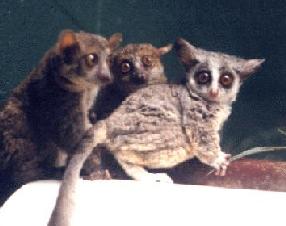
We next hit the small mammal house where river otters did their cute river otter thing, which is just a smidge less cute than the sea otter thing. Most of the monkeys, including the pygmy marmoset, were completely uninterested in being seen by us. The icky, horrible bats, in contrast, were all too happy to make their presence known (and I'm still having nightmares about the one that was loping across the ceiling while upside down). The wild kitty had just been given a treat ball and was being hilariously house-cat like. The bush baby remained cute, although he did not engage in any particularly spectacular locomotive feats this time around.

Our outdoor tour was rather brisk due both to the cold and the fact that we learned our lesson about sudden Wisconsin wind last time. The short list to the outdoors:

  • The peacock that was really really bummed about the closed snack bar and perpetually screamed about it.
  • Australia was a bust because it was under construction and being painted, which might explain the sacked out roos.
  • Giraffes look totally ridiculous indoors, but being that close, you can see them swallow, which is pretty freakin' cool. Also, their skulls are quite alien looking.
  • The wussy polar bears went back inside almost as soon as we showed up.
  • The black bears we saw look surprisingly like the hound, despite the fact that the hound is quite equine.
  • The "Farm" is generally pretty lame, but we did see:

    • A very twitchy bird of prey being trained and demanding food about every 5 seconds (reason for presence on farm unclear).
    • A cow that trotted in for its lunch when called.

  • The timber wolves that they have are just completely beautiful. They also very pointedly walked to the glass as we walked away, watching us for as long as they could see us with a look that clearly said "We don't want your kind 'round here, two legs."


After some lunch, we swung around the opposite side of the apes/primates to check out Macaque Island where the so-called "snow monkeys" were looking pretty miserable in the cold. Well, most were looking pretty miserable. There was one who was sitting with his legs splayed wide, his erect penis making a jaunty arch and resting on the rock between them like the proverbial third leg.

It was closing in on closing time by then, so we made one more swing through the primate house. This was quite fortunate, because we learned that the adult male orangutan "Tommy" (if that is his real name), suddenly seemed to be in possession of a bucket. We also got to witness all the bonobos going completely mental: They'd run into a deep, out of sight portion at the back of the habitat. For several minutes it would seem as if they had gone inside for the night, but moments later, they'd emerge, as if from a clown car, screaming. Over and over again they did this. Comical, yet mysterious, that's our bonobos.

Labels: , , , , ,

Friday, March 02, 2007

Happy Birthday, Annie: Darwin, His Daughter, and Evolution

Had she lived, Anne Elizabeth Darwin would have been 166 today.Ok, had she lived past childhood and then found her some sweet steam punk technology she would have been 166 today.


A couple years ago, my friend J was kind enough to buy me a copy of Darwin, His Daughter, and Human Evolution (sold in the UK under the title Annie's Box, and pointedly not sold under this title in the US for obvious reasons) as a thank you for guest lecturing in his class. For whatever reason, I had not picked it up before, but now I'm devouring it in chunks.

The author, Randal Keynes is Darwin's great-great grandson, and despite the title change for us maturity-challenged Merkins (heh heh, I said "Merkin!"), Annie's writing case (i.e., the box) is really the centerpiece of his story. The text is largely drawn from early 19th century writings, primarily those of the denizens of Down House, but radiating outward to create a rich social, economic, political, and philosophical context against which the extraordinary story of a very ordinary family is set.

As an avid consumer of Victorian literature, I've had more than my share of chuckles at the Heroine with the Mysterious Illness. (I mean, seriously what, exactly, is wrong with Laura in The Woman in White, other than the fact that she's not the highly superior Marion?) It's less funny when said heroine is the 9-year-old daughter, not just of the man that you personally regard as a hero, but of a doting, affectionate, playful father. Annie was simply "not well" for months. Except that sometimes, within the course of those months, she seemed well enough, as children do, when her cousins were visiting, when her brother was home from school, when there were adventures to be had.

Charles, of course, had his own chronic and mysterious illness, which eventually led him to take Dr. Gully's famous "water cure" at Malvern. Although Charles had experienced great relief from the treatments, probably because they involved the cessation of all the "legitimate" remedies—most chock full of heavy metal goodness—that he'd been taking, his turnoffs included mesmerism and clairvoyance, which Gully used routinely for diagnosis and treatment. They'd even sought out "bathing" treatments, the practical details of which were mind-bogglingly complex in the era of Vicorian sensibilities. However, when Annie's general absence of health devolved into a "bark," possibly indicating tuberculosis, Charles and Emma turned to hydropathy.

At first these were administered at Down where Charles used a qualitative scale to note Annie's general health and responses to the treatment. After a complicating bout of 'flu, Charles decided to take her to Malvern and Dr. Gully. Charles made the initial trip with, Annie, her sister Etty, the children's nurse, and the governess, then headed back Down-ward once the womenfolk were settled.

I'm not yet finished with the book, but I reached the chapter that culminates in Annie's death two nights ago (DUDE 5p01!3rz!). I wept copiously. Yes, I am ridiculous and, apparently, whether it's nonfiction or fiction I've read a zillion times before, I still hope that those crazy kids will somehow work it out. In stringing together some of the other events in the book, Keynes has little to go on: He infers a letter, a visit, a conversation from an abbreviated note in a personal diary, or he sifts through mundane materials that coincide with major goings-on and explores the incidental, everyday side of monumental events. But that brutal fact of it is, he has a lot to work with.

During what turned out to be Annie's final weeks, Emma was nearing the end of her confinement, as was the genteel phrase, with her seventh child. Given the social atmosphere, the medicalization of pregnancy, and have I mentioned it was her seventh child?, Charles traveled to Malvern alone when Annie's health took a turn for the worse. By the time he arrived, most of the Annie they had known had been gobbled up, physically and mentally, by fever and delirium. But Charles and Emma wrote to one another by every post. Each put off sealing letters until the last possible moment, eager to give and take the latest possible news. These are filled with hope for, despair of, and resignation to their daughter's fate as well as with affection, longing, and concern for one another. They are, 156 years on, a jagged distillation of a brutally intimate 24-hour news cycle. Keynes ends the chapter simply with a photo of Emma's diary page for April 23, which simply reads: 12 o'clock.

In the end, being able to do nothing for Annie, Charles and Emma did for one another and for their surviving children. Emma's sister-in-law, Fanny Wedgwood, had traveled to Malvern both to look after Charles on Emma's behalf and to reassure her sister-in-law, mother to mother, about Annie's condition. After Annie's death, Fanny urged Charles to leave the funeral arrangements to her and join Emma immediately. (I'm well on the "detached" end of the spectrum when it comes to rituals of death, but it still kills me to think of Charles choosing between attending his daughter's funeral and being with his wife and surviving children.)

This book is so much more than Annie's story or even the story of her relationship with Charles and Charles's relationship with her death. It's a book about what kind of men and women they were, these Darwins, as thinkers, writers, scientists, Christians, spouses, and parents. It's about the natural basis for moral behavior and ethical choices at a time when cruelty and injustice were propped up by supernatural rationalizations. It's about a world that is ripe for change, that must change, that is changing. (I don't want to digress or belabor here, but this is something that is very much on my mind at the moment, and I blabbed about it in the comments to this Pharyngula thread.)

Keynes has a light touch when it comes to personal relationships, letting surviving text speak for itself when possible and minimizing speculation. On the larger scale of interaction, he gives succinct, thorough introductions to the freethinkers, the dissenters, the writers, the scientists, and the clergy, both in the thick and at the fringes of the Darwins' lives. In broader perspective still, when the topic demands it, Keynes gives the reader a firm grounding in thought contemporary with the story.

When I cover the history of evolution in my classes, I always begin with my frank admiration for Darwin and his accomplishments. That said, I acknowledge that it was, in some sense, "time" for evolutionary theory in the mid-19th century and that Darwin, as insightful and methodical and brilliant as he was, could not have written The Origin of the Species without roughly 400 years worth of work by others. It's important not only to acknowledge the contributions that came before and to stress how much science is influenced by the social and cultural context in which it is practiced, but to underscore that Darwin is not the prophet of evolution. He's not the Messiah. He's not even the Great Man without whom we wouldn't have evolutionary theory. You can't make a (frankly very weird movie) about someone uncovering proof that Darwin never existed and expect much more than to rouse the fan!boy!girl!person in a metric assload of scientists to raise a collective "Dude! He was the man." (And you'd better believe that those bitches are going to be buying my steam punk novel, Darwin in America by the palletful.)


So every word I say in my typically digressive, caveat-laden lead up to evolutionary theory is perfectly true. But I always feel a right shit after I give that lecture. I always want to buy Charles a beer afterward and assure him that, you know, I really love and admire him, man. Keynes' book is that beer. It's a wonderful look at a great thinker and scientist living in volatile, dynamic times, who happens also to have been a very good man. And the movie based on it is officially on notice: Don't you go fucking it up.

Happy birthday, Annie.

Labels: , , , , , , ,

Thursday, February 22, 2007

I'm Stabby McSpear! Put Me in Your Tasty Bushbabies!

There's an exceptionally cool article in Current Biology's "Online Ahead of issue" section this week by Jill Preutz from Iowa State University and Paco Bertolani who seems to be a graduate student at Cambridge. In it, they report that chimpanzees in their study communities routinely make spears for use in hunting. It's a well-written article, and it's chock full of novel observations with far-reaching implications. The following is rated S for Stabby.

Primate tool use is taken somewhat for granted these days, but it's worth remembering that Jane Goodall's initial reports of termite fishing and wadge dipping at Gombe were met with considerable skepticism fewer than 50 years ago. And just when we'd gotten comfortable with our closest relatives modifying the environment through nonbiological means, there was the revelation in the mid-1990s that orangutans (the most distant of our Great Ape relatives) also made and used tools in the wild. Gorillas would join the party even later in late 2005. The bonobos, to date, remain on the outside looking in, possibly because their tools are sex-toy oriented and therefore not much good for opening doors.

So our thinking on tool use has come a long way just in the last few years. We've gone from thinking that a culture-ready brain (or at least a technology-ready one) evolved just 7 million years or so ago (before the human-Pan split) to accepting that, neurologically, the right stuff has been with the Hominoid lineage for more than twice as long. We've also realized that a number of different social structures, ranging from the semisolitary orangutan to the gregarious, constantly shifting community of the chimpanzee, can result in tool-using individuals. We've also had to give up overly simplistic notions about handedness and language going, as it were, hand-in-hand. Hell, just last week we had to give up any last-ditch hopes that chimpanzees might somehow have "caught" tool use from humans.

Even though chimpanzee tool use is, comparatively, a pair of comfy old cognitive pajamas, this research by Preutz and Bertolani introduces some pinholes here and there as well as a few things that might constitute a previously unrecognized pajamial butt flap. First off, the context of tool use is new and exciting: At Fongoli (the Senegalese study community), the chimps use tools for hunting, which has a couple of new and exciting implications.

A less radical, but still interesting, factor about the hunting context is the preferred prey of the Fongoli chimps. Elsewhere, chimpanzees tend to hunt young baboons, colobus monkeys of all ages, and things like antelope and bush pigs. At Fongoli, the environment is considerably drier than that of other chimps and these preferred prey are absent. The Fongoli chimps hunt bushbabies (a small, nocturnal prosimian primate) instead, using their spears to stab into the hollows where they shelter as they sleep the day away. Several characteristics of Fongoli hunting are probably related to this choice of prey.

First of all, the small size of the bushbaby, combined with its nocturnal activity patterns, mean that a lone chimp has a greater chance of success, whereas larger diurnal prey might be out of reach for the solitary hunter. An individual who successfully captures and kills a bushbaby thus has no social obligation to share the meat (elsewhere, hunted meat is virtually the only resource that is shared among adult chimps who parcel out the spoils to the hunters and to females who . . . ahem . . . have something to offer). The small size of the kill also probably contributes to the solo consumption. The "shooting fish in a barrel" (seriously, could you bring yourself to stab this in its sleep?) nature of bushbaby hunting also opens this economic niche to individuals who don't usually hunt, namely subadults and females.

The real kicker about the context of Fongoli tool use, though, is the fact that ape tool use in hunting is pretty much novel. Up until now, all food-related tool use by chimps has taken place in foraging contexts: They open nuts with stone or wood hammers; they make leaf sponges and dip for water; they dip stalks and twigs into ant or termite mounds and fish them out. Although "rousing" use of tools has been observed in isolated cases elsewhere, the Fongoli chimps employ tools in hunting frequently.

In addition to the quantitative shift from rare to routine, there's a qualitative difference: Whereas a chimp at Mahale picked up a nearby branch to rouse a squirrel from a hole, the Fongoli chimps are using spears to stab at the prey repeatedly. It is not yet clear whether or not the prey is killed (or even injured) with the spear, but there's a cognitively important difference between using a branch merely to extend the length of the arm and using a spear as a weapon. This isn't just appealing to those of us who enjoy a spot of violence now and again, it is very likely to improve the chimp's success by allowing him or her to invade the busbaby's nest and immobilize the prey in one swift movement. Rousing use of tools is just as likely to give the prey time to escape.

So tool use in an entirely new context is cool. New prey is conceptually cool for humans, albeit bad news for the endangered Senegalese bushbaby. Experimentation with hunting by chycks and youngsters also on the well-chilled end of the news spectrum. New data on chimpanzee cognitive evident in how they use their tools, approaching absolute zero.

But the real seat-busting potential of this research is in the manufacture of the tools themselves. Certainly there is something about the image of chimps running around with spears that tingles the Alan Moore sensors of the brain all on its own, but the data on the modification process certainly have more than just the "Stabby Chimps = Crazy Awesome" street value. Preutz and Bertolani characterize the manufacture of spears by the Fongoli chimps as "crafting," which doesn't sound like an earth shaking declaration. In anthropological circles, where even today we insist that the object in use be an "unattached environmental object" (this criterion was used for long time to deny the title of tool use to behaviors like "bridging" among male orangutans who bend saplings to travel from one larger trunk to the other), crafting has a flatbed of baggage with it.

The process that the chimps use to create their spears is both hierarchical and flexible. Certain steps must be taken early on, regardless of formal aspects of the material or any other factors, but once the base modifications are complete, the chimps can and do alter their techniques on the fly. That speaks volumes about their ability to generalize, which we consider to be an especially important facet of human intelligence. Another aspect of the manufacture that is especially intriguing is the fact that the chimps are sharpening the end of the tool using their teeth.

Again, this is a qualitative shift in a behavior that is seen in other contexts. In termite and ant dipping, as well as in nut-meat extraction (shut up JRH, a chimp will often use teeth to break off the tool after it is chosen and to strip it of leaves. However, in those contexts, the tool cannot fit into the space without the modification. At Fongoli, the sharpening behavior is not simply to make the tool fit, it is part and parcel of how the chimp wishes to use the tool. My favorite sentence in the entire article: "Chimpanzees forcibly ‘‘jabbed’’ (sensu Marlowe [16])." As I said earlier to M and J, it is now my goal to see in print "[Organism foo] comprehensively dismembered (sensu Matilda) that punkass po po bitch."

In terms of the bigger picture, the context of Fongoli tool use has real potential to shift our view of the early hominid resource base. As much as we have always loved a "Man the Hunter" model for our own evolution, most of the evidence suggests that hunting and tool use have fuck all to do with our first divergence from the Pan lineage. The earliest hominids do not have the teeth of a habitual meat eater, in terms of either architecture or wear; the earliest tools are persistently linked to scavenging/foraging behaviors (extracting marrow from the sloppy seconds of large carnivores and/or extracting insects from bark and mounds); and there's not a lot of clear evidence linking the earliest bipeds to any kind of tools at all.

The Fongoli chimps represent routine and systematic attempts at hunting with tools that are nondurable. Although there is the potential to do archaeological research into how long this behavior has been in their repertoire, ancient hominid behaviors of this type will be archaeologically invisible (at least until we shift our framework for recovering and recognizing tool-using behaviors) because of the much greater time elapsed. Thus, although it remains pretty incontrovertible that hunting and meat eating were not an appreciable trick up the hominid sleeve (not that we had sleeves until much later) until the emergence of Homo erectus about 2 million years ago, it is possible that hominids began experimenting with tool-assisted hunting as well as foraging at a much earlier date.

Off the top of my oversized head, I think that conceptual nugget has the potential to shed light on how the frilly heck we made it out of Africa in such a hurry, as the evidence from Dmanisi and tool finds in China suggest (both emphasize mastery of hunting as a key factor). I also wonder if there are dental implications for the chimps that would shed light on the weird dental problems that plagued the Neanderthals. To be sure, the Neanderthals had a wide variety of stone tools they could have used for sharpening, but it's also been suggested that a cognitive barrier prevented them from envisioning the snazzy, hafted, multicomponent tools that those rockstar modern humans favored.

Labels: , , ,