Telecommuniculturey

High- and low-brow cultural goings-on in the Second City, brought to you by a roving microtechnoanthropologist

My Photo
Name:
Location: Chicago, Illinois, United States

This is fiber optic cable, which is the future. This is culture, which is delicious.

Thursday, August 11, 2011

Re-Seduced: Minnesota Fringe Festival, Day 2.

On Sunday, we once again rearranged dinner plans slightly to accommodate our theatre schedule. Also, Saturday was just a leeettle overindulgent on the food and booze front, so a later dinner was not a bad idea.

First up, Steampunk! Anyone who knows anything about me knows that a show called Robot Lincoln: The Revengeance (The Musical) is like crack tailored to my specific nerd receptors, so that was our first show on Saturday, back at the Thrust (STOLL!) stage at the Rarig Center. (See previous entry for bitching about the building, but liking the actual space.) As we waited in the traditional second of 2 lines, I tweeted gleefully about the warning sign outside the theatre (guns, strobe lights, adult language, and violence), and broke the rules about no photography (only realized that I was breaking a rule in retrospect; also I'm not sure taking a picture of my program counts as rule breaking, even though I was in the theatre) to capture the Best. Dramatis. Personae. Evar.


Sadly, the show itself was pretty disappointing. The "plot" was convoluted and there wasn't much in the way of fun dialogue. The performers were singing to taped music, which led to a lot of problems. (I feel like an utter shit mentioning that—my homeless, underfunded theatre group had to do the same with a production of Mother Courage and Her Children, and it was a nightmare.) On the plus side, the group seems to have paid a lot of attention to the design, and that paid off. Robot Lincoln's costume was terrific, and there were a number of other great visual touches.

The "love duet" between Booth and Robot Lincoln was everything I think the show could have been with more time and stability for the production. Jason Garton was terrific as Booth, and Libby Slater was hilarious as Mary Todd Lincoln (less so as "Uncle Samantha," but that character was a very sketchy).

From the Rarig Center we were off to the Gremlin Theatre in St. Paul for The Duties and Responsibilities of Being a Sidekick by The Barkada Theatre Project. Other than being a sucker for superhero stuff, we hadn't chosen this show for any particular reason, but I'm so glad we did. The show was really well written (an interesting, compact story—no mean feat with a maximum of 60 minutes), had great fight choreography, and the cast (featuring Randy Reyes, whom we'd loved in Brain Fighters on Saturday) was just great from top to bottom. Also, great pre-show and entr'acte music, even if they DID cut us off on the theme from The Greatest American Hero just when we were taking it to the bridge.

From the Gremlin back to Theatre Garage for Those Were the Days by Blue Umbrella Productions. TV themes arranged swing-choir style with a minimal, but well-done framing story? Yes please! Really great arrangements, great ensemble and solo work from the whole cast (I forgive the mishap with the Jem theme, though it is dear to my heart), fun choreography. I'm not sure I would have done the whole Eight is Enough theme, but it's not my show, now is it? Shutting up, sir.

And finally, back to the Thrust at the Rarig Center for The Smothers Brothers Grimm., by Comedy Suitcase. This was the show we'd rearranged our dinner plans for. It had some great highlights, especially the closing "silent film," but the whole show was uneven.

The framing premise involves Milton, a young boy (wonderful work by Andrew Moy) who has recently lost his comedy-obsessed grandfather, and whose parents are convinced that he is not dealing with the loss. The parents try to get him to sleep by telling fairy tales, but Milton insists on "punching them up like grandpa would." We get Hansel & Gretel as told by Laurel & Hardy. Our group was divided on this. I mostly liked it, but felt it went on a bit long (then again, it's Laurel & Hardy . . .). Next was Rapunzel a la I Love Lucy, which just felt awkward and as if there weren't a lot of there there. Bob Newhart responding to the 911 call from the Three Bears, suffered from not enough Bob Newharty goodness. Some of the interstitial stuff with the parents and lovable drunk uncle were really good, and some fell a bit flat. The epic silent Sleeping Beauty segment was epic.

I was hit really hard by the realization that my fun at Fringe was over. I'm still trying to talk myself off the ledge of crazy renewal of my involvement in theatre.


Labels: , , , , ,

Monday, August 08, 2011

Re-Seduced: Minnesota Fringe Festival, Day 1

So, I used to do theatre, right? And then, quite a while ago, I broke up with it. Mostly. I mean, sure, I have been doing reviews, but that's safe, right? I mean, it's not like I'd go crazy and see 7 plays in two days and then desperately miss doing theatre, right? RIGHT?

Insert insane cackle here.

So I went to Minneapolis for my bunny-faced friend's birthday, and this just so happens to coincide with the first weekend of the Minnesota Fringe Festival: 168 plays, each no more than 1 hour long, running in rotation at 18 different venues. Um . . . ok, when I write that out, I don't sound like someone committed to recovery and breaking with my codependent ways . . .

BUT NEVER YOU MIND THAT.

We were set up with a 10-show pass and 3 buttons initially, and on Saturday, we were headed to Intermedia Arts for I'm Making This Up as I Go on Saturday afternoon. It was not the most auspicious beginning. The crowd was small and the sets were . . . of uneven quality . . . however, the last comedian, Mike Lester, was bizarre and quite funny.

Next, we were off to the Minneapolis Theatre Garage for Vampire Lesbians of Sodom by Brazen Theatre. I'm pretty sure I saw this show in Chicago more than a dozen years ago, but couldn't remember much about it. Having refreshed my memory, that's not surprising—it's a funny concept with a lot of potential, but the show itself is a bit ho-hum. As for the production: Its wigs were truly magnificent and Mark Hooker/Margo Caprice was fantastic as one of the titular sinners. In fact, he was so fantastic, I nearly failed to suppress my fan-girl-itude when we saw him 112 Eatery later that night. (Fear not, my pathological introversion raced to the rescue once again, and he and his companion were left in peace.)

The highlight of Saturday was definitely Brain Fighters by Joking Envelope on the Thrust stage (aka STOLL!) at the Rarig Center on the U of M's campus. As you can see from the linked photo, this building was forged in the bowels of architectural hell.

When we arrived, there was a line out the door for securing tickets (the system for multi-show pass holders was to hand over the pass for the appropriate number of punches in exchange for tickets), and then we had to trudge through the belly of the beast to wait in a second line into the theater. With no real sense of how big the venue was, we were worried—so worried that we did not get ice cream from the ice cream truck, despite my having loudly yelled "ICE CREAM TRUCK!" upon seeing it. I had tweeted a couple of pictures of the lines and made public my fear of missing the show, but the lovely Sara Stevenson Scrimshaw responded to say that we should not fear, as the theater was large.

And it was! Despite the building being ugly and having nothing resembling a plan for flow of actual people, the space was great and the show was greater. It's a three-person, all-ages show written by Joseph Scrimshaw, whom you may remember from such awesome cruises as JoCoCruise Crazy. (Can someone please tell me why Joseph Scrimshaw is not superextradoublefudgey famous?)

The script was funny and wonderfully paced. The three actors (JS himself, Randy Reyes [whom we'd have the pleasure of seeing in another great show on Sunday], and Mo Perry) worked flawlessly together and nailed the physical requirements of the story (ok, that sounds weird unless you know the plot, which involves being able to turn yourself into anything you can convincingly imagine). Oh, just go see it if you possibly can.

We'd initially had a dinner reservation that would have conflicted with Brain Fighters, but we rearranged our schedule to support our local Sea Monkey. This left us with a 9:30 reservation at the aforementioned 112 Eatery (and I would like to note once again that I DID NOT fangirl all over anyone there) and time to kill in between. We'd intended to go to Moto-I on Friday night, but we were seduced by champagne cocktails, chocolate chip cookies, yoga pants, and Ike, who thinks he is a lap dog.


The downtime between theater and dinner on Saturday gave us, as a group, time for sake and snacks at Moto-I, and me, as an individual, time to contemplate breaking and entering so that I could pet Casper the Great Pyrenees, who IS SO FLUFFY! Really enjoyed the sake flight at Moto-I (Junmai Nama Genshu was the best!), and the many yummy snacks we had that are lost to the mists of the sake flight and the Ginger Mistress.

Fear not, puppy lovers, I did eventually get to cuddle Casper (who, as previously mentioned, IS SO FLUFFY!), however briefly, before we headed to 112.
A word about 112 itself before getting to the good parts: Loud loud loud loud loud. LOUD. I wish that it weren't so loud.
We shared a bottle of a Turley Old Vines Zinfandel and continued our communist ways all through the meal. We had truly amazing scallops with oyster mushrooms, frog legs that are very nearly as good as those at Brigtsen's (I do not say this lightly), the 112 steak tartare (which kind of buried the lede, if one assumes the steak is the lede—it was weirdly chicken salad–like, and we wished we'd gotten it "unprepared"), and fried Shishito peppers (we liked Moto-I's version better). For our mains, we shared the prociutto ahi tuna (amazing), the stringozzi w/ lamb sugo (amazing fresh pasta, but the lamb didn't shine through), and the nori encrusted sirloin w/ ponzu (good . . . not great, though).

For dessert, the butterscotch budino (I don't like butterscotch at all, but this was relatively tasty), the lemon cheesecake, and . . . this is not good: I cannot for the life of me remember what I had. It was good. It was probably chocolate based. it is not on the menu they have up online. Olive oil chocolate cake! (Thank you, bunny-faced one!)

Ok, this is already a bit long, so I'll do Day 2 later on.

Labels: , , , ,

Saturday, May 07, 2011

Monsters, Boobies, and OCD: Danny Boyle's Frankenstein at the National Theatre

Sadly, we are not in the UK, but we did just return from The Music Box Theatre where we saw the last show they're broadcasting there. The title is the ZK's review.


This has been getting rave reviews, lines around the block for day-of tickets, and so on. In many ways, the production deserves that and more. I liked it, but did not love it.

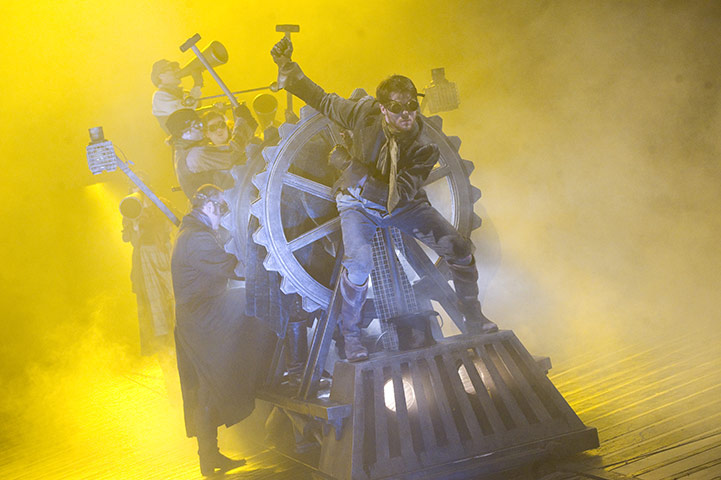
Every element of the design and staging is incredible. The stage is round with a central revolve, and overhead, there's a fixture comprising hundreds of lightbulbs. They're gathered in bunches, hung at different lengths, and it's at once oozing and organic and cold and artificial, evoking forges, power plants, and circuses. To represent the creature's first stumble into a town, there's this gliding platform topped with huge gears that rotate. Extras hang from the front and sides, jerking, slamming, writhing, and do-si-do-ing to something too clanging and brittle to be music, too patterned and hypnotic not to be. It's like Steampunk and German Expressionism had a Marxist-informed Baby.

The blind scholar's hut is represented by four scrimmed walls with a few natural elements stenciled on them; the Frankenstein home is all stiff, stuffy windows and shadow, but it churns up from beneath the stage and sits at a subtle angle. Victor's hut in Scotland has an appropriately claustrophobic, subterranean feel.

The monster is scarred, sutured, scabby, and oozing. The development of his movement, command of language, and command of . . . consciousness and self-awareness . . . are all stunning. The production we saw had Jonny Lee Miller as the Creature and Benedict Cumberbatch as Victor (the two leads swap roles each night). Both occupied their roles in a way that signals and excellent director and a creative process that's hard to achieve where actor and character are constantly growing and stretching. Really fantastic.

Oh, look! It's my "but" face. Charitably, Nick Dear's script is uneven, which is not to say that there aren't brilliant parts of it where Mary Shelley's text is illuminated, enlarged, and brought to life by the adaptation. But then there are parts that are just . . . clunky as shit: Felix and Agatha (the blind scholar's son and daughter-in-law) have awkward Tolstovian orgasms about having cleared all the rocks from their field; the Scots resurrectionists have painfully stilted attempts at Shakespearian comic relief; and Elizabeth lectures Victor on the God-given, societally approved power of her uterus. No, really.

Elizabeth, in general, is a nightmare. Boyle casts all the Frankensteins, save Victor, as actors of color for no reason that is particularly apparent (which is not at all to say that I think the actors ought to have been all white in some misguided attempt at authenticity, but Victor's whiteness becomes pointed). George Harris was simply not very good as Victor's father, although I wonder if his wooden delivery was directed that way, so that we remain entirely within the mind of Victor/The Creature.

Naomie Harris's portrayal of Elizabeth is almost beside the point as a performance. Her character is the victim of the worst of the script and a choice that came within a hair of ruining the whole shebang for me. As through the vast majority of the play, the action stays with the Creature, who springs from Elizabeth's bridal bed and has a conversation with her that, at times, almost salvages an otherwise dreadful scene. Then, unlike the book in which Victor hears a scream and comes across Elizabeth's lifeless body, Dear/Boyle have Victor burst into the room, revolver drawn (if you will) only to flail around on the floor for no apparent reason while the creature rapes Elizabeth, achieves orgasm, snaps her neck, and declares, "Now I am a man."

W.
T.
F?

Extra special bonus points not just for going to the "Women Exist For Men to Use in Their Attempts to Exert Power Over Other Men" Well, but going the extra mile and making the woman non-White. Seriously, just what the fuck?

But other than that, Mrs. Lincoln, it really, truly is a magnificent creative endeavor beautifully brought to life. But I'd consider nipping out for popcorn at strategic moments.

Labels: , , , , , , , , , , , , ,

Tuesday, December 22, 2009

Review: Marriott Theatre's My Fair Lady

My review for EDGE Chicago.

Labels: , , ,

Monday, November 23, 2009

Review: Silent Theatre Company's Carnival Nocturne

My review for EDGE Chicago.

Labels: , , ,

Tuesday, November 10, 2009

Review: Young Frankenstein at the Cadillac Palace Theatre

My review for EDGE Chicago

Labels: , , , , ,

Thursday, November 05, 2009

Review: The Walworth Farce, Druid at Chicago Shakespeare Theater's World Theater Series

My review for EDGE Chicago. Great stuff, despite the interference of the Navy Pier fireworks show.

Labels: , , ,

Monday, October 26, 2009

Review: Rosencrantz & Guildenstern Are Dead at Writer's Theatre

My review for EDGE Chicago.

Labels: , , ,

Tuesday, October 20, 2009

Review: Ma Rainey's Black Bottom at Court Theatre

My review for EDGE Chicago. Terrific production.

Labels: , , , , , ,

Tuesday, October 06, 2009

Review: Richard III at Chicago Shakespeare Theater

My review for EDGE Chicago is here.

Labels: , ,

Friday, September 25, 2009

Review: Man of La Mancha At Ridgewood Arts' Theater at the Center.

My review for EDGE Chicago.

Labels: , , , ,

Saturday, July 25, 2009

Review: Collaboraction & Teatro Vista's El Grito del Bronx at the Goodman

My review for Edge Chicago. I highly recommend this one.

Labels: , ,

Wednesday, July 22, 2009

Review: Hubris Productions' Bent at the Greenhouse Theater

Once again, my review for EDGE Chicago.

Labels: ,

Tuesday, July 21, 2009

Review: Footloose at Theater at the Center, Munster, IN

My Review for EDGE Chicago.

Labels: , ,

Wednesday, June 10, 2009

Review: Once On This Island at Porchlight Theatre

For EDGE Chicago

Labels: , , , , , ,

Monday, November 17, 2008

Radio . . . off? High Tea @ 103 and Radio Macbeth @ Court Theater

I recently inherited a very fancy Franklin Covey day planner from my sinister sweetie, who ditched the big 3-ring arrangement in favor of the spiral bound incarnation. Since I've begun to use it, I've double booked myself at least 3 times. And yet my gänger has remained stubbornly undöppeled.

The worst part of my double booking yesterday morning was the fact that I didn't feel like going anywhere at all. I recently incurred the rage of the karmic keepers of migraines by telling my doctor (at my long-overdue annual visit) that I hadn't had one in a long while. She didn't rewrite me a prescription for my medication, and thus I have had at least 2 since then, one of them yesterday.

Despite feeling pretty awful, and despite the fact that I should have been attending my song-writing class, I was determined to attend the high tea at Cafe 103, which had been arranged by the superexcellent owner of my beloved, doggie-friendly local yarn shop, My Sister's Knits.

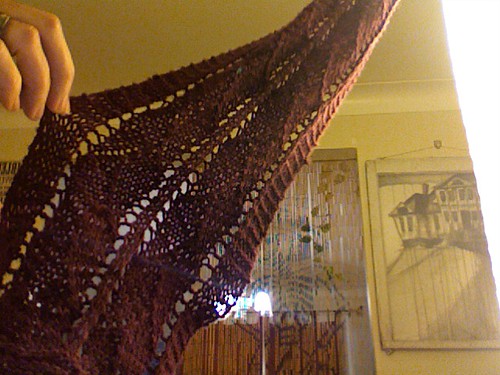
As I was pondering my wardrobe for such an occasion on Twitter (I suppose it is possible to clothe oneself without recourse to cannabis [so far removed from Texas THC am I that it took me 4 tries to spell that correctly], government hand outs, and Twitter, but I don't recommend it), pointed out that high tea was definitely a hat-wearing occasion. I located the MPage Memorial Hat and finished it off with a skirt, tights (which definitely squish), my insaneoid (but oh-so-cute and oh-so-conveniently-mammoth-calf-fitting) boots, a black top, and my newly blocked dragon-scales scarf, and dived into my trusty Corolla with about 5 minutes to get me to the tea on time.

Foolishly considering the Bears' interception of the ball deep in their own territory to be some kind of good omen, I headed in and slotted myself into the Matilda axis. (The Cafe can seat 30, 3 of us were named Matilda, and we happened to be sitting next to one another.) My hat was widely complimented until someone turned up in a tiara. (Let the record show that I, of course, HAVE a tiara, but I had not gotten the memo that this was a tiara-wearing occasion.)

The tea was lovely. We started with a basket of miniature scones and various breads and cakes (lemon-poppyseed, pound cake, etc.) served with jams, lemon curd, and so on. Next up were mimosas (Carol providing the champagne) and the first course of finger sandwiches, which included open-faced cucumber-dill on rye, turkey with an apple-cranberry chutney on a whole-grain pita, and something else my sleep-deprived brain cannot recall at the moment. The second course of sandwiches included spinach-walnut minitarts in phyllo, classic egg salad on white roles, and chicken salad with smoked grapes and walnuts on a croissant. I was a huge fan of everything, despite the fact that both the chutney and the chicken salad are things I normally would have shied away from trying.

There were various door prizes from the shop. Winning seemed to be a function of proximity to her majesty with the tiara (although the last person picked her own name out!). In addition to the prizes Carol had arranged, the owner of Cafe 103 (who, as usual, had on perfectly beautiful jewelry) announced that everyone should check the bottom of her saucer, because one person at each table would find a sticker indicating that she had won the centerpiece, which was a lovely antique cup and saucer filled with unique and gorgeous arrangements from the Blossom Boys, the super-excellent florist's shop (and more) just 2 doors down from MSK.

Before we could to anywhere, there was, of course dessert. First up, both by choice and necessity, was ethereally delicious orange mousse served in a chocolate tulip cup: One million times better than the average dreamsicle in part because of the spot-on evocation of all aspects of the dreamsicle experience. Next I tried the caramel-apple square, which was a little over-cinnamony for my tastes (almost any cinnamon at all has this effect on me, though, so take that in context). The chocolate walnut brownie was a marvel of brownieosity: Chocolatey, rich, and wonderful without being at all overly sugary. I kept telling myself that it was so rich I could only eat a tiny portion, and yet the whole thing disappeared. The final dessert had (presumably in error) described to us as something strawberry based. It was, in fact, a kind of chocolate cream cheese brownie. The slightly sour topping was in perfect balance with the chocolatey goodness underneath. Oh, there was a lemon bar in there, too, and I am a failure because I did not try it.

They owners opened the Beverly pantry to us as well, and I did lumber over there briefly. (My crazy!boots proved to be particularly ill suited to conveying my post-tea bulk around a shop filled with fragile and expensive things.) Many of us headed back to Carol's shop, which she was opening to us for an hour after the tea. Of course in our eagerness to get some food-coma-combatting fresh air, we arrived at the shop well ahead of her. I had parked in front of the Blossom Boys shop and noticed that they had a picture of Barack and Michelle Obama on their door (a specific picture of the two of them going to or coming from the kids' parent-teacher conference right after the election), and I stopped to examine it. (Turns out that the lovely arrangement that Michelle is holding in the picture is one of theirs.)

In my food-induced haze, I failed to note that there was someone inside the shop, even though it was close. Naturally, my mug pressed to the screen door was sufficiently alarming that he came to see what was up. He immediately recognized our gaggle as having been at the tea and invited us to come in until Carol arrived to open her shop. I narrowly escaped buying a number of pieces of jewelry and some other things. I did not escape buying yarn, however.

In the car on the way home, I discovered the awful truth about the Bears game. We have no wish to discuss it.

In the evening, we were scheduled to have dinner chez Editrix, as she was eager to cook dinner in her new and improved kitchen, and thence repair to the theatre to see Radio Macbeth. We were of the impression that RM was not, you know, The Scottish Play, given the different title and all. In fact, we were under the impression that it was a play about a group doing a radio version of TSP, which would be interesting. Sadly, it is not. Not about a group doing a radio version of TSP and, really, not interesting.

It's important to note that the performance was by a group called SITI. Although this seems once to have stood for Saratoga International Theater Institute, it seems now to be SITI forevermore. SITI is dedicated to training actors in a combination of the Suzuki Method of Actor Training (which, apparently, has no relationship to the Suzuki Method of Musical Instrument training, although I think a foot-based approach to musical instruments will soon be sweeping the globe) and the Viewpoints method .

It is further important to note that Kate Bredeson, the dramaturg for RM says:

In the world of SIT, the Scottish play is a 1940s radio drama in rehearsal . . . the company tells the story of the play through the ebbs and flows of sound. As in the most masterful classic radio dramas, the focus on sound in lieu of sight creates a world in which chatter is heightened and screams are more devastating — a world where silence creeps and menaces. In this stylish take on Shakespeare's tragedy, SITI gives us a full, albeit subdued visual terrain as well. The resulting crash of sight, sound, and a classic, iconic text is pure SITI: grounded, full, stylish, smart, raw."

Um. Sure.

There's almost no set for the show. Which is fine. The black cinderblock wall is exposed from floor to ceiling, except where a single, paint-splattered white drape descends from the ceiling to puddle on the floor up left. An upright piano is against the back wall up right. Other than that, at the top of the play, a small table is down left with two folding chairs in front of a microphone upstage between it and the aforementioned drape. A long boardroom table is set diagonally, running from down right to up center, and a handful of mismatched folding chairs are around it.

As the audience filtered in, a lone individual was visible slumped in a folding chair at about center stage. As a crowd of people was heard off stage left, he jumped up and ran off stage as the lights went completely down.

Four people seemed to enter in the dark with only a lighter's flame to guide them. As the lights came back up, two women were revealed. One was a young Japanese woman in black plastic-framed glasses and a convincing 40s-era skirt suit, another was a young woman in high-waisted, wide-legged trousers and a blouse and scarf. The former bustled around helpfully, the latter sat at the small table, seeming to concentrated on spiral-bound script. Also on stage from the moment the lights came up was a small, dark man in an argyle sweater.

Shortly, a man (apparently the one with the lighter) entered from the right-hand wings, presumably having been responsible for getting the lights working. He wore a cap and flannel shirt and had a pencil tucked behind his ear. This group was soon followed by a man and woman, also entering from the right, who were altogether more flashily dressed. The man had a pin-striped suit, the woman a red wrap dress, very 40s hat, and a fur coat.

Probably close to 5 minutes elapsed during which the Japanese woman continued to bustle, the woman in the red dress stalked about giving people the hairy eyeball, the woman in the trousers continued to focus on her script, and the men seemed to wander around whispering to one another and making "whaddaya gonna do?" gestures at one another.

It did seem as though relationships among these people were being subtly established during this time. For example, it seemed to me that Trouser!Woman and Red!Dress Woman were being contrasted: T!W was clearly a METHOD! actor, whereas R!D was a soap opera diva type who relied on histrionics. The Japanese woman was a Girl Friday type intent on convincing everyone of her indispensibility. There wasn't much to go on with the men other than perhaps a class difference between the two men who had entered first and the man who entered later with R!D.

With little obvious impetus, W!T launched into "When shall we three meet again?" reading all parts with very little differentiation between them. She moved more into characterization as Macbeth (the richly dressed man in the pin-striped suit) and Banquo (the guy in the newsie cap) entered the scene. From there it seemed as though the players were established: Pinstripe = Macbeth; R!d = Lady Macbeth; W!T = witches (and later the Porter, Lady Macduff, and Lady Macbeth's maid); Newsie guy = Banquo, Malcolm, and a handful of other characters; Argyle guy = miscellaneous characters; Japanese skirt-suited woman (who turned out to have a very heavy Japanese accent) = Various characters.

EXCEPT!

Right around Act I, scene iv, when we see Duncan for the first time, the pinstripe guy started to read the part, pulling out one cheek and doing a very distinct voice for him.

AND THEN!

When Macbeth is next set to speak, the guy who was on stage before the lights when down appears at the top of the house left audience, starts to say Macbeth's lines over pinstripe guy, and does some directors' notes type dialogue about what the play is about.

So, thought I, we are finally, after four scenes, getting into what this play is about! Sort of a leisurely pace for self assertion, but now we're cooking.

Yeah, not really. The second guy just read Macbeth for the rest of the play, while pinstripe guy moved into playing Duncan and then Macduff, and no attention was ever paid again to this godforsaken mid-performance improv freeze tag. In fact, there seemed to be no further acknowledgment of any other identity for or interactions among these players. They just . . . did an abridged staged reading of the play. And lo! We were mightily confused in an apathetic way.

Certainly, they used those mics to good effects sometimes! There were person-created storms. To be sure, there were a handful of radio foley techniques—slapping the big table with a piece of 2 x 4 to simulate the knocking at the gate before Duncan's murder is discovered, for example. Yes, there were some coffee moments among the players, but they seemed reducible to nothing more than a minimalist way to stage the various banquets. But other than that it was just sort of Speed!Macbeth. Why the 40s? Doesn't matter. Why the markedly different styles of dress? Who knows? WHY GOD WHY DO WE HAVE 2 MACBETHS? This question is as elusive as the truth about the number of licks it takes to get to the center of a Tootsie Pop.

The performances weren't bad. In fact, I thought Barney O'Hanlon (newsie cap guy) was quite good in particular, and once I realized that nothing interesting in the way of interpretation was going to happen, I clung to hope that I'd at least get to see some of his Macbeth. The Editrix did forcefully question whether Elizabethan English is really the best medium for a non-native speaker with a very heavy accent. M and I were divided on whether Akiko Aizawa's accent was real or part of her character-not-really-within-a-character. (I gave up on this idea toward the end, but the ZK still thought he'd heard her making some accentless witch contributions.)

In terms of the text presented . . . I'm not sure why one would include the bulk of the extended witches scene that most agree was not written by Shakespeare and not performed by the company in his lifetime, especially if one is going to cut "Tomorrow and tomorrow and tomorrow" down to about five lines, delivered in painfully flat style that cashes in on none of the possible readings of that speech.

Don't get me wrong, I'm not at all a Bard purist, but the shaved down play, as presented, did little to make me think. The additions, which included random stage directions (more frequent toward the end), the aforementioned replacement!Macbeth entrance music and pyrotechnics, and W!T ending the Macduff/Macbeth confrontation with a whimper as she yelled "Enough!" (This last was particularly snicker-inducing for M and me, as the two men were facing one another with folding chairs raised in menacing fashion. Been there, done that, bought the Luchador mask.)

RM would probably have been disappointing to us on the grounds that it was not at all what we thought it would be, and I think that SITI bears some responsibility for creating those expectations and not delivering. Observe:

“A great ghost story is best heard in the dark or by the shadows of flickering candle light. Darkness plays tricks on the mind and the ear; the smallest rattle will make our imagination churn. Macbeth—in my mind the ultimate ghost story.”
–Co-Director Darron L. West


But despite being doomed to disappoint, it needn't have . . . bored . . . to the extent that it did. Perhaps if we'd arrived a little earlier (we were enjoying QUITE TASTY chicken with potatoes and kale chez editrix until sauntering theatre-ward quite late), the boredom would have been prophesied in this from the OTHER director:

In the heat of the shared theatrical experience, an audience becomes its own society. You are here with a roomful of other people. Can you handle that? We are a community of people dealing with one another and challenging one another. The theater is about social systems and how individuals in communities function in concert. Can the planet be shared or does it just belong to me?


Why I do believe those are the second worst director's notes I ever did see. I'd have said they were the worst, but I presume that they are directed toward agoraphobic virgin theater-goers from Mars, rather than, you know, normal people like us.

Labels: , , , , , ,

Monday, March 10, 2008

Le manchot est mort, Vive le manchot: Eugene Onegin at Lyric Opera

It doesn't feel right to begin this entry without acknowledging the fact that my beloved Bad Badtz Maru evening bag began shuffling off its evil spheniscid coil. The side of the bag is pulling away from the gilded clasp frame, no doubt because I insisted on trying to fit both my iPod and moleskine in it at the same time. But fear not! Months ago, I was seized with fear about Badtz's inevitable demise (although I hoped that sad end was far in the future), and I purchased a back-up Badtz on eBay. I'm still going to see if i can repair this one, but a successor lurks in the wings.

But onward, eventually, to Russia.

I still have in the hopper a review of La Traviata that gives Fleming's considerable assets their due, and my determination to put my adoration of Dr. Atomic into words was recently renewed by a conversation with one of my OTSFM co-volunteers. I'm not going to dwell on the fact that I do not have a review of Falstaff on deck, thanks to the family medical drama that ate New York. But for now, I'll write while the iron is hot. Or something.

In contrast to the 1984-like unified party line of Giulio Cesare, the Pompous Program for Eugene Onegin contains a multiplicity of viewpoints entirely appropriate to a not!opera representing a problematic adaptation of Pushkin.

My bias is showing in that paragraph. The fact of the matter is, the blurbs from the design team are every bit as party-line tinged as those in the PP for Cesare, I just happen to love this design team (originally headed by designer Robert Carsen (he of the austerely luscious Orfeo ed Euridice and the world's most noteworthy grey walls in Dialogues des Carmélites), and here directed in revival by Paula Suozzi).

Although the source material Eugene Onegin is only a novella to begin with, it is written in verse by the Jolly Inviolable Russian Giant, Pushkin. Guest Pompous Essayist David Shengold, tells us that Tchaikovsky was not only reviled by contemporary and subsequent authorities on Russian literature, but Ivan himself also had quite the crisis of conscience about the libretto (which he coadapted with Konstantin Shilovsky) and the decision to stage it as "lyric scenes," thus freeing himself from some of the conventions and expectations of opera. (For more on this, see the this review at The Glittering Eye.)

But whatever qualms Tchaikovsky might have had, he ultimately took a whizz on the novella and the Aristotelian unities and produced scenes depicting just three points in time for Onegin. But this production team gathers up the urine-soaked brilliance (one hopes, for the sake of sanitation, that Tchaikovsky's bodily fluids have vodka as a significant component) and runs with it. In their unified vision, Onegin is not just the central figure: The story comprises his memories of Tatyana and his own formative events surrounding her.

As with the other productions from this team (Carsen's design was, once again, executed in sets and costumes by Michael Levine and lighting by Christine Binder [Who was not, apparently, on the job in Orfeo, but was for La Bohème and La Traviata {forthcoming}.]), their vision is realized in lovely fashion and constitutes a thought-provoking (if problematic) reading of the story.

Act I begins in Onegin's metaphorical autumn. He appears exactly in the center of the stage, which is covered in leaves. Only the small, tight circle surrounding the chair in which he sits is swept clear, creating a cold, bare space amid a gorgeous tumult of reds, browns, oranges, and golds. The lighting is such that the scrim's presence is obvious, giving a slightly grey cast to everything. In the last few bars of the opening music, Onegin stands and raises his hand imploringly to the sky as a scatter of leaves waft down and grace his shoulders. (A note: Michael Levine says "Onegin drops Tatyana's letter and the leaves fall." I missed any letter dropping, and since he pointedly hands her letter back to her at the end of Act I, that represents a failed saving throw vs. continuity. My version WINS!)

The stage greys out (the backlighting of the scrim is cut off) exactly as the music ends. It's an effective and affecting way to take the audience from Onegin's present into his past, although I'm not sure agree entirely with Carsen in how he sees it as functioning:
"Memory is selective and impressionistic. We start and end each scene seemingly with nothing onstage, because that's what your mind does when you go from one memory to another – what you're remembering is an emotional response."

To me, the fades to grey evoked film and television, a technological gimmick, rather than anything organic, but my disconnect with Carsen on that point bridged what could have become considerable gaps between the production's approach and the text as created by Pushkin and adapted by Tchaikovsky and Shilovsky.

To create the literal autumn in which Onegin and Tatyana meet, and the events of Onegin's tragedy are set in motion, half a dozen bare, grey trunks, branchless are lowered downstage, flush up against the proscenium arch, and the leaves cover the entire stage. Olga and Tatyana's singing is offstage while Madame Larina and Filipyevna are seated at a wooden table downstage right, listening as they jointly prepare food for the meal to come.

Their table is framed by two widely spaced trunks, whereas the rest of the trunks are set much closer together at stage left. The unequal spacing creates spaces appropriate to Olga and Lensky's open, sanctioned courting, as well as to Tatyana's bookish detachment from the harvest festivities and her walk with Onegin.

The more closely spaced trunks also create the impression of time passing at uneven rates. (Again, I'm not sure that the design team intended it that way, but to me, it evoked frames of a film, flicking by faster and faster.) For me, this was a subtle reminder of Onegin's role as narrator (or generator, in memory) of the story. In his memory—or in the narrative he's telling himself—he has to reconcile rejection of Tatyana by the Onegin of youth with the longing for her and all she represents by Onegin in his later life.

Even considering that this is an opera, Tatyana's headlong rush from shy, romantic wallflower to bold writer of impassioned love letters in the space of an afternoon walk is a whiplash-inducing event. It can be an especially hard sell when that transition simultaneously must be believable as a young girl's unwitting jig on the precipice of reputational ruin and as a young woman's first glimmerings of true, passionate love that should have been. That sense—that time lags, then leaps forward in fits and starts, that hearts, and minds, and characters, might suddenly blossom and mature in what seems like a moment—helped to make the production's vision of the story work for me.

And the production's vision of the story turned out to be integral to my enjoyment of the opera. As enamored of the set as I was in Act I, scene i, I was gearing up to appreciate the visuals and the performances on their own merits, because the music was . . . well . . . kind of ugly. Tatyana and Olga's offstage duet is tuneful enough, but ponderous (they are, after all, novices practicing their music). When Madame Larina and Filipyevna join in, the content of their conversation is intriguing enough (Madame Larina's playing hard to get, then eventually marrying her husband and living a happy, if dull, life), but the quartet is heavy and thick. The peasant dance, rather than showing the bright side of life in the Russian countryside, is also a clodhopper, musically.

The music supporting the lovers' (Olga and Lensky) and would-be-lovers' (Tatyana and Onegin), which also serves to contrast our opposing models of manliness and womanhood, is at least interesting, if not especially pleasing to the ear. Nino Surguladze (Olga) has some noteworthy insights on her character's aria:
"Tchaikovsky gave Olga a lot more character than Pushkin did. . . . She's saying in her aria 'I'm so cute, everyone calls me a child,' but she sings it with low notes, and it can still be sexy! My Olga is chldish, but she knows how to manipulate men, and she also wants to be happy. The aria has has to be very light and joyful. It also should not be vulgar in the low notes – they must keep their light color."

Surguladze is true to this characterization of Olga in her vocal and dramatic performance, and the blocking, pacing, and give-and-take between her and Frank Lopardo (Lensky), very nearly pull it off, but musically, there's not a lot of sparkle.

Shengold is kinder than I to the music of scene i:
"To operagoers weaned on verismo, the first scene's music can seem 'unoperatic.' A two-minute minor key prelude based on hauntingly descending string lines [This is the pre-greyout music with Onegin alone, which I liked–Ed.] leads directly into the Larin sister's nostalgic offstage duet. . . . Both a rural and an elegiac tone has been set, only intensified by the subsequent choral call-and-response folk singing, starting with an unforgettable a cappella entrance by an offstage solo tenor."

I'll give him the tenor introduction to the folk dance, but other than that, a big meh to scene i, musically.

Seeing the scene as Onegin's creation, though, works dramatically, even it is doomed, aurally speaking, to be crushed under its own weight. The Onegin of the present still has his prejudices against life in the provinces. His realizations about the emptiness of his psuedo-Byronic life don't extend to a Levin-esque fetish for the countryside as a whole. Present-day Onegin retains some understanding of and tastes with past Onegin and, in memory, he gives his younger self a pass on some events. The partial, uneven maturation of Onegin's character this reading implies is unusual in opera and, to me, appealing. And the good news is that things pick up, musically speaking, considerably, after scene i.

Scene ii is the "letter scene"—a long stretch of beautiful, challenging music for Tatyana, with brief relief pitching at the beginning and end by Filipyevna. The set of her bedroom is contained within a lighted square, swept free of the surrounding leaves. In the upstage right corner of this light-bounded room is her bed with a painted hope chest at its foot and a night stand with a basin, pitcher, and gas lamp to the left of it. Diagonally opposite the bed is her writing desk, and a rocking chair sits in the upstage left corner. Books are appropriately scattered throughout the room, and the floor is layered with odd-sized rugs, except for a large, bare, square of the trap door leading down into the rest of the house. It's an odd and appropriate mixture of the silly and the serious, the girlish and the womanly. It works just about 100% of the time, and the brief moment of failure to work—when Tatyana breaks through the boundary of the room to frolic in the surrounding leaves—may not apply to those less literally minded than myself. (I couldn't help but fear for her falling from what is clearly the attic of the house to her death, or at least severe maiming, on the grounds.)

Some of what I perceived as musical rough patches early on in the letter were probably hangover from the sodden tones of scene i. There are also some phrases that are tonal twins of bits from the "Dance of the Sugar Plum Fairies," stripped of their tinkling, staccato elements. It's no fault of Tchaikovsky's that I have long since had enough of The Nutcracker to last me a lifetime. But things get good quickly. In particular, there's some beautiful disagreement going on in the winds. The clarinet (or oboe? Please, like I would know) maintains this sinuous, climbing melody while the flute starts out shrill above it and descends in jarringly wide intervals, but the two—Tatyana the girl and Tatyana the woman—ultimately meet. It's musically and dramatically lovely, and it's tantalizingly missing from Onegin's reprise of the theme in Act III.

For scene iii, we're back in the land of Onegin's circle. The scene opens a dozen peasant women engaging in good-natured sparring with their besoms as they sweep outward from the square of Tatyana's bedroom to create a much larger circle of cleared space among the leaves. This is the setting for Onegin's rejection of Tatyana, with the warm afternoon lighting of the first scene gone, and the cold, bare white of the floor (Onegin's world) forcing the inviting colors (Tatyana's world) to the edges of the stage.

Musically, scene iii slaps the audience in the face, just as Tatyana is dramatically sent reeling by Onegin's bloodless, patronizing rejection. Pompous brass seems to dominate, but underneath, there's a lot of swooping and swirling of the strings around one another, until they finally meet up in something curiously seductive. Again, the production's reading of these scenes as pieced together in Onegin's memory is born out in the conflicting musical moods. The cold, blasting brass is how the audience receives Onegin (and how the part of him that reviles his younger self must see him), but the strings remind us that Tatyana is not the type of woman to either love or let go so easily, and she is still drawn to him.

Act II continues to play with the theme of worlds within worlds and scenes that memory sets allegorically. Tatyana's name-day cotillion takes place within the confines of a square bordered by all the mismatched chairs of the Larina household. Although larger than Tatyana's bedroom, the "ballroom" leaves a considerable chunk of the stage unused. (Of course, this is all in contrast to the beautifully matched, decadently upholstered chairs set around the very borders of the stage to sketch the outlines of the ballroom in Prince Gremin's palace in Act III.) It's homely and quaint and comfortable—the best the countryside has to offer its favorite daughter.

Both scenes of Act II are a hard sell as Onegin's mental constructions. The action takes place several months after his rejection of Tatyana, but we don't really know why he's still there, if he despises the country as much as he seems to. And the country has had time to despise him right back. From the libretto in scene i:
GROUP B
How sorry one is for Tanya!

GROUP A
He'll marry her …

BOTH GROUPS
… and then play the tyrant!
Thy say he's a gambler!
Onegin, passing, overhears the conversation.
He’s dreadfully uncouth, his behaviour's quite mad,
he won't kiss the ladies' hands,
he’s a freemason, he drinks
only red wine - by the tumblerful!

Onegin's response is to blame Levsky and punish him by flirting with Olga. Um . . . what? As Shengold points out, the rising action to the climax of Lensky's death by duel is uninspiring (and, frankly, unconvincing) at least partly because Tchaikovsky seems to have seen Lensky in a different light than Pushkin:
"Much has been made of the coincidence in time of Tchaikovsky's disastrous marriage with his work on Onegin; but this portrait of the vulnerable, impressionable Tatyana surely draws on the feelings of his hapless bride, Antonina – and indeed his own distress – about the hopeless venture towards conformity. Lensky's magnificent aria of resigned melancholy, in which he contemplates his fate before the duel, falls in to the category of a lament (traditional for Russian opera). Unlike Pushkin, who saw for Lensky a domestic, bourgeois future, the composer took seriously Lensky's German Romanticism-fueled estimate of himself as a talented young poet, and the opera is probably more affecting for that."

I agree that it's more affecting. Not for all the world would I sacrifice really feeling for and mourning Lensky all through that gorgeous aria.

But it's hard to sell the depth and breadth that Tschaikovsky gives to Lensky as the creation of the same mind that has not softened one whit its judgement of the frumpy, stuffy, mismatched landscape of the countryside. Likewise, the Onegin of Act II is so heartless, so actively cold in using Olga and then so erratic, one moment feigning surprise that Lensky is taking things so seriously, and the next coldly accepting Lensky's challenge to duel and ignoring any of the ways out that are offered. It's a strange version of events to be taken as the product of Onegin's mind.

Perhaps that's why I thought the only minor stumbles in staging occurred in Act II, bleeding into III. The duel takes place on an absolutely bare stage. Lensky waits downstage right and takes his position for the duel upstage center. The men's overcoats provide their marks in keeping with tradition. Onegin is downstage center. The lighting is low, and only Lensky's silhouette, with pistol raised, is really visible throughout the build-up. It's not even clear until the very last second that Onegin is holding a pistol, as he adopts a much more casual stance.

As Lensky falls, the upstage wall is lit in an arc at its base, presumably representing the sun as it rises a moment after the life leaves him. Perhaps a fine idea in concept, but in execution it looks a little goofy, as though they've buried him and there's an impressive hummock accommodating his belly.

I did like the pointed lack of the grey out at this point, despite the fact that we're moving between acts. Especially given how alienated the audience feels from Onegin in this moment, the fact that his own memory will not allow him to lower the curtain on Lensky's death is an important point of reconnection. Impeccably clothed serving men arrive on stage to carry Lensky away and retrieve the overcoats (a nice conflation of body and object, stage business and burial, that works well). A second set arrives carrying the chairs that will outline Prince Gremin's ballrom, and a great deal of choreographed business goes into placing them just so. A third set first brings Onegin a pitcher and basin in which to wash his hands (a little on the nose, I thought), then helps him into his evening clothes for the ball.

The knots of patterns and colors crowded on to Madame Larina's dance floor are replaced by carefully spaced groups of dancers in shimmering black, purple, and deep red. Unfortunately, there are no production photos that highlight the contrasts, but it was impressive costuming, the highlight of which is, of course, Tatyana's entrance in the kind of regal sophisticated finery Onegin only wishes he could imagine. The gown is key, but so is Tatyana's bearing throughout. She moves through the maze of her guests, clearly charming them with her sincerity and dignity, all the while tamping down the inner chaos stirred up by seeing Onegin again.

In the final scene, it is Tatyana who is seated in the chair, surrounded by the narrow circle that hemmed in Onegin at the opera's beginning, only without benefit of the warm, retrospectively fond colors of memory (except as they appear in the shawl she wears and casually leaves draped over the bone-white and gilt chair; it's a nice touch as it's a richer, more sumptuous version of the shawl she hides behind in Act I). The stage is otherwise absolutely bare. Mostly, I was so knocked out by the music and the performances that I didn't give this set much thought. In retrospect, I didn't quite drink the kool-aid, and I note that the barely visible borders of the panels covering the floor, together with the white-on-white joins of floor and walls give it a kind of rubber-room feel that I'm not fond of.

And speaking of performances, every single person in this production knocks it out of the park. Dmitri Hvorostovsky's voice and presence are so striking that it's a mere trifle to be repelled by, terrified of, fascinated by, and in love with him all at the same time. He hardly needs the superb costuming to take him through the paces of a character that can be read either as experiencing real transformation or merely going through the motions.

The production designers seem to espouse the former attitude, as does Mariusz Kwiecien, who'll be playing Onegin from March 17 through the end of the run:
"Onegin is a role where I can really develop: I start out being so cool and aristocratic, then become more human, and at the end I show my whole soul and love to Tatyana, growing to the last incredible duet. At the beginning, people should hate Onegin – he's so conservative, without a sense of humor. Then, at the end, they should both hate him for what he's done in the first act [I pass over this implication that dissing Tatyana is worse than murdering Lensky.–Ed.] and feel pity for him losing the most beautiful thing in his life."


In contrast to this view, Shengold goes directly to Pushkin's text for help in reading the title character:
"In a scene where Tatyana visits Onegin's library after his post-duel departure for Europe, Pushkin makes clear that the girl discovers that Onegin's 'fascinating' social poses are just a pale reflection of the Byronic heroes that he's read about. Tchaikovsky's making his baritone parrot the soprano's love music is similarly undermining, suggesting that Onegin can only experience a mere imitation of passion."


Hvorostovsky's blurb doesn't add much to the debate, although he compares Onegin to Don Giovanni in terms of a character that can be read in a broad number of ways. But to return to what we're given on stage, Hvorostovsky is selling the genuine passion. (Can it be a coincidence that the 20% of the production photos are devoted to that duet?)

My opinion of Dina Kuznetsovna has been steadily growing, and it's gratifying to see her shine so in such a substantial role as Tatyana. Her voice, always excellent, has grown better and better each time I've seen her. Neither her role in Vixen nor in Rigoletto really show off her dramatic chops (I'm sorry, Gilda's a beautiful musical role, but she's such a drip) in the way that Tatyana does. That must be why I never, until Tatyana, realized how huge, beautiful, and expressive her eyes are. Her heart projects to the second balcony every second.

The audience's response to Nino Surguladze was a little reserved, which I don't think is entirely fair. Although Tchaikovsky gives Olga more than Pushkin, he still doesn't give her a lot, and he gives her almost nothing in the way of the beautiful music that comes later. I loved her acting and liked her voice more than enough that I want to see her in a role that's vocally kinder.

Frank Lopardo played off Surguladze's Olga beautifully. Furthermore, he was very much at home as the German transplant into Russian literature. He simply slayed me (and the rest of the audience, judging from the curtain calls) with the Act II aria. (And you know that I have unusual resistance to tenors.)

In the same breath as Lopardo, I have to mention Vitalji Kowaljow as Prince Gremin. Tschaikovsky was definitely into the funny brownies when he gave the bass the classic A-B-A aria, and the performer has a lot to pull off within it. As Shengold quite rightly points out:
"His mood and situation could not be in greater contrast to the bored, rootless and (hitherto) loveless Onegin; but the aria also establishes the nature of Tatyana's marital ties; it reveals what she would harm and lose by giving into to Onegin's tardy return of her youthful passion."

Wherever one comes down on Onegin, the audience must believe that Tatyana's marriage is a happy, if offbeat, one. Kowaljow brought down the house, building from a quiet calm to real fire and coming back home again. A really moving performance for a character that, literally, has only that moment to convey himself.

I liked Catherine Wyn-Rogers significantly more as Filipyevna than I did when she snuck up behind me as Sosostris. She gets a lot of mileage out of her everyservant role as Madame Larin's friend, Tatyana's Nanny and confidant. Likewise, I feel like Marie Plette (Madame Larina) has more to her than is evident in this role. I'll be happy to see them both again in the future.

Labels: , , , , , , ,

Monday, January 14, 2008

Priscilla, Queen of Da Nile: Giulio Cesare at Lyric Opera

NB: This entry was started in timely fashion somewhere around the middle of November, but the glamorous world of teaching in 2 states sucked every last morsel of time from me between then and now. As it stands, I have another opera, 5 Robbie-Fulks-related shows, 6 movies, 2 museum exhibits, dinosaurs, and an honest-to-Ba'al NFL game yet to cover. No one ever accused me of timeliness or relevance.

I would like to begin by saying that the following—despite being, so far as I can tell, the only review containing even a hint of negativity—has anything at all to do with the fact that Lyric Opera's production of Handel's Giulio Cesare seems to have been some sinister plot hatched in collaboration with AT&T to kill my cell phone and to suck away many hours of my life trying to get it (the cell phone, not my life) replaced. I merely mention that the last living act of said cell phone was to text former opera-going-companion, L, in solicitation of his mental support to get yours truly through 4 hours of Baroqueapalooza—an event that involves an early curtain, no fewer than 3 countertenors, a trouser role, and the design team that brought you Giant Omnipresent Jesus and His Funkadelic Back-Up Thieves. I make no accusations, I point no fingers, but as of the first intermission, that phone had ceased to be. No doubt it was shuffling its mortal coil off to Buffalo.

Even before the Baroque-on-Silicon violence, the evening was vexing. The fury hair had failed to cooperate, leading to a late departure from the old homestead. Traffic around the Civic Opera House further conspired to delay me. (And although I found non-usurious street parking, even that wee boon resulted in poor little Kaga being shat upon quite extensively.) I was about 90 seconds late for the Pompous Lecture, and they had already cruelly barred the doors. The outside doors, in fact, meaning that hundreds of us were stranded outside for about 3 more minutes before they opened the building to those who had signed on for the Pomposity Lite version of the evening. Which is . . . well . . . extremely stoopit, especially given that the doors on the balcony level were open, so I was able to scoot up into my seat and catch at least some of the lecture.

I might as well get out my complaints vis-à-vis pomposity out of my system directly. As anyone who bothers to read knows, I am much more likely to complain about pomposity that tends to the Baby Bear end of the spectrum than I am to whinge when the pomposity reaches Papa Bear levels. But in this case, whinge I shall, not about the quantity of pomposity or even its quality (which got a much deserved whinge in my entry on Il Trovatore), necessarily, but about its . . . monolithic nature and the negative effects of same on the Pompous Program.

For example, the synopsis is the recycled work of stage director David McVicar. The Pompous Essay by Ellen T. Harris is much less an exploration of the opera itself than it is a plug for McVicar's vision of it. There are, at least, some thoughts from the performers and crew on their roles and on the opera (as opposed to straightforward, decontextualized resumés), but as often as not these are, again, commentaries on this particular production.

David Daniels, for example, is asked what he most enjoys in David McVicar's production (a rather noncommittal "my interaction with Cleopatra. And I love the violin aria, 'Se in fiorito,' where Lydia's servants are filing my nails and serving me tea!," so perhaps the production agenda was derailed there by the narcissisim of the countertenor). Patricia Bardon reveals that she's been nipping at the McVicar kool-aid as she lauds his desire "really to tell the Sextus-Cornelia story," going on to say that McVicar's treatment gives her an opportunity to "enjoy playing Cornelia as an altogether more multifaceted figure, not just the grande dame."

Most of the other cast and crew blurbs and bios throw around terms like "colonialism" and "Bollywood" with casual disregard for how the rest of the thinking, English-speaking world uses them. It's rather irksomely like watching a Daily Show condensation of the day's political buzzwords without the benefit of humor, a point, or a TV boyfriend of Jon Stewart quality. The David McVicar Award for Unclearness on the Concept (oh, come now, you must have known that, whatever I said three sentences ago, I was bound to bitch about the quality of pomposity) goes, this time, to Brigitte Reiffenstuel (who would like to remind you: It's pronounced RYE-fen-schtool):
"The atmosphere is Orientalism, very 'Death on the Nile.' [Seriously, I haven't heard anyone use the term "Oriental" in any serious way outside my cracker relatives or sandwiched in between "the" and "Institute," for the last 2 decades – Ed.] We used 1870s British uniforms because we wanted an army that would connect to the idea of intrusion into a foreign land [not exactly a limited pool to choose from, then. – Ed.] – the disturbance of a natural order."

No matter how hell bent on manifestation one's destiny might seem, Ms. Reiffenstuel, invasion, whether by Romans, Hyksos, or British is a bog standard disturbance of the human-imposed, unnatural-almost-by-definition, political order. But we do value your feedback.

Danielle de Niese actually blurbs outside the box, but sadly she seems doomed to disappointment for her troubles. I quote from her rather thoughtful commentary on Cleopatra qua Cleopatra (as opposed to David McVicar's George Frideric Handel's Cleopatra):
"There's such an arc to Cleopatra's development. Her aria 'Se pietà' encapsulates the moment when this young girl starts to experience deeper emotions than she was prepared to handle. She realizes she has an emotional attachment not only to the great alliance she's formed with Caesar, but to the man himself. In losing him, she'll lose more than just a political ally. We know from history that Cleopatra was intelligent and bold – she knew when to user her charms and when to be a politician – but it's clear in the music and the libretto that there's incredibly vulnerability in her."

Interesting points, all. A pity that the production seems interested in about every tenth word in that quotation. But I'll get there eventually.

In the interests of balance, I'll move on to the set, which really is not so bad. In fact, it is 100% Jesus free, and for small favors we are eternally grateful. (Of course, there is a mouldering head [stone head, although his fleshly head is also, rather importantly, mouldering, too] of, I think, Pompey, and it's silly, but it's intermittent and this is Alexandria, 48 BC. Not exactly the time to hide your monument under a bushel.)

The main set is simply nested proscenium arches that get narrower upstage. These are backed by sliding scenery so wee, bright, sparkly, childlike, and downright old fashioned that it tempts one to use the word "quaint." Throughout the show it serves to evoke waves just barely tipped in gold by the eternal sun of the British empire, as the theatre for a bathtub naval battle, as the sun-seared air settling over the Mediterranean outside Cleopatra's balcony. It's as marvelously versatile as a revolve, but it's also constant in a crucial way.

Set designer Robert Jones cites this as "the initial reference point . . . the opera house in Drottingholm in Sweden, where they have the old wave machine and sliding scenery." It's an homage to opera's past when the best that money and technology could buy resulted in a grand, albeit 2-dimensional, version of realism. Jones's respectful nod to tradition, though, has a playful bite to it (and that playfulness is surely due to McVicar, to give him his due in the things about this production that work most of the time).

There is never a time when this "reference point" is completely masked: In Caesar's war room, we glimpse it through the rigid frame of a doorway; in the palace, it is framed softly in swags of garish fabric; on the fields of battle, the entire back wall is opened up, but still the stridently linear boundary of the proscenium arch describes the limits of this on-stage "reality." At all times, it's appropriately evocative of a child's puppet theater. Jones's commentary on his design is enlightening (and cogent, which is a nice improvement over Charles "Seeping Ore" Edwards' efforts):
"The set is a modern take on Handel's Baroque theater world. . . . When we add the drapes it's ' Bollywood' [Not so much, but I'm so very fond of the deliberate duality of his set that I'll allow it – Ed.] but it still looks like a Baroque theater - two worlds in one. Our set is Handel's playing space as it would have been, but it's also a palace, a garden, the dock with boats arriving - wherever we want it to be without it being literal."

It's not as big a success along these lines as the set for Pirates of Penzance a few years back, but it's got a lot more going for it than simple absence of Jesus.

Jones and lighting designer Paule Constable seem to be on the same page about duality and artifice. Constable's lighting design is not only elegant and unobtrusive, it very nearly sells some of McVicar's stranger stage-directing choices. For example, the opera opens with slow motion on stage. I refer you to my regarding my policy on slow motion on stage. I will grant you that this is nonessential slow motion (befezzed Egyptians are backing their way across the stage, whisking the floors as they go), but it is slow motion in juxtaposition to JC himself, the original focus of my slow-motion-on-stage trauma. The fact that I was not crawling out of my seat and into a therapist's office is largely thanks to that languorous, dusty lighting. I would have licked that lighting if the lighting itself hadn't utterly compelled me to seek out a cool drink, a rattan chair, and the nearest fan on Casablanca speed.

So there I was, purring with contentment under some unlikely circumstances, when Caesar had to show up, apparently having taken some bad advice and traded his testicles for tragically p@5t3d 0n Gerard Butler abs. Thus began my hate on for Madame RYE-fen-schtool's costuming, primarily in concept, but occasionally (and certainly in the case of the most punk-ass armor possible for a countertenor) in execution as well.

I was eventually resigned, more or less, to the most obvious and least interesting representation of colonial power possible in for the Romans' costumes (although looking at the close up of Caesar's coat, I'm calling shenanigans on his shopping the Wotan line), and I disliked Reiffenstuel's vision of "Bollywood" enough that I ought to have been glad of it when the costume concept devolves entirely into every single character dressing as though they might be called up on to ride to hounds at a moment's notice. Certainly it did give me a break from Reiffenstuel's, dusty, puffy, swaggy, tackily tied back and betassled, appallingly Victorian rendition of "orientalism" (we just happen to be watching Chandu the Magician right now, and its lifelike realism is breathtaking in comparison), but it also embodies my major beef with the production's concept.

As much lip service as both cast and crew pay to the importance of colonialialism, invasion, duality, and the lure of the exotic, McVicar and Reiffenstuel, at least, seem to lose interest in these concepts almost before the end of Act I. I was willing to suspend my disbelief for the duration of Cleopatra/Lydia's Mata Hari number (although again I'm calling shenanigans on her for mailing away for Wotan's 6-DVD course on how not to be seen), as I was still holding out hope for the production doing something interesting on the topics of syncretism, acculturation, and so forth.

Cleopatra/Lydia does make one final appearance in her Vegas-by-Victoria (Queen, not Secret) wear for her seduction of Caesar (which begins with her being toted on stage wrapped in a carpet, leading me, at least, to wonder how even the teen-aged Cleopatra's notions of sexuality could be fucked up enough that doubling as a corpse in a particularly low-rent noir film = teh sex). From there it's straight into Opheliaware for consummation interruptus, thence into her disguise as a junior squire.

The appearance of Cleopatra's breeches coincides with the evaporation of any duality at all. Not only does all UR power aRe BelOng to the British, but in a story that features one of the most powerful and politically relevant women in myth and history, McVicar takes this legendary seductress, disguises her as a little boy, and gives her cheerleading moves and back-up dancers. I. Was. Pissed. In fact, I didn't think I could possibly be any more pissed, but then Cleopatra went to an even whiter place in the coronation scene. The cropping of that photo is not optional, incidentally. The dress was—and I am not exaggerating here—at least 1.5 times as wide as Danielle DeNiese is tall. For the curtain calls, she had to do this kind of skipping sidle on to the stage because she did not fit between the proscenium arches. Mr. McVicar, I hope that your orgasm over that bit of cuteness was truly phenomenal, because I don't think your contempt for your Cleopatra could have been any clearer than if you had urinated on her and used her ass as a footstool.

But I need to circle back for a moment to address yet another offensively shallow, unthinking directorial choice for Cleopatra. Before the atrociously choreographed Bring it On aria, I was vaguely annoyed by some of the invasive, aggressively kittenish aspects of Cleopatra's choreography. I'd been willing to let choreographer Andrew George off the hook because of my readiness to find McVicar's direction, particularly of women, to be an afterthought. Certainly I thought the choreography might have given the audience a little credit for being able to keep up with events without underscoring the relentless repetition of the da capo arias (collect all 742 in this opera) with equally repetitive choreography and all its jabby little hand motions, but I wrote this off to McVicar's being unable to resist any opportunity to be cute.

However, in retrospect, George goes up against the wall with McVicar and Rieffenstuel:
"Handel's music is so modern [Um . . . no. – Ed.], and there are so many levels in it. . . . In choreographing it, you can pick moments that are a real gift for rhythm and accent. For Giulio Cesare I was thinking of 'Bollywood' films, although Cleopatra's last aria was inspired by musical theater. I tend to bastardize different techniques – whatever best suits the piece – and the end of what we call the 'brolly number' is pure Ginger Rogers."

Mr. George, I am an aficionado of Ms. Rogers, and I can assure you that the stilted loping going on out on the apron with that damnable umbrella did not come with in a country mile of the gliding, graceful, sparkling phenomenon that is Ms. Rogers. I really do understand that the temptation to choreograph the role within an inch of its life must be absolutely overwhelming when you are working within the operatic confines and yet you have scored Her Majesty, Queen Hotness as your Cleopatra. But, seriously, with that much woman to work with, all you can come up with is underaged, empty-headed, completely Europeanized Gavroche impersonator? Shame. SHAME.

Cleopatra isn't the only victim of homogenization, of course. One of the things I find curious about the text of the opera is that every man in it, with the glaring exception of Caesar, is creaming himself over the conveniently recently widowed Cornelia. Bardon's comments on how McVicar makes more of Cornelia than usual certainly had me questioning how a production could make less of her. Although it's mostly our Egyptians, Ptolemy and his general (Achillas) who are auditioning for Cornelia-based pr0n, even Caesar's general (Curius) can't resist a comment on her hotness.

The tension between Ptolemy and Achillas over who will get the toy surprise widow is central to the plot, of course, but why Curius? In the context of this production, Curius is played by Darren Stokes, who happens to be African American. Reiffenstuel has him in the full regalia of a Scottish regiment in the Victorian British army. (Incidentally, he does fully as much justice to his kilt as he did to his Neptune costume.) "Interesting!" thought I, "They are explicitly making him 'other' to both Cornelia and Caesar. It's an invitation not just to ask 'why Curius?' but also 'whynot Caesar?' I wonder where they'll take that. Perhaps it's a commentary on how the exotic represents a lure with both sexual and political undertones." Unfortunately, where they were going with it was exactly nowhere.

That takes me back to the fork in the homogenous road so that we can explore the second dimension of failure. Along with taking woman's power entirely out of the equation, McVicar's production relieves the audience's mind of any worries that those dark, exotic types might be able to keep on keepin' on and still gain the upper hand. Starting with Ptolemy's second appearance, he's out of his puffy teal pants and into khaki knee breeches forever more, and his walking stick is always close at hand. His War Room seems cobbled together largely from the ruins of General Melchett's with Richard IV's "FRESH HORSES" table thrown in for historical color.

Thus all color, contrast, and alternative ways of wielding power are drained from Ptolemy. His pursuit of Cornelia ceases to be passion, politics, or even personal bad judgement. His youth, his Egyptian identity, his contrasting model of manhood are pureed until he's nothing but a pathetic wannabe. Again, this is a conceptual failure, and so I suppose you could argue that it's my reading of the production that's faulty.

Fair enough, let's talk execution: Achillas is dressed in a a version of the British uniforms cut from the cloth of a white flag of surrender (there is only one way to be military, after all, and that is the male, British way). When he turns on Ptolemy (whose finishing move in the quest for Whiteness is to do Cornelia) and, with is dying breath, gives Caesar the seal that will enable him to command Ptolemy's army, the soldiers that appear and give their lives to ensure Caesar's victory are clad in British/Roman red. Given that there are identifiably Egyptian/Ptolomaeic soldiers earlier on, I could not figure out for the life of me why Achillas's troops (and the army that boy!Cleo musters, for that matter) are dressed like Romans—a total mess and a blight on the face of thoughtful postmodern, neocolonial pastiche.

Why, 2 months down the line, does this still get me so worked up? Because this is all such a waste of potential. The set and lighting are wasted on a muddled concept and spotty execution. (Although, in fairness to Reinfenstuel, I suppose Robert Jones gets some of the blame for the heinous color choice on the hideous, frumpy, ostensibly Bollywood curtains.) Worse still, much of McVicar's direction can be every bit as brilliant as those he keeps on retainer would like us to believe it is. Although its seems Ellen Harris is among those retainers, she captures nicely a vital element of McVicar's success:
"As Ptolemy and his general Achillas exchange asides, Caesar recognizes that, under the mask of cordiality, they are plotting against him. He reflects upon this in an aria that compares Ptolemy to a cunning hunter who moves silently, not wanting his deceitful actions to be detected. Handel places Caesar's voice against a solo French horn, perfectly conveying the hunting image, while the primary theme inches forward on short, repeated notes suggesting stealthy movement through the forest. The effect is a musical tour de force, catching both the mood and the physical gestures of the text. But what happens on stage?
Here is the conundrum of Baroque opera. The drama has risen to the boiling point, and now the lead character apparently moves to the lip of the stage and delivers a virtuosic, solo aria as an aside lasting some seven minutes while the other characters wait – apparently without hearing anything or even noticing Caesar's withdrawal from the action.
David McVicar's staging rises brilliantly to this challenge, creating a tense pas de deux between the two rulers that fully embraces the physicality of Handel's music."


And she's right. The blocking, the composition of the scene, the balance of advance, retreat, and holding of ground are brilliant.And I could point to half a dozen individual moments that stun and disorient in their perfection. I can imagine other directors failing utterly to ground the music in the moment. Unfortunately, those half a dozen moments that brilliantly blend McVicar's contemporary sensibility with Handel's baroque music don't even cover all 9 of Caesar's arias.

Ultimately these string lights in the darkness primarily serve to highlight McVicar's dismal lack of attention to many important points. The combination of Handel's music, DeNiese's voice and presence, and the director that McVicar obviously can be should have resulted in an electrifying Cleopatra. Instead, she was merely a shocking, campy afterthought, stereotypically oversexed and sexless by turns.

I do not at all wish to cast aspersions on the performers, who were superb almost without fail over 4 hours of difficult music. Likewise, I have nothing at all negative to say about Emmanuelle Haïm whose Lyric debut marks the first appearance not only of a female conductor, but my first experience of an instrumentalist/conductor at Lyric. The blending of a handful of period instruments (theorbo, harpsichord, and I'm sure a few others I've forgotten in the time elapsed) gave a depth to the pit that is most welcome when 4 score and 7 de capo arias are on the program.

For individual performances, I place Maite Beaumont's Sextus at the top of the heap. I always have to factor in my pro-mezzo bias, and in this case I think men's roles, even when sung by women, are just more likely to flourish under McVicar's direction. Even figuring in these points her favor, though, she wins out for me thanks to the color and flexibility of her voice. Beaumont herself seems to be but a wee tot, so she comes by the youth and clarity of tone, so needed for and yet so often lacking in trouser roles, naturally. But it's appropriate for Sextus to be aging before our eyes, and so we were treated to some beautiful glimpses of how her voice is likely to mature.

DeNiese is quite deservedly opera's soprano darling. I feel petty calling her out for some isolated instances of suspect pitch and shoddy breath support given how bloody much singing she has to do, especially when McVicar and George to have been just barely able to suppress their urge to have her doing the robot as part of her jerky, jabby, hyperathletic-but-presumably-still-sexy-in-their-broken-demented-minds choreography. She is a stunningly gorgeous woman with a voice to match and she gamely attempts not just to inhabit, but to breathe life into every disjointed, pale, flaccid Cleopatra that occurs to McVicar as an afterthought. I would love to see her under direction that is more consistent and more interested in exploring the women in the text.

Like DeNiese, Patricia Bardon exceeds the director's vision of her character. Her Cornelia is necessarily pale, literally and metaphorically, in this production, but Bardon finds subtle shades, vocally and dramatically: She brings white hot fury to the widow's grief; she runs when she needs to, but ultimately stands and fights for her son and for dominion over her own body, sexuality, and fate.

Christophe Dumaux was a marvelous Ptolemy trapped in a decidedly vanilla directorial vision of Ptolemy. I also feel like I should give special credit to his Prince hair, which is the best hair since Dandini's. If I were feeling like kissing and making up with McVicar and Reiffensteul, I might allow that the Prince hair, in some small way, keeps him Egyptian, despite the tweeds. For reasons I can't quite put my finger on, Dumaux's voice and physical presence (helped along, no doubt, by the superfly Prince hair) seem to do especially well at resolving the visual/vocal paradox of the countertenor.

Of course, David Daniels is not helped along the paradoxical yellow brick road to Julius freakin' Caesar, Castrato, by his golden ab armor. However, even giving him a generous handicap for tragic costuming, he came in second (arguably a tie for second with Gerald Thompson's Nirenus) among countertenors as far as I'm concerned. That's not really fair to him, given that my discontent with McVicar's direction makes me more likely to ding Caesar for points. I also really do feel the loss of Roger Pines' lecture on the opera when considering Daniels as Caesar. I slipped into my seat just as he was closing his remarks on why Handel might have chosen to write the character in this range, so I've got little grist for my mental mill. I'm left with not a lot to say beyond noting that Daniels' Orfeo moved me much more both dramatically and aesthetically. Oh, and a quick trip to the Glyndebourne site reveals that the original production, the one captured on DVD, features a mezzo as Caesar. I don't think I'm quite intrigued enough to either shell out for or even sit through a rental of said DVD, but I do wonder . . .

The supporting players are all of the quality I expect from Lyric. Wayne Tigges is impressive and impassive as Ptolomey's heavy, but also downright beautifully lyrical as Cornelia's would-be lover. Tigges put me favorably in mind of Joseph Kaiser's Narraboth from last year. Darren Stokes is vocally an ideal foil for Tigges, but the dramatic cul de sac that he ends up in thanks to his costuming is unfortunate (again, no disrespect of Stokes intended at all). I did also like Gerald Thompson's Nirenus. In fact, I feel like I should have spent more time liking this performance than I did. Unfortunately, I was thrown for a loop (a) because I had for some reason gotten it in my head that Nirenus was a woman, so I was confused about what appeared to me to be drag, and (b) although Reiffenstuel fails to acknowledge this, in a move stunning in its politically incorrect camp (even in the context of this production's dedication to taking a giant colonialist dump on all traces of ethnicity and difference), his costume was patterned after that of Morocco Mole.

So there you have it, my long delayed, much-discontented, lone voice in the wilderness, lukewarm review of David McVicar's Giulio Caesar. Shutting up now, sir.

Labels: , , , , , , ,

Sunday, November 18, 2007

Fairytale, Fractured: Lyric Opera's Die Frau Ohne Schatten

My opera season is quite temporally dispersed this year. In fact, I wouldn't have been back in the first balcony until Thanksgiving weekend if I hadn't rescheduled Die Fraul Ohne Schatten for this evening. (I had to, because I'm the World's Best Aunt, and I'm taking El Nerdlinger to this, thus securing my place in the Aunt Hall of Fame.)

My virtue in rescheduling was rewarded with my getting to see opening night of what turns out to be a phenomenally good production of a gorgeous opera. Lyric, however, should not take my immediately rushing into gushing to mean that all is forgiven. You see, I learned a few days after seeing La Bohème that (a) I could have been pre-ordering my drinks, rather than standing in line like a sucker and (b) Lyric is now doing pre-opera lectures for most performances, meaning that I've already missed out on crucial pomposity that I'll never get back.

I thought that this time I could not be screwed out of the precious pomposity resources that I crave to a unique degree. However, rush hour traffic in the Loop had other ideas. I sailed up the Ryan (which, seriously, is like the autobahn now that the fucking construction is done), exited Madison at, let's say 4:55 PM. I finally made it into the theater just after 5:30 and completely missed the introductions. Thus it was not until just this minute that I realized that I was in the presence of Pomposity Personified: Roger Pines. In actuality, his lecture was quite enlightening, hardly pompous at all, charmingly delivered, and not entirely derivative of his in-program Pompous Essay. So I was informed, entertained, and not cheated by repeat text-based pomposity. Color me pleased.

The lecture wrapped up right around 6 PM (early curtain time for marathon Straussing), so I had plenty of time to head up to the plebian seats and settle in for continuous pomposity until curtain time. I suppose I could churlishly argue that the program was pomposity poor because none of the performers' nor crews' bios had anything at all to say about their take on the characters, opera, or production. This was, to a small extent, compensated for by a very brief interview with the director, Paul Curran, and His Pompousness in which Curran compares the Empress with Paris Hilton and Paris fails to measure up on the personal growth metric.

Frau was wholly unfamiliar to me before last night. In fact, it was so unfamiliar that I kept mistranslating the title as The Woman Without Shame (rather than The Woman Without a Shadow, natch) in my head. And so, a brief synopsis: The Empress is Spock is the daughter of the god Keikobad and a human mother. Twelve months before the story begins, she met the Emperor (as one does when one is a demi-deity) in her guise as a white gazelle. The Emperor and his prize falcon run her to ground, but the falcon's attack unveils her human form. The Emperor turns on and attacks the falcon, which flies off, injured and weeping.

The Emperor marries her after what sounds like an unusually violent and hypermetaphorical booty call (in his Act II monologue, when he inevitably escalates to murderous rage [under the Universal Operatic Conventions Code] 4 nanoseconds after finding out that she's wandering through the woods, rather than scrapbooking at home with the Nurse, he reasons that he cannot kill her with his sword, because it cut the knot of her sash on "that night"). Keikobad, as big a hypocrite as the next patriarchal deity, has been willing to let the relationship play out for a year, but has now decided that it's time to bring the hammer down and dispense some indiscriminate justice on his daughter's liminal state. He gives the news to his woman in the field, the Nurse: If the Empress is not pregnant within 3 days, she'll be zapped back to the divine world, and the Emperor will be turned to stone. And, because Keikobad has apparently read Romeo + Juliet and appropriately heaped blame on Friar Laurence for his poor message-sending follow-up. To avoid any such wackiness ensuing, he sends the Emperor's falcon to give the message directly to his daughter.

With the help of the Nurse, the Empress hatches a plan to purchase the shadow of a Dyer's Wife (the Fäberin—she, like everyone except Keikobad and the Dyer [Barak, who pegs the Negrometer at around new Michael Jackson]—is unnamed, so I'm sticking with that). Like the Empress, the Fäberin is still childless. However the Fäberin's liminal state (between wife and mother, the Country and Western of female operatic roles) has extended over 3 years of marriage to Barak. Given that Barak's brothers are credited as "the Hunchback," "The One-Eyed Brother," and "The One-Armed Brother," it is perhaps unsurprising that she's begun to rethink a dip in that gene pool.

The Fäberin, a legendary beauty in her youth, and now a harried, dissatisfied housewife to a tradesman, doesn't take much convincing. The Nurse offers her the affections of an ifrit whom she summons up from the coals of the hearth. The Fäberin gets one look at his golden six pack and is intrigued by the Nurses's ideas and would like to receive her newsletter. The Nurse and the Empress pose as the Fäberin's poor relations and temporary handmaidens to keep an eye on the the marital bed, which must remain in its be-50s-sitcommed state for three days until the contract can be executed. This gives the Empress ample time to observe what the simple folk do, get to know Barak, and have some rip-roaring nightmares that might well have come out of Og!Brain.

The Fäberin, frustrated by her husband's eternally even keel flies into a fury and tells him everything, but accelerating events to imply that the sale of the shadow and all their future children is already a done deal. At this, Barak finally loses his shit entirely. He is about to murder his wife for her betrayal (with a light saber the nurse has prepared earlier). The Fäberin is moved by this manly show of manly domestic violence (Gag. Please, Richard, work out your marital issues elsewhere) and confesses that she only has every intention of leaving him and motherhood behind for the first sparkly loincloth that thrusts itself into her hand, but she hasn't actually signed the paperwork.

Apparently, however, intention is close enough for supernatural work, as the house and business are flooded by Keikobad's black lake and the couple is sucked into the Earth. Having realized that she loves this new and manly version of Barak (again, I say GAG! to the story, but see below), the Fäberin is naturally separated from him. For his part, Barak laments having failed in his husbandly duties (which, really, is almost as gag worthy as the "chycks like it rough" trope).

Meanwhile, the Nurse and the Empress have somehow been caught up in the sucking as well. The Empress overhears the lamentations of the couple and is moved by them. The Nurse curses the Empress's mother for leaving the Empress with the gooey center that will surely be their undoing. Keikobad is annoyed enough to break out the big guns, and the Empress sees her husband turned to stone and encased in a cage that's straight out of Tron. (This appears to be Keikobad's standard fleshly containment unit, as the falcon is similarly ensconced.)

The Empress is devastated by the choice before her, but given a choice between harming two blameless mortals and paying for her own transgressions, she chooses the latter, deeply regretting that this makes the Emperor collateral damage. She twice refuses to seal the bargain by Talking to the Divine Hand (no pictures, but this was the lone tragic design choice in the whole production). Such compassion and determination to suck it up metaphorically while refusing to suck up the Water of Life literally, of course, turns out to be the secret to becoming a Real Boy. The Emperor is released from his stony form and his Bitchin' Floyd Laser Light Prison and the imperial couple is reunited. Similarly the spirits lead Barak and the Fäberin back to one another, and they all sing and dance about their for the great state of O-Klahoma about their eager anticipation of parenthood.

So the story is likely to induce fury in some and despair in others. Y'all get three guesses about which category I'm in, but I won't keep you in suspense about Strauss. Hofmannsthal, the librettist, was in love with the story, and in fact, according to Pines, wrote a more expanded form of the story after he'd finished the libretto. (Also according to Pines, this fucking figures, as Hofmannsthal was "highly strung, intense, earnest"—in other words, ripe for a collaboration en fuego with Puccini). Strauss, Pines tells us, struggled with the music:
He admitted to Hofmannsthal that the Empress, the Emperor, and the Nurse "can't be filled with red corpuscles in the same way as a Marschallin, an Octavian, or an Ochs. No matter how I wrack my brains — and I'm toiling really hard, sifting and sifting — my heart's only half in it." The moving spirit here was Hofmannsthal, invariably more deeply connected with the world of the spirit than Strauss.


(This last I see as Pines' politely pompous way of saying that Hofmannsthal [was] what you'd technically describe as a loony.)

I find Strauss's struggles with the text reassuring, his solutions magnificent, and the further remedies offered by this production to the punk-ass characterizations and gender politics of the story to be deeply, deeply satisfying. It's fitting to begin with the performances.

I am shocked, appalled, shame-faced, and embarrassed at the cool review of Franz Hawlata that I gave post-Der Rosenkavalier. His Barak was rich, fluid, and pure delight vocally (and that's not just the bass whore in me talking). But equally important, his dramatic performance was subtle, complex, and always moving. In Hawlata's capable hands, Barak is dutiful toward and genuinely fond of his natal family, and he obviously struggles with the conflict between those obligations and his deeply felt, if too much internalized, passion for his wife. His situation is often funny, and never played for comedy by Hawlata. Never, not even when he has that benighted and silly sword in his hand, does he come across as a hen-pecked, bullying, blow hard. Never does he go spelunking in the bag full of clichés to which a lesser actor (and, as always, to give Curran his due, director) might've resorted. The resulting laughs the audience gets from Barak are as lasting and as warm and perfectly resonant as his voice.

Next up, all due apologies to La Voigt. Last year, I came away from Salome convinced that Voigt had surely earned her technical stripes and that she could easily take any score and make it her bitch. But it was her very command and self possession that left me cold, given the fucked-up depths of the character. I also cattily cited her age as a complicating factor in selling her version of Salome. I take 100% of it back. From the very first notes of Ist mein liebster dahin?, she radiated light, sweetness, and youth from body, soul, and voice. Without sacrificing an iota of technical prowess, she avoided all the rigid inflexibility that left me unable to "buy" her Salome.

Voigt's fearsome chemistry with Jill Grove's Nurse was also the cornerstone of a wholly satisfying production. Having heard Grove's Erda a few years back, I would have considered her vocal and dramatic chops to be wholly unassailable. But that was before Rogers Pines made me nervous, referring again and again to the "jaggedness" of the Nurse's vocal line, alluding to the character as being "amoral," and leaving me wondering what on earth (or below it, I suppose) could be motivating her. Pines mines Grove's thoughts on the character for his own essay:
As a character, the Nurse is on the surface what Lyric's Nurse, Jill Grover, describes as the "Type A personality from hell." And yet, through that quality must emerge considerable persuasiveness. As Grove says, "If she were singing ugly all the time, no one would pay any attention to her."


True to her vision of the character, Grove is arrogant and self-assured in the Dyer's house, playing up the subtext of the class politics beautifully. With the Empress, she conveys a genuine fondness, but a fondness that only goes so far. Strauss and Hofmannsthal give her precious little to work with―a moment almost as soon as the opera starts in which she realizes that the sooner all this "human nonsense" is over, the sooner she can get back to her rightful place in Keikobad's world. In Grove's portrayal, the divine world is so wholly superior to that of humans that choice is almost irrelevant. Pines refers to the moment when the Empress turns on the Nurse as "shattering," and Groves projects that to the second balcony: It is not simply a personal betrayal, it is an impossibility come to pass that the Empress could be so moved by something so fleeting, so trivial, so common. Lovely.

As for the vocal work, the Nurse is brutally rangy. I wish I could better remember the quotation Pines gave from Lucie Weidt, who originated the role. In essence, she asked Strauss he'd deliberately written a role in which the contralto would spend 3 hours nearly killing herself and surely ruining her voice, only to then have the Empress come on stage and sing the most beautiful piece in the whole thing. Strauss replied, "But of course!" I won't say Grove made it look easy, because nothing about the Nurse ought to be or look easy, but she has an attack so robust that the highest notes and most demanding passages are never shrieky, breathy, or swallowed up to mask vagaries of pitch.

Although Grove deserves the most kudos on this score, any salute of her skills leads naturally into praise of Christine Brewer as the Fäberin. In the synopsis, interview, pompous essay, and preshow lecture, the words "harpy" and "shrew" come up with some frequency in reference to the Fäberin. I'd bridle at this, being a nearly unqualified fan of Christine Brewer's portrayal and the dramatic interactions in this production, but Paul Curran makes that unnecessary. In the interview, he says
Well, after 100 years of Hollywood, it's a very American thing, I'm afraid, to sanitize people — there's a great desire for liking or loving them. That comes thrugh in eery part of storytelling in the arts. The Fäberin is so interesting because she's an unhappy character! Trying to understand her makes us understand the part of ourselves that is dissatisfied with life. I wouldn't turn her into anything likeable —it's more interesting for me to make an unpleasant character understandable.


Brewer shares her director's fearlessness. She is awful to Barak, awful to his brothers, and awful to both the Nurse and the Empress once she is certain that she has something they want. But in the private, internal moments that she creates for the Fäberin, a terrible sadness bleeds through. Equally impressive, even in the final act when the Fäberin has realized that she does love her husband and does want their children, Brewer retains a bit of the character's edge in both voice and body language. No milquetoast reformed by luuuuv, she. As with Grove, she handles the sharp contours of the "harpy" vocal line masterfully.

Robert Dean Smith deserves more than a brief mention at the tail end of the performance review, but he'll have to be content with it. This is certainly more of a commentary on Strauss as a love 'em and leave 'em composer than it is on any forgettability on Smith's part. The Emperor has a shockingly difficult opening piece after which he trots off, presumably to have a lie down back stage and to moan his hatred for Strauss, until Act II, when he descends from the heavens on his sparkly hunting pony. One could argue that this was the first questionable design choice of the evening, and certainly, the plaster pony seems to have been purchased from the same store as the Giant Hand of Divine Sassiness, but I was totally on board with this, thanks largely to Smith's fantastic Falke, Falke, due wiedergefundener!.

And if I may digress for a moment, and I may, because it's my damned blog, the My Little Pony entrance was also practical: It revealed that Stacy Tappan, who sang the part of the Falcon had not, in working her way up to Turandot levels of headdressery, tragically strained something important. Having adored her Bella, I was shocked at how easily her large and lovely voice was overpowered by the orchestra; however, when Smith's voice all but disappeared during the airborne parts of Falke, I concluded with a sigh of relief that there was something sound-sucking going on in the upper regions. But overall, Falke was so fantastic, in fact, that the audience applauded in defiance of all laws of god, man, and the German obsession with through composing. Smith's presence was even more deeply felt in the closing quartet as his tenor slotted into place, filling a void I hadn't known was there until that exact moment.

All of these marvelous performances are, fortunately, set against brilliant set, costume, and lighting design. The opera opens, of course, in the realm of Keikobad. The stage is empty save for the wall forming the upstage boundary. Later, it will be obvious that this is at least 5 separate panels, each with a center door that be slid up and out of sight. But at this point, it is lit only with sharp white pinpoints of light holding steady amid shifting iridescent smears. This reveals an element of the backdrop cutting horizontally across the wall that dips sharply from stage left to stage right, relative to the true horizontal of the floor. Together, the light and the orientation of the set piece give the impression of half-submerged stars, as if the firmament and earth with it, are sinking into Keikobad's black lake. It's a foreboding hint of things to come not just for the Empress, but for all of humanity if she cannot obtain a shadow and become fully human.

As the Nurse commands the audience's attention, we only gradually become aware that light has come up behind a square of scrim in the upper region of the stage left panel. It's a perfect square of light in the blackness, and it is painted with the pupil and iris of a human eye opening from the blackness. Keikobad's messenger (Quinn Kelsey, wonderful as usual) sings from behind this―the iris's perfect circle, disconcerting against the stark boundaries of the square, is a fantastically surreal element.

As the human and human-adjacent characters appear, the light becomes less ethereal and less disorienting, subtly shifting in how much solidity it imparts as appropriate to each character. Later on there would be so much else to see, hear, and absorb that I lost focus, but I remember thinking that there almost seemed to be literal light motifs, not obtrusive, not distracting, but subtle cues guiding the mind to see the scene as set in the human world, the divine, or some dangerous place between the two. Whether that's intentional or exists only in my fevered brain, David Jacques' lighting design deserves recognition as an important player in the production.

Of course, the world of the Emperor and Empress shade decidedly toward the divine, which calls for a more obvious separation between their world and that of Barak and is wife. And the best way to accomplish that is with a revolve. (Of course, the best way to accomplish ANYTHING is with a revolve, if you ask me, which no one does. Humph.) The first time that we see the set for Barak's home, the back wall is flown out, revealing a dozen dye kettles lit from underneath, they glow and pulse in shades of red, yellow, orange, and green like an eerie autumn tree line. It's positively beautiful, encapsulating the Empress's dreams of motherhood and mortality.

But, of course, this is a naïve, romanticized view of a hard knock life. As the real lights come up, harsher and more unforgiving than anything we've seen so far, the dye kettles, which are rounded hollows set into the floor at irregular levels, are revealed to be filled with flat, hideous colors slopping over on to the rough ground on the shore of the black lake. Even the empress herself loses the luster obvious in her father's realm as her robe becomes a dull peasant blue. The house itself is represented only by part of its front wall at stage right. It slopes away off stage and looks tiny and rickety, cowering under a roof formed by the catwalk over it, which extends across the entire stage, supported at intervals by unstable-looking "derricks." The catwalk was a great device that allowed the main part of the stage to always feel crowded and completely without privacy, but still left the possibility of placing players above the main floor to spy on intimate conversations as seen in the end of Act II.

Slightly right of center, a circle of wooden slats radiates out from a low, circular brick hearth. From this hearth, the Nurse summons the ifrit with which she tempts the Fäberin. Whenever the Nurse is exerting her power, we (and the Fäberin) see this world through the Empress's semi-divine eyes (it's a shame that photo doesn't do the set and lighting more justice, as it was breathtaking). Swathes of silk erupt from the dye kettles, followed by sinuous dancers in flowing monochrome robes. As the ifrit rises into view, Bryan Griffin, his voice, rises behind him, clad in black robes and a mask. The costume is similar to that worn by puppeteers, meant to signify their "invisibility," but the fabric is slightly reflective, making him the barest shimmer over the lake. I liked this technique, indicating that the Nurse's treachery could be obvious to the Fäberin if she'd only bother to look.

Act II is demanding with its five set changes, but these are accomplished beautifully and seamlessly through the use of the revolve and flying the back wall in and out as needed to represent the Emperor in the forest, the profane work and the sacred feast with the beggar children in the work area, the Empress's dream in the lonely interior of the house, and ultimately the dye works being swallowed up by the black lake at the very end of the act. (Once again, this is accomplished by strategic use of the dancers covering, in record time, every inch of exposed floor with blue-green silk veils. Marvelous!)

The ideas behind the design of the set for Act III were solid and workable, but we saw some opening night kinks in the works. As Barak and the Fäberin wander through Keikobad's world, they are static in pools of spotlight for long intervals, then rush to the next spot. It's a fine dramatic idea that works beautifully with the music, but Christine Brewer seemed to have some issues keeping up with the cues as the pace became more rapid and erratic. As for the inverted umbrella raft that carries the Nurse and the Empress across the surface of the subterranean lake, I was on the fence about it. On the one hand it was a lovely visual note, especially when paired with the dancers' black, upright umbrellas, which were a key element in the always wonderful lighting design in this act; on the other, I think it was simply two small to accommodate two adult women having the last argument they will ever have.

And then there was the hand. Now, Kevin Knight, the set designer, is English. I suppose it's just possible that he has never seen a hand chair. (In the spirit of charity and almost unqualified love for his design, I pass over the fact that the link provided is to a British retailer.) His design is such a triumph―despite the Dark Side of the Moon neon poles recycled from The Cycle, despite the plaster pony descending from the sky amid said neon poles, despite dancers, which are sometimes tragically overused to muddled effect (definitely not the case here, I hasten to clarify)―that I want to give him a pass on the bone-white hand gliding into view, representing the Water of Life. (Oooh ooh ooh! You can just see a bit of it in this photo, but ignore that scale, which lies. It was much, much bigger than that in reality, and the sillyness progressed geometrically.) I want to pretend like I didn't think of the Fonz and giant foam fingers. But I did. I'm sorry, Mr. Knight, but the hand is just silly. You pulled it out of the fire and saved the design bacon with the fabulous mirrored doors rising from the core of the earth as the Empress faces her fate, but only just barely.

But not to end on a note that could even be construed as negative about the design, my hat is off to Knight's costumes. Mostly there is not much to do with costuming in this opera. The Nurse needs something that distinguishes her earthly persona from her divine, and that needs to be accomplished without time for any off-stage change. Knight gives her a hooded cloak and again uses slightly reflective fabric in conjunction with Jacques' lighting design to achieve this beautifully. I might have poked occasional fun in my head at the Falcon being ready for her Vegas spotlight, but again, the costume gathers in the light and sends it blazing outward again as is wholly appropriate. The dancers' costumes were subdued and eye catching as needed and, alongside Curran's tight and able direction, very much added to the mythic, liminal feel of the story, rather than taking away by being overly busy.

To end, I must give a shout out to the design for Keikobad's lone appearance at the very end of the opera. He appears from above, a dancer suspended from wires. His face is painted in a death's head mask surrounded by a shock of hair that seems to writhe. At the curtain call, I realized that the dancer's whole torso had actually been skillfully painted to reflect a hideous cross between flesh and bone. Unfortunately, for whatever reason, the rest of the body paint was not visible from where I sat. But even with just the face thrusting out of the shadows as the Empress faces herself, the effect was chillingly impressive. Which is an excellent summary of the whole production. Well done, Lyric!

Labels: , , , , , ,