Telecommuniculturey

High- and low-brow cultural goings-on in the Second City, brought to you by a roving microtechnoanthropologist

My Photo
Name:
Location: Chicago, Illinois, United States

This is fiber optic cable, which is the future. This is culture, which is delicious.

Saturday, May 07, 2011

Monsters, Boobies, and OCD: Danny Boyle's Frankenstein at the National Theatre

Sadly, we are not in the UK, but we did just return from The Music Box Theatre where we saw the last show they're broadcasting there. The title is the ZK's review.


This has been getting rave reviews, lines around the block for day-of tickets, and so on. In many ways, the production deserves that and more. I liked it, but did not love it.

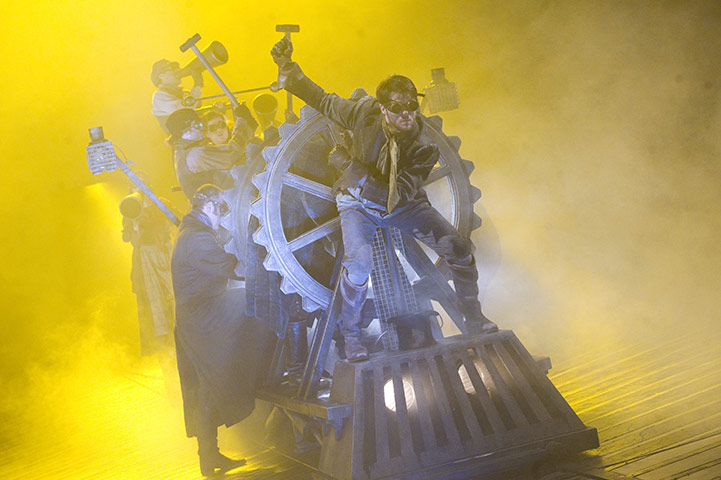
Every element of the design and staging is incredible. The stage is round with a central revolve, and overhead, there's a fixture comprising hundreds of lightbulbs. They're gathered in bunches, hung at different lengths, and it's at once oozing and organic and cold and artificial, evoking forges, power plants, and circuses. To represent the creature's first stumble into a town, there's this gliding platform topped with huge gears that rotate. Extras hang from the front and sides, jerking, slamming, writhing, and do-si-do-ing to something too clanging and brittle to be music, too patterned and hypnotic not to be. It's like Steampunk and German Expressionism had a Marxist-informed Baby.

The blind scholar's hut is represented by four scrimmed walls with a few natural elements stenciled on them; the Frankenstein home is all stiff, stuffy windows and shadow, but it churns up from beneath the stage and sits at a subtle angle. Victor's hut in Scotland has an appropriately claustrophobic, subterranean feel.

The monster is scarred, sutured, scabby, and oozing. The development of his movement, command of language, and command of . . . consciousness and self-awareness . . . are all stunning. The production we saw had Jonny Lee Miller as the Creature and Benedict Cumberbatch as Victor (the two leads swap roles each night). Both occupied their roles in a way that signals and excellent director and a creative process that's hard to achieve where actor and character are constantly growing and stretching. Really fantastic.

Oh, look! It's my "but" face. Charitably, Nick Dear's script is uneven, which is not to say that there aren't brilliant parts of it where Mary Shelley's text is illuminated, enlarged, and brought to life by the adaptation. But then there are parts that are just . . . clunky as shit: Felix and Agatha (the blind scholar's son and daughter-in-law) have awkward Tolstovian orgasms about having cleared all the rocks from their field; the Scots resurrectionists have painfully stilted attempts at Shakespearian comic relief; and Elizabeth lectures Victor on the God-given, societally approved power of her uterus. No, really.

Elizabeth, in general, is a nightmare. Boyle casts all the Frankensteins, save Victor, as actors of color for no reason that is particularly apparent (which is not at all to say that I think the actors ought to have been all white in some misguided attempt at authenticity, but Victor's whiteness becomes pointed). George Harris was simply not very good as Victor's father, although I wonder if his wooden delivery was directed that way, so that we remain entirely within the mind of Victor/The Creature.

Naomie Harris's portrayal of Elizabeth is almost beside the point as a performance. Her character is the victim of the worst of the script and a choice that came within a hair of ruining the whole shebang for me. As through the vast majority of the play, the action stays with the Creature, who springs from Elizabeth's bridal bed and has a conversation with her that, at times, almost salvages an otherwise dreadful scene. Then, unlike the book in which Victor hears a scream and comes across Elizabeth's lifeless body, Dear/Boyle have Victor burst into the room, revolver drawn (if you will) only to flail around on the floor for no apparent reason while the creature rapes Elizabeth, achieves orgasm, snaps her neck, and declares, "Now I am a man."

W.
T.
F?

Extra special bonus points not just for going to the "Women Exist For Men to Use in Their Attempts to Exert Power Over Other Men" Well, but going the extra mile and making the woman non-White. Seriously, just what the fuck?

But other than that, Mrs. Lincoln, it really, truly is a magnificent creative endeavor beautifully brought to life. But I'd consider nipping out for popcorn at strategic moments.

Labels: , , , , , , , , , , , , ,

Wednesday, April 22, 2009

Breathers: A Zombie's Lament, by S. G. Browne

I realize that my review of anything with the subtitle A Zombie's Lament will be considered suspect, but this is quite a good read. I'll try to keep this as free from substantive spoilers as possible.

The opening scene of Breathers—and I do not say this lightly—rivals the opening scene of Sunset Boulevard. It's quite an opening scene to live up to for better than 300 pages, but Browne pulls it off almost flawlessly. The whole novel is narrated in the first person, present tense, although about 2/3 of it is actually spent catching the reader up to the events in progress in the opening, so again, very much like SB, except our William Holden stand-in is available for another third of a novel. Aces!

Despite the opening nod to SB, Breathers is more Catcher in the Rye than it is Maltese Falcon. (Although Joe Gillis is more Holden Caulfield than Sam Spade,isn't he? Forgive me while I lurch my way out of this metaphor.) Sure, there are noirish elements to Breathers: Andy, our undead narrator, is quite the Everyzombie, and he neither courts nor consciously creates the interesting times in which which he's not living.

Most of the chapters are short, sleek vignettes. They're a series of funny, painful glimpses into a Day in the Life of a Zombie. Through them, Andy's individual story is revealed. There's not a lot of time spent on Browne's zombie mythos, which is fine, as it amounts to "Some people just reanimate, don't really know why. Probably genetic, but anyway, it's been happening for decades, if not centuries."

Browne wisely spends his time fleshing out (oh ho ho! I swear to you, I did not see that one coming until it was typed!) the unlived experience of Zombies, showing the reader how reviled and disempowered a segment of society they are (even in Santa Cruz—I suspect the vampires). He shows us, through Andy and his compatriots in an Undead Anonymous group (the only manifestation of Zombies' First Amendment rights, and these are monitored by a Breather), what human habits die hard and which ones slip away all too easily.

What else can I say? There's romance, fighting, dismemberment, fire, chases, escapes, porn, civil disobedience, disguises, and a self-actualized Zombie named Ray who turns out, strangely, to be a kind of Mary Poppins for Andy and his posse. (Actually, that would be one minor criticism of the book: Ray turns up, takes everyone by the shoulders, nudges them down a particular path, and then meets an ambiguous end off screen, so he's a touch Zombie ex machina.) It's funny—very funny—but like the best Zombie movies it's also social commentary and social commentary done deftly.

Without spoiling anything, I think I can say that the book ends with the Zombie Apocalypse (a very local one, at least) on he horizon, but leaves the door plausibly open for a sequel. And let's face it: If you could reanimate Joe Gillis for one (possibly) last hurrah, wouldn't you?

Labels: , , , ,

Thursday, February 26, 2009

Outta My Way, Nerdlingers: South Water Kitchen & Coraline 3-D

So my sweet boo-boo and I were apart for Commercial Love Holiday this year because I was giving a Darwin Day talk at not!church in Jesus Central, Real America. (This represents a substantial improvement over Commerical Love Holiday last year when we were together, but the ZK was mostly dead.) Anyway, we had a belated VD celebration last Friday when we went to South Water Kitchen for dinner and thence to River East for a showing of Coraline in 3-D. Which I liked, but didn't love. Please stop shooting me, Gaiman devotees!

Meal at South Water was terrific, which is good, because I was spitting mad when I got there. Traffic was a nightmare (bite me, Chicago Auto Show, have you heard about this little thing called a recession?), and furiously blinking cars were 9 deep at the Hotel Monaco with nary a valet in sight. Presumably the valets were attending to the complimentary fishies.

But! Screenwipe! New Scene! Dinner was marvelous. Every dinner is improved by the Jesus!Phone, which not only distracts from what would otherwise be awkward silences between this old married couple (Kidding, Kidding. Please recall, we often have other couples inching away from us when we are out or Certified Romantic Evenings, because our conversations are nonstop and strange), but also enables me to marinate all my food in the virutal tears of wire monkey mother's envy.

Twitterstream dutifully reproduced:
ZK begins with a trio of whiskey & orange cocktails. Shooting star blue franc for me.
ZK belatedly remembers that he isn't a fan of goat cheese. More flatbread for me.
Scallops with chanterelles & homemade bacon. Trayflicious! [NB: Mushrooms were simply "wild mushrooms, not chanterelles; also forgot the sunchoke puree. YUM!]
ZK's duck confit salad is good - very good - but tragically lacks homemade bacon
Entrees: sturgeon with yet more fabulous chanterelles, plus whole roasted & smashed baby reds. Ironically earthy fish, but fabulous!
Entrée for ZK: pork chop with cheese grits & creamed brussel sprouts + homemade bacon FTW!
For dessert: bittersweet chocolate cake with salted caramel and malted vanilla gelato. Cake edges a teeny bit dry, but lovely under gelato.
ZK's dessert: deep dish apple pie & toasted almond gelato. Also good, but sadly lacking in chocolate.
And they comped our dessert, which alleviates parking rage.

We weren't actually sure why the comped our dessert. The service was maybe a touch slow, but we weren't fussed by it. I took it as karmic repayment for the parking debacle.

So anyway, Coraline. Theater was completely packed. We weren't prepared for that and had to sit in the front row. (Other movies I've seen from the front row: JFK, Branagh's Hamlet.)
Visually, the movie is wonderful, and it is certainly true that it makes wonderful use of 3-D, rather than throwing gratuitous pick-axes at you. (Although as an avid Dead Rising fan, I am generally pro–pick axe.)

Continuing on the visual here's something deeply appealing about the way Selick renders human motion. It's sinuous without being at all fluid, and it feels like a loving homage to Rank-Bass, Harryhausen, and every other stop motion giant. But it's also not simply more of the same from The Nightmare Before Christmas, at least not when real people in the real world are being rendered.

It's a good thing that I didn't look to closely at the voice casting before going in. In fact, I only knew that Hodgman was the Father and Al Swearengen, now with 100% fewer references to snatch, was involved somehow. I am surprised to find that I hated War of the Worlds so much that I was comparatively speechless about it. (As anyone who has ever met me, literally or virtually, can tell you, hate usually makes me wax eloquent.) My entire review:
There is nothing to enjoy in War of the Worlds. It's two hours of riding on Tom Cruise's back while he trudges slowly from one special effects disaster to another, many of which seem not to have been edited down from the original prolific bad!fic version. There is no plot to speak of. It's the least suspenseful, least interesting Apocalypse on record (and I include The Nonsensical Mission-Statement-less, Highly Localized, Be-Platformed Shoed The Beast from Angel, Season 4 in that). The ending is not only ridiculous, it's a giant Republican "fuck you" to the scabby, the poor, and the ethnic as our clean-scrubbed Boston Brahmins emerge from their pristine brownstone, intact, coiffed, and manicured, giving their blue collar ex-son-in-law /ex-husband/subpar sperm donor a grateful elbow-elbow-wrist-wrist-wrist wave from an appropriate distance.


Do you see that? Not a SINGLE mention of how Dakota Fanning's character needed to die more than any annoying child in any movie ever—including Pia Zadora in Santa Claus Conquers the Martians—needed to die. But I can assure you that is true. So, no, I would not have cast Dakota Fanning. And let us not speak of Teri Hatcher, whose only enjoyable role ever has been as a corpse 15 minutes into Tomorrow Never Dies.

Wow, that was a little vehement, wasn't it? So you can see why not having paid close attention to casting was a good idea for me. As it turns out, Fanning was better than I expected. Hatcher was not quite as bad as I expected, although the performance deteriorates just when the movie most needs her to step up.

Hodgman was amazing, and I am not simply saying that because he had the good grace not to run screaming from the signing table when I brought him a giant stack of More Information Than You Require to sign. His Father was distinctly NOT Hodgman the minor television personality, and his Other Father was magnificent in its mix of chipper and creepy. McShane, French, and Saunders were likewise absolute gold, and the scenes of their performances in the Other World were easily the highlights of the movie. (Along with Coraline's ride over the garden on Hodgman's Magical Steampunk Machine.) Keith David? Well is it any surprise that Keith David rocks as the cat? Everybody wants to be a cat.

Before getting into why I liked it, but didn't love it, I should admit that I haven't yet read the book. That's unusual for me, as I am a neurotic spoilerphobe who doesn't even read book jackets. But the fact of the matter is I seem to be missing some crucial Gaiman receptors. I'm not trying to be too-cool-for-school by disdaining a popular-to-the-point-of-inspiring-fanatacism author. I don't hate him, I just . . . don't get the fuss. I've read American Gods (and I still think that SOMETHING should eventually happen in a 400-page book), Anansi Boys (better than AG, but its appeal for me was pretty superficial), and Good Omens (which I love, but one has to factor in Pratchett), so maybe I just haven't hit the sweet spot yet.

But I haven't read the book, it's true, so I am unsure whether to lay the things that left me cold at its feet or the feet of the screenplay and/or editing-room floor. The fact that Coraline the character starts off as rather a pill and is eventually revealed to have some frighteningly sociopathic tendencies (giving the forcibly muted Wybie the the thumbs up springs to mind, but her mean-spirited attitude toward her eccentric neighbors goes well beyond childish self-absorption into real cruelty) certainly seems to be a problem with the original text. I'm less sure whether Coraline's eventual face-turn-amid-the-rotting-vegetables is so pat and shallow in the book, or if the reasons she realizes that she'd rather embrace her life in the real world (as opposed to simply escaping from the scary button-eyed world) are better communicated in the original and were poorly translated to the screen. I have no problem with main characters that aren't all sweetness and light (in fact, Diana Wynne Jones and Terry Pratchett, two of my favorite authors, are masters at somewhat unlikable characters with whom one can emphathize), but it takes a defter hand than is evident in Coraline.

I wonder if the ZK will have more to say about the British fascination with truly horrible parents, but the Senior Joneses are truly horrible, narcissitic, VW-Bug-Driving poseur greenies. It's really no wonder that Coraline herself is such a beast, given that her parents are prone to foist her off on the neighbors for whom they have such ill-concealed contempt. Certainly I can see the eye-buttoning process as a strong motivator to get the hell out of the Other World, but it's not as though Coraline's real parents have anything to induce genuine, active longing to be reunited with them.

The Other Mother/Belle Dame was yet another problem for me. Perhaps it's just that Teri Hatcher always sounds like a complete raging bitch to me, but there seemed to be no appreciable reason to be attracted on one incarnation of the Raging Bitch over the other. Given that OM/BD's hedonism goes to 11 from the start, Coraline falling for it leads one to worry about head injuries. If there is anything that sells the sinister attraction of the Other world, it is Hodgman's performance as the Other Father. He's genuinely fun and affectionate, and yet the slight slow slur in his speech has warning bells clanging in the distance.

Unfortunately, the OF being a victim (or a tool? he seems to have been raised from a pumpkin? this also raises the question of who the hell is muted Wybie? How does the OM/BD create/control the Others in her world?), rather than an accomplice, gave the story a distincly misogynistic tinge in my opinion. Yes, it ties the story more closely to Keats' poem, but associating the OM/BD with the original Belle Dame Sans Merci, as well as the more generic Hansel & Gretl witch/Snow Queen/Shelob, etc. ends up feeling like piling on. Yes, we get it, she's an Evil Spiderwoman constructed from evil parts that look like Coraline's mother designed to do evil. We get it. I'm not doing a great job at articulating why the OF's enslavement changes the equation, but for me it did, and changed it for the worse.

Some of the disjointedness in the story may be attributable to lack of editing fu. For example, when Coraline soliloquizes about Mr. Bobinsky, she notes that Wybie, the story's only character who is even arguably sympathetic and narratively reliable, has been talking trash about Mr. Bobinsky being crazy. As far as I can recall, that conversation didn't make it into the dialogue, and it seems out of character and out of storyline for Wybie (after all, he isn't allowd in the Pink Palace). And speaking of Wybie, he's pretty poorly integrated into the story (again, at least the story we see on screen), and it feels like he could have/should have been important.

When I brought up the putative editing error to the ZK, he said he had the impression that we were not seeing all of a continuous stream of time, so there would have been conversations taking place off screen. (He cited Mother Jones knowing the downstairs neighbors well enough to snark about them before unloading her little shit on to them.) I, in contrast, felt that the story was pretty dependent on us following Coraline constantly for a couple of days in a row. Not adhering to the Aristotelian unities isn't exactly a deal breaker in a movie based on a children's book, but I think the lack of decisiveness about time contributed to the jerkiness of the plot, which kept me at least from understanding and being fully invested in the emotional forward progress in the story.

There are things that I did like about the story, even though I sound like a giant, sulking curmudgeon. Coraline has the potential to be a great, punky heroine, and there are moments when that shines through. Her "I like it" upon seeing Wybie with his sewn-up mouth, though, just left her dead to me. I love the unflinching attitude toward the terrifying in the story. I will say for Gaiman that he gives kids more credit for being able to handle an emotional roller coaster than they seem to get from most these days. The tone of the movie is exactly that of movies that both attracted and terrified me as a kid, and I think the world needs less milquetoast in it. Strangely enough, if it weren't for the absolute beauty of the art and the wonderful elements of the story, I probably would have been less discontented with the weaker elements of plot and acting.

There you have it. I liked it. I may have even like liked it. But I didn't love it. Commence evisceration sequence.

Labels: , , , , , , , ,

Sunday, January 04, 2009

Follow-Up Reading Recommendation: Scott Lynch's Red Seas Under Red Skies

So, a little while back, I noted that I'd really enjoyed this author's first book, The Lies of Locke Lamora. I've just finished the sequel, Red Seas Under Red Skies, and Lynch continues to defy expectations.


Brace yourselves: I am about to speak favorably about the dread Boys'N'Boats genre.

Ranking two data points is more than a bit silly, but if forced to do so, I'd have to say I liked the first better. However, most of my reasoning has more to do with chronology, first exposure, and the possibilities native to the first novel in a new universe than with any real flaws or gaps in the second book.

As with The Lies of Lock Lamora, Lynch structures Red Seas Under Red Skies intelligently. In the former, Lynch uses two timelines simultaneously: One to tell us how the characters came to be the people they are, the other to show us what that means. Lynch seems to have taken great pleasure in constructing his characters' back stories, but having done such a thorough job in Book 1, there's little need for it in Book 2. In admiring Lynch's gift for structure and pacing, I appreciate the wisdom of not returning to the well of Locke and Jean's past; having really loved those vignettes, I missed them.

In the case of RSuRS, Lynch takes advantage of the device of those parallel time lines to propel the reader directly into a long con in progress as the initial hook, and still honor the toll the events of the first book have taken on the characters by showing the reader the long, ugly path they've taken to get back into the game. About a third of the way into the book, though, the timelines converge (in fact, there is a chapter bearing the heading "Final Reminisce"), and the narrative is more or less linear from there on out.

As I was reading RSuRS, I kept telling M that it seemed more complicated than the first, but of course the first book also takes a large left plot turn at Albuquerque. In the case of TLoLL, though, it's more a noirish plot complication, whereas RSuRS ventures into entirely new plot and character space once the timelines converge. In the interests of rapidly sketching that space, Lynch plays much more with point of view in RSuRS, whereas TLoLL stayed almost entirely with Locke. As a result, a handful of scenes and plot elements are left hanging for a bit, although everything is ultimately tied up.

As with his narrative techniques, Lynch seems to have a great sense about what character elements to leave intact and where he can and must make his characters grow and change. There is no mistaking Locke and Jean, and no doubt about why we grew so fond of them in the first place, but they are not unchanged, and neither the characters themselves nor the reader can always tell whether they'll behave as we expect them to. (On that note, one standing complaint with RSuRS is that it opens with a rather cheap mislead.)

The newly introduced characters are very well done for the most part. Lynch does stray into ridiculously overpowered villain territory once again, and we spend more time with the villain of RSuRS than we did with the Gray King, so the cheese grows a little ranker a little sooner in this book, but the other additions are so good that they make up for a lot of it.

One of the issues I had with TLoLL was the invisibility of women in the book's setting. That's far from the case in RSuRS, which features a number of women in well-done lead and supporting characters.He makes good on the device established in the first book, namely that women are well represented in almost all professions, and draws them out into the narrative without having to draw attention to gender. His leading and supporting women are 3-dimensional and well-drawn, and Lynch doesn't spend pages telling us how hot they all are or what they're wearing at any given moment (Jim Butcher, I'm looking at you). There's a certain amount of gooeyness associated with one of the leads, who becomes a love interest, but it's not dire. Moreover, he *gasp* implies that not everyone is heterosexual without at all fetishizing non-hetero relationships.

For me, personally, as a reader, the real marvel of RSuRS is that fully 2/3 of the book is about sailing, and I did not want to flash freeze and chip out my own eyeballs even once. I hate Boys 'N' Boats books. Really, truly hate them. Thought The Hunt for Red October contained about 100% too much submarine. Could have really gotten into Polar Star if were, say, set on a Dude Ranch. HATE THEM. But this one was cool. Check it out.

Please note that I am also bloody annoyed that (a) I have to wait until the end of February for the next book and (b) I'll apparently be buying the hardcover.

Labels: , , , ,

Monday, November 24, 2008

Reading Recommendation: Scott Lynch's The Lies of Locke Lamora

Just branefarted the author's name as 'Stephen Lynch.' With all due respect to Scott Lynch, I would very much like to receive the newsletter of Stephen Lynch's fantasy novel.

I have a million things to do, so naturally I am not sleeping. Not sleeping leads to reading in the bathroom in an attempt to render myself sleepy. This, in turn, leads to finishing a very long book at an odd hour and feeling compelled to pen a review IMMEDIATELY. Although I suppressed that urge last night, editing really doesn't stand a chance against a quick review of a book I really liked.

This is another novel that passed through the one-way barrier between me and the M. (I can't think of a single thing he's read at my recommendation, but I frequently assert my right to our common property by reading things he's bought.) Truthfully, both the title and the cover would have put me off. I'm calling the title a fair cop (maybe it's decades of watching General Hospital, but the L overkill says "Romance novel!" to me), but the crappy cover on ours looks even crappier in comparison to the one on the author's website.

The blurb on the back describes it as "One part 'Robin Hood,' one part Ocean's Eleven," which is sort of off-putting, too. I loves me some RH, and Ocean's Eleven was the first movie that made Brad Pitt seem remotely appealing to me, but that sentence just smacks of smarmy elevator pitch. But it has a point: TLoLL is fantasy, mostly in an incidental way (the universe just happens to have alchemy mixed into its technology, and just happens to be politically organized and culturally reminiscent of the pre-modern Mediterranean). But really, it's a caper novel.

Regardless of genre or setting, it's worth noting that Lynch does a lot of things right that have been done wrong in so many creative ways. For example, the narrative is nonlinear. It cuts from the characters' present to their past, and from the novel's world's present to its past. The time shifts are frequent, but very nearly flawless. In a 600+-page book, I can only think of one instance where the device went wrong (the chapter flashes back to the very recent past, presenting the current-day "action" out of sequence and left me wondering of there were two night-time visits).

But as a rule, the trips to the past build the characters, set the scene for important plot developments, and generally lend texture to the story. What's more, Lynch doesn't sacrifice the pace of the plot to the back-and-forth timeline device. In many cases, I was on the edge of my seat in the story's present, yet still eager to get at the back story.

The plot is ambitious, but well executed. The characters are well drawn. (Although there is a pivotal scene late in the book in which Lynch came very close to losing my capacity to give a shit about the main characters; M, for the record, didn't especially object to the scene on the grounds of characterization, but did see it as emanating from a poorly executed Phlebotenum in Jar C.) In the case of both plot and characterization, Lynch does occasionally beg the reader's patience through long, complex sections, but the payoff is well worth it. Furthermore, once I was past the first 50 pages or so, I was only aware of the length of the book when the ZK called attention to it.

Praise duly and deservedly bestowed, it's not perfect.

One potential downside of the "fantasy lite" approach is in the dialogue. I certainly appreciate Lynch's restrained approached to coinage, jargonization, and deployment of faux-Victorian linguistic crusty-ness. However, I'm not sure that the liberal application of "real world" profanity works as well as Lynch wants it to. (And I say this as cocksucking devotee of Deadwood who was never bothered for a fucking instant by the anachronistic goddamned nature of some of the finest fucking dialogue ever penned.)

As is all-too-common in geek-dom, the sisters are underrepresented on Lynch's canvas. Yes, there are two (and a half) major players who happen to be women, but they are major players in the plot sense, rather than the characterization sense. A third character is introduced early and never appears in this novel (although clearly she is meant to have great significance in future books). I don't object to placing a character on the board in advance, but in this case, she is mentioned so early and so consistently that I was preoccupied with trying to figure out as whom she might be disguised. (That sentence, right there, might just be the kind of pedantry up with which no one should put, and yet I cannot bring myself to end it with "as.")

To give Lynch some XX-equity cred, he does include an interesting chapter in which he does not engage in the fantasy/scifi-obligatory romanticization of prostitution, and throughout his landscape, it's clear that men and women are equally likely to hold any given job or be any given type of character, good or bad, young or old, etc.

Anyway, it's very good fun, and I found myself exceptionally pleased that there's already another book in the series for me to pick up, and another on the way early next year.

Labels: , , , , ,

Wednesday, October 29, 2008

Penguins Are Assholes: John Hodgman and David Rees at Second City E.T.C.

Tonight I had the pleasure of joining about 200 of my closest fellow citizens for an evening filled with snifters filled with Jeppson's Malört.* You may revoke my Swede card now, for I had never heard of Malört before. I have, however, been drinking glögg made with grain alcohol since childhood.

I arrived at Second City E.T.C. at about 5:30, which was later than I'd planned. DO NOT BE ALARMED, my friends, because I had the most rockstar of rockstar parking: A spot not 15 feet from the door of Piper's Alley, meter needing to be fed until 6 PM, 32 minutes remaining on meter at 5:36. Contrary to my expectations, I was not eaten by a bear moments later.

There were probably about 15 people queued up outside the theater, and I sat down at the end of the line to do some reading for class. Someone from Second City came around and handed out tickets, letting us know that they guaranteed us entry, but not any particular seats. A little after six, a SWAT team from The Book Stall swept into action and assembled a retail operation to be reckoned with. Roughly 10 seconds later, I found myself in possession of several copies of More Information Than You Require and a copy of Get Your War On.

There was some instinctive sheep action shortly before 7 PM and this, fortunately, proved to not be too far ahead of them opening the doors. They seated people by party size, and I got an aisle seat next to a table. The slightly hyperactive microgeek on the other side of the table audibly gasped when I piled up my purchases in the course of rearranging my bag so that I could get at my knitting. I got through about two repeats of my pattern (Dragonscales in Shibui sock's mulberry colorway for those of you playing along at home) before the house lights went down and the Hodg-man himself came out in his RNC-provided tuxedo.

A bottle of Malört dangled carelessly from his elegant, Gatsby-esque fingers, and soon that very bottle was circulating through the audience (neither it nor the second bottle ever did make it to my section, though) as John introduced David Rees. David had apparently been promised $500 by the Hodgman if he were to drink an entire bottle of Malört. When he tried to claim a cold, John poured him an Irish coffee mug full (fill it to the rim! With Malört!) and retired to the green room to microwave it. Ravaged by illness, Rees gave way to Hodgman's insistence that he "Enjoy it hot!"

While Hodgman was preparing the toddy of the damned, Rees announced his intention to retire Get Your War on officially as of January 20, 2009. We were treated to an exciting preview of his next venture: Relationshapes. Allow me to say that it was like looking into an expertly shaded, geometric mirror. Having taken a bracing sip of hot buttered Malört ("That tastes like a forest fire"),
he then did GYWO in 9 min, 9 seconds (causal relationship between timing and Malört: indeterminate), and thus conclusively proved that Criswell had exactly JACK on Rees.

Hodgman took the stage again and immediately began flinging monkeys to the middle of the house and abusing lecterns. He then proceeded to borrow a copy of his book from the friend with whom he'd been sitting (and, of course, sharing Malört with) and demonstrated how it can be used as a page-a-day calendar. But most of the presentation was devoted to the trials and tribulations of a famous minor television personality. Without wishing to venture into the territory of what the kids call 5p01lerz, I will simply share the following phrases:

  • "Well done, Peter Berg, I wish I had a copy of Frank Herbert's Dune!"
  • "Pudgy. Portly. Round-faced."
  • "And I would fall asleep with Rachel Hunter's breath on my cheek. In the sky."
  • "It is perilously easy."
  • "Enervating."
  • "Or lamb sandwich."
  • "Thank you, Malört."
  • "Tarmac is from the Celtic for 'you're fucking stuck here'."
  • "I am tempted to talk about that terrible movie."
  • "The answer is cream pie. Over."
  • "Cheese it, it's the cops."
  • "Ira Glass wrote that to make me sound sympathetic."
  • "Though I had, in fact, leaned nothing against a fence."
  • "Shaved men and women roaming the countryside, dripping nutritive slime."
  • "A child. Taking a picture of me. While I sleep."
  • "Thank you, Malört, liqueur of digression."


I got to ask a question over the walkie talkie, and I was relieved that my stage-managing fu did not fail me in using the walkie talkie, unlike SOME audience members I could mention. I was also NOT the audience member attempting to bogart the walkie talkie at the end. The line for book signing extended down to the main floor and I got yet more knitting done. Both gentlemen were gracious and gentlemanly while signing. (If you recall from my encounter with Sarah Vowell, wherein I unsuccessfully attempted to employ a beard, I can't seem to embrace the notion that just because I've bought a stack of books, I have the right to enslave these individuals and monopolize their time.) Hodgman was even kind enough to express relief when I reassured him that I was NOT having him sign a book for a serial killer.


*Please note that this Flickrer is mistaken when sie claims Malört is the most repulsive spirit known to man. That honor goes to Chinese sorghum liquor. No. Srsly.

Labels: , , , , , , , , , ,

Thursday, June 12, 2008

Scribe by Night

I can't seem to sleep. Probably a combination of too much caffeine too late in the day, not nearly enough exercise of late, and a brain busy with the fauna of of Georgia (the state, not the republic, not the south fucking island). But all are on my mind.

I'm reading Fierce Invalids Home from Hot Climates at the moment, and it's pissing me off rather seriously. After the Villa Incognito debacle, perhaps I should have written old Tom off, but in the interim I read Still Life With Woodpecker, which came nowhere near the brilliance of Skinny Legs and All or Jitterbug Perfume, but at least had a little of that certain something that makes those two what they are.

It's notable that Skinny Legs, Jitterbug, and Still Life are told largely from the point of view of the heroine; Villa crawls inside the hairy, unpleasant mind of its male characters to a much greater degree (although the the Toy Surprise Lady Tanuki Tamer is nominally a main character), and Fierce Invalids, at least so far, is almost exclusively from the main (male) character's vantage point—so nearly exclusively, in fact, that it was almost not worth bothering with a 3PO narrator.

As for his disservice to womenfolk in Fierce Invalids, we're left to accept the word of his Robbins' "hero" that the object of his lust (said hero's 16-year-old stepsister) is just so gosh-darn desirable that any sane man would be dying for her. And when I say we have to accept the hero's word, I mean that the lust object isn't even introduced until 1/3 into the book, and she has no redeeming qualities beyond a unique smell and a cliched rump, both of which are hyperdescribed to the point that I'm spontaneously slipping into a state of transcendental meditation every time they come up.

But this is only tangentially about the book pissing me off. I took what I'd hoped to be a brief bath (it was already late) tonight, and found myself at what promised to be a critical point in the book. This being Robbins, the plot-critical elements were put off in favor of some justification-critical ruminations on the Virgin Mary, particularly her incarnation at Fatima. Catholic visionary twaddle, particularly late at night, when visions of 69-in armadillos are dancing through my head, still has some power to freak me out just a little bit. Call it trickle-down mania or proof that no one escapes my natal home entirely unscarred, but the big VM is particularly freak making.

So anyway, off to bed I went, now trying to banish Portugal as well as Georgia from my overactive mind. I gave sleep the old college try, but it was pretty clear from the get go that it wasn't happening. So I got up, figuring I'd read for a bit. As I came down the stairs, I noticed that the front hall was pulsing with blue light. Virgin on the brain notwithstanding, my first thought was:
Shit.
What?
Rollers.
No!
Yeah.
Shit.

So I moved to the big window to peer around the screen, expecting—I don't really know, now that I think about it: I guess a squad car sitting on top of my innocent Corolla in the driveway? But the further I moved into the room, the clearer it was that ZOMG! The light was coming from inside the house!

Rest easy, fellow passengers on the swift boat to hell, the Virgin has not sought me out to convey her demand for a new and exciting appellation, complete with superfly street tag. It was just M's geeky new umbrella sending messages to the mothership. I've said from the first that thing is the first pebble of the avalanche leading directly to the robot holocaust, but at least it's unlikely to demand that we build a shrine to its aspect as the Radio-Controlled Aluminum Co-Redemptrix. So there's that.

Labels: , , ,

Monday, March 10, 2008

Le manchot est mort, Vive le manchot: Eugene Onegin at Lyric Opera

It doesn't feel right to begin this entry without acknowledging the fact that my beloved Bad Badtz Maru evening bag began shuffling off its evil spheniscid coil. The side of the bag is pulling away from the gilded clasp frame, no doubt because I insisted on trying to fit both my iPod and moleskine in it at the same time. But fear not! Months ago, I was seized with fear about Badtz's inevitable demise (although I hoped that sad end was far in the future), and I purchased a back-up Badtz on eBay. I'm still going to see if i can repair this one, but a successor lurks in the wings.

But onward, eventually, to Russia.

I still have in the hopper a review of La Traviata that gives Fleming's considerable assets their due, and my determination to put my adoration of Dr. Atomic into words was recently renewed by a conversation with one of my OTSFM co-volunteers. I'm not going to dwell on the fact that I do not have a review of Falstaff on deck, thanks to the family medical drama that ate New York. But for now, I'll write while the iron is hot. Or something.

In contrast to the 1984-like unified party line of Giulio Cesare, the Pompous Program for Eugene Onegin contains a multiplicity of viewpoints entirely appropriate to a not!opera representing a problematic adaptation of Pushkin.

My bias is showing in that paragraph. The fact of the matter is, the blurbs from the design team are every bit as party-line tinged as those in the PP for Cesare, I just happen to love this design team (originally headed by designer Robert Carsen (he of the austerely luscious Orfeo ed Euridice and the world's most noteworthy grey walls in Dialogues des Carmélites), and here directed in revival by Paula Suozzi).

Although the source material Eugene Onegin is only a novella to begin with, it is written in verse by the Jolly Inviolable Russian Giant, Pushkin. Guest Pompous Essayist David Shengold, tells us that Tchaikovsky was not only reviled by contemporary and subsequent authorities on Russian literature, but Ivan himself also had quite the crisis of conscience about the libretto (which he coadapted with Konstantin Shilovsky) and the decision to stage it as "lyric scenes," thus freeing himself from some of the conventions and expectations of opera. (For more on this, see the this review at The Glittering Eye.)

But whatever qualms Tchaikovsky might have had, he ultimately took a whizz on the novella and the Aristotelian unities and produced scenes depicting just three points in time for Onegin. But this production team gathers up the urine-soaked brilliance (one hopes, for the sake of sanitation, that Tchaikovsky's bodily fluids have vodka as a significant component) and runs with it. In their unified vision, Onegin is not just the central figure: The story comprises his memories of Tatyana and his own formative events surrounding her.

As with the other productions from this team (Carsen's design was, once again, executed in sets and costumes by Michael Levine and lighting by Christine Binder [Who was not, apparently, on the job in Orfeo, but was for La Bohème and La Traviata {forthcoming}.]), their vision is realized in lovely fashion and constitutes a thought-provoking (if problematic) reading of the story.

Act I begins in Onegin's metaphorical autumn. He appears exactly in the center of the stage, which is covered in leaves. Only the small, tight circle surrounding the chair in which he sits is swept clear, creating a cold, bare space amid a gorgeous tumult of reds, browns, oranges, and golds. The lighting is such that the scrim's presence is obvious, giving a slightly grey cast to everything. In the last few bars of the opening music, Onegin stands and raises his hand imploringly to the sky as a scatter of leaves waft down and grace his shoulders. (A note: Michael Levine says "Onegin drops Tatyana's letter and the leaves fall." I missed any letter dropping, and since he pointedly hands her letter back to her at the end of Act I, that represents a failed saving throw vs. continuity. My version WINS!)

The stage greys out (the backlighting of the scrim is cut off) exactly as the music ends. It's an effective and affecting way to take the audience from Onegin's present into his past, although I'm not sure agree entirely with Carsen in how he sees it as functioning:
"Memory is selective and impressionistic. We start and end each scene seemingly with nothing onstage, because that's what your mind does when you go from one memory to another – what you're remembering is an emotional response."

To me, the fades to grey evoked film and television, a technological gimmick, rather than anything organic, but my disconnect with Carsen on that point bridged what could have become considerable gaps between the production's approach and the text as created by Pushkin and adapted by Tchaikovsky and Shilovsky.

To create the literal autumn in which Onegin and Tatyana meet, and the events of Onegin's tragedy are set in motion, half a dozen bare, grey trunks, branchless are lowered downstage, flush up against the proscenium arch, and the leaves cover the entire stage. Olga and Tatyana's singing is offstage while Madame Larina and Filipyevna are seated at a wooden table downstage right, listening as they jointly prepare food for the meal to come.

Their table is framed by two widely spaced trunks, whereas the rest of the trunks are set much closer together at stage left. The unequal spacing creates spaces appropriate to Olga and Lensky's open, sanctioned courting, as well as to Tatyana's bookish detachment from the harvest festivities and her walk with Onegin.

The more closely spaced trunks also create the impression of time passing at uneven rates. (Again, I'm not sure that the design team intended it that way, but to me, it evoked frames of a film, flicking by faster and faster.) For me, this was a subtle reminder of Onegin's role as narrator (or generator, in memory) of the story. In his memory—or in the narrative he's telling himself—he has to reconcile rejection of Tatyana by the Onegin of youth with the longing for her and all she represents by Onegin in his later life.

Even considering that this is an opera, Tatyana's headlong rush from shy, romantic wallflower to bold writer of impassioned love letters in the space of an afternoon walk is a whiplash-inducing event. It can be an especially hard sell when that transition simultaneously must be believable as a young girl's unwitting jig on the precipice of reputational ruin and as a young woman's first glimmerings of true, passionate love that should have been. That sense—that time lags, then leaps forward in fits and starts, that hearts, and minds, and characters, might suddenly blossom and mature in what seems like a moment—helped to make the production's vision of the story work for me.

And the production's vision of the story turned out to be integral to my enjoyment of the opera. As enamored of the set as I was in Act I, scene i, I was gearing up to appreciate the visuals and the performances on their own merits, because the music was . . . well . . . kind of ugly. Tatyana and Olga's offstage duet is tuneful enough, but ponderous (they are, after all, novices practicing their music). When Madame Larina and Filipyevna join in, the content of their conversation is intriguing enough (Madame Larina's playing hard to get, then eventually marrying her husband and living a happy, if dull, life), but the quartet is heavy and thick. The peasant dance, rather than showing the bright side of life in the Russian countryside, is also a clodhopper, musically.

The music supporting the lovers' (Olga and Lensky) and would-be-lovers' (Tatyana and Onegin), which also serves to contrast our opposing models of manliness and womanhood, is at least interesting, if not especially pleasing to the ear. Nino Surguladze (Olga) has some noteworthy insights on her character's aria:
"Tchaikovsky gave Olga a lot more character than Pushkin did. . . . She's saying in her aria 'I'm so cute, everyone calls me a child,' but she sings it with low notes, and it can still be sexy! My Olga is chldish, but she knows how to manipulate men, and she also wants to be happy. The aria has has to be very light and joyful. It also should not be vulgar in the low notes – they must keep their light color."

Surguladze is true to this characterization of Olga in her vocal and dramatic performance, and the blocking, pacing, and give-and-take between her and Frank Lopardo (Lensky), very nearly pull it off, but musically, there's not a lot of sparkle.

Shengold is kinder than I to the music of scene i:
"To operagoers weaned on verismo, the first scene's music can seem 'unoperatic.' A two-minute minor key prelude based on hauntingly descending string lines [This is the pre-greyout music with Onegin alone, which I liked–Ed.] leads directly into the Larin sister's nostalgic offstage duet. . . . Both a rural and an elegiac tone has been set, only intensified by the subsequent choral call-and-response folk singing, starting with an unforgettable a cappella entrance by an offstage solo tenor."

I'll give him the tenor introduction to the folk dance, but other than that, a big meh to scene i, musically.

Seeing the scene as Onegin's creation, though, works dramatically, even it is doomed, aurally speaking, to be crushed under its own weight. The Onegin of the present still has his prejudices against life in the provinces. His realizations about the emptiness of his psuedo-Byronic life don't extend to a Levin-esque fetish for the countryside as a whole. Present-day Onegin retains some understanding of and tastes with past Onegin and, in memory, he gives his younger self a pass on some events. The partial, uneven maturation of Onegin's character this reading implies is unusual in opera and, to me, appealing. And the good news is that things pick up, musically speaking, considerably, after scene i.

Scene ii is the "letter scene"—a long stretch of beautiful, challenging music for Tatyana, with brief relief pitching at the beginning and end by Filipyevna. The set of her bedroom is contained within a lighted square, swept free of the surrounding leaves. In the upstage right corner of this light-bounded room is her bed with a painted hope chest at its foot and a night stand with a basin, pitcher, and gas lamp to the left of it. Diagonally opposite the bed is her writing desk, and a rocking chair sits in the upstage left corner. Books are appropriately scattered throughout the room, and the floor is layered with odd-sized rugs, except for a large, bare, square of the trap door leading down into the rest of the house. It's an odd and appropriate mixture of the silly and the serious, the girlish and the womanly. It works just about 100% of the time, and the brief moment of failure to work—when Tatyana breaks through the boundary of the room to frolic in the surrounding leaves—may not apply to those less literally minded than myself. (I couldn't help but fear for her falling from what is clearly the attic of the house to her death, or at least severe maiming, on the grounds.)

Some of what I perceived as musical rough patches early on in the letter were probably hangover from the sodden tones of scene i. There are also some phrases that are tonal twins of bits from the "Dance of the Sugar Plum Fairies," stripped of their tinkling, staccato elements. It's no fault of Tchaikovsky's that I have long since had enough of The Nutcracker to last me a lifetime. But things get good quickly. In particular, there's some beautiful disagreement going on in the winds. The clarinet (or oboe? Please, like I would know) maintains this sinuous, climbing melody while the flute starts out shrill above it and descends in jarringly wide intervals, but the two—Tatyana the girl and Tatyana the woman—ultimately meet. It's musically and dramatically lovely, and it's tantalizingly missing from Onegin's reprise of the theme in Act III.

For scene iii, we're back in the land of Onegin's circle. The scene opens a dozen peasant women engaging in good-natured sparring with their besoms as they sweep outward from the square of Tatyana's bedroom to create a much larger circle of cleared space among the leaves. This is the setting for Onegin's rejection of Tatyana, with the warm afternoon lighting of the first scene gone, and the cold, bare white of the floor (Onegin's world) forcing the inviting colors (Tatyana's world) to the edges of the stage.

Musically, scene iii slaps the audience in the face, just as Tatyana is dramatically sent reeling by Onegin's bloodless, patronizing rejection. Pompous brass seems to dominate, but underneath, there's a lot of swooping and swirling of the strings around one another, until they finally meet up in something curiously seductive. Again, the production's reading of these scenes as pieced together in Onegin's memory is born out in the conflicting musical moods. The cold, blasting brass is how the audience receives Onegin (and how the part of him that reviles his younger self must see him), but the strings remind us that Tatyana is not the type of woman to either love or let go so easily, and she is still drawn to him.

Act II continues to play with the theme of worlds within worlds and scenes that memory sets allegorically. Tatyana's name-day cotillion takes place within the confines of a square bordered by all the mismatched chairs of the Larina household. Although larger than Tatyana's bedroom, the "ballroom" leaves a considerable chunk of the stage unused. (Of course, this is all in contrast to the beautifully matched, decadently upholstered chairs set around the very borders of the stage to sketch the outlines of the ballroom in Prince Gremin's palace in Act III.) It's homely and quaint and comfortable—the best the countryside has to offer its favorite daughter.

Both scenes of Act II are a hard sell as Onegin's mental constructions. The action takes place several months after his rejection of Tatyana, but we don't really know why he's still there, if he despises the country as much as he seems to. And the country has had time to despise him right back. From the libretto in scene i:
GROUP B
How sorry one is for Tanya!

GROUP A
He'll marry her …

BOTH GROUPS
… and then play the tyrant!
Thy say he's a gambler!
Onegin, passing, overhears the conversation.
He’s dreadfully uncouth, his behaviour's quite mad,
he won't kiss the ladies' hands,
he’s a freemason, he drinks
only red wine - by the tumblerful!

Onegin's response is to blame Levsky and punish him by flirting with Olga. Um . . . what? As Shengold points out, the rising action to the climax of Lensky's death by duel is uninspiring (and, frankly, unconvincing) at least partly because Tchaikovsky seems to have seen Lensky in a different light than Pushkin:
"Much has been made of the coincidence in time of Tchaikovsky's disastrous marriage with his work on Onegin; but this portrait of the vulnerable, impressionable Tatyana surely draws on the feelings of his hapless bride, Antonina – and indeed his own distress – about the hopeless venture towards conformity. Lensky's magnificent aria of resigned melancholy, in which he contemplates his fate before the duel, falls in to the category of a lament (traditional for Russian opera). Unlike Pushkin, who saw for Lensky a domestic, bourgeois future, the composer took seriously Lensky's German Romanticism-fueled estimate of himself as a talented young poet, and the opera is probably more affecting for that."

I agree that it's more affecting. Not for all the world would I sacrifice really feeling for and mourning Lensky all through that gorgeous aria.

But it's hard to sell the depth and breadth that Tschaikovsky gives to Lensky as the creation of the same mind that has not softened one whit its judgement of the frumpy, stuffy, mismatched landscape of the countryside. Likewise, the Onegin of Act II is so heartless, so actively cold in using Olga and then so erratic, one moment feigning surprise that Lensky is taking things so seriously, and the next coldly accepting Lensky's challenge to duel and ignoring any of the ways out that are offered. It's a strange version of events to be taken as the product of Onegin's mind.

Perhaps that's why I thought the only minor stumbles in staging occurred in Act II, bleeding into III. The duel takes place on an absolutely bare stage. Lensky waits downstage right and takes his position for the duel upstage center. The men's overcoats provide their marks in keeping with tradition. Onegin is downstage center. The lighting is low, and only Lensky's silhouette, with pistol raised, is really visible throughout the build-up. It's not even clear until the very last second that Onegin is holding a pistol, as he adopts a much more casual stance.

As Lensky falls, the upstage wall is lit in an arc at its base, presumably representing the sun as it rises a moment after the life leaves him. Perhaps a fine idea in concept, but in execution it looks a little goofy, as though they've buried him and there's an impressive hummock accommodating his belly.

I did like the pointed lack of the grey out at this point, despite the fact that we're moving between acts. Especially given how alienated the audience feels from Onegin in this moment, the fact that his own memory will not allow him to lower the curtain on Lensky's death is an important point of reconnection. Impeccably clothed serving men arrive on stage to carry Lensky away and retrieve the overcoats (a nice conflation of body and object, stage business and burial, that works well). A second set arrives carrying the chairs that will outline Prince Gremin's ballrom, and a great deal of choreographed business goes into placing them just so. A third set first brings Onegin a pitcher and basin in which to wash his hands (a little on the nose, I thought), then helps him into his evening clothes for the ball.

The knots of patterns and colors crowded on to Madame Larina's dance floor are replaced by carefully spaced groups of dancers in shimmering black, purple, and deep red. Unfortunately, there are no production photos that highlight the contrasts, but it was impressive costuming, the highlight of which is, of course, Tatyana's entrance in the kind of regal sophisticated finery Onegin only wishes he could imagine. The gown is key, but so is Tatyana's bearing throughout. She moves through the maze of her guests, clearly charming them with her sincerity and dignity, all the while tamping down the inner chaos stirred up by seeing Onegin again.

In the final scene, it is Tatyana who is seated in the chair, surrounded by the narrow circle that hemmed in Onegin at the opera's beginning, only without benefit of the warm, retrospectively fond colors of memory (except as they appear in the shawl she wears and casually leaves draped over the bone-white and gilt chair; it's a nice touch as it's a richer, more sumptuous version of the shawl she hides behind in Act I). The stage is otherwise absolutely bare. Mostly, I was so knocked out by the music and the performances that I didn't give this set much thought. In retrospect, I didn't quite drink the kool-aid, and I note that the barely visible borders of the panels covering the floor, together with the white-on-white joins of floor and walls give it a kind of rubber-room feel that I'm not fond of.

And speaking of performances, every single person in this production knocks it out of the park. Dmitri Hvorostovsky's voice and presence are so striking that it's a mere trifle to be repelled by, terrified of, fascinated by, and in love with him all at the same time. He hardly needs the superb costuming to take him through the paces of a character that can be read either as experiencing real transformation or merely going through the motions.

The production designers seem to espouse the former attitude, as does Mariusz Kwiecien, who'll be playing Onegin from March 17 through the end of the run:
"Onegin is a role where I can really develop: I start out being so cool and aristocratic, then become more human, and at the end I show my whole soul and love to Tatyana, growing to the last incredible duet. At the beginning, people should hate Onegin – he's so conservative, without a sense of humor. Then, at the end, they should both hate him for what he's done in the first act [I pass over this implication that dissing Tatyana is worse than murdering Lensky.–Ed.] and feel pity for him losing the most beautiful thing in his life."


In contrast to this view, Shengold goes directly to Pushkin's text for help in reading the title character:
"In a scene where Tatyana visits Onegin's library after his post-duel departure for Europe, Pushkin makes clear that the girl discovers that Onegin's 'fascinating' social poses are just a pale reflection of the Byronic heroes that he's read about. Tchaikovsky's making his baritone parrot the soprano's love music is similarly undermining, suggesting that Onegin can only experience a mere imitation of passion."


Hvorostovsky's blurb doesn't add much to the debate, although he compares Onegin to Don Giovanni in terms of a character that can be read in a broad number of ways. But to return to what we're given on stage, Hvorostovsky is selling the genuine passion. (Can it be a coincidence that the 20% of the production photos are devoted to that duet?)

My opinion of Dina Kuznetsovna has been steadily growing, and it's gratifying to see her shine so in such a substantial role as Tatyana. Her voice, always excellent, has grown better and better each time I've seen her. Neither her role in Vixen nor in Rigoletto really show off her dramatic chops (I'm sorry, Gilda's a beautiful musical role, but she's such a drip) in the way that Tatyana does. That must be why I never, until Tatyana, realized how huge, beautiful, and expressive her eyes are. Her heart projects to the second balcony every second.

The audience's response to Nino Surguladze was a little reserved, which I don't think is entirely fair. Although Tchaikovsky gives Olga more than Pushkin, he still doesn't give her a lot, and he gives her almost nothing in the way of the beautiful music that comes later. I loved her acting and liked her voice more than enough that I want to see her in a role that's vocally kinder.

Frank Lopardo played off Surguladze's Olga beautifully. Furthermore, he was very much at home as the German transplant into Russian literature. He simply slayed me (and the rest of the audience, judging from the curtain calls) with the Act II aria. (And you know that I have unusual resistance to tenors.)

In the same breath as Lopardo, I have to mention Vitalji Kowaljow as Prince Gremin. Tschaikovsky was definitely into the funny brownies when he gave the bass the classic A-B-A aria, and the performer has a lot to pull off within it. As Shengold quite rightly points out:
"His mood and situation could not be in greater contrast to the bored, rootless and (hitherto) loveless Onegin; but the aria also establishes the nature of Tatyana's marital ties; it reveals what she would harm and lose by giving into to Onegin's tardy return of her youthful passion."

Wherever one comes down on Onegin, the audience must believe that Tatyana's marriage is a happy, if offbeat, one. Kowaljow brought down the house, building from a quiet calm to real fire and coming back home again. A really moving performance for a character that, literally, has only that moment to convey himself.

I liked Catherine Wyn-Rogers significantly more as Filipyevna than I did when she snuck up behind me as Sosostris. She gets a lot of mileage out of her everyservant role as Madame Larin's friend, Tatyana's Nanny and confidant. Likewise, I feel like Marie Plette (Madame Larina) has more to her than is evident in this role. I'll be happy to see them both again in the future.

Labels: , , , , , , ,

Monday, August 20, 2007

Eminently Violable: Stardust

I am not a Neil Gaiman fan. Stop with the pelting already. I'm not not a Neil Gaiman fan, I just haven't drunk the kool-aid and, therefore, don't get what the big deal is. Also, in fairness, my not not state is based only on reading American Gods (which is a wonderful set of short stories and, in my opinion, a very lackluster novel; if I'd edited it, it would have been about 40% the size of the end product and, in all probability, 100% Shadow free, but I digress) and Anansi Boys (a great improvement, and enjoyable, but still didn't grab me). Anyway, that's apropos not much, except for the fact that it may utterly negate for you my feelings about Stardust.I guess validation is possible, just a lot less likely.

I feel bad about not liking Gaiman's writing more. I mean, Diana Wynne Jones, my absolute heroine and, as far as I'm concerned, the absolute pinnacle of fantasy writing, is fond enough of the writer to have "loaned" him the plot for American Gods (from Eight Days of Luke) and fond enough of the man to have immortalized him in the character of Nick Mallory, whom I love as I can only love a DWJ hero. Probably I should just read more, but, seriously American Gods took a lot out of me. And what it took out, it replaced with the cranky and very ready to find fault and be bored.

As to what bearing all that baggage has on Stardust . . . well, probably none. (If nothing else, I forgot completely until about 30 minutes in that Gaiman had anything at all to do with it.) I'm not sure where this movie was until about 3 weeks ago, when the marketing for it began, seemingly as an afterthought. As more facts about it came to light during that period, my unease grew: Robert DeNiro? Michelle Pfeiffer? Ricky Gervais? Claire Danes? Peter freakin' O'Toole (ok, I didn't know about him until we were in the theater, and even then, I didn't think it was really him, because he apparently has access to a time machine)? Based on a Neil Gaiman story (not that this was especially played up)? And no advertising? I smell Mists of Avalon.

But hey, we at the Telecommuniculturey support our local genre films.

And hey! I'm really glad we did. I'm not prepared to put a percentage to the "better than expectations," mostly because I had no expectations whatsoever, but it really was delightfully entertaining. M tells me that it was pitched as the Princess Bride meets Pirates of the Caribbean. I'll call shenanigans on that: It's more The Princess Bride: Newly Expanded with a True Account of What Happened to Westley During His Adventures as the Dread Pirate Roberts.

The story is as old as the hills: How do boys become men? And Gaiman tells that story from the shoulders of giants. The Captain of the lightning ship is the Dread Pirate Roberts, in this case nee Ryan (i.e., he of the infamous bedtime sign off, "Good night Westley. Good work. Sleep well. I'll most likely kill you in the morning"). But of course, as much as Gaiman is borrowing from Goldman, Goldman's having bummed a fiver of those who've gone before is acknowledged in the name the sky pirate takes as his own: Shakespeare. How do boys become men? They go from war to Messina, from Wittenberg to Denmark, to Shrewsbury to London to France, and back again (and, whether Gaiman intended this as pre-Tolkien fantasy or not [as, again, M's information suggests], they go There and Back Again). They make the journey, fight the war, set the wackiness to rights, rake in the chicks, and settle down to rule the kingdom.

One could argue that it's really the only story, so its derivative nature isn't worth talking about. But of course, it matters whether it's rip off or homage (I'm going with definite homage in this case), and it matters from whom one's doing the deriving. Goldman and the Bard are both aforementioned and foregone conclusions. It's hard to go wrong with either. Garth Nix is there, too, in style and content. (As you might suspect, that's a big hit with me.) And there is—and I don't say this lightly—Diana Wynne Jones herself.

Given the giants that Gaiman's chosen to form the base of his narrative pyramid, he's well-positioned to retell the only story ever told. I'd add that retelling it within the fantasy genre has its own peculiar charms. How boys become men is the story, but how men remain boys is vital to the telling of it. In Stardust, Gaiman's characters are irrepressible and forward moving.

They're not undaunted by their missteps and misfortunes, but they are rarely, if ever, paralyzed by them. There is—thank you axe-headed buddy Jeebus (man, I wanted a picture of that to link to, but searches "stardust" and "axe in head" turn up "kid friendly" dissections of the movie, which tragically, do not rate it on a scale of 1 to 10 boobies, but they ought to)—not an iota of emo in Tristan (I understand the name was changed from the more tongue twisting "Tristran" in Gaiman's original, but the nod to another story involving funny ears isn't bothersome if you have the luxury of not being a Gaiman purist) or Yvaine.

Tristan's job at the shop isn't feeding his 7 starveling brothers. He blows his money on a candlelight champagne picnic, and there's no implication that he's killed the cow and taken his first step on the long road to spousicide and capital punishment. He doesn't cross the wall into Stormhold to obtain the last of a rare blossom to save his consumptive mother. He's on a playful, romantic whim. In other words why does Tristan set off on the journey to become a man? To quote Jeremy Goodwin "It's for the same reason anybody does anything: to impress women." Which is rather circular, but so, I hear, is life. And the Tristan of the movie, at least, comes by this honestly: Why did his father go? Because the men who were busily photographing the moon couldn't see the other world right in their midst. He went because it was there.

Which is not to say that there's no peril, no anxiety, or nothing at stake in Stardust. All along, a net is closing around Tristan and Yvaine. The two of them matter quite deeply to the villains of the piece, who would win a kingdom, regain youth, and achieve immortality. And even they are having a good time about it. There's fratricide galore, but no hard feelings. There's remaining-star-heart bogarting, but everyone knows it has to be done and shares a hearty cackle.

Being the only story ever told, being fantasy, there's a core of bog standardness: Tristan is the real heir to the kingdom, his slave girl mother being the missing princess. He wastes the gifts given to him by his parents, and perseveres anyway. All hope is lost, and true love wins the day. It's entirely predictable for adults, and it's filled with surprise reveals and shocking discoveries for the youngsters. And what it's filled with hardly matters, because it's so charmingly told.

I think the secret to its charm is in the balance. For so silly a movie, it's scarier and Grimmer (caps intentional—think of the blood in the shoe!) than any recently told fairy tale (Pan's Labyrinth excepted, but that's another animal entirely): The witches divine with bona fide entrails of recently living critters; the princes off one another and other obstacles in sometimes grisly fashion (sadly not in grizzly fashion, despite the array of animals represented). There's dramatic music aplenty to honor these dark goings-on. But for every beat on the tympani, there's the tinkle of a bell. For every time Michelle Pfeiffer monologues, then magics an unwitting bystander, she gives herself a magical face lift that costs her a double boob droop. It's fun and it's funny and it knows exactly how seriously to take itself.

I'm kind of surprised to learn that this is only Matthew Vaughn's second time in the director's chair. Granted, his stable here is largely populated with self-jockeyed thoroughbreds (too many horse-racing plot lines in my junk TV lately), but it's not like being the newbie to your actors and their potential egos is a sinecure, either. But certainly the unified, exactly right tone of the movie has to be largely attributable to him. But every actor, almost every moment, palpably "got" the movie's vibe and understood its delicate balance.

Charlie Cox was simply wonderful as Tristan. Young, goobery, articulate, spazzing, nerdy, gallant, and thoroughly loveable. Although Nathaniel Parker's role as the elder Thorn is small, their father-son relationship is exceptionally well done and vital to why, exactly, Tristan charms. (And can I say that my heart went pitter pat when I spied the role of Gabriel Oak in Mr. Parker's IMDB credits?)

The sons of the King of Stronghold are side-splitting as a group and delectable as individual. Of course Mark Strong and Jason Flemyng are the only two who have any real material to work with, and yet the strong individual personalities are more than the just the product of their amusingly idiosyncratic corpses. (Seriously, the ghostly Waldorf and Statler Septet just cracked my shit up.)

Michelle Pfeiffer is bitchy and witchy, stupid and vain, threatening and ridiculous in almost exactly the right proportions, and Sarah Alexander and Joanna Scanlon are exceptional wrinkly back-up singers. DeNiro . . . well, he's quite often DeNiro, which is pretty much all he ever is. But he's a very silly DeNiro, and a bittersweet, aging queen DeNiro and that's . . . different (and not in the best taste from time to time, but if you'd described his role to me and told me how well, overall, it was pulled off, I'd have laughed in your face).

And the very minor supporting roles are cast with loving care. Jake Curran as the farmboy/goat and Olivia Grant as Bernard-as-Inn-Wench turned in just superb performances that could have been ham-handed comedy. Sienna Miller managed to give the snotty, vain Victoria just enough gold beneath the tarnish beneath the gold that we never had to fully despise Tristan for wanting her. Peter O'Toole? Do I really need to praise Peter O'Toole? Well, I've got to. He's got a bed-ridden 7-minute, exposition-laden scene and he rocks the fucking house.

My only reservation regarding the casting was, sadly, Claire Danes as Yvaine. Early on, she's entirely too one note. All haughty, more British than British (metaphorically in manner and literally in accent). All pain-in-the-ass, no gooey center. But it's never even near fatal, and she improves decidedly. I should also say that given how strongly evident I felt DWJ's influence to be, I was especially unlikely to be lenient about any lack of complexity in the female characters.

And in fairness to her, I have to say that there's some weakness in the source material (the screenplay, if not the original novella. Please to not be firebombing my house, Gaiman Brigade!): Notice that I've been all about boyz 2 men above. That's not just a sudden failure of torturous gender-neutral jargon.

This is a story about boys and men. While Tristan is learning to fence and to harvest lightning, Yvaine learns how to play the piano and to dance (and, presumably how to lace herself into a corset built for Robert DeNiro). When Tristan is reunited with his mother, she kisses his forehead (no lightning bolt scar, and thus no sounds of uncontrolled vomiting from this quarter), tells him to be the man she knows he is, and meekly complies with his order to wait outside.

True, it's Yvaine who ultimately saves the day (and the next tenants of Witchy Manor will be picking Michelle Pfeiffer out of the carpet for generations to come), but she "couldn't do it without [Tristan]," and somehow her womanly hug seems a bit standard-with-all-models rather than anything peculiar that our heroine picked up along the way. And, in short, although it honors the letter of the Bechdel-Wallace test (many women talking to many other women, and boys almost never come up) it rather egregiously violates its spirit (preoccupation with physical beauty gives entrails a run for their money in witchy conversational terms).

So it's not the girl-power vehicle of the year, but it's a lovely movie nonetheless. And apparently no one's seeing it.

Labels: , , , , , ,

Sunday, July 22, 2007

All the lonely hotels stand like monuments to fear: 1408

So I don't sit at home pining for Halifax all day or anything. We go out, we do stuff. Last night "stuff" involved a trip to Fry's, some top notch Mexican food, and
an investigation of whether Stephen King has ever ended a story successfully.

I'd like the look of 1408 for a while: John Cusack? Gooood! Samuel L. Jackson? Goood! Non–torture porn horror movie? Goooooood! And despite the gratuitous slam on Mr. King's struggles above, I have spent many enjoyable hours having him scare the bejeezus out of me.

The timing for the start of the movie was not great. We were thus subjected to the macking of the teenage couple next to us, which was interspersed with her whiny inquiries into why he'd taken a Koren class for HER (HER clearly being a previous girlfriend), when he hadn't bothered to learn her (her being one of the mackees) language. I also learned that I really would rather be forced to sit through I Now Pronounce You Chuck & Larry than a Harry Potter movie.

M and I agree that 1408, although far from a perfect movie, is a really damned good one. It's a simple enough story that the events are believable and don't distract the audience by making them ask, "Now why the hell would he be doing that?" It has a character that one empathizes with and roots for, although he's not wholly likable or always sympathetic. And most important, it's intensely scare in the grand old spine-tingling, suspenseful tradition, rather than relying on excessive gore or extreme violence.

Oddly enough, having seen the trailer a number of times acted like "Cliff's Notes" to the movie (I normally object to the spoiler-riffic nature of trailers), because one of the ways in which the movie falls down on the job is in letting us really know who Mike Enslin (Cusack) is and why he does what he does. From the trailers, we at least have some idea that he didn't just start out as the walking stereotype of a drunken, one-hit-wonder writer. Rather, trailer watchers know that the loss of his young daughter has derailed him fairly seriously.

Even with the helpful trailer clues, Cusack has his work cut out for him making Enslin both sympathetic and comprehensible to the audience. In the opening scene, he's driving through a dark back road on the dark and stormy night required by law. After some backtracking, he arrives at an inn and is pretty much a dick to the friendly, if somewhat overeager and consequently inconsiderate, couple who run the inn. We see a very small amount of his night drinking and listening for ghosts before we see him crankily driving away, dooming the inn to "5 skulls on the shiver scale."

Later, at a depressingly poorly attended book signing, we see a few more snippets of him using "tools of the trade" to gauge supernatural residue and what have you, but it's not exactly clear at whom 10 Haunted books are aimed or what his purpose in writing them is. As M said, the scenes with Olin (Jackson), the manager of THE hotel, there is a strong implication that Enslin is pissy and jaded because he's uncovered numerous not-particularly-sophisticated attempts at deliberate hoaxing, but that's not what we've seen. Furthermore, the trailer gives the strong impression that his daughter's death led him into research on the supernatural in the hopes of discovering something beyond life, but there's virtually no follow-through on that score at all.

Beyond waffling on what Enslin's attitude and motives are, the movie is not on especially firm territory when it explores its own orientation toward the supernatural. There's a scene just about in the middle of the movie when Enslin opens the minibar in his fridge and encounters mini-Samuel L. Jackson. It's a well-shot, well-acted, very Lynchian scene, but the content is baffling. In it, mini-Olin chides Enslin for raining on the metaphysical parade of his readers, taking away their hope of an afterlife. This is in keeping with some flashbacks to the time after his daughter's death when he was prone to beating up himself and his wife (metaphorically) over the fact that they assured her that she was going to Heaven or a reasonable facsimile thereof and that all her friends and God would be there. But it seems very out of step with the research and book-signing scenes, which don't really indicate that he's writing sneering debunkings of these supposedly haunted locales.

But if the movie fails on the grand philosophical score, it succeeds in exploring the many faces of fear: abject, senseless personal terror; big-time phobias; the fear that bleeds into despair and hopelessness; the banal stresses of everyday life. The conceit, of course, is The Unbeliever and the Terrible, Horrible, No Good, Very Bad Hour in the haunted room.

Mike Enslin did not so much relocate to the West Coast as he did flee as far away as he could from anything that would remind him of his daughter's death. But he decides to make an exception to his "No more New York, EVER" rule when he gets a postcard from the Dolphin Hotel that says; "Don't Stay in 1408." He notes that 1 + 4 + 8 = 13 and remarks, "Cute," but he's intrigued enough to try to book the room. He is not explicitly told that he can't stay in the room, the room just happens to be unavailable for any date he mentions.

He gets his publisher's lawyer on the issue and learns that under antidiscrimination laws, they cannot refuse to let him stay in the room unless it is already occupied. When he arrives Cheryl Hines informs him that he'd better be "Packing His Trunk", the desk clerk alerts management. Enslin is oh-so-very-politely ushered into Olin's office for some very expensive cognac and gentle persuasion from the Bad Ass Motherfucker himself. He takes the cognac, but still insists on staying in the room, even after Olin offers him free access to the gory crime photos and other details of the suicides, maimings, and natural deaths that have occurred there. On their way up to the room, Enslin asks what the "story" is on the room: Who died there? Who killed whom? What gypsy had a bug crawl up her ass and die there? Olin (whom we've just seen speaking French to some other staff member in an awkward I ASSURE YOU HE'S VERY CULTURED EVEN THOUGH HE'S BLACK moment) leans in and Jackson gets his contractually obligated f-bomb in: "It's an evil fucking room." 'Nuff said.

And truly the room itself is unremarkable, save for the fact that it is (a) supposed to be a hotel room in New York and yet (b) it is larger than my first apartment. Still, it's unnerving in an effective way. As Enslin talks into his recorder, he notes that all hotel rooms have something creepy about them, but this one especially so: The sightlines are bad; there are too many corners, too many oddly placed pieces of furniture, too many closets, curtains, and . . . well hiding places for things that want to eat your face, ok? The paintings are grim and depressing, but no more so than typical hotel room paintings. The room is uncomfortably hot (although this is fixed without incident, just a moment, a detail). The sounds from other rooms seem to occur not quite randomly, managing to be startling just as you start to relax.

The tension builds fairly slowly with a few well chosen scream moments: The clock radio blares on (revealing, unsurprisingly, that the soundtrack to hell is provided by the Carpenters) as it has in a dozen other movies, but it's accompanied by the bed being turned down, chocolates on the pillow, and the toilet paper having been refolded to its hotel-required point. They're funny little hotel-specific adjuncts to a tried and true horror device, but the giggle they evoke is just slightly hysterical.

And then the window slams down on Enslin's hand, cutting it badly. Again, any fan of horror movies is necessarily a connoisseur of slamming, digit-maiming windows, but 1408 smashes your fingers with a difference. Enslin is really in pain. He's bleeding, and when he goes for the bathroom sink to rinse the injury, steam explodes from the faucets, driving him back to the shower curtains, which, from then on, bear bloody, straggling hand prints.

And Enslin does something no character in the history of horror movies has ever done: He gives up when it makes sense to do so. He picks up the phone to check out and is caught in an endless loop of hotel services. He goes for the door himself, smearing yet more blood, and finds that it won't open. He tries to unlock the door from the inside with his key. It breaks off and the shaft is pulled through from the other side. When he climbs out on to the window ledge, making for the room next door, the outer wall is transformed into a brick expanse in which his two windows are the only openings. As he makes it back in to recheck the floor layout, he realizes that it is blacked out except for the island that is 1408 (with, of course, the helpful red "YOU ARE HERE" dot).

And . . . well, I won't belabor the review with a point-for-point synopsis, but it's full of clever plays on general horror tropes and it very successfully mines its own specific setting. There's real claustrophobia, paranoia, and despair. Even the device of the clock radio counting down from 60 (no one's ever lasted more than an hour, of course), which could have been so very done works, not just because it resets and you realize that there's no magic dawn coming to save him, but because it forces a mental inventory of the fears to which Enslin (and the audience through him) has just been subjected: Claw-hammer-wielding maniacs, failure at parenthood, failure of one's own parents in their old age, old age itself, disease, financial ruin, parking tickets . . . just everything . . . ending with his daughter dying in his arms.

As for the eternal question "Can Stephen King successfully end a story," well, I don't know, as I haven't read the short story. The real resolution for Enslin in the movie is pretty satisfying: It's redemptive without requiring total sacrifice, but it's also not a saccharine happy ending (and real horror fans hate those). Throughout the movie, it's entirely possible that Enslin is hallucinating the whole thing and several shots establish that the camera is not seeing what he does. Although I favor at least some resolution over hedging, I thought the epilogue was a touch on the ZOMG IT REALLY HAPPENED melodramatic side.

But with its relatively minor flaws (and believe me, even though I liked Secret Window, I am aware that its flaws weren't minor) it's quite a watchable movie and maybe the best Stephen King adaptation I've seen.

Labels: , , , ,

Friday, June 01, 2007

Sicily When it Should Sizzle: Béatrice et Bénédict at Chicago Opera Theater

And so with a little Shakespeare, a little crazy French man, and some sadly indifferent direction, I bid adieu to opera for the 2006-2007 season. 3months3months. I can do this. 3 months!

The preshow lecture last night was by Stephen Alltop, who is intimately connected to Northwestern and not so intimately connected (or if he is, it's between him and whomever he's intimately connected with) with Chicago Opera Theater. He, of course, had to start by eroding our self-esteem. He told of Berlioz's extremely limited exposure to music (he learned flute and guitar as a mostly-home-schooled rural Alpine kid bound for medical school), which gave him no problem or pause whatever when he sat down to write his first symphony after "absorbing" music by watching the pit closely. "You've all probably sat in dozens or hundreds of audiences for opera and symphony. Are you ready to write a 55-minute symphony?" No. No I am not, thank you so very much, now why don't you give me a nice paper cut and poor lemon juice on it?

But Alltop knows how to work an audience of frustrated nonartists, because he then read from a letter from Mendelssohn to his sister about about Berlioz. It went on at length about Berlioz's ability to watch a performance, incisively evaluate every move by every player, and give insight into it as a whole. And yet, as a composer, Berlioz's excesses, cluelessness, and inability to hear anything but the voices in his own head depressed Mendelssohn to the point of rendering him unable to work. Berlioz, in contrast, rushed the stage and fell on his knees before Mendelssohn to tell him that he was a god among conductors.

It's sad that I can't find the text of that letter on line, because it's quite hilarious to think of the refined, repressed, white-gloved Mendelssohn pouring his rage out in ink to say, essentially, "He just bugs me." And dear Felix wasn't the only one that Berlioz bugged, of course. As Mendelssohn no doubt thought proper, Berlioz was much more successful as a journalist and critic than he ever was as a composer.

Berlioz as writer has a lot of relevance to Béatrice et Bénédict in general and to COT's production of it, in particular. Alltop had drawn a number of parallels between Berlioz and Wagner, both biographically and in terms of their approach to their musical works. During the Q&A someone pointed out that as Berlioz had written the libretto for B&B, so Wagner almost always wrote his own libretti and asked for Alltop's commentary on that. Very hesitantly, Alltop said, "Well . . . I think that either of them would have been awful for a librettist to work with, don't you?" Me? I don't think it's really an opera until you've thrown at least a few librettists on the fire.

Despite the fact that Berlioz's reputation as a writer exceeded his reputation as a composer, there seems to be a distinct lack of enthusiasm for his text, both historically and in this production. I'm still working through my issues with it, and I'm not sure who'll bear the full force of my righteous indignation in the end. Because B&B seems like a great idea: Much Ado: The Good Parts Version, right? I mean, Hero is such a wet rag, if Claudio were any more impressionable, he'd be silly putty, Don John's jealousy is so diffuse and indiscriminate he's like some pansexual/panaggressive hybrid chimp/bonobo hybrid. It's all about teh h0tn355 of B&B.

And yet, Béatrice et Bénédict serves to illustrate why you just shouldn't fuck with the Bard. Without the toothless main romance for contrast, the woo they're pitching to one another feels more like hanger after hanger, rather than an erratic series of fast balls and wicked curves. Without the misogynist insanity that ensues from Don John's plot, it's never clear that marriage is a threat and a danger, because it complicates relationships and loyalties. Without Beatrice demanding that Benedick avenge Hero by killing Claudio, Benedick's commitment to bachelorhood has about as much force, logic, and relevance as Saving Silverman.

So there's that, which I guess could be laid at the feet of Berlioz as an objective problem with the whole endeavor. In the program there's a 2007 essay by David Cairns (that link is not to the program essay, but to an article he wrote in the wake of London's bicentennial honoring Berlioz's birth) in which he sidesteps, to some extent, issues of blame by pointing out that B&B was not really the opera that Berlioz wanted to write (or should have written, Cairns implies) as his last operatic effort.

Although Berlioz had thought of working on a much more transformed version of the story 30 years earlier (fusing the Shakespeare to Boccaccio by moving the action to a Sicilian castle under quarantine during the plague), toward the end of his life, he'd gotten a case of the Wagners and had been dreaming big dreams of writing Cleopatra. However, his health and commission to write an opera for a theater's opening dictated something fluffy. (Ironic, given that the theater was in Baden Baden, and as we know, the Germans have no word for "fluffy.")

Obviously a big Berlioz banner-waver (as am I), Cairns is reluctant to criticize too directly or too harshly, but he does say this:
Even in its final two-act form, the work remains a divertissement, mercurial and fleeting as the love the protagonists celebrate in their final number. Formally it breaks no new ground, being content to stay within the conventions of opera-comique. What are unusual are its attitudes and the delicacy with which it depicts them, catching the conversational quality of Shakespeare's dialogue 'with the point of a needle' indeed. the tender, sparkling woodwind writing and the teasing, fine-spun lines of the first-violin part are marvels of orchestral imagination and craftsmanship.


Although he doesn't come out and say it, I think Cairns has hit the nail on the head: Musically, Berlioz grabbed the brass ring with B&B. It should be no surprise that the overture is the most frequently heard part of the opera. He creates this dense, frenzied world in the strings (after all, the play takes place in the midst of a war), and then writes these strong lines in the woodwinds that bob and weave to make themselves heard as bold individual voices and as something grander and more beautiful in pairs.

That's true of many of the numbers in the opera proper as well. Hero and Ursula's "Nuit paisible et sereine," is a love song to love as much as it is a superficial pastoral interlude. It's the flip-side to Benedick's fears about marriage (realized in the play, but absent here), as Hero and her mother figure reinforce their familial love even as they celebrate Hero's romance. Likewise, "Je vais d'un coeur aimant," adds Beatrice's voice, a mixture of longing and reservations, maturity and insecurity, to the conversation about love.

But as much success as Berlioz enjoyed at musically illuminating Shakespeare's text, his text not so much. Director Nicola Raab is much less delicate than Cairns in her criticism of Berlioz's libretto. (And speaking of criticisms of text, I'm going to assume that some of the more opaque sections of Raab's notes are attributable to either poor translation from German or her not writing in her first language. At least she doesn't imply that if Hero would just employ maids who looked less like her, she could have avoided the whole disgrace-and-death nonsense.) In case you don't feel like trudging through those, here's the meat of her beef:
Shakespeare’s language, full of wit, word-play, and images, matches this feeling perfectly. The original French operatic dialogue of the opera - at least to our nowadays ears and understanding - does not. This is not a negative evaluation at all: the original dialogue, indeed Berlioz’s own adaptation of Shakespeare’s comedy, “Much Ado about Nothing,” obliges to the operatic conventions of the time when the opera was written. Whereas Berlioz was able to surpass, mostly only to be completely misunderstood by his contemporaries, conventions of the time mile-high in his musical thinking, in the dialogue for his comic opera (after all his last opera altogether written 5 years before his death), he didn’t.


This is the underpinning for her decision to adapt the dialogue from Shakespeare in English. It's also worth noting that in the Q&A, Artistic Coordinator Alexandra Subbarao quoted Raab as saying in a previous discussion that she'd have used the best German translation for the dialogue if she were mounting this production in Germany. At first, I'd been thinking that I was perfectly able to enjoy the comedy of, for example, Die Fledermaus despite the German dialogue. But of course the situations aren't really parallel. Shakespeare wrote in English, Berlioz in French 300 years later, so there's little reason to take mid-19th century French as "cannon" for the dialogue. And since Raab wisely confined her role to deciding what dialogue to include and what to cut (certainly I haven't committed Much Ado to memory in its entirety, but it's among the plays I know very well and I detected no fuckery with the Bard's dialogue), there's not a lot to criticize in her text.

That said, the very small amount of dialogue that involves Somarone, the kappelmeister added by Berlioz to work out a touch of his aggression about his critics (who were, admittedly, thick on the ground), was very poorly integrated. It clunked. Loudly. I find that particularly interesting because Raab spends some time on Somarone in her notes:
Another element of the opera, this time one of the characters, had to re-learn its identity.

Berlioz, out of sheer mischievousness, based only on a minor incident of music-making in the original, had created Somarone, a music teacher, as his private joke against his critics and the then current musical taste dominated by Academism. Without that knowledge though, the poor guy’s musical in-jokes are completely lost on us! So the music making stayed, but within a newly found context to underline plot and mood and situations - and a character with a story: a humane, believable one, emerged. Truth also serves beauty.


I regret to say that Raab's reimagining of Somarone was entirely lost on me. He's wearing a leg brace, so maybe he's 4-F or something? Or was injured earlier in the war and had to return? He's on stage a total of, I think, four times: At the very top of the opera, he's leading the local youngsters in a song of welcome for Don Pedro and his entourage. Later, he's far, far upstage behind a platform that mostly obscures him, again directing the youngsters who are singing to the upstage wall. He rolls around drunkenly (or maybe he's just limping because of the brace) at the top of act II and sings a song in praise of the wines of Sicily. And then he seems to be sulking and/or reading a pr0n magazine during the wedding festivities. Perhaps it seems mean to pick so ruthlessly on the most minor of characters. Unfortunately, I do so because the strange handling of Somarone is emblematic of some pretty confused direction overall.

Raab sets the action in the 20th century. I can't really be more specific than that. The dresses and hairstyles say WWII, the bobby sox say later. (And the distinguishing feature of our two heroines? A sad genetic predisposition to wear bobby sox with open-toed shoes. For shame.) In terms of place? It seems to be some kind of Logan's Run district of Sicily (what's that I hear? M calling shennanigans on me because I've never seen LR?), as Leonato is the lone "white-haired" fellow in town, thus putting a different spin on Benedick's transparent willingness to believe Beatrice is in love with him: If the geriatric oddity says so, maybe it's not just that he wants to be convinced or is conceited that he hardly needs to be.

So there's baffling directorial decision #1: Where- or whenever the play is supposed to take place, I just can't think of any reason for the town to be entirely population by those under 25. If you're worried about the pretty factor, may I direct your attention to the bathing scene in Branagh's Much Ado (remember? it was back when Kate Beckinsale had her own nose, some flesh on her bones, and integrity and talent), which is a veritable study in multiracial, multigeneratial, multi-body type hot, wet, soapy, nekkid asses and other bits. I think probably Ursule was supposed to be a bit older, but Jurgita Adamonyte just radiated youth.

Baffling directorial decision #2 was not knowing where within Logan's Run, Sicily, most of the action was taking place. I absolutely appreciate that neither the music nor the libretto lends itself to elaborate staging. However, I do wonder why, then, Raab opens her notes by remarking on the fact that the plot, not the music, mind you, "constantly evokes situations and locations of Mediterranean beauty." That quote struck me as being particularly at odds with the fact that the set designer seems to have been ordered to stage the action inside a packing crate.

The preshow curtain was an indiscriminate beige mottled as though it had been used as a drop cloth and washed a dozen times over. At the bottom, clusters of faded letters had been stenciled on. When the curtain rose, the back and wings were masked with very stiff and heavy cleaner versions of the front curtain. There were sets of movable bleachers fashioned from plywood, one at each side of the stage and two smaller, permanent sets of these that were actually built out from the apron, flanking the orchestra.

At the top of the opera, this was the entire set, but as soon as the soldiers actually began returning, the main set piece, a rolling platform about 15 feet square and 4 feet high or so, also of unadorned plywood, was moved out to the center of the stage. The angle of this piece could be adjusted to suggest a change of scene, and it was revealed very late in the show that it could be opened into three separate pieces, each about 5 feet wide, that could either be set at angles to one another (suggesting a path winding in a W shape) or unfolded completely to make up the aisle of the church, extending the whole depth of the stage. This versatility was sadly underused, though, and mostly it was just a big raised block in the center of the stage.

At first, I rather liked the idea of this platform. It could have suggested a dock where the battered soldiers were reunited with their loved ones. It had the potential to serve as a stage-within-a-stage. It's funny that this is one of Shakespeare's few plays that doesn't feature a play-within-a-play and yet there is so much speech and interaction that is deliberate, calculated performance (especially in the B&B plot), that it could have been tremendously fruitful to highlight the contrast between performance and genuinely felt, honestly conveyed emotions and thoughts.

Unfortunately, it was a possibility not only never capitalized on, but actively squandered. Benedick and Beatrice both break the fourth wall, delivering their soliloquies (both sung and spoken) quite pointedly to the audience. And, mostly, the set piece just blocked sight lines and kept me wondering about blocking and staging choices.

For example, if we take the "platform as dock," then we've got a whole bunch of Jesus soldiers walking on water upstage of it. At the end of act II, the Ursula/Hero duet, which, unbeknownst to them, is overheard by Beatrice, really should be in an intimate space that is open to the night they're glorying in . . . the balcony of her room, a private courtyard maybe, but it's on the same old platform on which the soldiers shave, Beatrice hangs out clothes (for a badly done sight gag when Benedick "overhears" the conversation between Don Pedro, Leonato, and Claudio). Worse still, this seemingly thoughtless, might-as-well-plop-them-here staging of the Duo-Nocturne squanders Adam Silverman's magnificent lighting design in this scene. With care suggesting that he planned each move down to the bar, he lowers in single bulbs, first one at a time, then in pairs, trios, and so on, as the stars wink into existence overhead. (Sadly, these same lights are used in Beatrice's act II aria, sans platform, so she appears to be wandering through a dangerous and potentially painful forest of unlit lightbulbs.)

Then, most bizarrely, when Beatrice and Benedick haltingly and abrasively declare their love for one another, the monolithic platform is finally spread out into three pieces set in a W-shape. But Beatrice sits on the end of the piece at stage right and Benedick is pinned in the V formed by that piece and the center piece, physically separated from her as she delivers every. single. line. to the house. That was possibly the biggest dud of a love scene I've ever seen on stage, all the more so because it is, by nature, one of the best love scenes in all of Western literature.

In addition to some pretty comprehensive failure to stage (or failure in staging if more thought was put into this than I'm giving credit for), Raab seems to have devoted an inordinate amount of attention to a handful of on-stage gags with dubious payoff. During the soldier's clean-up (oh, I forgot to mention that every single freaking person has a real mirror. No. Mirrors. On stage. EVER!), there's this . . . canvas bucket thing that gets flown in at the beginning of Claudio/Don Pedro's song. It just hangs there, siphoning off attention until the very end when, in yet more clumsy blocking, they drag Benedick under it. I think it's supposed to dump water on him, but either there was a misfire, or it really was just that much of a whimpering effect. Similarly, at the very end, the letters "in their own hands" from Beatrice and Benedick, confirming one's love for the other, are dropped in on little parachutes. Cute, perhaps, but the time it takes for them to drop and then the time it takes to find them and then the time it takes to get them into Hero's and Claudio's hands? Well, you've got a real pacing killer on your hands there.

The one gag in which Raab invested that worked on any level at all was the letter gag. Alltop had referred to the importance of letters in the production, but didn't say much more, because he knows teh 3v1l tht is 5p01l3rz!

During "'Comment le dedain pourrait-il mourir'," the upstage curtain rose about a third of the way up, revealing a bank of letters, each about 18" high or so, hanging on the wall. (I immediately wondered if someone was going to use them to spell out "Fuck you, male oppressor," and thus get themselves kicked out of the Pottery Barn Kids on the Plaza, but no pink stand mixers or blue chain saws made an appearance, which explains why this didn't come to pass.) The chorus members selectively harvested letters and handed them around. Beatrice and Benedict scavenged them for weapons in their war of words, spelling out various things like "Women are Smart," "Men Fart," and so on. I'm surprised, given the slapdash appearance of so much else in this production, that this wasn't a clumsy, disorganized nightmare. But to give deserved credit, it worked quite well, thanks to investment and commitment on the parts of Joseph Kaiser (Bénédict) and Sandra Piques Eddy (Béatrice).

But if direction and individual performance came together during that number, they rarely did elsewhere. Rinnat Moriah's Hero, in particular, seemed to suffer from lack of the slightest idea what her character was about. Her single-cadence approach to dialogue brought to mind some of the more painful auditions I've sat through. Even Piques Eddy, who seemed to have a lot more comfort with spoken-word acting, frequently seemed adrift in a see of acting choices not made.

Kaiser comes the closest to thriving in this production. He's tall and not particularly slight (that's him on the left as Tamino in Sir Kenneth's upcoming Magic Flute), so the decision to go with a very physical Benedick was not the most obvious path. Mostly he makes it work, though. He's dark and scornful with a decidedly masculine edge that resists slashing him with Claudio (thank jeebus), but the physical take makes him enough of a dork that you can see why Beatrice can't help but find him endearing. Certainly there were a few instances in which the physical comedy was overplayed, but for the most part, I was glad to know who at least one person really was.

I'm willing to let Raab off the hook on Claudio, because there's just next to nothing to go on for his characterization. Matthew Worth and Kaiser seemed to work up enough of a rapport that their friendship is believable despite Berlioz's lack of attention to it. I wanted to love Joshua Bloom's sonorous Don Pedro (and who could help but love him as a singer?), but he's so saddled with shiny knee-high boots, his officer's hat, and cigarette after cigarette after cigarette that he just comes off like some kind of inverse drag queen.

I felt for both Bloom and Piques Eddy during the "Will you have me, lady?" scene. They both wanted so badly to do something with it, but it fell utterly flat. I hate to keep making unfair comparisons, but I have certainly been spoiled forever by Emma Thompson's "Why thank you very much I would love a heaping helping of Denzel Washington and a side of his tight blue leather breeches, please," read on that scene, but even leaving that definitive treatment aside, that scene is exactly the kind of moment that makes Shakespeare something to discover your whole life long and I hate to see those opportunities wasted.

Larry Yaddo (Leonato) and Jurgita Adamonyte (Ursule) are an interesting pair. Leonato has nothing to sing that distinguishes him from the chorus, but has to handle a lot of dialogue. Yaddo does so admirably, except perhaps in the opening scene (which was so confused and confusing I wondered if they prematurely raised the curtain or something). Adamontye has almost no dialogue, but she has a strong vision of Ursule, her role in the stripped down play (that still manages to evoke the role she plays in the "Ado"), and her relationship with Hero. Both deserve kudos for escaping the directorial vortex.

I seem to be flying in the face of something that Alltop asserted in the preshow lecture, namely that there was a degree of care and attention obvious in this production. If he was speaking of care and attention to music (and several adjacent comments suggest that he was), then I actually agree with him. There was very little to take issue with on the musical front. The overture had a questionable tone or two in the winds, but otherwise, I think Jan Latham-Koenig's COT debut in the pit was just fantastic. In terms of the singers, the only person I could find fault with was Rinnat Moriah who lacked confidence and power in a number of places. Funnily enough, although John von Rhein was unbelievably soft on this production, in my admittedly bitchy opinion, he takes issue with her performance in the Duo-Nocturne, which I thought was lovely, and makes no mention at all of the fact that her opening aria, complete with painful end cadenzas, led me to believe that she must have distinguished herself as a failure among failures as the Queen of the Night. (Seriously, vocally speaking she improved greatly through the evening, and although her opening was less than stellar, I don't think that there's a thing wrong with her voice that time and experience can't fix.)

Kaiser is officially going on the list of boyfriends. This was inevitable as of Midsummer Marriage, but it was his Narraboth that streamlined his application. His Benedick sealed the deal, and I can't wait to see his Tamino. He is everything good about tenors, vocally all wrapped up in an intelligent, emotive package.

I also greatly enjoyed Piques Eddy's voice, even if her acting went astray too often. It's big and warm as a mezzo's should, but surprisingly delicate and sparkling in the upper register when it needs to be. If there was one flaw in the Act II trio, it was that Piques Eddy and Adomonyte were just too damned powerful, despite Moriah filling out her soprano to its utmost.

Worth and Bloom sang and worked well together and were excellent vocal contrasts to Kaiser not just as baritones, but because, vocally at least, they had good direction and were able to distinguish themselves from him and from one another in phrasing, tone color, and so on.

I wish that I had loved this production more. I'd been doubting my dissatisfaction after seeing what passes for a glowing review from von Rhein. Not that I care what he, in particular, has to say, as he is quite frequently pompous (in the bad way), silly, and wrong. But Andrew Patner has renewed my faith in my bitchiness. The singers, the costume design, the lighting, and even the set design deserved better attention. And lord knows that the text, even Berlioz's flawed version of it, deserves more.

Labels: , , , , , , , ,