Telecommuniculturey

High- and low-brow cultural goings-on in the Second City, brought to you by a roving microtechnoanthropologist

My Photo
Name:
Location: Chicago, Illinois, United States

This is fiber optic cable, which is the future. This is culture, which is delicious.

Saturday, May 07, 2011

Monsters, Boobies, and OCD: Danny Boyle's Frankenstein at the National Theatre

Sadly, we are not in the UK, but we did just return from The Music Box Theatre where we saw the last show they're broadcasting there. The title is the ZK's review.


This has been getting rave reviews, lines around the block for day-of tickets, and so on. In many ways, the production deserves that and more. I liked it, but did not love it.

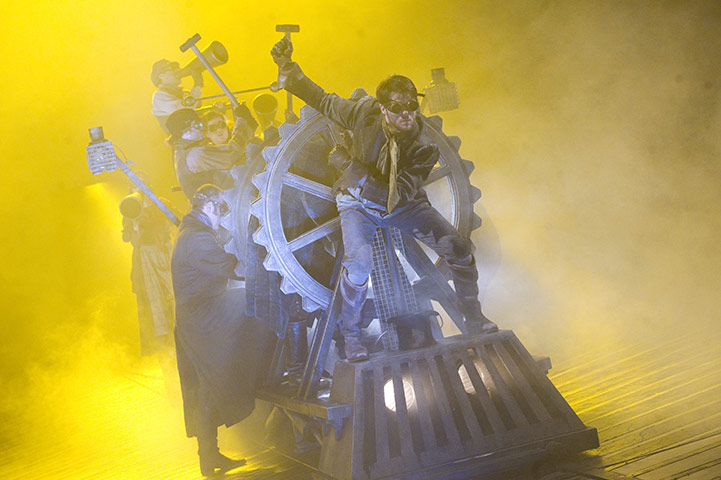
Every element of the design and staging is incredible. The stage is round with a central revolve, and overhead, there's a fixture comprising hundreds of lightbulbs. They're gathered in bunches, hung at different lengths, and it's at once oozing and organic and cold and artificial, evoking forges, power plants, and circuses. To represent the creature's first stumble into a town, there's this gliding platform topped with huge gears that rotate. Extras hang from the front and sides, jerking, slamming, writhing, and do-si-do-ing to something too clanging and brittle to be music, too patterned and hypnotic not to be. It's like Steampunk and German Expressionism had a Marxist-informed Baby.

The blind scholar's hut is represented by four scrimmed walls with a few natural elements stenciled on them; the Frankenstein home is all stiff, stuffy windows and shadow, but it churns up from beneath the stage and sits at a subtle angle. Victor's hut in Scotland has an appropriately claustrophobic, subterranean feel.

The monster is scarred, sutured, scabby, and oozing. The development of his movement, command of language, and command of . . . consciousness and self-awareness . . . are all stunning. The production we saw had Jonny Lee Miller as the Creature and Benedict Cumberbatch as Victor (the two leads swap roles each night). Both occupied their roles in a way that signals and excellent director and a creative process that's hard to achieve where actor and character are constantly growing and stretching. Really fantastic.

Oh, look! It's my "but" face. Charitably, Nick Dear's script is uneven, which is not to say that there aren't brilliant parts of it where Mary Shelley's text is illuminated, enlarged, and brought to life by the adaptation. But then there are parts that are just . . . clunky as shit: Felix and Agatha (the blind scholar's son and daughter-in-law) have awkward Tolstovian orgasms about having cleared all the rocks from their field; the Scots resurrectionists have painfully stilted attempts at Shakespearian comic relief; and Elizabeth lectures Victor on the God-given, societally approved power of her uterus. No, really.

Elizabeth, in general, is a nightmare. Boyle casts all the Frankensteins, save Victor, as actors of color for no reason that is particularly apparent (which is not at all to say that I think the actors ought to have been all white in some misguided attempt at authenticity, but Victor's whiteness becomes pointed). George Harris was simply not very good as Victor's father, although I wonder if his wooden delivery was directed that way, so that we remain entirely within the mind of Victor/The Creature.

Naomie Harris's portrayal of Elizabeth is almost beside the point as a performance. Her character is the victim of the worst of the script and a choice that came within a hair of ruining the whole shebang for me. As through the vast majority of the play, the action stays with the Creature, who springs from Elizabeth's bridal bed and has a conversation with her that, at times, almost salvages an otherwise dreadful scene. Then, unlike the book in which Victor hears a scream and comes across Elizabeth's lifeless body, Dear/Boyle have Victor burst into the room, revolver drawn (if you will) only to flail around on the floor for no apparent reason while the creature rapes Elizabeth, achieves orgasm, snaps her neck, and declares, "Now I am a man."

W.
T.
F?

Extra special bonus points not just for going to the "Women Exist For Men to Use in Their Attempts to Exert Power Over Other Men" Well, but going the extra mile and making the woman non-White. Seriously, just what the fuck?

But other than that, Mrs. Lincoln, it really, truly is a magnificent creative endeavor beautifully brought to life. But I'd consider nipping out for popcorn at strategic moments.

Labels: , , , , , , , , , , , , ,

Sunday, February 21, 2010

Pizza. French Fry. Pizza. French Fry. Stripper Pole? Damnation of Faust at Lyric Opera

So, Damnation of Faust (Berlioz) wasn't in my opera season, but Faust (Gounod) was. Not exactly sure why, as I saw the latter a few years back. Which isn't to say that this year's rendition wasn't lovely, but new material is always nice. And boy howdy was THIS new.


First of all, let's talk about Berlioz: Martian, time traveler, or what? Nineteen scenes born of his obsession with Goethe's characters, heavenly vocal pieces strung together with even better orchestral passages. Sir Andrew and the orchestra were absolutely superb.

This is the first time Lyric has staged Damnation, the production is new, and tonight was opening night. Being spoiler-phobic (yes, even when the source material is 160 years old), I have no idea what buzz, if any, there is surrounding this, but I'm going to make a prediction that there'll be praise for the performers and white-hot, searing hatred for the production.

I'll start from the top: The blacker-than-black stage curtains retract in multiple directions to unveil Faust's study, which is a square about 1/6 the size of the stage in the three-dimensional center of the field (i.e., the floor is raised above the stage's floor). The study is stark white and rigidly bounded by the masking curtains as well as walls flown in upstage of the curtain. It evokes snapping on an old tube television and waiting for its pinpoint of light to expand to the corners of the screen. And Berlioz's music, for all the world, has suggests the hum of it warming up.

Faust is hunched over a small computer cart, typing, writing, writing, typing, until suddenly the white walls confining him erupt with text—hand written notes, overlapped with monospaced computer fonts, sliding, scrolling, spilling out from him and over him to the audience as he darts around in the cramped space, scrawling on paper, typing madly.

A for effort on the part of Stage Director Stephen Langridge, but unfortunately Cish in execution: The computer cart is about 10x too crowded with what appears to be an Apple IIe, and a clamp-on desk lamp. Faust's stool is several inches taller than the cart (and has wheels), so when he's meant to be sitting on it, he looks for all the world like he's hovering over a gas station toilet seat. There's no space to write on the desk, so Paul Groves is forced to doodle against his own thigh. And thus the awesome mood was partially squandered.

Until scene 2! Because the curtains draw back entirely, and Faust's study is suspended in midair over an army clones hell-bent on picnicking. No, wait! It's very cool!

First, just the curtains draw back, and the only lighting for the chorus was the projections, which by now were shapes and pulses of light. But then Faust's study begins to descend, and eventually he is on the ground, surrounded by these groups, each of which has an older woman in a pale green 2-piece suit, a youngish man in a sport coat and tie, and a youngish woman in a skirt and twin set. Each group unfurled a red-and-white checked picnic blanket and settled on to the ground.

Around the margins, some of the skirt/twinset women were, instead, passionately kissing soldiers about to go off to war. (The soldiers, alas, were in some motley camouflage and would be undetectable only in my grandmother's living room, I think.)

Later, these women are pushing prams through the picnickers, then children of various ages appear and chase one another through the scene. Occasionally, another woman pushes one of the older women across the stage in a wheel chair. Eventually, the unattached women serve as flag bearers, and the projection across the whole stage becomes a German-adjacent flag (red, gold, and black, but with a complex A-based emblem in the center; I think it was made up, but my ignorance may be showing).

All the while, Faust is in the thick of the scene, yet wholly apart. The design, the blocking, choreography, everything contributes to the eternal, absolute sense of his isolation. And still, there is nothing about the use of the chorus that relegates them to propping up the main character: Despite their absolute identity with one another, they are people forming relationships, taking risks, making mistakes, loving, going to war, aging, maturing, not maturing. Exceptionalism and universalism together. Neat.

In the fourth scene, we're briefly returned to Faust's study where he contemplates his own navel and decides to end it all. As usual, some old time church music stays the killing hand. But as the curtains retract again, the hymn is not quite what you expect: At stage left is a series of flag-draped caskets with the funeral congregation at stage right.

The reveal is effective, but again some problematic design elements crept in during this scene. First of all, although I think the flags were the same color and design as those in the previous scene, under the lighting at the top of scene 4, they read as orange, yellow, and white, and I don't think they were going for candy corns.

But a bigger problem presented itself. From the ceiling a wall-to-wall beam was flown in. Based on further developments, I think that the beam itself was covered in reflective material so that its color could be changed with lighting alone. However, at this point it was bright yellow and it looked like a french fry. THEN a floor-to-ceiling pole was lowered in, intersecting the french fry close to the stage right proscenium, and I thought, "Oh dear, it's a stripper pole." For the first 10 minutes or so that these elements were on set—until they were flooded with yellow—I really didn't get that they were supposed to represent the cross inside the church.

So hold the french-fry-intersecting-stripper-pole in mind for just a moment. Perhaps you're eagerly awaiting the arrival of Mephistopheles on the scene? Fear not: This is where he comes in. The reveal and costuming here, I'm afraid to say, were disappointing. It turns out, of course, that he's the priest officiating at the mass funeral. When he reveals himself (umm . . . ok, I'll leave it) to Faust, he tears off his collar and doffs his cassock to reveal—a shiny royal blue/purple suit and black turtleneck?

I get that this is well-tread ground. I get that you don't want to go cliché (although what, I ask you, is ZOMG! DEVIL AS PRIEST!) I get that you don't want to put him in bright red. (For what it's worth, my annoyingly chatty neighbor INSISTED not only on bright red, she wanted a tail and horns.) But the shiny suit just made him look like he shops Liberace cast-offs.

So back to the french fry–stripper pole nexus. As Méphistophélès begins his seduction of Faust, his attention is drawn inexorably to the stripper pole and, well, he pretty much gives it a hand job. Remember, at this point, I am still thinking this is a tragic design accident, so I am basically in the shoes of Emma Thompson in the Tall Guy as she's watching Elephant! unfold.

But it's intentional. Because scene 6 is set in a strip club. The single yellow french fry is flown out and lo! The ACTUAL stripper pole is left behind. Vertically staggered neon-pink french fries are flown in to provide a sparkly backdrop, and strippers in corset-based rat costumes tumble out of two of the coffins.

COME BACK! It was actually really neat!

Ok, I admit that I cannot stop laughing when I think about the design meetings and the uphill battle, the passionate arguments in favor of, the decision to die on the hill of the stripper pole. But still, I was absolutely delighted at the way they handled the transition.

It's in this scene that we meet the only other major character in the opera, Brander, who enters into a "Devil Went Down In Georgia"-esque singing contest with Méphistophélès. As much as I (ultimately) loved the devotion-to-debauchery transition, though, I am wondering who, other than me, is paying attention to two—admittedly rockstar—bass-baritones and their dick-waving competition when they are AT A STRIP CLUB?

To compound this logistical flaw in the design, there is no getting around the fact that Branden's make-up and costume design goes well beyond homage and into plagiarism. Plagiarism of Riff Raff. Apparently neither strippers, nor songs about vermin, nor even the Rocky Horror Picture Show can satisfy Faust, who insists they leave.

Marguerite, of course, is the next trick up Méphistophélèseses's sleeve. As he and Faust wander through a field of roses and canoodling lovers, the upstage wall parts slightly to reveal Marguerite's bedroom, which is straight out of a 1950s sitcom: A chest of drawers, a bedside lamp, and a narrow twin bed with a crucifix hanging over it. As Méphistophélès lures Faust into the dream, Marguerite—who we now recognize as the woman pushing the wheelchair in earlier scenes—repeatedly enters and leaves the scene, each time curling, fully clothed, on the very edge of the bed.

So we've gotten to intermission without actually meeting Marguerite. And when Marguerite is Susan Graham, you have to sort of resent that, because she just gets better and better. But resentment aside, the set for Marguerite's home and the staging therein are wonderful. The bedroom set turns out to be the center of three panels. At stage right, the bedroom opens on to a patio with a cafe table and chairs. At stage left, Marguerite's mother sits in an armchair, facing an upstage television. Her folded wheelchair leans against the wall next to the door.

Méphistophélès urges Faust to hide under the bed as Marguerite serially attends to her mother, enters her bedroom and wearily sheds her coat, and slips out on the patio to enjoy an illicit cigarette. She sings about a legend of unending love and her dreams of Faust.

As her simply gorgeous ballad (through almost all of which the guy behind me was coughing, a guy up and to my left was coughing, and my annoyingly chatty neighbor decided that the way to remedy the coughing was to dig through a GIANT HOBO BAG APPARENTLY FILLED WITH SILVERWARE AND BROKEN GLASS to find a cough drop, which she then unwrapped as loudly as possible, then loudly and rudely offered it to the guy behind us, WHO HAD ALREADY UNWRAPPED HIS OWN COUGH DROP [and who was really making a heroic effort to suppress the coughing]) gives way to orchestral music, doubles for Marguerite enter and exit the various areas of her house, repeating her earlier actions. Soon, these are joined by Faust doubles and the pace accelerates into a cascade of mundane domestic scenes and tantalizing foreplay. As with the opening scenes, it's breathtaking the way the staging plays with time, despair, sparks of connection. And oh! The magnificent line it treads between farce and tragedy! Just lovely.

As with the earlier scenes, the design, although effective, isn't perfect. While Faust is infiltrating Marguerite's reality as thoroughly as he has infiltrated her dreams, Méphistophélès and his spirits are providing seductive backup. Marguerite's house, like Faust's study, is elevated above the stage floor, and the spirits appear in male–female, soldier–twinset pairs on the apron. The choreography echoes, but doesn't faithfully mimic the movements playing out above. Not that I yearn for rigid logical cohesion, but this element just ended up being confused and not especially seductive.

Just as Marguerite and Faust get down to business, Méphistophélès, King of Cock Blockers, arrives to announce the gathering mob. This time, the whole chorus appears from doors below the house. The men are in wife beaters and suspenders, wielding cleavers, axes, and hammers, while the women sport aprons and rolling pins, beating down the romance with the weight of parochial domesticity. It's nice, but everyone's wearing blue rubber gloves. So I'm thinking that either George Souglides (set and costume designer) is either a big cult SciFi fan, or the victim of an unfortunate series of pop culture coincidences.

Marguerite's fallen status and eventual imprisonment are signaled by a costume change: Rather than the dull-patterned wrap dress of filial duty, she wears a peignoir. Initially, we see only her severely framed bedroom as she obsesses about Faust. Eventually the curtains draw back to reveal her mother's sheet-draped body on the living room floor as uniformed investigators collect evidence from the scene. On the patio, a female jailer stands by.

From here, the story demands a return to Faust's study, the expected blood contract, a hell-bent ride through a forest of demons to save Marguerite, the damnation of the former and redemption of the latter. Faust signs a square of floor with end-of-broadcast snow projected on to it, scrawling barely recognizable letters into a broad jet of red. To signal the ride, the rat/strippers return to kind of tie him to his lab chair and put . . . goggles? . . . on him? Not my favorite narrative choice, especially as a series of blue french fries descends in a kind of pick-up-stix formation to suggest a forest canopy. As Faust descends into a narrow trench in the center of the stage, the chorus of demons sets down their hammers, which was a little too on-the-nose Communism.

But Marguerite's redemption was beautiful, despite multi-colored french fries and the return of the stripper-pole cross. It's the same old set from the earlier funerals, but this time the chorus is arranged on either side of an aisle, facing the audience. Marguerite herself sits on a set of upstage stairs, observing. The adult chorus is joined by children attired in an array of patterns that are remarkable after army-of-clones approach that deliberately dominated the costume design up to this point.

As the heavenly chorus calls to Marguerite, she makes her way downstage to the splash of Faust's blood. She lays a single rose on it, then turns to—ok, I guess you have to do it—walk into the light.

If I haven't mentioned the performers (other than Graham) it is not meant as any kind of slight. Groves (Faust), Relyea (Méphistophélès), and Van Horn (Brander), are magnificent individually and in concert. The chorus is stupendous.

Hmmm . . . I guess I'm pretty critical at points here, but make no mistake: With all its flaws, I really loved this production. It's such a wonderful canvas for Berlioz's music. It underscores how unlike anything contemporary this work is, musically, formally, and conceptually. And I would rather see a dozen fresh, ambitious, insightful productions like this than that dusty-ass old Tosca. And strangely enough, the same audience that walked out of The Cunning Little Vixen (seriously, your loss, assholes) stayed to the end and applauded wildly for this. Yes, I heard some boos when the design team came out, but they were far outnumbered by the sighs, laughter, and appreciative noises I heard throughout, to say nothing of the thunderous applause for the performers.

Labels: , , , ,

Tuesday, December 22, 2009

Review: Marriott Theatre's My Fair Lady

My review for EDGE Chicago.

Labels: , , ,

Monday, November 23, 2009

Review: Silent Theatre Company's Carnival Nocturne

My review for EDGE Chicago.

Labels: , , ,

Thursday, November 05, 2009

Review: The Walworth Farce, Druid at Chicago Shakespeare Theater's World Theater Series

My review for EDGE Chicago. Great stuff, despite the interference of the Navy Pier fireworks show.

Labels: , , ,

Tuesday, October 20, 2009

Review: Ma Rainey's Black Bottom at Court Theatre

My review for EDGE Chicago. Terrific production.

Labels: , , , , , ,

Friday, September 25, 2009

Review: Man of La Mancha At Ridgewood Arts' Theater at the Center.

My review for EDGE Chicago.

Labels: , , , ,

Saturday, July 25, 2009

Review: Collaboraction & Teatro Vista's El Grito del Bronx at the Goodman

My review for Edge Chicago. I highly recommend this one.

Labels: , ,

Wednesday, June 10, 2009

Review: Once On This Island at Porchlight Theatre

For EDGE Chicago

Labels: , , , , , ,

Wednesday, March 04, 2009

The Chicago Promoters Ordinance: Alive and Kicking the Crap out of Independent Music

So, remember the Chicago Promoter's Ordinance? It's probable that a lot of people don't, or they remember the success the Chicago Music Community had in postponing a vote on the Ordinance in May, 2008. That was a significant win, but it's not the end of the story. A revision of the Ordinance is likely to go to a vote soon. The revision is still a very poorly written piece of legislation that will greatly harm Chicago's arts community.

In addition to its usual First Friday festivities, on March 6 the Old Town School of Folk Music (4544 N. Lincoln Avenue) is holding a Free-Speech Jam and screening the documentary Chicago's Promoters' Ordinance Kills Independent Music: A Documentary from the Street (more information on the documentar available at: http://www.therecordindustry.com/chicago-promoters-ordinance-kills-independent-music-documentary.htm). Doors open at 5:00 PM. The Jam begins at 6:30 PM, and the documentary will be screened back-to-back in the school's Resource Center beginning at 7:30 PM. $5 donation.

Labels: , , , , ,

Thursday, February 26, 2009

Outta My Way, Nerdlingers: South Water Kitchen & Coraline 3-D

So my sweet boo-boo and I were apart for Commercial Love Holiday this year because I was giving a Darwin Day talk at not!church in Jesus Central, Real America. (This represents a substantial improvement over Commerical Love Holiday last year when we were together, but the ZK was mostly dead.) Anyway, we had a belated VD celebration last Friday when we went to South Water Kitchen for dinner and thence to River East for a showing of Coraline in 3-D. Which I liked, but didn't love. Please stop shooting me, Gaiman devotees!

Meal at South Water was terrific, which is good, because I was spitting mad when I got there. Traffic was a nightmare (bite me, Chicago Auto Show, have you heard about this little thing called a recession?), and furiously blinking cars were 9 deep at the Hotel Monaco with nary a valet in sight. Presumably the valets were attending to the complimentary fishies.

But! Screenwipe! New Scene! Dinner was marvelous. Every dinner is improved by the Jesus!Phone, which not only distracts from what would otherwise be awkward silences between this old married couple (Kidding, Kidding. Please recall, we often have other couples inching away from us when we are out or Certified Romantic Evenings, because our conversations are nonstop and strange), but also enables me to marinate all my food in the virutal tears of wire monkey mother's envy.

Twitterstream dutifully reproduced:
ZK begins with a trio of whiskey & orange cocktails. Shooting star blue franc for me.
ZK belatedly remembers that he isn't a fan of goat cheese. More flatbread for me.
Scallops with chanterelles & homemade bacon. Trayflicious! [NB: Mushrooms were simply "wild mushrooms, not chanterelles; also forgot the sunchoke puree. YUM!]
ZK's duck confit salad is good - very good - but tragically lacks homemade bacon
Entrees: sturgeon with yet more fabulous chanterelles, plus whole roasted & smashed baby reds. Ironically earthy fish, but fabulous!
Entrée for ZK: pork chop with cheese grits & creamed brussel sprouts + homemade bacon FTW!
For dessert: bittersweet chocolate cake with salted caramel and malted vanilla gelato. Cake edges a teeny bit dry, but lovely under gelato.
ZK's dessert: deep dish apple pie & toasted almond gelato. Also good, but sadly lacking in chocolate.
And they comped our dessert, which alleviates parking rage.

We weren't actually sure why the comped our dessert. The service was maybe a touch slow, but we weren't fussed by it. I took it as karmic repayment for the parking debacle.

So anyway, Coraline. Theater was completely packed. We weren't prepared for that and had to sit in the front row. (Other movies I've seen from the front row: JFK, Branagh's Hamlet.)
Visually, the movie is wonderful, and it is certainly true that it makes wonderful use of 3-D, rather than throwing gratuitous pick-axes at you. (Although as an avid Dead Rising fan, I am generally pro–pick axe.)

Continuing on the visual here's something deeply appealing about the way Selick renders human motion. It's sinuous without being at all fluid, and it feels like a loving homage to Rank-Bass, Harryhausen, and every other stop motion giant. But it's also not simply more of the same from The Nightmare Before Christmas, at least not when real people in the real world are being rendered.

It's a good thing that I didn't look to closely at the voice casting before going in. In fact, I only knew that Hodgman was the Father and Al Swearengen, now with 100% fewer references to snatch, was involved somehow. I am surprised to find that I hated War of the Worlds so much that I was comparatively speechless about it. (As anyone who has ever met me, literally or virtually, can tell you, hate usually makes me wax eloquent.) My entire review:
There is nothing to enjoy in War of the Worlds. It's two hours of riding on Tom Cruise's back while he trudges slowly from one special effects disaster to another, many of which seem not to have been edited down from the original prolific bad!fic version. There is no plot to speak of. It's the least suspenseful, least interesting Apocalypse on record (and I include The Nonsensical Mission-Statement-less, Highly Localized, Be-Platformed Shoed The Beast from Angel, Season 4 in that). The ending is not only ridiculous, it's a giant Republican "fuck you" to the scabby, the poor, and the ethnic as our clean-scrubbed Boston Brahmins emerge from their pristine brownstone, intact, coiffed, and manicured, giving their blue collar ex-son-in-law /ex-husband/subpar sperm donor a grateful elbow-elbow-wrist-wrist-wrist wave from an appropriate distance.


Do you see that? Not a SINGLE mention of how Dakota Fanning's character needed to die more than any annoying child in any movie ever—including Pia Zadora in Santa Claus Conquers the Martians—needed to die. But I can assure you that is true. So, no, I would not have cast Dakota Fanning. And let us not speak of Teri Hatcher, whose only enjoyable role ever has been as a corpse 15 minutes into Tomorrow Never Dies.

Wow, that was a little vehement, wasn't it? So you can see why not having paid close attention to casting was a good idea for me. As it turns out, Fanning was better than I expected. Hatcher was not quite as bad as I expected, although the performance deteriorates just when the movie most needs her to step up.

Hodgman was amazing, and I am not simply saying that because he had the good grace not to run screaming from the signing table when I brought him a giant stack of More Information Than You Require to sign. His Father was distinctly NOT Hodgman the minor television personality, and his Other Father was magnificent in its mix of chipper and creepy. McShane, French, and Saunders were likewise absolute gold, and the scenes of their performances in the Other World were easily the highlights of the movie. (Along with Coraline's ride over the garden on Hodgman's Magical Steampunk Machine.) Keith David? Well is it any surprise that Keith David rocks as the cat? Everybody wants to be a cat.

Before getting into why I liked it, but didn't love it, I should admit that I haven't yet read the book. That's unusual for me, as I am a neurotic spoilerphobe who doesn't even read book jackets. But the fact of the matter is I seem to be missing some crucial Gaiman receptors. I'm not trying to be too-cool-for-school by disdaining a popular-to-the-point-of-inspiring-fanatacism author. I don't hate him, I just . . . don't get the fuss. I've read American Gods (and I still think that SOMETHING should eventually happen in a 400-page book), Anansi Boys (better than AG, but its appeal for me was pretty superficial), and Good Omens (which I love, but one has to factor in Pratchett), so maybe I just haven't hit the sweet spot yet.

But I haven't read the book, it's true, so I am unsure whether to lay the things that left me cold at its feet or the feet of the screenplay and/or editing-room floor. The fact that Coraline the character starts off as rather a pill and is eventually revealed to have some frighteningly sociopathic tendencies (giving the forcibly muted Wybie the the thumbs up springs to mind, but her mean-spirited attitude toward her eccentric neighbors goes well beyond childish self-absorption into real cruelty) certainly seems to be a problem with the original text. I'm less sure whether Coraline's eventual face-turn-amid-the-rotting-vegetables is so pat and shallow in the book, or if the reasons she realizes that she'd rather embrace her life in the real world (as opposed to simply escaping from the scary button-eyed world) are better communicated in the original and were poorly translated to the screen. I have no problem with main characters that aren't all sweetness and light (in fact, Diana Wynne Jones and Terry Pratchett, two of my favorite authors, are masters at somewhat unlikable characters with whom one can emphathize), but it takes a defter hand than is evident in Coraline.

I wonder if the ZK will have more to say about the British fascination with truly horrible parents, but the Senior Joneses are truly horrible, narcissitic, VW-Bug-Driving poseur greenies. It's really no wonder that Coraline herself is such a beast, given that her parents are prone to foist her off on the neighbors for whom they have such ill-concealed contempt. Certainly I can see the eye-buttoning process as a strong motivator to get the hell out of the Other World, but it's not as though Coraline's real parents have anything to induce genuine, active longing to be reunited with them.

The Other Mother/Belle Dame was yet another problem for me. Perhaps it's just that Teri Hatcher always sounds like a complete raging bitch to me, but there seemed to be no appreciable reason to be attracted on one incarnation of the Raging Bitch over the other. Given that OM/BD's hedonism goes to 11 from the start, Coraline falling for it leads one to worry about head injuries. If there is anything that sells the sinister attraction of the Other world, it is Hodgman's performance as the Other Father. He's genuinely fun and affectionate, and yet the slight slow slur in his speech has warning bells clanging in the distance.

Unfortunately, the OF being a victim (or a tool? he seems to have been raised from a pumpkin? this also raises the question of who the hell is muted Wybie? How does the OM/BD create/control the Others in her world?), rather than an accomplice, gave the story a distincly misogynistic tinge in my opinion. Yes, it ties the story more closely to Keats' poem, but associating the OM/BD with the original Belle Dame Sans Merci, as well as the more generic Hansel & Gretl witch/Snow Queen/Shelob, etc. ends up feeling like piling on. Yes, we get it, she's an Evil Spiderwoman constructed from evil parts that look like Coraline's mother designed to do evil. We get it. I'm not doing a great job at articulating why the OF's enslavement changes the equation, but for me it did, and changed it for the worse.

Some of the disjointedness in the story may be attributable to lack of editing fu. For example, when Coraline soliloquizes about Mr. Bobinsky, she notes that Wybie, the story's only character who is even arguably sympathetic and narratively reliable, has been talking trash about Mr. Bobinsky being crazy. As far as I can recall, that conversation didn't make it into the dialogue, and it seems out of character and out of storyline for Wybie (after all, he isn't allowd in the Pink Palace). And speaking of Wybie, he's pretty poorly integrated into the story (again, at least the story we see on screen), and it feels like he could have/should have been important.

When I brought up the putative editing error to the ZK, he said he had the impression that we were not seeing all of a continuous stream of time, so there would have been conversations taking place off screen. (He cited Mother Jones knowing the downstairs neighbors well enough to snark about them before unloading her little shit on to them.) I, in contrast, felt that the story was pretty dependent on us following Coraline constantly for a couple of days in a row. Not adhering to the Aristotelian unities isn't exactly a deal breaker in a movie based on a children's book, but I think the lack of decisiveness about time contributed to the jerkiness of the plot, which kept me at least from understanding and being fully invested in the emotional forward progress in the story.

There are things that I did like about the story, even though I sound like a giant, sulking curmudgeon. Coraline has the potential to be a great, punky heroine, and there are moments when that shines through. Her "I like it" upon seeing Wybie with his sewn-up mouth, though, just left her dead to me. I love the unflinching attitude toward the terrifying in the story. I will say for Gaiman that he gives kids more credit for being able to handle an emotional roller coaster than they seem to get from most these days. The tone of the movie is exactly that of movies that both attracted and terrified me as a kid, and I think the world needs less milquetoast in it. Strangely enough, if it weren't for the absolute beauty of the art and the wonderful elements of the story, I probably would have been less discontented with the weaker elements of plot and acting.

There you have it. I liked it. I may have even like liked it. But I didn't love it. Commence evisceration sequence.

Labels: , , , , , , , ,

Friday, February 20, 2009

Unravel Me . . . .

So yesterday my friend, the bunnyfaced one, sent me a link to this knitting blog entry to a supercool exhibit at my very place of employment. (Well, one of them, anyway.)

The pointer was just in the nick of time, as the exhibit closes on Saturday. I managed to subvert my usual slothful tendencies and get there today before my evening class. That's the good news. The bad news is the Sullivan galleries were hosting a benefit for the Ox-Bow School of the Arts.

Ok, so classifying that as bad news is totally narcissitic. But when I got up to the 7th floor, clearly security was on the look-out for slovenly hangers on (like yours truly), and the guard at the desk was totally baffled when I asked for the Redress exhibit. In fact, I had to make knitting motions before I could get her to understand what I was asking about. There is nothing sadder than a mime miming knitting.

The second barrier was the general bustle in the galleries themselves. There were big signs for "BENEFACTORS" to check in. Some people reporting for the caterers were sent around to the non-BENEFACTORS door (which, one assumes, was smaller, out of the way, and generally more scabby). In between me and Redress were tables for ticketholders to check in. The handful of folks milling around them were youngish and had the look of volunteers about them. I asked if it was ok for me to go into the exhibit and they looked at one another in confusion. One said, "Are the galleries open?" I told her that the website said they were open until 6, but I hadn't known the benefit was there . . . so . . . As is fairly typical in my experience, indicating that I didn't want to cause trouble or be an inconvenience won the day, and they thanked me for asking before barging in.

From the photos at Panopticon, I'd been thinking the exhibit was a bit bigger than it was. It's probably about 10 x 10, and I was a little at a loss for where to stash my stuff (eventually settled on tucking it into a corner. I also felt more self-conscious than I had anticipated, ironically because I was the only one there except for those engrossed in setting up for the benefit. Nonetheless, I'd come to knit and knit I would!

There are seven stations set up. On one side of the space, the bicycle wheels are mounted upside down on two stacked wooden pallets. The working strand of yarn is wound several times around the rim, then goes up through a hook above the wheel, swags across the center of the space, goes through another hook above the hanging row of sweaters, and descends along the wall behind the "seats." In front of each wheel is a neatly folded piece of fabric which I assume is a remnant of the garment from which the yarn has been harvested. Next to each wheel is also a small ball of the same yarn, wound. In addition to the pendant sweaters, there are more piled in the corner.

Opposite each wheel is, of course, a station with a piece in progress. There are bits o' pallets for sitting, and needles for each piece. I found myself dithering about yarn to sit down by. None is particularly pretty or soft, which isn't particularly surprising: You can pry my favorite sweaters out of my cold, dead hands, after all.

Finally I settled on a rainbow-colored, chunky yarn. This, of course, turned out to be the one station where the yarn had gotten completely fucked up in coming off the wheel. Furthermore, my dumb cracker mind was, of course, too befuddled to figure out how to right the situation. Plus, I felt weirdly anxious about trying to fix it, as though it was a violation of the imaginary velvet rope that always exists around art in the mind of someone as profoundly unartistic as I am. Although that piece had, at one point, been quite wide, it was decreased to a narrow strap by the time I got a hold of it. I did a few rows of seed stitch on it, then played around with k2togs and kfbs before I just couldn't deal with the lack of slack anymore.

Being fundamentally lazy, as well as nonartistic, I simply picked up the tweedy dark grey piece to my right. This one was more satisfying to me, as it was wider, and I could really play with stitches across its length. Also, I could reach up and give a big tug to the strand and get the pleasant, productive-sounding clicky noise (made by a thin piece of metal arranged to hit the spokes—I rather wished it had been a clothespinned playing card!) as the wheel turned to release more yarn.

I'm jealous of Franklin's experience, as mine was missing the sociability of knitting. Not only was I there alone, I felt in the way because of the prep for the benefit. And to cap the experience, I was rereading an article on female genital mutilation in Sudan in preparation for my class. In other words, circumstances conspired to keep me from my happy art-brain place, which I'm usually so ready to go to. I did have some of the same out-of-context, disjointed, disconnected thoughts he mentions. At one point, I stared down at the next row in the seed stitch I was going to do an I literally could not remember if seed stitch was purling the knits and knitting the purls or maintaining the stitch type across rows. I then suddenly couldn't tell reliably if a stitch had been knit or purled on the previous row. Unfortunately, rather than it being a sort of cognitive sorbet, I just felt frazzled, frustrated, and weirdly alone.

Oh! Another weird thing. I had my Jesus!Phone out to take a few pictures (again, I felt self-conscious and invasive even though I'd seen pictures on Panopticon). The phone rang, or rather, the "Lai-dai-dai, lai-dai-dai, lai-dai-dai-dai-dai-dai-dai" part of Janis Joplin's "Me And Bobby McGee" sounded, revealing the caller to be the bunnyfaced one herself. Without thinking, I answered it. But a few seconds later we got disconnected, and I suddenly thought, "ZOMG! YOU JUST ANSWERED YOUR PHONE IN AN ART GALLERY! YOU ARE LIKE A LEVENTY-SIZED ASSHOLE!" So when she called back, I didn't answer and was all anxious about not answering. (We did eventually have a conversation, the first part of which revealed just how freakin' LOUD downtown Chicago is.)

Anyway, it was a cool and interesting exhibit. I wish I'd been more in the right headspace and/or hit on a more convenient time to see it, though. I won't even bother with my iPhone pictures (I mostly took them for Twittering purposes) as Franklin's are much better. Sorry to not have reported on this sooner for the convenience of my Chicago knitting peeps!

Labels: , , , ,

Wednesday, November 05, 2008

November 4, 2008, Chicago

Spring here is really little more than a rumor. In some ways, though, it's all the more impressive watching taut bundles of life cling to their branches through the frost, ice storms, and of course wind for which we are famous. (In Peru, revealing that I am from Chicago is always met with a grave, knowing nod, "Mucho viento.")

Spring here is muddy and often grey. And cold, although most of us are prone to sartorial denial about this. We move, heads down, necks pulled into the inadequate collars of our useless spring jackets, declaring the weather "Brisk!" to one another through chattering teeth.

I'm not a fan of spring, or of summer for that matter, but I can't help but get a little rush of excitement the first time we have that distinctive chalkboard smell after a rain. I can't help admiring that bonnie blue spring sky. And when those stubborn little buds eventually uncoil and leaves stretch out to one another, when there's a solid canopy of green interrupted only by a road map of veins, it's beautiful.

But honestly, even I—I who have so much green in my wardrobe that I try not to leave the house without performing what I call the "cabbage check"—get tired of all that uniformity. I love fall for its short days. I love it for its dry, crackling smells. I love its overcast afternoons and howling wind. But what I really love is how the relentless green gives way to an incredibly diverse palette as each species, each tree makes a separate peace wth its own cyclical death.

November 4, 2008, was a beautiful day in Chicago. And I took pictures. Partly to keep from going insane, of course, but partly because I really wasn't convinced that Wednesday wouldn't bring another disappointment, and I felt an urgent need to preserve that beauty and have something that would remind me of that feeling of hope, of possibility, of progress.

November 4, 2008, was a beautiful day in Chicago, but it was also a day that brought disappointments—terrible and important disappointments in California, Arkansas, Arizona, Florida. I think those losses are attributable in part to ambitions for what we can be that withered as we watched ourselves become something terrible. But there is beauty, there is possibility, there can be progress. And I have pretty pictures of trees to prove it.


More here, including Hound Pr0n for those not into fall foliage pr0n.

Labels: , , , , , , , ,

Monday, June 30, 2008

Farewell, Papa General

Just found out that Don S. Davis died yesterday. I loved him as an actor going back to Twin Peaks, and of course he was the absolute rock of Stargate SG-1. He was also a tremendously talented artist. I was lucky enough to obtain two prints of his work a few years back: Appropriately enough The Gate II and Lighthouse. I will forever regret that I didn't buy Moon Flowers at the time.

He was too young and too wonderful to go so suddenly and so soon.

Labels: ,

Thursday, May 01, 2008

Authors! In My Navel!

This has been percolating for months and changing all the while, unsurprisingly. Feel free to skip this, as it could not possibly be of interest to anyone, even me (perhaps especially me).

I was supposed to go to Santa Fe at the end of February/beginning of March to present a poster at a conference. I did not go to the conference, but the poster—eventually—did, in the capable hands of my colleague, J. For reasons related to why I did not go to the conference, the research underlying the poster limped along and ended in an all-nighter. (Ok, I'll come clean. The all-nighter was probably inevitable, but life was not helping at the time.)

I sent the finished product off to a Kinko's in Santa Fe, then collapsed into bed. Moments later, I leapt from bed back to laptop in a single motion (no small feat, as this involved two sets of stairs and four 90-degree turns; plus, you know, my innate grace). Was this inspiration gently rapping, rapping at my chamber door? No. Indeed it was the Spirit of Paralyzing Fear of Inadvertent Plagiarism.

I realized, just as I was drifting off to sleep, that I'd forgotten to put a caption underneath one of my figures acknowledging that it was a modification of one from someone else's work. I fired off an e-mail to my intrepid colleague asking him if he could scrawl in the acknowledgment when he picked up the poster. (He pointed out to me that the text on the slide appropriately cited the work in question, so I was probably safe anyway, but still . . .)

At the time these gripping events were occurring in my life, plagiarism seemed to be everywhere in the news. It was around the time that Madonna Constantine published a statement condemning the investigation of accusations of plagiarism on her part by Columbia's Teachers College, and I finally realized why her name was ringing such a bell for me. (It's a magnificent name in its own right, of course, but the swinging and the ringing/ Of the bells, bells, bells for me personally resulted from my having edited some articles by her.)

And then everyone and his famous, one-quarter Cherokee grandparent seemed to be outed as having written a fake memoir. Incidentally, I don't mean to link Constantine to two substantiated cases of faking in any way other than temporal coincidence that connects them in my mind. I know very little about her case, and obviously I have no basis even to begin to judge. But other than the mild, "How 'bout that?" personal connection to that unfolding drama, it's the other two cases I linked up there that have really been snagging on my grey matter.

Margaret Seltzer cobbled together her faked memoir of a Native American/White girl growing up gang banger in LA from the stories of people she met doing anti-gang outreach (although even this much appears to be in question). As to why she did this, Seltzer has famously said, "For whatever reason, I was really torn, and I thought it was my opportunity to put a voice to people who people don't listen to." It's an appropriational nightmare and a crisis of ethnographic theory in a breathtakingly compressed package. Eisa Ulen covers a lot of this ground better than I can in this NPR interview.

As for Monique De Wael/Misha Defonseca's decade-old not!memoir of going feral during World War II . . . well, at least she has come out and said that it represents an internal reality and admitted that she can't reliably distinguish between that created reality and the one in which the rest of us live. But even with that nod to mental illness, there is her statement that actual truths of her childhood led her to "feel Jewish," which no doubt fueled (but certainly do not excuse, as Bruno Waterfield and Blake Eskin ably address) her deconstructionist issues.

And then I think of Lucy Grealy's Autobiography of a Face. Of course, it's a different kettle of fish, as Grealy is telling no one's story but her own. (However, it's worth considering that sensu stricto Grealy could only be claimed to speak for the 1 in 1 million who get Ewings Sarcoma, but sensu lato, her memoir is about normative beauty, which changes the stakes considerably.) But I also recall a memory of Lucy that Ann Patchett shares in Truth & Beauty: A Friendship.

Lucy's memoir had just come out to great success and acclaim. Ann's novel, Taft, had come out to deafening silence (which is terrible, it's a wonderful, wonderful novel and probably my second favorite of hers). Lucy suggested they turn Ann's book signing into a double bill, so Ann got to see first-hand what a typical crowd gathered for Autobiography of a Face was like. I'm going to skip around a bit in quoting from Truth & Beauty here.
There was a lot of cancer in the room that night, cancer in the process of being defeated and cancer in the process of defeating people. There were the ravages that cancer, long gone, had left in its wake, including the damage it had done to Lucy.


Of course, in thinking about voice and Voice, I hadn't remembered to think of Grealy as the Voice of Survivor. It seems that she didn't care too much for being that Voice, though.

After the crowd was able to control their weeping after hearing the passage she read . . . she opened the floor for questions.
"You were so incredibly brave," a woman began "If it were me, I wouldn't have been able to survive it."
"Meaning what, you would have died?" Lucy said. "It doesn't work that way, unless you kill yourself."
People said it to Lucy all the time. . . . My brave and heroic Lucy made it clear to the audience that she had no interest in being anybody's inspiration. She was not there as a role model for overcoming obstacles. She was a serious writer, and she wanted her book to be judged for its literary merit and not its heartbreaking content. (Emphasis added.)


But the point that stuck out enough in my mind that I went and found the book, then found the quote (then found all the other morsels that are on point here) is this:

"It's amazing how you remember everything so clearly," a woman said, her head wrapped up in a bright scarf. "All those conversations, details. Were you ever worried that you might get something wrong?"
"I didn't remember it," Lucy said pointedly. "I wrote it. I'm a writer."
This shocked the audience more than her dismissal of illness, but she made her point: she was making art, not documenting an event. (Emphasis added.)


In college, I had the good fortune to take a class called "American Lives." It was taught by Amy Kass, one of the five best teachers I have ever had, and certainly someone who strongly shaped my thinking and approach to teaching. In it, we read The Autobiography of Benjamin Franklin and The Education of Henry Adams. As it turned out, we were all—except for one guy, and he was, you know, that guy—in it for Ben. (In my defense, I was in it because I wanted to take a class with Amy Kass.)

What's not to love about Ben? Of course he's a liar and a cheat, but a brilliant mind, a character, and one hell of a writer, too. We all loved Ben. Henry Adams, not so much. As far as we were concerned, he was denser than a dining hall brownie, probably amoral, and he marked his wife's suicide with a chapter break, picking up the thread of the narrative 20 years later. Man, did that piss us off. How dare he deprive us of the creamy, eviscerated center of his life?

I was hard-pressed to get the intart00bz to admit it, but in 1995, Mrs. Kass published a book of paired autobiographies, American Lives: Cultural Differences, Individual Distinctions, An Anthology of American Autobiography. The book was in progress during the time I took the class, and you may notice that Mr. Adams does not make the list. So great was our hatred for him and his autobiography, so feeble was the defense of the lone Adamsophile in the crowd, that she took him out. I'll forever feel guilty about that.

It's not that my dislike for him or the Education has softened. It's matured, in fact, and I now dislike him for the dirty modernist and hopeless positivist that he is. But it's his autobiography that I pick up again and again, his autobiography that I leaf through while chuckling, and it's him that I find myself wanting to call and say, "You see, Henry, the problem is that you're full of crap, and here's why . . ." Benjamin Franklin is pretty unanswerable. What would a schlub like me have to say to Ben?

If you're asking where I'm going with all this, I'm pleased to meet you. This started, lo! those many months ago with me thinking about plagiarism. Then I realized that I was really thinking about voice and Voice for a number of reasons, not least among them that I was about to embark on my first songwriting class. (That particular realization led me to wonder when, exactly, I'd offshored my subconscious, but from January 1 to about March 1 of this year, I had exactly zero time to devote to subtext.)

And then the Spirit of Coincidence and Leprechauns visited me in the form of a comment by "Anonymous" on my long-ago entry about our very first foray into Robbie's Secret Country. I don't have any means of asking for Anonymous's permission to quote from him or her, but s/he did make a public comment, so I'm hoping s/he won't mind.

"I very much enjoyed your piece on Kevin Gordon. [Well, thank you kindly, A!—Ed.] In doing some searching on Jimmy Reed, I came across the KG song and was moved--well, as moved as a person my age can be about an artist (KG) with whom he was was not familiar. In trying to find out why on God's Green Earth a poet/singer-songwriter from Iowa (albeit via Louisiana) would have written a song about Jimmy Reed, I came across your blog and, as I mentioned above, enjoyed it very much. What prompts me to comment, however, is that your remarks led me to Webb Wilder's version (complete with the haunting guitar) of the KG song. In short, I doubt that I would have found that version, save for your pointing me in the right direction. So, thanks, and keep up the good work.
PS: If you gleaned any insights into why KG would write a Jimmy Reed song, pass them on in another blog."


I found the comment gratifying in a number of ways. Even I—neurotic old "please don't actually read anything I write, no matter how much time I've spent writing it" I—must admit that it's nice when someone says something nice about one's writing. And even neurotic old I—"is there something more 'I' than 'I' on the Myers-Briggs?" I—regret from time to time that I don't often have the chance to share things that I love with new people. But even through the warm, fuzzy glow of gratification, I wondered about a couple of things in A's comment.

First, this: "well, as moved as a person my age can be about an artist (KG) with whom he was was not familiar." Interesting! I've no idea how old A is, but isn't it fascinating that s/he either sees him/herself as beyond the age of being easily moved? Or maybe not yet having arrived at such an age? Or maybe the real core of that idea is that it takes intimacy, familiarity, and knowing the artist before their art can really dig in, undo,change, and move the audience? And A's was already an opt-in audience: S/he was interested in the Jimmy Reed first, and sucked in by Kevin Gordon and Webb Wilder second.

But another part of A's comment that got my gears grinding was this: "In trying to find out why on God's Green Earth a poet/singer-songwriter from Iowa (albeit via Louisiana) would have written a song about Jimmy Reed, I came across your blog." My anthropologist self leaps on the designation "from Iowa." Where is Kevin Gordon from? Well Kevin Gordon seems to think he's from Louisiana (which A, of course, allows parenthetically, and you know how much I love parentheticals, so I'm not knocking it), but A clearly sees Iowa—more specifically, I suspect, the Iowa Writers' Workshop (which, incidentally, also gave us Ann Patchett and Lucy Grealy, as well as Ann-and-Lucy)—as the place that gave us "poet/singer-songwriter" Kevin Gordon.

And, finally, A wants to know, why would this Iowan, this refugee evacuee (and that joke's no good, as Kevin himself pointed out in the very interview in question, that he's not from the Gulf Coast, and there's nothing swampy about him or his Louisiana-tude), this poet/singer-songwriter write a song about Jimmy Reed (I Did Not Know that he was buried in Blue Island! I feel a Macabre Pilgrimage coming on!) of all people? Obviously, I'm a tax-and-spend liberal with regard to the surplus of subtext that built up earlier this year, because I'm once again about to read things into A's question.
Again, I know nothing about A, which makes this all the more fun, but I don't think it's too much of a stretch (and I'd love it if A weighed in on any and all points) to say that A is wondering what led a white boy from a hoity-toity edumacated background to write about a man whose life drew so heavily on the Stereotypical Tragedy of the Bluesman (son of a sharecropper, killed by epilepsy misdiagnosed as the dts).

As much fun as it is to have a one-sided, perhaps completely unfair, conversation with poor, beleaguered Anonymous, I thought it might be even more fun to just ask Kevin Gordon about the Jimmy Reed song. So I did. And not only did he actually respond with flattering promptness, he also gave me permission to share some of the answer.
"I don't really know where to start. The title for the song came from a memory I had--I was riding back from a gig in Ottumwa IA, I think, when I was in Bo Ramsey's band(ca.1988-89). It was just me and him in the van for some reason. The sun was coming up; we'd stayed up all night. He had Jimmy Reed on the stereo. He said, in his characteristically understated way, "you know, Kevin, Jimmy Reed's the king of rock n' roll". (He may have actually said "father of rock n' roll"). It was just a moment, but it stuck with me--and the song itself came from thinking about several related things at once: the memory described above, the general experience of playing with Ramsey and scenes from those days, and, Jimmy Reed himself, and what I knew of his life, that he was quite the late-night man himself, to say the least. So the song is sort of about Bo Ramsey, sort of about Jimmy Reed, sort of about the experience of touring in less-than-prime situations, and the self-destructive element that's very much around . . . and ends up (hopefully) being about all those things."


Gold. Awesome. Can't you just hear Bo Ramsey? Can't you just taste that hyperalert, completely exhausted, barroom-grit-behind-your-eyes feeling? I also love the casual acknowledgment that the entire song might be built around a misquote of Bo Ramsey. He didn't remember it, he wrote it. He's a writer.

One of the most stunning, important, revelatory things that Steve Dawson (he's not just a great teacher, but an incredibly gifted singer-songwriter, one I really admire) said in the songwriting class: "When you write songs, you have no obligation to the truth." I'm deliberately leaving that untouched, unqualified, because it's been important to me over the last couple of months.

But really, my gentle reader wants to know, what the fuck am I on about? Well, it's like this: I would like to make my living by writing. On the one hand, that is up there with "And I want a pony and the power of teleportation." On the other, as J pointed out recently, I do make my living by writing, for extremely broad values of "make," "living," and "writing." BUT NOT THE RIGHT WAY as a drunken me once said. (Hey, L: Have I mentioned recently that I'm really sorry about that?) Whatever (not "Whatever" to L, I really AM sorry about that!). The truth is, I'm not proud enough of myself or my writing to be overly particular about what it means to "be a writer," but I've had some interesting brushes with surrendering my amateur status lately (interesting to me, not really to anyone else, and in any case, I can't bear to talk about some unresolved aspects of it at the moment).

At the moment, I'm having a struggle with voice and Voice in an increasingly bizarre context. I am being paid to do some technical writing, not really what I picture William Goldman picturing when he first read "Richard Cory" and set off on the road to Writerdom. But, like I said, it's bizarre. It's been bizarre from minute one (and minute one happened long before I was involved), and it just keeps on trucking down the bizarre highway.

There are a lot of things that need doing in the production of this piece of work, but the most challenging is getting an idea out of someone else's head and on to paper. That "someone else" happens to be Black, which I suppose could be an obstacle in the path, given my Whiteness. That "someone else" happens to be a man, and again, maybe my innie genitalia complicates or outright disqualifies me from doing the job. But the real problem, in the beginning, is this "someone else" is brilliant. I mean crazy, terrifying, inconceivably brilliant.

I am not stupid, but I have a lazy, plodding little mind. I've never been more aware of that than I have been on this project. I met with this guy several times over the last year and a half, and J and I have met several more times than that to work things related to the project. I've read his notes (in so far as my pointedly not brilliant mind can read anything he's written). I've read patent applications. And every time, I've been left struggling, gasping, panting, daunted, exhausted. But also invigorated, challenged, determined, and interested.

Do I have an obligation to the truth? If so, I've fallen down on the job, because I've been writing about this "someone else" in the present tense. He died last week after almost 5 months of struggling to speak after a car accident took no one knows how much of his brain from him. It certainly stopped up irrevocably the conduit carried his incredible mind out to the rest of us. J and I, in the midst of our sadness (because, make no mistake, we both liked tremendously, even when he was driving us completely mad with his crazy, string-theory nonlinearity and quantum communication style), have long been aware how screwed we are in being left with the task of bringing this into the world. But it's worse now.

But leaving that tragedy-wrapped-in-a-technicality aside and heading for Big W Writing (but for the record, most of the time I think that making some kind of absolute distinction between writers and Writers is as bogus as the one between Fine and Folk art), it all comes back to the issue of voice and identity. Say I did convince someone to pay me to be a Writer: What would I write about? Obviously I do a lot of reviewing, but I hope that it comes across clearly that I do that because I am interested in how people create their art, whatever medium it's in. Maybe it doesn't, and I fall into the dread dual trench filled with those who cannot do. I'm down with that.

But in Big W terms, I'm very much aware that Oprah is never going to ask me to draw my breath in pain to tell my story. I'm down with that, too. I am aware of the extent to which my story is the watery, boiled down, generalized, abstracted story of any given American. It's a dominant, hegemonic story and one that many rightly and justly point to and say, "That is not my story and it sucks more every time that it's told as a universal truth." But what are you going to do? 'Tis mine own, and in case I wasn't clear, these crazy, lying, appropriating fake memoirs leave me sputtering.

But whatever better part of my nature might advise me to keep quiet, whatever shoulder angel might gently hint that it's time for People Like Me to shut up for a while, I still would like to write and to make my living by writing. Once again with the offshoring of the subconscious, I've just realized that I resorted to good old Henry Adams in pursuing that goal, I wrote a cover letter that at least got me an interview (and we'll see if it goes anywhere [oh please, oh cat fud]) drawing on this from dear Hank (and a hat tip to Manybooks.net, which saved me the trouble of hunting through my well-worn copy for the context):
"[E]ducation should try to lessen the obstacles, diminish the friction, invigorate the energy, and should train minds to react, not at haphazard, but by choice, on the lines of force that attract their world."


Also of note to me, if to no one else, in the songwriting class I struggled and I struggled and I struggled some more. (Still struggling. I'm right now trying to decide whether to take the first class over again or move on to the second level.) One of things filed under "Tentacles, wrestled," was snark. You may have noticed that it's my default. Yeah, I've noticed that, too. I've also noticed that the handful of things that I've written that (a) have raised any appreciable reaction (we disqualify, for obvious reasons, the story about the toddler grabbing my boob in a coffee shop) or (b) that I have been able to reread even once without wanting to throw myself under the nearest heavy vehicle are low on the snark.

One of our assignments was to write a "list" song (there are millions upon bajillions of examples, but the two examples that Steve gave me were "Can't Take That Away From Me," and "California Girls"). And I had a brilliant plan! I would devour my own navel and write a song called, "It Comes Out Funny," in which I could lay out my feeble, faltering steps towards conveying the real emotion underlying things that I feel deeply about, but then I could scurry back for cover, because it always comes out funny! GENIUS! You may have guessed that this never got written.

Instead, I got hung up on a handful of very, VERY strong images from my childhood home. Actually, it was a lot more than a handful of images, but one of the really fascinating things about songwriting, and poetry, too—please don't disown me for admitting that I've been dabbling in that dark art: instead, blame Stephen Fry—is the ruthlessness it forces on you. You might be in love with every image that pops and flashes and burns itself on to your authorial retina, but some of them have got to go. Last-minute slackerness also focuses the mind wonderfully, and I wound up choosing just three things. (And, sheepishly, I realized that these were the very images that made it into one of those very few things that I've written that I will grudgingly say isn't entirely terrible.)

The specter of snark still threatened, though. One of the things I need and want to work on in the songwriting class, whichever I end up taking this time around, is thinking of music and lyrics as a more intimately related whole. In the first go-around I tended to lean heavily on writing the lyrics, then scramble at the last minute to do something musical with them. In this case, I had a vague, bouncy, sarcastic melody in the back of my mind. I came up with a chord progression, tried playing an out-of-the-box 4/4 rhythm under the vague melody, and it wouldn't come.

Desperate to get at least something out of the time spent with guitar in hand, I finger picked through the chord progression, and suddenly there it was: a sad, sincere little song. Not earth shattering, certainly not a great song, probably not even a good one, but a song, and not a terrible one, either. And it's made up of nothing more exciting, tragic, or triumphant that me and my childhood.

One of my very favorite fictional Hoydens (created by one of my very favorite real-life Hoydens) has a way of delivering the most trite advice ever given to a writer (or a Writer): Write what you know.
"What do you think is my latest activity, Daddy? You will begin
to believe that I am incorrigible--I am writing a book. I started it
three weeks ago and am eating it up in chunks. I've caught the secret.
Master Jervie and that editor man were right; you are most convincing
when you write about the things you know. And this time it is about
something that I do know--exhaustively. Guess where it's laid?
In the John Grier Home! And it's good, Daddy, I actually believe
it is--just about the tiny little things that happened every day.
I'm a realist now. I've abandoned romanticism; I shall go back to it
later though, when my own adventurous future begins."—Daddy Long-Legs, by Jean Webster (available via Project Gutenberg)

Labels: , , , , , , ,

Sunday, March 30, 2008

Mules in Horse Harness: Il Barbiere di Siviglia at Lyric Opera

Back when it was ticket-buying time in Nebraska, only friend J and his paramour, Wire Monkey Mother (WMM) took up the challenge to infiltrate the ranks of crusty old people take back the Lyric Opera House. On their behalf, I got the single ticket for WMM for La Traviata (STILL forthcoming) and two for Barbiere on the premise that they'd come in for a repeat of Carmen. Shit happened, and lots of it, for all of us, and the March trip for the House of Wombats was not to be.

Briefly, they entertained the idea of sending their street team in the second city (Wire!Monkey!Mother!Mother and Wire!Monkey!Mother!Uncle), but they're having staffing problems. In the end, my sister-in-law, A, kindly pretended that she'd rather go to the opera with me than go out drinking with a bunch of He-Men after their 8-hour (EIGHT!) fantasy baseball draft. spousal unit M also decided that he would come along, but he was getting up and walking out after the Fiiiigggaaaarroooo part. So we got our opera-fine butts to Panera for some dinner and hit the road. Hmmm, I've only just now realized that my main title could be construed as insulting to my companions from last night, but IT'S TOO LATE NOW!"

I'd gotten in a fair amount of reading of the Pompous Program before the lights went down, but somehow I missed the fact that this production was designed and directed for the stage (originally in 1989) by John Copley, who did quite the swell job with Carmen (my pathetically over-literal problems with "inside" and "outside" the bull ring aside). Despite having missed that tidbit, I was excited (and amused for personal reasons) to read the opening sentence of his blurb:
"For me, Rossini's Barbiere di Siviglia has been an amazing mixture of commedia del'arte [I did have qualms at that, as I've yet to recover from the rotten commedia-inspired Don Giovanni.—Ed.] and surreal happenings, especially in the two great finales. So when invited to do this production by Ardis Krainik and Bill Mason, I asked designer John Conklinto [sic] find a painter form [sic] the school of Surrealism on which to base our visual production. We toyed with Salvador Dali, who we found too heavy, but the glorious blue skies and white flowery clouds of René Magritte were a true inspiration."


The personal amusement comes not just from my own love for surrealist art (love it though I do), but from conversations with pal M. It would be hard to find two opera lovers who love opera in such different ways. If you've read even one of my opera low-downs, you know that I'm obsessed with design and visual presentation. Pal M has said that she likes to do everything but shut her eyes and just submerge herself in the music. She further says that visual art, in general, doesn't move her as music can, but she finds surrealist art pleasing because it's like a visual version of especially clever wordplay. So, yes, he had me at Magritte (despite the typos, which were unprecedentedly frequent in this Pompous Program: In a one-page look at the women who've played Rosina through the years, poor Henriette Sontag has an unwelcome third t foisted on her).

And now, in complete violation of the principles and preferences of pal M, I will go on at length about the visuals. Oh! But first, I have to go on about something that I only learned just now: This is not your father's Il Barbiere di Siviglia! It's freshly packed with pomposity by none other than the University of Chicago. I quote from the Sun-Times review by Andrew Patner:

"Editor Patrcia B. Brauner, a member of University of Chicago professor Philip Gosset's international musicological team, has used the widest availability to date of original manuscripts and the best set of editorial tools to clean up the score and its instrumental scoring. Her work takes us back to Rossini's intentions and preferences while giving the singers appropriate leeway -- a part of the operatic game in the composer's day -- rather than having them rely on encrusted, but unsupported, 'traditions'."

Well, you know how I feel about pomposity, so what could be better?

A GUITAR in the PIT could be better. During the overture, I was having fun watching conductor Donato Renzetti (not intended as a slight to Sir Andrew, whom I love, I just find different conducting styles fascinating, plus that overture is kind of the Iditarod of overtures). Suddenly I realized that there was a ripple of activity going through the first balcony as person after person lifted hir opera glasses and stared intently into the pit. What could this be?

I looked through mine like a good little sheep and saw the shocking instrument with mine own eyes. Yes, we should have all KNOWN that a guitar had to be somewhere. And conservative as Lyric patrons are, I'm sure that leaving the job to a musician would be preferable to trusting in a stage performer, but there was tacit disapproval of plopping him down in the middle of the REAL musicians, rather than establishing a cordon with custom police tape reading: CAUTION! NONORCHESTRAL INSTRUMENT.

Anyway, on to the real visuals. Pal M's distaste for them aside, it's really hard to imagine a better treatment of this buffstravaganza than to play up the nonstop wackiness without ever getting cute. Mission accomplished. The overture takes place while the set is blocked from view by a scrim lit from the front. In the center of the scrim is a circular collage centered around a bust of Rossini, which is then ringed with a guitar, a key, a shaving brush (the fuzzy end of which appears to be coming through the scrim at you in glorious 3-D), a barber's chair, and so on.

When the lights come up behind on stage and the scrim is flown out, we see the houses of Dr. Bartolo/Rosina's street in silhouette. The buildings are all broad shouldered and arch topped, each with at least one shuttered, high-up window letting slats of light through. The voluptuous curves of the architecture are echoed in the window and door frames, the shape of the chair backs, and even in the cuts of and stitching on the costumes. And, of course, in Bartolo's Beautiful Bel Canto Hair. (Although it beggars belief, our Bartolo's hair was even more gloriously swooped than that.)

The majority of the floor of the stage was painted a deep sky blue with a border of black surrounding it. There's nothing really to be done about it, given the complexity of a set that needs to be redressed every 12 bars by supers in full vintage costumes, but there was some failure to observe the 15th Techie Commandment, and on that blue, there was some tendency to be like unto an airport. They did take the concept, and its limitations, and run with it from the very first. The street is an empty, wide square of blue for half a beat as the scrim is flown out, then Almaviva and his minions of seduction swarm the stage. In record time, they block the chorus and assemble not just a portable stage but Fiorello's travel piano. Tote-able baby grand with carrying case = buffo gold.

The attention to visual detail also comes through in the opening scene's marvelous lighting. The architectural outlines are velvety black, and the lighting behind only just hints at the blue of the Magritte-cloud backdrop. It's simultaneously suggestive of the shocking brightness of a completely clear, full-moon night and the wholly artificial quality of day-for-night. This delicious, romantic, unreal lighting returns at the end of Act II, this time from the perspective of Rosina's tower room. Duane Schuler's lighting design is great throughout, but the lighting in these two scenes functions as elegant bookends for the highly silly, decidedly intelligent production.

The sun rises on Figaro in scene ii, gloriously. His home cum shop is brilliantly executed in shades of yellow from its gilt frame to the lazy clouds wafting across the toasted yellow sky of its back wall. The diorama effect of the framed space is complemented by flying in a square of blue cloud background at about center stage, forcing the box further downstage.

The dressing of the shop's set is a beautiful exercise in forced perspectives. Figaro himself is appropriately larger than life: His lofted bed can't quite contain his nearly naked form (kudos to both Nathan Gunn, his personal trainer, and his foot-long pixelated penis [™ Ned Flanders]), and his loll over the window sill. For balance, a grossly oversized shaving brush sits atop a cabinet opposite the loft.

The best feature, hands down, is the fireman's pole. In fact, this is so fabulous that my inner stage manager didn't even make a peep about a principal exiting the loft in this manner on stage. Furthermore, the set, the performance, the costuming, and "Largo al factotum della crittà" are all so incredibly perfect that my mind could not even register a complaint that, tragically, Nathan Gunn is getting dressed throughout this scene. Under lesser circumstances, I'd have objected to this most strenuously.

Because I'm not temporal linearity's bitch, I think it's appropriate to skip to Act II for the moment. (I think it's Act II, anyway: Tragically, the synopsis on the Pompous Program completely omits the Berta's [the maid of the Bartolo household] aria.) Berta, too, gets a diorama, but like everything about her aria, it is the inverse of Figaro's. Where his is huge, golden bang, hers is a cramped, grey whimper. He sings of his bustling, rewarding life in the thick of everything in the city; she sings of her cramped existence. He dresses in his finery to face the day; she—incredibly impressively, I might add—strips off her dowdy, fussy, complicated (and please believe that I can speak with authority on this subject, given that we had attendants at our wedding primarily because I needed a mammy to get me in and out of the dress and all its supportive architecture) period wear to reveal nothin' but [her] red silk petticoat. (Ok, she's wearing a ridiculous, head-to-toe, lingerie-or-period-equivalent get up in flame red, not just a petticoat, but work with me here.)

The other sets depicting the interior of Bartolo's house are a clever blend of black, red, and gold civilization with sky blue surrealism. There's lots of brilliant play with nested arches that suggest a maze of stuffy, twisty hallways, all alike. Likewise, the flats rolled in from the wings suggest drawn-back curtains in alternating literal and surreal incarnations. And speaking of the strangely literal, there was an intermission contretemps in which my companions ganged up on me.

spousal unit M: I don't know why there are chairs hanging from the ceiling.
Me: Because it's a Magritte-inspired metaphorical set, not a literal set.
spousal unit M: I don't know why there are chairs hanging from the ceiling.
Me: Don't make me blog the conversation about the Archbishop of Canterbury, World War I, and it being too late for me to complain about being married to Baldrick.
A (having just emerged from the bathroom): I don't know why there are chairs hanging from the ceiling.
spousal unit M: THANK you.
Me (striving not to sigh): Because it's a Magritte-inspired metaphorical set, not a literal set.
A: I get that. I don't know why there are chairs hanging from the ceiling.
Me: I think it's meant to imply that it's a house of lots of rooms, each identical in their stifling nature.
A: Ah. (Looking at spousal unit M) She's handy to have along.

Anyway, I thought it was a neat way to resolve the period-faithful elements of the design with the spareness of the overarching surrealist concept. I also loved the way they played with the balance between the two influences on the design, adding in imposing, period-appropriate columns, but painting them with the sky motif, peppering the music room with the busts of famous composers, but rendering them in ridiculous contexts, positions, and proportions.

There are two particularly terrific moments that really capture the sly magnificence of the design: The first comes at the end of Act I when supers (representing the denizens of Seville, who have had enough of the silliness from Casa Bartolo begin to crowd on to the stage. They carry music stands and a riser and commence to herding the principals hither and yon as the incredibly complex finale rages. After a number of misfires, a dozen or so supers crouch under a series of individual panels creating a sketch of Rossini's face.

The second is very near the end of the opera. It's necessary to create some drama at this point. The force of Rosina's offer to marry Bartolo must be felt as more than the typical opera protagonist's rush to judgment. As Joyce DiDonato says of her character:
"[Rosina] talks really big, like any eager adolescent, but she's never had to put her money where her mouth is, never had t actually prove what she says in her aria: 'If you touch me, I'll be a viper.' But in the single day that the opera takes place, it's time for her to actually put her words into action, so all that follows is a surprise, because she doesn't know if it's actually going to work."

As Rossini has given his heroine more substance and depth than is usual, particularly in opera buffa, production designers and stage directors would do well to treat her plight at least somewhat seriously.

In addition to doing right by Rosina, delicate treatment of the end of Act II is also crucial to fleshing out Figaro. HIs urgency in the face of the lovers' continual descent into duet is comic, certainly; but if Figaro is to be taken seriously as "the factotum of the city," (wow, I seriously wanted to go to the Yeats place there, but I simply could not wrangle the allusion) the cool, wily, practical strategist who renders the precaution useless, there has to be genuine doubt whether or not he can pull off the elopement of Rosina and Almaviva.

Plus, Rossini went to the trouble of writing this ass-kickingly, groin-grabbingly dramatic storm music, replete with rolling bass, ponderous chords, and so on. Of the music characterizing the bulk of the opera, Maestro Renzetti says:
"It's the first time the orchestra is truly comic, working in tandem with the text."

So the storm represents a complete inversion of the orchestra's character up to this point.

And inversion is really what Il Bariere is all about (in so far as such a silly story is about anything in particular). So in looking at the music here, it pays to recall the roots of opera buffa, as pompous essayist Roger Pines reminds us, in the intermezzo:
"[Opera buffa] had actually been alive almost from the beginning of opera itself. As far back aas 1642 with Monteverdi's L'incoronazion di Popea, a shor scene fro two servants occurs between acts – known as an intermezzo – which offers a light-hearted relief from the heated goings-on among the serious characters. . . . The music of the intermezzo was generally oriented in the direction of rhythmic energy, with vivid articulation of the text."


So that's my long-winded case for why the staging of the opera at this point can't just keep on keepin' on. (What do you mean you'd forgotten what point I was trying to make and were dubious that I had any point anyway? You're totally in league with my strangely literal companions, AREN'T YOU?!?) So what's a smart, classy, understated design team to do?

First of all, go grayscale in the color scheme. This is shocking after 2.5 hours of blues, golds, and reds. Even the blacks up to this point ripple and undulate with midnight blue, mourning purple, and blood red, thanks to tasteful use of sequins, lace, layering, and piping in Michael Stennet's almost impeccable costume design. Step 2, have your grayscale cyc span the entire width of the stage and drop it in just behind the apron, suddenly robbing the audience of all the crazy forced-perspective antics they've been enjoying all evening. Step 3: Have the claustrophobic, grayscale cyc depict a world that's Raining Rossinis, the perfect marriage of period and surrealism. The capstone on this delightful visual surprise was a flurry of supers struggling to cross the stage against the wind, the last of whom carries a massive umbrella that gets turned inside out by the gale, revealing, well . . . you know. (Apropos this umbrella, I can't remember where I was, but very shortly after seeing the opera, I had the misfortune to overhear a conversation in which someone persistently referred to this as a Matisse umbrella.)

Since I brought up the costume design near the end of my ramblings on the set and direction, I may as well address it more fully now. It's easily as marvelous as the set, and much of the set wouldn't work half so well without it. It bears a lot of the responsibility for period appropriateness, but the surrealist touches are light and delightful: Bartolo's aforementioned hair, the glorious, shiny, Coroner-of-Munchkinland hats, comedy mustaches, Rosina's superfly mary janes (tragically, no pictures that I can find), and Rosina's Darth Insipidous cloak (I wish, most sincerely, you could have seen her with the hood pulled up), and (also pictured in that last link), Almaviva's surreal count suit.

Rosina's costumes are, by far, the least literal, comprising a black off-the-shoulder, full-skirted tea-length number with a red sash, and then its inverse (red dress, black sash). I like the youthfulness of this style for Rosina, especially paired with the Carmen-evoking rose in her hair, but they're a little . . . off the rack at Deb, post-prom season, if you know what I mean.

Rosina is also saddled (and book-ended!) with the two most questionable costume choices of the evening: When she first makes her appearance on the balcony, she's wearing this . . . well, let's call a mumu a mumu, shall we? She's enrobed in Magritte's blue sky, but it can't quite conceal the whole volume of her black dress, and there are things peeping that might or might not be Berta, and it's just a weird choice, ok? Then, during Almaviva's final aria, she removes her cloak (and, incidentally, I love how the pink of its lining, having no precursor in the color scheme of the show, communicates that she's had her "soul's life" drained to heinous pink by Almaviva's betrayal) to reveal a dress matching Almaviva's suit. It's conceptually nice, but in execution, that dress style makes her look like she's determined to be the queen of Tackytown High's Annual Barn Dance and Stall Mucking.

Those minor quibbles, though, are the worst I have to say about the production. I'd forgotten until after we were home that that production was to have starred Juan Diego Flórez as Almaviva. John Osborn stepped into the role long enough ago that only his bio appears in the Pompous Program (Flórez apparently missed his appointment with St. Blaise this year and injured his throat on a fish bone). I won't say that Florez hasn't been missed, but Osborn certainly has been warmly received.

I'm happy to join in the warming of Osborn's cockles, although I had my reservations about him early on. I am amused to note that I had the same reservations about Flórez in La Cenerentola and came to realize that my problems really rest with Rossini and his relationship with tenors. However, both Osborn and Almaviva have conspired to give me a better appreciation of that relationship. Certainly "Lindoro's" initial serenade borrows more than just the fabulous hat from Munchkinland (i.e., too much vibrato), but this is beautifully parodied in Almaviva's turn as Don Alonso. I have to give Rossini credit not just for borrowing from himself, but for having the grace to pull off self parody. Likewise, Osborn's game, agile acting and vocal evolution throughout the two acts deserve credit for helping me along to that realization.

Nathan Gunn? Love every single thing about him. Love his voice, love his swagger, love his chemistry with every single other performer, love his comradely approach to acting. Gunn and Osborn were completely on fire together during their scene in Figaro's shop. Gunn and DiDonato schemed and teased, plotted and danced, and just generally had such a great time together you just wanted to be invited to their party. At every moment, Gunn seems totally self assured and totally enamored of those he's playing with and against. One never can tell, but I'd bet he's a delight to direct and to work with.

As we were on our way home, A commented that she was glad to see the young lovers actually being (or believably appearing) young. She further commented that lack of opera glasses (she was across the aisle from us) helped that along, but she needn't have worried. DiDonato's headshot opposite in the program seems to be from this shoot, so it's not exactly capturing the ingenue in her. It turns out, though, that her chronological age is completely irrelevant, because it seems there's nothing she can't do, vocally or physically, to make you believe whatever she likes. Her Rosina is smashingly particular, individual, and full of personality. She glides through the crowd of men around her with sophisticated grace, then stumbles, skips, and is a perfect child when no one but the audience is looking. She nails everything difficult about the role, but still sells Rosina's breathlessness and palpitations when Bartolo and Alonso come to her aid during her music lesson. Lovely, lovely, lovely.

We had Andrew Shore for our Bartolo, as he'd finished his run as Falstaff. His performance did nothing to assuage my bitterness at having missed that production. He wore his hair admirably, and he describes his approach to Bartolo better than I can:
"I can't help feeling affection for the old fool because he displays so many recognizable human weaknesses. He bolsters his self-importance with his fastidious behavior and pompous attitudes; consequently he's extremely sensitive to any perceived loss of dignity. This is such a typically English characteristic – it probably explains why I feel such sympathy for him."

He does manage to infuse a surprising amount of tenderness for the character into his portrayal, and yet he grows more and more believably sinister as the story progresses.

Wayne Tigges's Don Basilio plays well against Shore's Bartolo, but character rather bugs me. For a silly, silly comedy Rossini's characters are surprisingly three dimensional, but Basilio gets the short end of depth stick. He's slimy and self serving, not clever, and I dislike the gag of him being dirty and smelly. There's just not much to work with, but Tigges still makes him worth listening to and watching, as is usual with him.

Lauren Curnow notes in her blurb that this is her first aria at Lyric, and I'm shocked to report that my archives bear that out. Travesty! But what a way to lose one's arial virginity. She's a delightful comedienne and certainly has earned the right to respect herself every bit as much as she says she respects those who sing Rossini well. I'd further add that she performs it well, which is really, truly saying something in this production.

I had previously been instructed by WMM to say that this production sucked thoroughly. FAIL!

Labels: , , ,