
Telecommuniculturey

High- and low-brow cultural goings-on in the Second City, brought to you by a roving microtechnoanthropologist

My Photo
Name:
Location: Chicago, Illinois, United States

This is fiber optic cable, which is the future. This is culture, which is delicious.

Thursday, June 23, 2011

Songwriter's Navel: Week 21, In Which There Is A Questionable Bb And Dangerous Levels of Drama!

Recording. (I know the drama is unforgivable. Please forgive me anyway.)

Given the choice between Doomsday and cocktails, you might expect me to choose the latter. I expect me to choose the latter. But Doomsday it was. This week's assignment was to write about our favorite Doomsday scenario.

Doomsday it, apparently, is.

Given that the song started to go in a Doomsday-y direction immediately, I at least thought I knew what I'd write about: Nostradamus, obviously. IMDB insists that The Man Who Saw Tomorrow came out in 1981, but my memory is equally insistent that I saw this several years earlier than this. In any case, it freaked me the fuck out and I resigned myself to not seeing the age of 14, thanks to the impending nuclear holocaust.

I jotted down a lot of detailed memories from watching this: how we watched on our cutting edge OnTv box, the nightgown I had at the time and the way that the elastic pulled at the skin on my wrists and neck, the detailed inventory of the dolls and stuffed animals that I would pile up over my heart when I went to bed at night—to prevent me from being stabbed to death by the maniac afflicted with ADD who was obviously going to climb in my bedroom window, but only try to stab me once— and the order of dearness to me in which they were piled. And, of course, my nightly prayers, which always ended with "and let the world never end and let no one ever die again."

I think that I have grown into a remarkably well-adjusted adult, if we're grading on a curve.

Anyway. Having gotten a bunch of that stuff down, I wrote in my notebook:

It is a single moment.
It was a million moments.


I guess that got me thinking about absenting thee from felicity awhile, yadda yadda, drawing one's breath in pain to tell my story and what have you. And I thought to myself, "Who cares? Who WOULD care, even if there were anyone to care?" And, you know, all that "whimper, not a bang" astronomical Sagan-y stuff.
Which naturally lends itself to metaphors about light traveling through great distances of space.

And then it turned into a Roger Whittaker song. Ok, my classmates say that it did not, but they are nice people and I'm pretty sure they're lying.

But let's see how this all actually came together into a melodramatic mess.

[Em] When the light arrives
[D] Light of a [Am] single moment
[D] Shadow of a [Am] million moments
[Em] Trapped in the [D] teeth of [Em] time
Rhyme and [Bm] reason [D] died on the [Em] doorstep


Most of that's pretty straightforward from the stream of consciousness outlined above. "Trapped in the teeth of time" took a while to get. I ended up feeling like that fourth line needed to at least quasi-rhyme with line 1, and I stuck myself with "time." The metaphor is ZOMG melodramatic, but I wanted some hard, closed consonants after all the sibilance and mmm sounds. I also don't like the use of the phrase "rhyme and reason," but I did want something that would convey the idea that whatever "reasoning" led us to finally blowing ourselves completely apart would be lost before the initial pulse of light had even finished.

Verse 2 continued on in a similar, "Seriously, chuckleheads, no. one. will care." No one will care what outraged you, there will be nothing there to sympathize with your fear. Nada. Yeah, that's a recipe for more DRAMA!


[Em] When the light arrives
[D] Who will taste the [Am] steel of malice
[D] Press the fear from [Am] every atom
[Em] Snatch the future [D] from [Em] the sky
Speak the [Bm] final [D] lines of the [Em] fable


Oh, a note on the chord progression and how it's executed. It all started with the pinch-fingerpick on the Em. Initially, I carried that throughout the whole song. In my lesson, E quite rightly pointed out the wrongheadedness of this. Given that there's a whole bunch of split measures running into one another in the verse, and that my fingerpicking is erratic and unreliable, this left almost no harmonic support underneath the melody (which was obvious as I kept losing the damned melody).


She suggested using it as an intro and then strategically in the course of the song. Despite my distaste for this song, it's probably one that I'll play at the showcase on Sunday (which says more about the crap I've churned out this session than anything positive about the song), and when we worked on it again this Tuesday, we'd decided on carrying the strum through the verses and returning to the fingerpicking before the chorus-B-section-whatever-the-hell-that-is. Not sure that's the right call, but that's the way I recorded it for the moment.

Speaking of the odious B section. The Em-driven verses felt overbearing after 2, so I originally wrote a new section that more or less replaced each chord in the verse with its relative major (if it was minor in the verse) or relative minor (if it was major in the verse). Super. Duper. Roger. Whittaker. Naturally, this became a chorus by consensus and to spite me. Here it is as originally written:

[G] When the light [D] arrives
[C] Keen and cold and [D] silent
Not a [Em] breath to [Bm] bear the [Em] cries
[G] When the light [D] arrives
[C] Passionless and [D] violent
From the [Em] void to [Bm] paint the [Em] night


The ever-wise Kernel commanded "When in doubt, reharmonize!"

So what I recorded was:

[G] When the light [Bb] arrives
[Am] Keen and cold and [Bm] silent
Not a [Em] breath to [D] bear the [Em] cries
[G] When the light [B] arrives
[Am] Passionless and [Bm] violent
From the [Em] void to [D] paint the [Em] night


That Bb sounds incredibly strange to me. In fact, it sounds so strange that I meant to ask the Kernel if I had possibly written it down wrong twice. Of course, I forgot to do that Tuesday, so the weird Bb is immortalized.

Content-wise, I think it's clear that whatever Brenda says, it is irresponsible of me not to keep the drama and emotion shackled. The only line I'll even make an argument for is "Not a breath to bear the cries." 'Cause there ain't no air in space.


Several times this session, my brain has tricked me into writing songs that are too long. I wrote what became the fourth verse and then all of a sudden the old brain was like, "Oh, you know what? There's a another verse before this one." What the hell, brain?


[Em] When the light arrives
[D] Casting off the [Am] mighty and
[D] Meek and every [Am] story of the
[Em] Foolish [D] of the wicked [Em] of the wise
None of [Bm] these will [D] rise from the [Em] ashes

[Em] When the light arrives
[D] Sleek and fleeting, [Am] rarefied
[D] Stone faced and [Am] hollow eyed
[Em] Callous as the [D] rising [Em] tide
As the [Bm] sinless [D] mind of the [Em] ages


In retrospect, I guess I get what the brain was getting at. The last verse is the "In summary, morons, no one gives a ballistic fuck about your issues. Congratulations on killing 7 billion people and ruining a perfectly nice planet" verse. But before that the song wanted a "I'm looking at YOU" verse, in the spirit of "And finally, Christians? Christians? Yes, I'm sorry, I'm afraid the Jews were right."

Labels: , , , , ,

Saturday, May 07, 2011

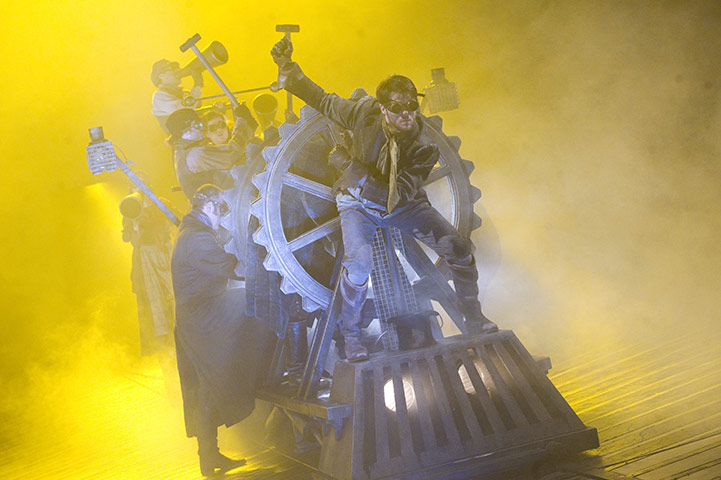
Monsters, Boobies, and OCD: Danny Boyle's Frankenstein at the National Theatre

Sadly, we are not in the UK, but we did just return from The Music Box Theatre where we saw the last show they're broadcasting there. The title is the ZK's review.


This has been getting rave reviews, lines around the block for day-of tickets, and so on. In many ways, the production deserves that and more. I liked it, but did not love it.

Every element of the design and staging is incredible. The stage is round with a central revolve, and overhead, there's a fixture comprising hundreds of lightbulbs. They're gathered in bunches, hung at different lengths, and it's at once oozing and organic and cold and artificial, evoking forges, power plants, and circuses. To represent the creature's first stumble into a town, there's this gliding platform topped with huge gears that rotate. Extras hang from the front and sides, jerking, slamming, writhing, and do-si-do-ing to something too clanging and brittle to be music, too patterned and hypnotic not to be. It's like Steampunk and German Expressionism had a Marxist-informed Baby.

The blind scholar's hut is represented by four scrimmed walls with a few natural elements stenciled on them; the Frankenstein home is all stiff, stuffy windows and shadow, but it churns up from beneath the stage and sits at a subtle angle. Victor's hut in Scotland has an appropriately claustrophobic, subterranean feel.

The monster is scarred, sutured, scabby, and oozing. The development of his movement, command of language, and command of . . . consciousness and self-awareness . . . are all stunning. The production we saw had Jonny Lee Miller as the Creature and Benedict Cumberbatch as Victor (the two leads swap roles each night). Both occupied their roles in a way that signals and excellent director and a creative process that's hard to achieve where actor and character are constantly growing and stretching. Really fantastic.

Oh, look! It's my "but" face. Charitably, Nick Dear's script is uneven, which is not to say that there aren't brilliant parts of it where Mary Shelley's text is illuminated, enlarged, and brought to life by the adaptation. But then there are parts that are just . . . clunky as shit: Felix and Agatha (the blind scholar's son and daughter-in-law) have awkward Tolstovian orgasms about having cleared all the rocks from their field; the Scots resurrectionists have painfully stilted attempts at Shakespearian comic relief; and Elizabeth lectures Victor on the God-given, societally approved power of her uterus. No, really.

Elizabeth, in general, is a nightmare. Boyle casts all the Frankensteins, save Victor, as actors of color for no reason that is particularly apparent (which is not at all to say that I think the actors ought to have been all white in some misguided attempt at authenticity, but Victor's whiteness becomes pointed). George Harris was simply not very good as Victor's father, although I wonder if his wooden delivery was directed that way, so that we remain entirely within the mind of Victor/The Creature.

Naomie Harris's portrayal of Elizabeth is almost beside the point as a performance. Her character is the victim of the worst of the script and a choice that came within a hair of ruining the whole shebang for me. As through the vast majority of the play, the action stays with the Creature, who springs from Elizabeth's bridal bed and has a conversation with her that, at times, almost salvages an otherwise dreadful scene. Then, unlike the book in which Victor hears a scream and comes across Elizabeth's lifeless body, Dear/Boyle have Victor burst into the room, revolver drawn (if you will) only to flail around on the floor for no apparent reason while the creature rapes Elizabeth, achieves orgasm, snaps her neck, and declares, "Now I am a man."

W.
T.
F?

Extra special bonus points not just for going to the "Women Exist For Men to Use in Their Attempts to Exert Power Over Other Men" Well, but going the extra mile and making the woman non-White. Seriously, just what the fuck?

But other than that, Mrs. Lincoln, it really, truly is a magnificent creative endeavor beautifully brought to life. But I'd consider nipping out for popcorn at strategic moments.

Labels: , , , , , , , , , , , , ,

Saturday, April 02, 2011

Songwriter's Navel: Week 12, In Which I Feel Both Very Sad and Very Weird

When I first started songwriting classes, I embarrassed myself mightily on 2 occasions by crying in class. I am both a crier and not a crier. During that time, life really kind of sucked. The ZK had spent the first few months of 2008 mostly dead and entirely unemployed. I was woefully underemployed and we were both discovering how bad the job scene was. (Lest you question my priorities, I use my volunteer points to pay for my songwriting classes.) At the time of both crimes, I really had no idea I was going to cry until I was actually crying, and the tears were only loosely connected to the songs. I am sitting here on my couch nearly 3 years later, cringing and seriously considering fleeing the country.

I would like to say for the record that I DID NOT CRY this week in class, although it was a very close thing. On March 26, Diana Wynne Jones died. She'd been diagnosed with lung cancer a few years ago, and had recently stopped treatment for a recurrence, after her doctors deemed it ineffective.

Having always been a nerd and a reader, I have many, many authors that I love, but I can't really think of one more important to me than Diana Wynne Jones. When I was about 9, I checked Witch Week out of the library and read it probably 4 times before it was due again. I was over the moon when I found Charmed Life in a second hand bookstore and my mother let me use some of her store credit to buy it. And then it was the library again for Fire and Hemlock.

So many of the things that I used to make and define myself come from her: I became fascinated by England and scared up a British pen pal (who, sadly, proved to be rather boring and annoyed by my incessant questions). I decided that, like Polly, I wanted to like classical music, and it turned out that I did. And I identified with her characters: With Polly and her broken parents and their invasions into the life she was trying to make. Maybe most importantly, Diana Wynne Jones showed me that escape was possible—through books, through school, through art, and through sheer force of will.

Of course, my obsession with DWJ and other fantasy forms wasn't always easy. At some point, I started to experiment with writing a little of my own fantasy. Around the same time, I was also falling in love with Jean Webster and her epistolary pastiche, so most of my writing was "homage" in the form of letters and diary entries. My mother found and read my notebooks in one of her routine violations of my fourth amendment rights and decided that I had had a break with reality. There was a particularly epic fight in which I essentially invited her to fax me the rules to her little game about what was real and what wasn't.

Passing over that unpleasantness, about 10 years ago, I was chatting on a Buffy the Vampire Slayer IRC channel with an acquaintance. She revealed that she was going on the London Eye with an author of hers as part of some World Book Day Event. I asked her the author's name, and she said something along the lines of "Oh, you probably won't have heard of her, it's Diana Wynne Jones." I exclaimed, "The silken skin of his back!" and she responded, "Sentimental drivel." And oh, what a renaissance! Such riches that I hadn't known existed: I'd never read Howl's Moving Castle or The Homeward Bounders or or or or or . . . wonderful. And, of course, I got a dear friend out f the deal who managed to convince my sister that the bust of Giles as a Fyarl demon that she'd given us as a wedding present was, in fact, a juicer.

Our assignment for this week had actually been to rewatch a movie that was important to us, choose a character we identified with, and write a song (in first person) from that character's perspective at the end of the movie. As soon as I read the news about DWJ I thought, "I am going to need to write my song about her." Immediately after that, I thought, "Ugh, you pathetic feeb. You can't possibly write a song about her! How dare you!?" Hmm . . . mom might not have been ENTIRELY off base about that break with reality.

Sunday night I was more or less trying to sneak up on my songwriting self, if such a self exists. I had really not had any time to rewatch a movie, and anyway, only strange Japanese movies kept presenting themselves. We didn't technically have any musical requirements except the Kernel's parting shot "It should sound like what it sounds like," which, you know, complicates the Japanese thing.

Kikujiro was the movie that kept most insistently presenting itself for consideration, and I did actually watch the last 7 minutes or so. Masao's dream on a field of stars led me to what would eventually become my bridge/B section/whatever you want to call it.


[Dsus4] How can I [G7/F] sleep I am [Csus2] closing in [G]
On the [Gsus2/A] name [Csus2] of the [G7/F] last of the [Dsus4] stars


Initially that second G7/F (if in fact that is the name of that chord—I neglected to get confirmation in class, possibly because I was trying not to cry). was actually an Ebmaj7, which was very weird and dissonant, but I kind of liked it. When this section had that chord and was standing alone, I thought, "Ok, I am not writing a DWJ song after all." It seemed too firmly tied to the Kikujiro ending.

And then I started writing verses that were very clearly DWJ verses, as the phrase "I am going nowhere" struck me as a not terrible opening line. (Playing with the word nowhere is central to the plot of Fire and Hemlock and "alternative wheres" are at the center of many of DWJ's works.) Parts of verses started to come to me pretty quickly, then, and I just left the bridge on the page under them, figuring I'd separate it out into its own document later.

Initially, Verse 1 was purely references to DWJ's books and characters, which kind of left me nowhere to go. So I had a version of Verse 1 and the bridge sitting on the page. I realized that the verses needed to mix things about her books and characters with a more immediately present moment. It shortly became obvious that the moment had to be connected to the fact of her death. And then I remembered this lovely piece that Neil Gaiman wrote about seeing Diana for the last time.

Suddenly, the bridge fit with the verses that were shaping up, if I changed the word sleep to "rest" and got rid of the aggressively weird Ebmaj7. The second half I had for Verse 1 became the second half of verse 2. Without too much trouble the lyric for the second half of Verse 1 got roughed out along with the first half of Verse 2. By Sunday night had the chords for those as well.


[Dm] I am going nowhere, I have [F] been there in the dreams
Of a [Gm] silver-haired woman and the [F] child she has been [Dm]
[Dm] I hear them say it's [F] safe to rest, the [Gm] light is paper thin
Now, [Fadd9] here I am [Am] waiting while the [C] stone vases spin [Dm]


[Dm] Another time, another place, [F] another life consumed
By the [Gm] white, hot, bloodless fires I [F] walked through in my youth [Dm]
[Dm] I have braved the [F] ghosts, the mothers, [Gm] worlds away from mine
Now, [Fadd9] here I'm going [Am] nowhere, [C] running out of time [Dm]

[Dm] [Dsus2]


Verse 1 is almost entirely drawn from Fire & Hemlock; Verse 2 could also be a reference to the Undying Laurel from that book, but also to Christopher, Cat, and the other 9-lived enchanters from that series. For once, I didn't struggle too much with rules about what the verses must be or do. It felt like thinking out loud about the themes in all her books, which of course deal with a lot of the good and not so good in her own life.

I'm not in love with the verse's chord progression. It is more mournful than I wanted it to be, although changes I made to the melody as late as Tuesday afternoon alleviated that, at least to some extent. The progression in the bridge is one of those weird things that came all by itself and insisted that I figure out how to play it. When I had originally written it with the Ebmaj7 in it, whatever wrote it insisted that was right. After I grafted it to the verses, though, it was content to ascend, then descent. I kind of like its ambiguous character, but I'm still not sure it's right for this song.

I wrote the third verse on Monday evening before rushing up north to practice, then play at Silvie's. . There's a brief shout out to Calcifer and Howl's Moving Castle, then just generic reflections (that I have no right to make) on life and all that. The long second line dogged me when playing it in class, but it also was resistant to change. I really don't like the last line of this verse.


[Dm] Stars must fall to earth we cannot [F] catch them in our hands
Anchored [Gm] heartless like these hours slipping [F] by like grains of sand [Dm]
[Dm] I have sown a [F] paper garden, [Gm] sons and daughters grown
Now, [Fadd9] here in the [Am] arms of nowhere, [C] I am not alone [Dm]


I was really unsure if I could go back to the bridge/B part, but it felt abrupt just ending on the third verse. As it turned out, R wanted to hear the B part again, hence the repetition at the end. I didn't tell my classmates what the song was about before playing it, and they had funny guesses. D said something that I really liked about how the narrator seemed like this ephemeral being dipping in and out of the scenes, which I guess is not a terrible way to describe the relationship between author and characters.

Very hard pressed for recording time, as we have house guests and I have work coming out of my bottom. There are incredibly dead spaces where I just keep hanging out on Dminor for no good reason other than I didn't have time to do another take. Probably there could be short melodic passages there. Or something. Um, you'll also hear the tippy tappy of hound dog nails over the vocal track.


As the title notes, I feel really weird about this song and was tempted not to record it, but here it is anyway.

Labels: , , , , , , , ,

Friday, July 31, 2009

Undead By Numbers: Dead Snow

From the time that the very first previews for Død Snø popped up, there was never any doubt that the citizens of the Painful Acres would be taking in a film. We very nearly missed it at the Music Box Theatre, but not even our short attention spans could undermine our resolve, thanks to the fact that the run was extended, and off we went Wednesday night.


I know that you're all thinking "Of course that's what she was going to say!", but it's good! Wait! Shane! Come back! Mother wants you! I know she does!

Ahem.

No, seriously, it's good.

It's good as a zombie movie: Gross, but not too gross. Funny, but not too self-consciously funny. Filled with surprising moments and suspenseful moments in good balance with one another. (And if one is looking for further evidence that Tommy Wirkola has studied his Hitchcock, I'd swear that there's a scene or two where hand props are oversized.)

It's good as an homage to the horror genre, generally speaking, and to the zombie subgenre, something that is not easy to do. One character is a movie buff, and Wirkola and co-writer Stig Frode Henriksen (who also stars) lightly sprinkle the dialogue with references to other genre classics. There's very little that's unexpected as the plot unfolds, but Wirkola is very good at including shots or sequences so typical of the genre as to be mandated, and still making his own mark on them.

It's good as a movie, period. All the cast members are good, and there's no one in particular that you'd like to see chomped immediately. The screenplay is structurally successful. It starts with zombies. It ends with zombies. It capitalizes on the genre very well by having 99% of the exposition confined to "Monologue by Mysterious Stranger in Act II" (in this case delivered by Bjørn Sundquist, aka the Norwegian Harvey Keitel). And it moves along at a good clip, running just 90 minutes. It's filmed with considerable technical skill (no heavy-handed irony about inept filming techniques or subpar equipment), and it has considerable style.

For example, the opening sequence involves an outdoor chase through a snowy mountain forest. It's set to "In the Hall of the Mountain King" from Peer Gynt: Not exactly a bold and new choice for horror music, right? But it's deployed in a really effective way. The music drops out entirely in midsequence, then returns, reaching its crescendo as the chase comes to its expected conclusion. Visually, we've been given the briefest of glimpses of the zombies, and even briefer peeks at a character that hardly appears at all, but who is nonetheless important to the plot. All we see of her unfortunate end, really, is bare, winter-blackened branches shaking wildly, but it's somehow a perfect distillation of the sex and violence mash-up that is the horror genre.

Certainly there are excesses and bits of silliness. As the ZK pointed out, someone seems to have gotten a bulk discount on pig intestines, and I was wondering what it is about this particular species of Norwegian tree that makes it crave entrails. In an otherwise pretty solid screenplay, Wirkola and Henriksen are perhaps a bit too casual about the plot mechanism driving the zombies. Toward the end, they also might veer slightly over the line into heavy-handed hilarity (then again, it's handled admirably by the actors).

So don't listen to Ebert and those other cranky butts. Many disembodied thumbs up!

Labels: , , ,

Tuesday, July 07, 2009

De Trop: Transformers 2—Revenge of The Fallen

There's really so little point in my attempting to review Transformers 2: Revenge of The Fallen, first because it is not really a movie, as such, second, because you can't top Topless Robot. But when have I ever left it at that?

In some ways, T2:RotF (hmmm, is that a 533kr1t message in the title's acronym?) is more successful than the first movie, because it does not make the mistake of shorting you, the viewer, on the Giant Robots Kicking The Asses Of Other Giant Robots front as the first "film" did. Even Optimus Prime's stabby, stabby swordfist makes a very early appearance in Shanghai.

Speaking of Shanghai . . . oh, damn, I was about deploy my Home Movies–based "shooting day-for-night, like Truffaut" joke ('cause the helpful War Games-era computer-y text at the bottom of the screen says "Shanghai, 22:15," but it's bright daylight), but I just realized that this could be a time-zone thing. Alas. Can I still quibble about the movie's deep confusion regarding to which branch of the military Josh Duhamel (still pretty, still charming) belongs? Can I note that I appreciate Rainn Wilson in . . . an opera cape? . . . as much as the next gal , but I have never, in my whole born life, been to a huge lecture class attended by "the Dean" or even "a Dean"? Yes, I think I can.

I'm not even going to have a go at this plot, because, really "Michael Bay does not understand what a robot is" and "Because... because FUCK YOU, that's why" pretty much sum it up. I'm not sure that these statements are any less true of the first movie, by which, you will recall, I was pretty charmed. I was not charmed by Transformers 2.

Despite the aforementioned stabby, stabby swordfist, despite the fact that Devastator is pretty freaking cool, despite the complete absence of the demented Australian Black Canary rip off from the first movie, and despite the fact that Michael Bay clearly stopped creaming himself long enough while watching The Incredible Hulk to write in a car boxing gloves scene of his own, I was really not charmed. Why?

Well, you've seen the trailer, right? So you, like everyone else in America, are qualified to comment on Megan Fox's pelvic health, courtesy of the scene of her dry humping the motorcycle. If that struck you as a bit much, let me tell you that the scene in the movie would have required lights, gels, and make-up for her freaking fallopian tubes. It is that extended and invasive. Even if I didn't think less than nothing of Megan Fox, to say that this is creepy doesn't begin to describe this sequence.

Of course, Fox has competition this time in the form of Isabel Lucas, the human-form Deceptislut planted at Sam's college for God Knows Why. At first, it simply seems that "Alice" is simply the most frequently objectified blip on the radar of Sam's web entrepreneurial roommate (I do have to be grateful to Michael Bay for NOT exploring the purpose of the serial killer wall of photos of young women in the cyberden). You see, women go to college to walk the hallways with washcloths wrapped around them, and Alice excels at fitting into this environment. But then she enters upon her campaign to show Sam that MF knows exactly jack about dry humping.

I find that here I really must pause—and I apologize, because I know you're excited about the humping—to address a "plot" element not covered in the Topless Robot FAQ. So Sam lives in LA, right? And it's mentioned several times that he is going to college "On the East Coast." There's a whole baked scene at his natal home with them all packing up the minivan before the appliances come to life in a scene that I'm pretty sure is just doctored footage from Gremlins.

(Here I pause in my pause to, once again, thank Michael Bay for NOT including one of Sam's mother's sex toys among the appliances come [so to speak] to life. Given your rock-bottom opinion of women, Michael, it must have KILLED you to skip the "ZOMG! Middle-aged women like sex! HOW GROSS IS THAT?" joke.)

ANYWAY. LA to East Coast, presumably by minivan. Except that all members of the Witwicky clan are wearing exactly the same things when they arrive at the college as they were when they left LA. Fine, whatever, they were loading up the minivan to head to the airport to pay another $40K in extra-baggage charges, rather than driving cross-country. BUT THEN Bumblebee, who was cruelly left behind by Cool!CollegeBound!Sam in move that smacks of Act III of any nerd-based 1980s classic, shows up on Sam's first night of college. Can he, like Jetfire, inexfuckingplicably teleport? AND WHY DO I CARE?

In truth, I do not. I want to get back to the Deceptislut for a moment. So Sam, who is having the world's least convincing quasi-epileptic episodes, courtesy of the Hellraiser shard, initially tries to fend off her advances. Bumblebee, like a true nerd!friend, is determined to save Sam and his relationship from Sam himself, so he drives up on the hedge of the fraternity house. Sam beats feet out of there, and Deceptislut calls shotgun. She starts talking car!pr0n to him, and Bumblebee deploys the possessed radio gag, beginning with "Your Cheatin' Heart." Funny! He then switches to "Superfreak." Still funny! And then he whips the passenger seat forward, slamming Alice's face into the dashboard. HILARIOUS, right?

You can certainly feel free to call me a hypocrite, because I enjoy violence-laden action movies. So what is it about this that really chaps my hide? It's a passing moment in a comic relief scene. It's hilarious that Sam is such an over-caffeinated boob! It's touchingly funny that Bumblebee is so devoted Sam, despite the fact that Sam has spent their time together in this movie being a complete prick, that he will totally put that bitch out of commission to protect Sam. So he—I have to say it again—slams her face into the dashboard for comic relief purposes. And, yes, I know she's a Bad Guy! (although Sam doesn't know that, and his reaction is so underwhelming that that's a huge part of what's disturbing about the scene).

Moving on. With all my sensitive girly worrying about misogyny here, I'd certainly be remiss if I did not give a WTF?!? shout out to racism in the movie as well. Recall, this is from the same director who included a scene of unbelievably old school racism with a human in the first movie, BUT STILL. Skidz and Mudflap both have giant, sticking out ears and buck teeth. Their dialogue out-Jar-Jars Jar-Jar by a loooong shot. Also, please note the gold pimp tooth. That's Klassy with a K, Mr. Bay.

Overall, the movie is just without charm. It's just as baked (literally in this case, and I'm with Topless Robot in wondering what the hell they were thinking with the pot brownie scene) and nonsensical as the first one, but there's very little that's fun about it. John Turturro seems sort of pissed off and slightly bitter. Also, though I love him, I did not need to see his butt crack being flossed by a Sector 7 thong (although that provided postproduction hilarity when the ZK asked me, "Did he say I wear it when I fuck?" No. No. he did not. He said, "I wear it when I'm in a funk.") The EBIL GOBERNMENT subplot makes no sense at all. The attempts to inject emotion into the relationships Sam has with MF and his parents were a tragic mistake.

This thing is One Hundred And Fifty Minutes Long. There is no excuse for that in a well-ordered society. A lot of the dead weight that the movie is carrying seems to be 12-year-old boy-directed humor. I do not begrudge my up-and-coming tween nerds their dumb comedy, but there has to be 20 minutes of ill-advised scenes like Johnny 5 or whatever the hell his name is humping MF's calf, and every one of those 20 minutes was met with dead silence in our theater, which was heavily populated with the presumed target demographic.

So I have to ask myself, as you should be asking yourself: At what price more hot robot-on-robot violence?

Labels: , , , , ,

Thursday, May 14, 2009

Welcome to the Bridge of the USS Crap You Already Knew: Star Trek

First, everyone either looooooved or haaaaaateed Watchmen, and I thought it was ok at best. And now Star Trek—this would be the same Star Trek that has a 96% at Rotten Tomatoes—well, it was ok.

I mean are we getting the subpar Midwestern cuts?

I suppose I should begin by praising casting: They certainly prepared me to watch Chris Pine for a couple of hours by casting two astonishingly ugly people as his father and as his younger self. On the other hand, is wholly unbelievable that these eyebrows, this blank stare sprang forth from the loins of Jennifer Morrison, who is quite gorgeous. I'm not sure I'll ever feel the same about Cameron again, though.

We'll be kind and leave the aberration of casting Winona Ryder in any role for any reason and say that casting really did quite a good job.

  • Zachary Quinto as Spock is rather a no-brainer. I do wonder how many times daily they had to stop filming to remove his 11 o'clock, 11:15, 11:27, etc., supraorbital shadow. Also, the back of my mind kept screaming that Kirk had obviously stolen Sylar's eyebrows.
  • Zoë Saldana was a good Uhura, and she had a promising start in the movie. Actually, I'll reserve my reservations (ha, do you see what I did there?) on this front for later.
  • I like Anton Yelchin. Have liked him since !Huff, although he took a while to grow on me. Sadly, all Chekov is to Abrams is an ambulatory accent joke that, in retrospect, is kind of a slam on Walter Koenig.
  • I was not feeling the love for John Cho as Sulu. I didn't dislike him or anything about his performance, it was just kind of a void. And, yes, it bothers me that he's Korean not Japanese.
  • Simon Pegg was completely flawless and wonderful for the 8 minutes that he is actually in the movie.
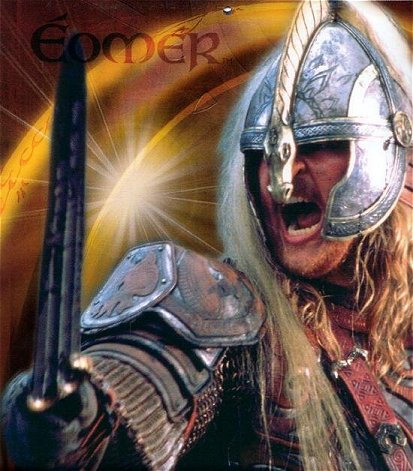
  • Karl Urban. I can't remember if it was an Onion joke or something from Peter Sagal or others on the WWDTM crew, but I chuckled in my usual sophisticated manner at the thought of Karl Urban losing it and lapsing into Eomer. Whoever it was appears to have been joking on the square. Ok, so he wasn't Eomer in the scene where he and Kirk meet, but he was like some awful DeForest Kelley impersonator. Certainly he was better later, but I don't know what kind of director yells "Cut! Print! GOLDEN!" after those shenanigans. Oh, wait: I do.
  • Bruce Greenwood's good. He even manages to sell the line about Kirk being the only "genius-level repeat offender in the Midwest" while looking into the terrifyingly blank eyes of Chris Pine.
  • Pine. Other than cheap shots about how unattractive I think he is, how was his performance? Kind of irrelevant. Abrams' approach is to catapult Kirk through a series of masturbatory Adventure!Scenes! Really, a crash-test dummy could have played Kirk, so there's not a lot to judge Pine's performance by. I will say that most of the cast managed to have at least one moment of emotional reality, despite Abrams. Not Pine. Not even with Nimoy on Hoth the M-class planet near Vulcan.
  • Bana's Nero was exactly what I imagine they wanted. He outgrowls Bale in The Dark Knight; He yells SPOOOOOCKKK presumably until the entire crew reaches climax; he wears the prosthetics well. I thought maybe there would turn out to be something interesting about his relationship with Ayel (and you should totally go see Clifton Collins, Jr., in Sunshine Cleaning, by the way), but . . . no, they're really just two Romulan miners displaced from time hoping . . . well, I really have a better idea of what the Decepticons' goals were, I guess, because I was thinking that they deserved a trip to Disneyland after getting not one but two Spocks to witness the destruction of Vulcan.


I really should have liked the whole movie more, because the casting really was very good. Unfortunately, the script and direction weren't. Last fall, my sister, my niece, and I went to see the stage version of Dirty Dancing. It was a very strange experience. Not unenjoyable, but strange. The leads were made too look as much like Jennifer Grey and Patrick Swayze as possible. They were very good dancers. But other than a strange and misguided attempt to inject some more Civil Rights–Era weight into the script, it's basically a stage reenactment of the movie.

The dancer (I deliberately refrain from calling him an actor) playing Johnny had an extremely strange and heavy accent. I remember being very surprised that he was supposedly from Australia, because his delivery strongly suggested that he had learned his lines phonetically. This mattered not a whit. The crowd still went wild when he declared, "Nobody puts Baby in the corner." It's fortunate that this comes near the end, otherwise one senses that the place would have emptied faster than Springfield's Ghery-designed Concert Hall.

The script for Star Trek resembles nothing so much as a series of post-it notes, each with a "must-have" moment scribbled on it. You have the heavy-handed establishment of the "Bones" moniker in Urban's painfully unchecked DeForest Kelley impersonation, and later the mandatory "Dammit, Jim!" You have "I have been, and always will be, your friend," and I admit that Nimoy, as always, pulls it off despite Pine's resemblance to the world's most mentally challenged cocker spaniel. You have the tragically underused Simon Pegg "Givin' it all she's got!" You have the audience fairly shouting "Say it! Say it! Say it!" for Chekov's "Wictor Wictor" and later "Wessels."

I suppose sticking to the well-known territory was all for the best. From early on, when the script tried to be a script for the movie in progress, it was filled with "Wait, what now?" moments. It's true that I often have to consult my spousal unit to clarify certain issues about Trek. So when a Romulan shows up on screen and no one on the Kelvin has any reaction whatsoever to what I gather is supposed to be the first-ever sighting of a Romulan in this shiny new timeline, I figured I was misunderstanding something, but it seems not.

When big-handed Kirk (ok, I admit that I got deep satisfaction from McCoy chasing Kirk around and jabbing him in the neck repeatedly) busts on to the bridge and makes his big reveal to Pike, well correct me if I'm wrong here, but our Young Turk has just bust in and said Shit. That Everyone. Already. Knows. The only thing that he even arguably reveals is the transmission that Uhura intercepted, a little fact that would've been common knowledge if Abrams—as every watcher of Lost knows—didn't have some deep fear of periodic staff meetings in which information is added to the common pool.

As the ZK pointed out, I guess Kirk gets Pike to raise the shields before dropping out of warp (which, call me crazy, if I'm flying blind into a distress call–driven situation with no further information, I'm all about the shields). Starfleet really has lowered the bar if that's enough to get you bumped to first officer.

The ZK inadvertently preyed on my shaky Trek knowledge when he started flipping out about Spock's mother dying. I, for one, supporting killing Winona Ryder as often as possible on screen, particularly when she has been inexplicably mummified with half a pony keg over the front of her torso. (In general, my feeling is a giant WTF? about the costuming; nice slash-pocket Dockers on all the boys!) PLUS, I was all "Why is he worried about messing with the fact that Spock's mother is supposed to be alive and well when I am worried about the fact that, as far as I know, VULCAN has never been blowed up real good." But the ZK's Trek priorities, like Tim Conway, defy augury.

It's a shame that the script is such a shambles, because I don't think it had to be. I really like it being anchored in the extraordinary relationship between Kirk and Spock. (I liked it better before the unnecessary scene with Nimoy and Quinto that spelled this out, not because I begrudge either of these two screen time, but because it shattered my last hope for any kind of delicacy in this movie.) But I don't think that centering the movie on that relationship should involve sacrificing your other characters to campy "TCB now! No New Crap!" cameos." And if that IS the center of your movie, then maybe spend a little less time on the Wet Dream Adventures of James Tiberius Kirk and a little more time on WHY that relationship is important (and why it's crucial that Spock be the "bottom" in it).

Let's now talk completely extraneous crap:

  • Hoth the M-class planet near Vulcan? In addition to being silly, what the hell's up with having Kirk climb out of the pod's crater in his Academy jammies? Couldn't help thinking that this looks like the kind of planet where exposure = death in seconds. Also, totally gratuitous use of Cloverfield leftovers. I would like to invite Mr. Abrams to get over himself.
  • I'm willing to give Abrams a pass on the "Why do we even have that cavernous central pit?" for the Romulan ship, because it's de rigeur for all space-faring movies at this point. But seriously, a ship designed entirely around catwalks?
  • I honestly don't know if the Uhura/Spock relationship is extraneous. Sadly, Uhura is practically extraneous, which is made worse by a promising start for the character. I don't particularly object to the relationship (although I don't buy them macking in plain sight on the transporter pad for a minute), but it highlights Star Trek's gender fail. I appreciate that the movie is stuck with a lot of the baggage of the 60s series (especially the costuming, and both the ZK and I agreed that female crew's uniforms were an area where the costuming succeeded pretty well), but I don't get the feeling it was a priority to work their way free of that baggage. I mean, seriously: A "Hope this hick isn't bothering you!" bar fight? Serial "lingually gifted" jokes? I liked the chemistry between Saldana and Quinto. I liked that she is supremely uninterested in Kirk. But it chafes that making her the girlfriend is all they could think to do with her.
  • The scene with the convertible—and again, I feel I must point out the incredibly ugly child.
  • Abrams' directorial "style." Bad bad bad bad bad bad bad and again BAD. Step away from the shakier-than-thou hand-held nonsense. And I SWEAR TO BA'AL if you dolly in and swing 270 degrees around a character's GIANT NOSTRIL HAIRS just one more time, I am going to give you such a pinch. Oddly enough, I had some hopes early on that he'd toned down some things. In retrospect, the directorial moments I didn't hate seem to have been cribbed from Battlestar Galactica.


I suppose that's about it. I could rant about the IMPLIED VIOLENCE AGAINST BEAGLES! But then I would never stop. I could spend some time on "It's a big red ball. I can't wait to tell my friends. None of them has a red ball this big." I could chide Abrams for stealing the Fire Swamp's Flame Spurt gag from The Princess Bride. But that would be piling on, now wouldn't it?

Labels: , , , , ,

Wednesday, April 22, 2009

Breathers: A Zombie's Lament, by S. G. Browne

I realize that my review of anything with the subtitle A Zombie's Lament will be considered suspect, but this is quite a good read. I'll try to keep this as free from substantive spoilers as possible.

The opening scene of Breathers—and I do not say this lightly—rivals the opening scene of Sunset Boulevard. It's quite an opening scene to live up to for better than 300 pages, but Browne pulls it off almost flawlessly. The whole novel is narrated in the first person, present tense, although about 2/3 of it is actually spent catching the reader up to the events in progress in the opening, so again, very much like SB, except our William Holden stand-in is available for another third of a novel. Aces!

Despite the opening nod to SB, Breathers is more Catcher in the Rye than it is Maltese Falcon. (Although Joe Gillis is more Holden Caulfield than Sam Spade,isn't he? Forgive me while I lurch my way out of this metaphor.) Sure, there are noirish elements to Breathers: Andy, our undead narrator, is quite the Everyzombie, and he neither courts nor consciously creates the interesting times in which which he's not living.

Most of the chapters are short, sleek vignettes. They're a series of funny, painful glimpses into a Day in the Life of a Zombie. Through them, Andy's individual story is revealed. There's not a lot of time spent on Browne's zombie mythos, which is fine, as it amounts to "Some people just reanimate, don't really know why. Probably genetic, but anyway, it's been happening for decades, if not centuries."

Browne wisely spends his time fleshing out (oh ho ho! I swear to you, I did not see that one coming until it was typed!) the unlived experience of Zombies, showing the reader how reviled and disempowered a segment of society they are (even in Santa Cruz—I suspect the vampires). He shows us, through Andy and his compatriots in an Undead Anonymous group (the only manifestation of Zombies' First Amendment rights, and these are monitored by a Breather), what human habits die hard and which ones slip away all too easily.

What else can I say? There's romance, fighting, dismemberment, fire, chases, escapes, porn, civil disobedience, disguises, and a self-actualized Zombie named Ray who turns out, strangely, to be a kind of Mary Poppins for Andy and his posse. (Actually, that would be one minor criticism of the book: Ray turns up, takes everyone by the shoulders, nudges them down a particular path, and then meets an ambiguous end off screen, so he's a touch Zombie ex machina.) It's funny—very funny—but like the best Zombie movies it's also social commentary and social commentary done deftly.

Without spoiling anything, I think I can say that the book ends with the Zombie Apocalypse (a very local one, at least) on he horizon, but leaves the door plausibly open for a sequel. And let's face it: If you could reanimate Joe Gillis for one (possibly) last hurrah, wouldn't you?

Labels: , , , ,

Wednesday, March 25, 2009

So Say . . . Well, I . . . Because "We All" Said So Some TIme Ago

A handful of thoughts on the ending of Battlestar Galactica. 5p01l3rz, obviously!

I really liked Battlestar Galctica a lot, although I don't think I ever loved it. Just when I might've gotten to that point, the first season ended with the "1 Year Later" bullshit. I never quite got over that, which is unlike me. (I am, generally speaking, a very adaptable TV viewer.)

We were well behind in BSG viewing pretty much all season. I don't think I got spoiled for much of anything, which has a lot more to do with being out of the fandom than good behavior on anyone's part.

My interest really dipped to a low in "Revelations," as the nuked Earth seemed so very obvious. The byzantine explanation of the final five and their place in human–cylon history was not helping. When we picked back up "Sometimes a Great Notion," I was frustrated with all the shortcuts taken to Dee's end.

It isn't that I find a suicide at that time unbelievable. It isn't even that I didn't buy that Dee would take her own life. In fact, I pretty much knew from the moment we saw Dee's reaction shot on Earth that she was done for (didn't necessarily know it would be such an overt suicide). But her whole story line takes place against a kind of emotional green screen. By the time we have the bizarre scene with her romping with Hera, Helo, and Athena, I wondered if the problem wasn't Dee, but that everyone else in the main cast had suffered some kind of head injury that prevented them from seeing that she'd snapped. And, well, the best thing I can say about that episode is that Lucy freakin' Lawless and her nightmare hair finally got left behind.

I liked "The Oath" and "Blood on the Scales." It was good to have Gaeta finally do something—some culmination of behavior that had been bizarre and erratic since he served as President frakking Baltar's aide de camp. There was plenty of fury to go around on both sides. Zarek's slaughter of the quorum could be viewed as annoyingly directive (LOOK! LOOK! HE'S THE BAD GUY! DON'T ROOT FOR HIM!), but that gun was on the mantel when Zarek was introduced: Whether he's a guerrilla or a freedom fighter in today's paper, his tactics will always be brutal and uncompromising. Oh, and I loved the return of Starbuck—MY Starbuck, devoid of emo and bubblegum.

Unfortunately, "No Exit" killed any momentum that had been built, at least for me. Talky, talky. Obvious. Boring. Stale metaphors. Yes, I have couch trauma related to No Exit, specifically, but I don't think it was all in my head. "Deadlock" didn't do a great deal to pick up the pace, either. Part of the problem was poor Ellen's schizophrenia.

I've no idea when they decided that she was the final cylon, but boy was that decision covered in phlebotenum. I don't fault Kate Vernon, who did very well occupying an entirely new character we'd never seen before. I fault the whipsaw writing that tried to reconcile her as the real brains of the five with her long-running, completely-toxic-but-somehow-a-great-love relationship with Tigh.

But then I loved almost all of "Someone to Watch Over Me." Ok, I loved about half of "StWOM." Ok, I loved the Starbuck parts. The crushing monotony of the briefings. The sudden memory that the more fucked up things get, the funnier she gets.

But then there's Chief. What. the. Fuck? In addition to not buying for a frakking second that he is so completely undone by Boomer's reappearance that he can't think straight, I found it staggering that the script for the episode barely acknowledges the fact that Chief presumably beats another 8 unconscious to make the substitution in Boomer's cell. When we then add in the torture porn of inherent in juxtaposing the Boomer/Helo sex to the bruised, bloody, and bound Athena in the closet . . . UGH. Please, writers, work out your own mommy/woman-who-done-you-wrong issues on your own time.

I'm just going to skip "Islanded in a Stream of Stars." Honestly, I can't remember much about it, and the Boomer Beating/Beat Off material of "StWOM" leads pretty well into what I liked and disliked about "Daybreak."

The flashbacks to before the fall could have gone wrong, but on balance, I liked them and appreciated the pieces of characters that they slotted into place. On a technical note, using long shots in most of these flashbacks caused me a lot of "Is that Lee or is that Anders?" confusion.

I know there's a lot of dissatisfaction with the Kara/Lee nookie close encounter, and I appreciate and get the criticisms. However, it kind of worked for me. I buy the fact that Kara loved Zak in her fucked up, damaged way. But I also buy that Kara is and always has been exceptional, in both positive and negative ways, and so is Lee. In contrast, Zak is a nice guy, but plodding. Ordinary. Mediocre.

It's not particularly admirable in either Kara or Lee that in the moment, they'd forget about the little people (and it's a pretty tired, ethically suspect convention) but I believed it. Anders' monologue about perfection shed more light on both Kara and Lee than it did on him. (That's my bias, certainly. Michael Trucco's performance never elevated Anders to anything more than a Lee also-ran as far as I'm concerned.) Plus, I'm sorry, but no one's chemistry comes close to rivaling that off Bamber/Sackoff. I am shallow.

Beyond that, most of my likes/dislikes are bullet-pointable, and so I shall bullet-point:

  • Nice of the writers to leave Chief completely out of "Islanded in a Stream of Stars," and then casually reveal, "Oh yeah, Chief's complicity with Boomer? We knew about that." Um, what?
  • Hated Kara-as-Angel. Hated the Angels in general. Hate hate hate the tired SciFi (SyFy, syphilitic) trope of postcorporeality being the ultimate stage in unilinear human evolution.
  • Poor Cally's kid! (Does he even have a name?) Everyone forgets until the last moment that his mom got airlocked My Two Dads both go off on the suicide mission.
  • And speaking of our belated recall that Cally got airlocked. . . . I've been hating on Tory for a good long while for a variety of reasons, Cally's quickly forgotten death being chief amongst them, but I hate that her end came Tyrol's hands, given the events of "StWOM." Nice that Boomer buys it for her sins, Tory buys it for her sins, Dee buys it for . . . well, I don't especially know why Dee drew the suicide card, and Tyrol gets to finish the series with a manly act of violence against his former lover. In general, the clumsy inattention to gender in the last few episodes really annoyed me.
  • WTF? on Cavil deep throating his own gun.
  • Yes, I know that President Badger made no sense whatsofrakkin' ever, but it made me laugh. Plus the dog makes it, which means I don't have to hunt down and kill every last person associated with the show. A domesticated dog in the mix 150,000 years ago probably shouldn't screw with the timeline of animal domestication TOO much, and dogs do come first.
  • Not that anyone but me cares, but the setting of the fleet's arrival on Earth 150,000 years ago means that we might attribute the successful diaspora of anatomically modern humans at the expense of archaic Homo sapiens to interbreeding with the fleet. That's a pretty punk-ass unifactorial explanation. The ZK, at 1:26 into "Daybreak," paused the TiVo, put his hand on my shoulder, and said, "This may be hard for you." It's fortunate that the script didn't go too far down that road.
  • Mary McDonnell is such a star. I just loved her performance at every single moment in the series, even when the writing for her was shit. Like everyone else, I was completely undone by her scene with Cottle, and I just love her.
  • I'm glad that Helo survived, even though I'm not sure how he did. Helo may be the one character whose moral compass remained more or less intact through the whole series.


And that's about the it.

Labels: , , , ,