
Telecommuniculturey

High- and low-brow cultural goings-on in the Second City, brought to you by a roving microtechnoanthropologist

My Photo
Name:
Location: Chicago, Illinois, United States

This is fiber optic cable, which is the future. This is culture, which is delicious.

Sunday, July 22, 2007

That Province . . . Took ADVANTAGE OF ME: The Halifax Report, Day 5, pt 1

Thursday was the last day of the conference, and it was really only a half day with the most appalling excuse for 'science' packed into it.

Truth be told, I spent most of the first morning session catching up on my e-mail. As I mentioned in my first report, the Lord Nelson's lone flaw was the lack of free wireless in the rooms; fortunately part of our conference schwag packet was a login and password for the Dalhousie wireless network. However, I'd been mostly too lazy to carry the New Hotness to campus most days.

Anyway, caught up during the first session so that I was able to devote full attention to the second. It had some hoity-toity title like "The Phenomenological Post-Kantian Repercussions of How Totally Awesome it Is to Be Human," which was not confidence inspiring. Fortunately, the chair, who was also the first speaker said, "I have no idea what's up with that title . . . but all the papers in this session kinda sorta deal with humans. Let's rock and roll." (I paraphrase.) Most were good, even one by a member of the legion of our sworn codon-model enemies. (Diabolically good, because convincingly presented and completely devoid of any of the criticisms we've been leveling, which amount to: "Yes, and? What the hell difference does this actually make to anything we're looking for?"

But there was a truly appalling paper in this session. Worse, it was a truly appalling NIH-funded paper. It had ridiculously hand-waving hypotheses, a good 20 years out of sync with current literature and thinking, that were not even being tested by the data collected. True crap and very disappointing to see it anywhere, let alone at an otherwise high-quality meeting. It was especially unfortunate that this was in the last session and left me with a bad taste in my mouth. A bad taste that could only be removed . . . by shopping.

Most of our walkabouts were at night, and most nonhospitality businesses were closed at that time. This had absolutely zero effect on my drooling over things in windows. Specifically, there was a small hosiery/lingerie shop that had a to-die-for grey scarf with a skull-and-crossbones motif. Had to have it. Also had to have some superfly skull laces for my Doc Martens as it turns out. Who knew?

While I was merrily shopping, J drew the unenviable task of not only shopping with me, but simultaneously trying to sort out why the hell we couldn't check in for our flight online. We had discovered this unfortunate fact just as we discovered that the Lord Nelson really is not very smart about these Intarwebs things. (Even in their business center [which comprises 2 PCs], they required that you call down to the desk for a 45-minute key to log in. Blegh!)

As we wandered away from the hosiery store and further down Spring Garden, J scored (a) a live person at United (SPIT!) Airlines and (b) a fabulous shirt befitting Puffy D (you probably don't want to ask). Still further down the street, there was a shoe store that, at first glance, I thought was called Ka/Ks. (It was, actually, Kas Footwear, which is weird enough, and if you know why, I either pity you or scorn you as one of our legion of sworn codon-model enemies.) Some Campers totally wanted me there, but I remained strong.

Continuing on, we decided that it was probably a good idea to fortify ourselves with at least a bit of lunch. We shared a tasty enough bagel sandwich and I recaffeinated. Always a good idea.

We soldiered on past the Commonwealth's most baked library. As we were heading down the diagonal path toward the store next to Mary Jane's Smoke Shop (not a smoke-shop, a hippy clothing/jewelry/fabric/tchotchke store; ah, thank you, google, it was called The Black Market ), J took my elbow, and stepped us off to the side of the path, muttering "Rickshaw." I was just on the verge of laughingly saying, "I'd have sworn you just said 'rickshaw'," when a man pulling a rickshaw passed us by. Though slackjawed, I was able to repeat, "Rickshaw?" And being Canadian, he politely offered us a ride. We did not, however, take him up on this.

I got a cute wrap skirt and a red belly-dancing top at the Black Market. Why a belly-dancing top, other than to make all who have seen me scream, "MY EYES! MY BRAIN! HOW COULD A SUPPOSEDLY BENEVOLENT GOD ALLOW THIS TO HAPPEN?" Well, (a) because it was $9, (b) because if I ever do get off my butt early enough, I want to take the Middle Eastern Belly Dancing class at OTSFM, and (c) because Puffy D was watching out for the interests of the ZK.

From the Black Market, we continued on along and down, passing the Press Gang 15 or 20 times as we made our way northeast. The most notable stop we made along the way was at Peep Show Girly Boutique (I have to tell you I loathe that article, which I'm glad I didn't see before we went in). Rather than being . . . well, anything at all like what that article purports it to be, was eerily like stepping back into the shopping fugue I experienced in New Orleans last fall. The staff were over-the-top friendly (even for Canadians), but were far from attempting the hard sell. Rather they kept urging us to have fun and look at things.

There were easily 7 different bags that I really, truly, needed to have. And dresses. And skirts. And kneesocks. And jewelry. And shoes. And then there was this completely awesome shirt that had a guy with giant mutton chops and the caption "I like boys in punk rock bands," (tragically, it did not fit). How I had the willpower to leave there with nothing more than a bright blue shaving kit decorated with the Warhol skull (I'll use it as a toiletry bag, which I honestly needed) I will never know. Probably inciting J to purchase items as gifts helped.

We'd sort of had a vague intention of going down to the maritime museum (and there just HAPPENED to be a store down there we wanted to pop into), so we headed waterfront-ward. At the store that just happened to be there, I picked up some neat little hexagonal hoop earrings and a necklace with an interesting brass pendant. We tried hard to get a luscious silk blouse for Wire Monkey Mother, but sadly, the sizers in this store were working on the "teeny, rackless" Asian sizing model and there was no room at the inn for The Girls. Pity, because that charcoal blouse was smokin'.

The outbreak of capitalism rather derailed our plans on the cultural front. By the time we got to the Maritime Museum, we realized that we'd only have 45 minutes or so to wander around. Now that might be enough to time to taken an exhibit called, simply, Pirates, but once you add in the exclamation mark, you're in for the whole day. We decided instead to walk up toward the Citadel.

There was a last gasp of running-dog-ism at a jewelry store (and I'm glad there was, as we found a great pendant for and I got a bit giftie for a friend) and then a real trek. You must remember that J and I are not used to topography at this point. It wasn't especially hot that day, but the sun was bright and the grade impressive.

We were puffing more than a little bit by the time we reached the level of the Clock Tower. WE rested a bit there on the pretense of reading the text, then made the big push up to Citadel Hill itself. We were destined to be completely culture free (there's also a charge to get into the Citadel proper, and the guards wear the fluffy hats of ultimate seriousness regarding their duty. But it was well worth the climb, as the view of the city and the harbor is absolutely breathtaking from that height.

We headed back to the Lord Nelson along a road just north of the gardens, which was not our usual route. That's how we discovered that the Highland Games were going to start without us. Curses! Back at the hotel, we cleaned up quickly and went to catch a cab for the Hydrostone Market, where we had dinner reservations at Rogi Orazio.

Our cab driver was a very chatty lebanese guy, and we bonded over pizza (he told us where to get the best pizza in Halifax and had a good handle on the fact that this was a local rendition of pizza, and a good one, rather than being any kind of attempt to imitate Pizza) and garlic. The restaurant just happened to be right next door to LK Yarns and we just happened to arrive with about 10 minutes to spare for yarn shopping. I yarn shopped, obtaining some lovely mohair in a lustrous navy color for something out of the Sublime Very Gorgeous Kid Mohair book, and another odd skein in a colorway I just couldn't resist.

Although it had felt hot during the day, by the time we sat down to dinner, it was breezy and lovely, so we sat outside. Have I mentioned that Halifax builds these boardwalks on to the fronts of their streets so that outdoor seating doesn't completely bugger up pedestrian traffic? Well they do. So as we sat enjoying champagne, a large number of extremely cute dogs walked by for the petting. We also realized while sitting there munching on awesome red pepper bruschetta and spicy, cornmeal crusted calamari (no, I'd have never thought of combining cornmeal with calamari, either, but it was fabulous) that I was staring at a wine supply store, and J was staring a brewery. Oh, and there was a massage therapist on the upper floor of the yarn shop's building. In a lesser city, this would have looked desperate.

I knew nothing about the Hydrostone Market, and J only knew that it was historic in some way, so we asked our server about it. As so many things are, the market is tied into the Halifax Explosion. The neighborhood was built on the Garden City plan as temporary housing after the explosion under the supervision of Thomas Adams. Our server thought that all the stone for the neighborhood actually came from Boston, but I can't seem to find confirmation of that, just indications that Boston and Massachusetts in general were of great help around the time, and Halifax still sends them their giant Christmas tree every year.


After appetizers, J had a soup and I had a salad, both quite luscious. For my entree, I had a fabulous mediterranean pasta dish with chicken, shrimp, bacon, sun-dried tomatoes, and olives, and J had something spicy (as a final safe indulgence in a context that would not kill his lovely wife). We had another very good bottle of wine and I could barely make a dent in my dessert, which was some kind of will-sappingly-scrumptious brownie concoction.

And then, suddenly, it was very nearly 8:30, and we needed to get back to the Lord Nelson, but quick, for our date with the pirate (who had actually called during dinner to confirm that the hike was a go for that evening). The hike and the pirate deserver their own entry, and this one's long enough, but I just have share our opening conversation with said pirate. He gathered folks up and handed out tickets, then said we'd wait a few more minutes, both to let it get a bit darker and to accommodate any stragglers. In the meantime, he said in an unmistakably Newfoundland accent, "I've got to get a coffee. I am useless on the tour without a coffee. Does anyone want one?"

Labels: , , , , , ,

Tuesday, July 17, 2007

Provincial Hipsters: The Halifax Report Day 4

So Wednesday was J's turn in the barrel. Although he'd been passionate about the possibility of another Tim Horton's breakfast sandwich in the afterglow of the donair, we skipped morning food and went straight to sessions, which turned out to be a poor decision, as fortification was definitely needed.

The earlier set of sessions was on primate populations genetics. It was not as exciting as I had hoped, although that speaks more to the fact that, by now, my standards were pretty high: If this had been at ASHG, with the exception of the one truly pointless, wrong, and terrible paper in this session (boy was the rage building for those horrible 15 minutes), I would have wept for joy. The final paper in this session was the exception to the rule of mediocrity. Rather than being about primates, per se, it was a very elegant experimental design to identify the sources of human food-borne infections. Furthermore, it actually had implications for public policy. Imagine, as Vince Noir would say, that!

Fortified with coffee and danish (Have I mentioned that the danish and other pastry things were, like, not just edible but actually good? All hail the SMBE organizers!), we headed for the very first time into the Ondaatje Auditorium for the all-math, all-the-time session (hiding under the guise of the Methods in Population Genetics session and fooling no one). This was pretty much the return to Texarkana for J and myself. We made it through the whole thing, but we were whimpering "Math hammer, don't hurt us!" by the end.

Oh! I've just remembered something that I think began on Tuesday. You see, Halifax is smoke free indoors, and that includes Dalhousie, of course. So, you have the usual ashtrays down by the street and the usual folks pushing the limits of the 15-feet-from-the-door rules. On Tuesday, when we were in the Methods in Comparative Genomics Session (and I was still in my suit and feeling cranky), I suddenly realized that my lungs were seizing up like mad. Before I'd even registered that I was having trouble breathing, I was in a state where it was an extremely bad idea to try to walk, particularly up the treacherous stairs of the theater in which the session was held. I realized the source of my trouble was the woman sitting in front of me: She was wearing this hideous multicolored sweater and she smelled like she'd been smoking inside a telephone booth for the last 25 years. For the rest of the conference, she was everywhere, wearing that same sweater and smelling and aggravating my asthma from incredible distances. Anyway, she was at the math!fest, so my brain AND my lungs were going all French on me.

We headed back to the hotel for lunch and decided that we'd neglected the Victory Arms Pub for far too long. You're probably thinking that this was just around the corner from the Lord Nelson, but you'd be tragically wrong in this instance: It's actually in the Lord Nelson. Neener. I had these sinfully good quesadillas, and I think J had a shepherd's pie. It was all so delicious and comforting that I didn't even care that I was being forced to watch tennis the whole while.

But we had to shake off the food coma, because it was show time for J. The session was a very good one, although it's probably inevitable that there will be some "does not, does too-ism" on the subject of selection on synonymous sites, how much difference it makes in the grand scheme of things, and other issues. Time ran a bit short on J, but he got to explain thoroughly the all-important multicolored quadrant slide.

The paper right after his was a very good one, and it was delivered by our aforementioned Gaius Baltar. He joined us along with the young woman from the previous day at the bar in the student union after the session. M (said young woman) showed us her presentation, which was quite good and, best of all, has some interesting jumping-off points for future research, should one desire to spend the rest of one's life buried in the Y chromosome.

After she departed for the banquet, J revealed to me Baltar's deep secret: He'd been working with the data from our paper and had managed to replicate the results. That might sound like no big deal, but given that it took us, 5 years of jumping through hoops to get that published, it was pretty freaking exciting for us. We had a fine time trying to decide how much Castle Dementedness we could comfortably reveal to Baltar in trying to communicate how pleased we were to hear about his results. This dance, of course, was enhanced greatly by the pitcher of beer we were consuming.

J and I learned our lesson about attending conference social events a few years back, so we were definitely skipping the banquet. In fact, we were dead set (so to speak) on doing the Haunted Hike that evening. Accordingly, we decided to have a drink and a snack before heading to the Burns statue. And, really, there was only so long that we could avoid a restaurant called Deco (we sat right under the Charnay poster), which was not just around the corner from the Lord Nelson. Goodness, it must have been at least a block and a half from there!

We had some dangerously cracklicious drinks and shared the mussels (a fabulous Thai-esque take on them, completely different from those at Tizi Melloul, but just as good) and the crab cakes. I still don't know how I had the willpower to walk out of there without the better part of their furnishings.

We dutifully arrived at the Burns statue around 8:15. There were various people waiting around, enjoying the goods from the Dairy Queen on the corner. These included an extremely cute greyhound (a rescued racer) named Samson, who must have been a very good dog indeed, because every single person there with ice cream shared some with him. He was a total sweetie pie, and I had to laugh when his person revealed that when she first adopted him, he used to shoulder check her when they were walking. She couldn't figure out why he was doing this until she looked into his racing history and realized that this is why he'd been a big winner.

We waited until about 8:45, but sadly, the square remained pirateless. We walked back over to Your Father's Moustache and checked the poster, which assured us that we had not been high in reading the specs. J put in a call and left a message. We then walked across to the gate to the gardens and asked the attendant if he knew anything about the Haunted Hike. He said that he knew the pirate well and, unfortunately, said pirate had been quite sick recently. Saddened by the lack of pirates and ghosts, we traveled water-ward again.

We made our stop in at Cows to obtain gifts for our loved ones and began to wander in search of a place to sit and have a drink. Our main requirement for said place was, basically, dark. In walking down the street we thought would contain the Economy Shoe Shop , we found that it did not, in fact, contain it. It did, however, contain The Argyle, which met our undemanding criterion. I had a G&T and noted that the Blue Jays have finally caught up with the hideous and tragic uniform trends of the 1980s.
Go Jays!

After glancing at a food menu and finding nothing especially promising (and not even a hint of oysters), we moved on, once again, in search of the ESS. Naturally, we wound up at The Press Gang. But we decided not to let it be the boss of us just yet. We turned back and really, really did try to find the Shoe Shop. But first we stumbled across Seven, a wine bar that was most definitely dark.

We had a very nice chat with the bartender, who turned out to have worked in seafood brokering for much of her life. She knew and spoke highly of DiCola's, my preferred seafood procurement facility. I had a New Zealand pinot noir that I can't really recommend, although it was drinkable enough to raise it well above the level of the best pinot noir to come out of MIchigan. J had some kind of vodka that might or might not have been blue.

There were some food items on Seven's menu that looked highly intriguing, but the kitchen was sadly closed. This was the first and most gentle chastisement we received for slutting around on the Press Gang. The worst was yet to come. In a final attempt to wind up at the ESS, we got lured into a basement bar called The Seahorse Tavern.
We really should have known better when we were charged a cover, but we pressed on. I was having trouble making up my mind on a drink and finally settled on a Black Russian. Oh, tragic, tragic mistake. The infant bartender dutifully mixed kahlua and vodka and then FILLED UP THE REST OF THE ROCKS GLASS WITH PEPSI AND ADDED A LIME WEDGE.

Thank the evil spirits that I hadn't ordered a White Russian. J was comparatively safe with his tequila, and we sequestered ourselves in the nook with the large round table that bore incredible and eerie resemblance to the book with the large round table at The Pub. Once ensconced in the nook, we had a chance to appreciate how very dire this place was. There was incredibly dire hip hop being "created" by very, very white Canadians with equipment far more expensive and sophisticated than their skill level merited. The space is absolutely fantastic (the pictures on their web page don't do it justice) and it was utterly wasted on . . . whatever it was trying to be.

We finished up our drinks but quick and dragged back into the Press Gang with our tails between our legs. S, the bartender, laughed at our travails. The owner of the PG's property also owns the ESS and The Seahorse. Apparently at the Seahorse, they deliberately mix drinks wrong so that people will stop ordering things that are more complicated than beer or wine. Aiyeeee! Someone might have mentioned that, you know!

To comfort ourselves, we asked S if he would allow us to experiment with making a sazerac on our own. Initially dubious, he eventually poured us two shots of rye, a shot of absinthe, and provided us with lemon, sugar and the bottle of bitters. We eventually managed to mix something that was a pretty passable rendition of the sazerac and patted ourselves on the back for it. Having done so (and J having consumed the balance of the absinthe), it became a good idea to have some more food in our stomachs (you may have noticed that we'd neglected to have any dinner). And so we were forced to have another half dozen oysters, prompting S to tell us that he had 12 steps he'd like to introduce us to.

We managed (narrowly) to make it back to the Lord Nelson without indulging in donair. And so we retired, the last half-day of the conference and our departure looming large.

Labels: , , , , , ,

Thursday, February 22, 2007

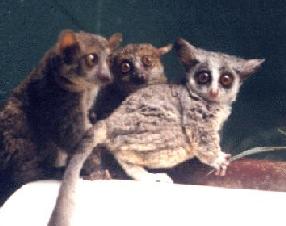
I'm Stabby McSpear! Put Me in Your Tasty Bushbabies!

There's an exceptionally cool article in Current Biology's "Online Ahead of issue" section this week by Jill Preutz from Iowa State University and Paco Bertolani who seems to be a graduate student at Cambridge. In it, they report that chimpanzees in their study communities routinely make spears for use in hunting. It's a well-written article, and it's chock full of novel observations with far-reaching implications. The following is rated S for Stabby.

Primate tool use is taken somewhat for granted these days, but it's worth remembering that Jane Goodall's initial reports of termite fishing and wadge dipping at Gombe were met with considerable skepticism fewer than 50 years ago. And just when we'd gotten comfortable with our closest relatives modifying the environment through nonbiological means, there was the revelation in the mid-1990s that orangutans (the most distant of our Great Ape relatives) also made and used tools in the wild. Gorillas would join the party even later in late 2005. The bonobos, to date, remain on the outside looking in, possibly because their tools are sex-toy oriented and therefore not much good for opening doors.

So our thinking on tool use has come a long way just in the last few years. We've gone from thinking that a culture-ready brain (or at least a technology-ready one) evolved just 7 million years or so ago (before the human-Pan split) to accepting that, neurologically, the right stuff has been with the Hominoid lineage for more than twice as long. We've also realized that a number of different social structures, ranging from the semisolitary orangutan to the gregarious, constantly shifting community of the chimpanzee, can result in tool-using individuals. We've also had to give up overly simplistic notions about handedness and language going, as it were, hand-in-hand. Hell, just last week we had to give up any last-ditch hopes that chimpanzees might somehow have "caught" tool use from humans.

Even though chimpanzee tool use is, comparatively, a pair of comfy old cognitive pajamas, this research by Preutz and Bertolani introduces some pinholes here and there as well as a few things that might constitute a previously unrecognized pajamial butt flap. First off, the context of tool use is new and exciting: At Fongoli (the Senegalese study community), the chimps use tools for hunting, which has a couple of new and exciting implications.

A less radical, but still interesting, factor about the hunting context is the preferred prey of the Fongoli chimps. Elsewhere, chimpanzees tend to hunt young baboons, colobus monkeys of all ages, and things like antelope and bush pigs. At Fongoli, the environment is considerably drier than that of other chimps and these preferred prey are absent. The Fongoli chimps hunt bushbabies (a small, nocturnal prosimian primate) instead, using their spears to stab into the hollows where they shelter as they sleep the day away. Several characteristics of Fongoli hunting are probably related to this choice of prey.

First of all, the small size of the bushbaby, combined with its nocturnal activity patterns, mean that a lone chimp has a greater chance of success, whereas larger diurnal prey might be out of reach for the solitary hunter. An individual who successfully captures and kills a bushbaby thus has no social obligation to share the meat (elsewhere, hunted meat is virtually the only resource that is shared among adult chimps who parcel out the spoils to the hunters and to females who . . . ahem . . . have something to offer). The small size of the kill also probably contributes to the solo consumption. The "shooting fish in a barrel" (seriously, could you bring yourself to stab this in its sleep?) nature of bushbaby hunting also opens this economic niche to individuals who don't usually hunt, namely subadults and females.

The real kicker about the context of Fongoli tool use, though, is the fact that ape tool use in hunting is pretty much novel. Up until now, all food-related tool use by chimps has taken place in foraging contexts: They open nuts with stone or wood hammers; they make leaf sponges and dip for water; they dip stalks and twigs into ant or termite mounds and fish them out. Although "rousing" use of tools has been observed in isolated cases elsewhere, the Fongoli chimps employ tools in hunting frequently.

In addition to the quantitative shift from rare to routine, there's a qualitative difference: Whereas a chimp at Mahale picked up a nearby branch to rouse a squirrel from a hole, the Fongoli chimps are using spears to stab at the prey repeatedly. It is not yet clear whether or not the prey is killed (or even injured) with the spear, but there's a cognitively important difference between using a branch merely to extend the length of the arm and using a spear as a weapon. This isn't just appealing to those of us who enjoy a spot of violence now and again, it is very likely to improve the chimp's success by allowing him or her to invade the busbaby's nest and immobilize the prey in one swift movement. Rousing use of tools is just as likely to give the prey time to escape.

So tool use in an entirely new context is cool. New prey is conceptually cool for humans, albeit bad news for the endangered Senegalese bushbaby. Experimentation with hunting by chycks and youngsters also on the well-chilled end of the news spectrum. New data on chimpanzee cognitive evident in how they use their tools, approaching absolute zero.

But the real seat-busting potential of this research is in the manufacture of the tools themselves. Certainly there is something about the image of chimps running around with spears that tingles the Alan Moore sensors of the brain all on its own, but the data on the modification process certainly have more than just the "Stabby Chimps = Crazy Awesome" street value. Preutz and Bertolani characterize the manufacture of spears by the Fongoli chimps as "crafting," which doesn't sound like an earth shaking declaration. In anthropological circles, where even today we insist that the object in use be an "unattached environmental object" (this criterion was used for long time to deny the title of tool use to behaviors like "bridging" among male orangutans who bend saplings to travel from one larger trunk to the other), crafting has a flatbed of baggage with it.

The process that the chimps use to create their spears is both hierarchical and flexible. Certain steps must be taken early on, regardless of formal aspects of the material or any other factors, but once the base modifications are complete, the chimps can and do alter their techniques on the fly. That speaks volumes about their ability to generalize, which we consider to be an especially important facet of human intelligence. Another aspect of the manufacture that is especially intriguing is the fact that the chimps are sharpening the end of the tool using their teeth.

Again, this is a qualitative shift in a behavior that is seen in other contexts. In termite and ant dipping, as well as in nut-meat extraction (shut up JRH, a chimp will often use teeth to break off the tool after it is chosen and to strip it of leaves. However, in those contexts, the tool cannot fit into the space without the modification. At Fongoli, the sharpening behavior is not simply to make the tool fit, it is part and parcel of how the chimp wishes to use the tool. My favorite sentence in the entire article: "Chimpanzees forcibly ‘‘jabbed’’ (sensu Marlowe [16])." As I said earlier to M and J, it is now my goal to see in print "[Organism foo] comprehensively dismembered (sensu Matilda) that punkass po po bitch."

In terms of the bigger picture, the context of Fongoli tool use has real potential to shift our view of the early hominid resource base. As much as we have always loved a "Man the Hunter" model for our own evolution, most of the evidence suggests that hunting and tool use have fuck all to do with our first divergence from the Pan lineage. The earliest hominids do not have the teeth of a habitual meat eater, in terms of either architecture or wear; the earliest tools are persistently linked to scavenging/foraging behaviors (extracting marrow from the sloppy seconds of large carnivores and/or extracting insects from bark and mounds); and there's not a lot of clear evidence linking the earliest bipeds to any kind of tools at all.

The Fongoli chimps represent routine and systematic attempts at hunting with tools that are nondurable. Although there is the potential to do archaeological research into how long this behavior has been in their repertoire, ancient hominid behaviors of this type will be archaeologically invisible (at least until we shift our framework for recovering and recognizing tool-using behaviors) because of the much greater time elapsed. Thus, although it remains pretty incontrovertible that hunting and meat eating were not an appreciable trick up the hominid sleeve (not that we had sleeves until much later) until the emergence of Homo erectus about 2 million years ago, it is possible that hominids began experimenting with tool-assisted hunting as well as foraging at a much earlier date.

Off the top of my oversized head, I think that conceptual nugget has the potential to shed light on how the frilly heck we made it out of Africa in such a hurry, as the evidence from Dmanisi and tool finds in China suggest (both emphasize mastery of hunting as a key factor). I also wonder if there are dental implications for the chimps that would shed light on the weird dental problems that plagued the Neanderthals. To be sure, the Neanderthals had a wide variety of stone tools they could have used for sharpening, but it's also been suggested that a cognitive barrier prevented them from envisioning the snazzy, hafted, multicomponent tools that those rockstar modern humans favored.

Labels: , , ,

Wednesday, August 17, 2005

The Left Hand of the Dark Continent: Chimpanzees, Handedness, Brain Asymmetry, and Language

Note: I originally wrote this for Noodly.org, which is currently in flux. I'm archiving it here at telecommuniculturey, because there's nothing more cultural than language and because I found myself wanting to refer to it.

In their usual Today Is Opposite Day approach to clarity, the AP (and CNN, presumably by way of the AP) are reporting that a study published in this week’s PNAS that shows that most chimpanzees are left-handed (southpaws, ’cause it’s catchier [pitchier, I suppose—southpaws catch with their right hands {myself, I would have gone with “sinister,” because it’s just much cooler}]). For an AP science article, I suppose the errors are not so serious: The study is not in this week’s PNAS, but in this week’s early edition of the journal; one also needs to pad the sentence “Most chimps are southpaws” quite liberally with adjectival phrases, such as “in a subsample of the larger of the two known communities at Gombe” and “when termite fishing, but don’t ask about nutcracking.”

The leftyness, though gratifying to your wooly-headed, liberal correspondent, isn’t particularly relevant. I mean, it’s neat in an “ain’t that a hell of a thing?” kind of way, given that we estimate that 90% of individuals in (putatively) literate human populations are right-handed. But the key point is that they exhibit statistically signfiicant population-level handedness at all.

Previous studies (which are casually folded into this paper as well) have lacked the sample sizes and statistical power to demonstrate true handedness. Although this is still a wee sample (N = 17), it has the numbers behind it. By combining the samples from these studies, our intrepid authors were able to determine strong right-handed preference for nutcracking and weaker right-handed preference for “wadge-dipping” (I suppose in a world ravaged by Jerry Seinfeld, that sounds better than “sponging,” but not much). I anticipate many taking these supposed inconsistencies and saying “Ah ha! But that shows chimps aren’t handed at all! They use different hands for different things!” with a sigh of ill-founded relief.

“Why ill-founded?”, you are probably not asking yourself, because it is unlikely in the extreme that you are still reading. Well, it’s manifold ill-founded relief. The first problem with it is the failure to recognize that these are not the same chimps using different hands for different tasks. We don’t know what hand the lefty, termite-fishing Gombe chimps would use to crack nuts, because they don’t crack nuts. Not for lack of opportunity, mind you, there are plenty of nuts and plenty of appropriate hammerstones available in their environment. They just don’t. In fact, none of the wild chimp populations that have been studied engages in all three of these tool-using behaviors. Those of us who are not bending over backwards to ixnay on the ulturecay in nonhuman primates shrug and attribute the differences to a cultural preference. Those whose I M SPESHIAL t-shirts burst into indignant flames when the words “culture” and “chimpanzee” are uttered in the same sentence are still scouring the underbrush for an ecological explanation. But I digress.

The second problem is related, but more intertwined with the whole handedness issue. To be handed is to be cerebrally asymmetrical (see a recent Pharyngula entry for a cool piece with cooler pictures on how asymmetry, in general, is accomplished in superficialy symmetrical beasties like us). To be cerebrally asymmetrical, so many theories go, is to have all kinds of M@D 5K1LLZ. Researchers on schizophrenia have danced around implicating a lack of sufficient asymmtery in the disease, for example. Others have suggested that men and women be different, because lateralization is complex and affected by gonadal hormones, so it functions differently in women by virtue of their menstrual cycle. But the most persistent, most contentious shiny thing attached to asymmetry (and, by extension, to handedness) is the L word.

It is certainly true that language ability tends to hunker down in one side of the brain. For most people, whether they are sinister or dextrous, that’s the left side. Because language appears to be dependent on lateralization and handedness is dependent on lateralization, it was decided some time ago that they’re two great tastes that taste great together. As such, handedness became both a proxy for asymmetry (with a dash of linguistic ability strongly implied) and a necessary correlate of language (i.e., if handedness was not evident, language could not be present). It’s not, shall we say, the most robust relationship upon which to insist as proof, but it has certainly stuck.

This has important and direct implications for primatology and paleoanthropology/archaeology and no less important, but fuzzier implications for evolutionary biology in general. Language is a thorn in the side of all three fields. For evolution, it’s been declared “a disaster” by Chomsky, because there are supposedly no primate precursors evident.

For paleoanthropology and archaeology, the pressure is on to come up with a time, place, and species for the evolution of language. Part of the problem in reaching that goal is the criteria that have been used. To have language as it is used by modern humans, a species should have the anatomical stuff (fine control of breathing, fine control of muscles and structures used in phonation, and a low-positioned larynx [this is, of course, leaving aside the hairy question of gestural language produced manually and facially and processed visually, which is very likely to have preceeded a language produced vocally and processed aurally]), the neuroanatomical stuff (Broca’s area, Wernicke’s area, lateralization, and Ba'al knows what else that might be implicated in language), and a social environment conducive to language (high investment in child care, probably by multiple adults).

But we can’t agree on what markers would reveal whether or not these prerequisites are present. Basicranial flexure, which is argued to reveal the position of the larynx, has devolved into an “is not, is too” exercise. Homo erectus who has promisingly sophisticated behaviors, seems to have quite a small neural canal, indicating that his breath control was not all that. The same endocasts are used to argue for and against enlargement in Broca’s and Wernicke’s areas. Once a material culture record is in play (about 2.5 mya), so is handedness. We peer at tool industry after tool industry, we flint knap until our lily-white academic hands are raw and bleeding, and try to determine whether the magical right-hand bias is present, which would imply lateralization, which would imply the capacity for language, right? RIGHT?

Even if we could get two anatomists and/or two experimental archaeologists to interpret the same data in the same way, we are now told that the mere anatomical and neuroanatomical capacity for language won’t satisfy. There has to be evidence for symbolic behavior to show that a given species is making good use of the lop-sided brain and the Adam’s apple. This may prove to be the fatal mistake of the non-physical anthro types, as they’ve generated a rallying point that may draw primatologists and paleoanthropologists together.

A lot of the symbol debate centers, unsurprisingly, around Neanderthals. People get downright snippy about them. “Where’s your Cave Bear Cult now, Milford?” they say and “Ritual burial? Ha! The flowers didn’t pan out, did they?” (For the sake of not introducing yet another of my bioarchaeological pet peeves, I’ll forego the rant [ok, I’ll mostly forego it, because Look! It’s a parenthetical rant!] about how grave goods are not the only medium for symbolic behavior in a burial).

Bringing the symbol card into play with reference to Neandethals is very likely to be a serious misstep for those who really really really want language and culture to be the exlcusive property of anatomically modern humans (that’s you and me [well, it’s me, I assume it’s you, too {on the internet, no one knows you’re a dog}]). It carries with it the assumption that the physical structures that allow for spoken language evolved first, and the abilities inherent in language (e.g., the capacity for symbolism) came later. There’s a lot of baggage there about how language made the difference for us, why the Neanderthals didn’t make it, etc.

The problem with that is sneaking up behind them from primatology, though. The body of evidence supporting symbolic behaviors in nonhuman primates (who, most definitely, have few or none of the anatomical prerequisites for spoken/heard language) is growing. It’s looking more and more like the brain comes first and the body follows.

So where do handedness, lateralization, and this paper (remember the paper? I started out with it roughly 10 kya) fit in this? Maybe nowhere. The authors of the study conclude that handedness in chimps is present, runs in families, and varies either from task to task and/or from community to community. The most straightforward implication is that cerebral asymmetry is something that evolved more than 5 mya, when the human and Pan lineages were not yet distinct. Research on handedness in mountain gorillas tentatively moves that date back to at least 8 mya, when all the African apes (that, naturally, includes you and me [barring your secret identity as a dog]) were a single lineage, and what the heck, I’d argue that the date is probably going to get pushed even further back to something like 15 mya, when all the great apes were a twinkle in the eye of a creature like Pierolapithecus catalunicus, given the fact that we are pretty confident that orangutans are wild tool users, too.

The AP article ends with the author interpreting the early evolution of lateralization to mean that handedness and language have fuck all to do with one another. That certainly is the most parsimonious explanation, particularly given the evidence for some type of handedness in all kinds of vertebrates. However, it raises the intriguing possibility that a lot of the supersecretextradoublefudgey parts of our neuroanatomy have been accumulating over a pretty long stretch of time. All in all, somee pretty intriguing stuff out of a pretty simple paper.

Labels: , , ,

Thursday, April 07, 2005

Lean on Dmanisi

Originally written for noodly.org, but archived here on account of flux and wanting to refer to it.

First, I should reveal that y'all are likely better off reading Pat Shipman's excellent article Doubting Dmanisi than this. That's not going to stop me from blathering on for a good long while, mind you, but I love, therefore I disclose.

The third article in yesterday's Nature that got the scientific blood a-pumping was a nicely written, unassuming piece. The straightforward reporting and elegance of the conclusions are also typical of the two previous publications in Science regarding the same site, and of the original 1993 Nature paper. This scientific cool is all the more impressive given the massive potential of the finds for shaking things up as well as the fact that the team has been waiting for 12 years for real acceptance of their work. All in all, this is a most refreshing contrast to the kind of shennanigans evident in the Sahelanthropus saga (and, let's face it, most of paleoanthropology). The newest paper is the icing on a painstakingly constructed cake. This is a cake that required a substantial labor force in the strawberry mines. As ever, a bit of background is needed.

Part of the problem with paleoanthropology is that discoveries have proceeded ass backwards. The earliest hominid finds were Neanderthal and Cro-Magnon individuals in Europe, followed hot on the heels by things in the Far East that we then called by catchy titles like Homo pekingensis and Homo modjokertensis (no, really, I only wish I'd made that up) and that we now call by the wholly misleading Homo erectus. It means "Upright Walking Man," which, ok, true enough. He is upright walking, it's just that his daddy, grandaddy, and probably great-grandaddy are too. it's just kind of like calling "A New Hope" Star Wars. Oh . . . ahem. Moving on.

The earliest finds reinforced the already fairly robust tendency to emphasize Europe and Asia in all things. So, despite the hunch by Darwin that Africa would figure prominently in hominid evolution, no one felt too much like ferreting out relatives on the Dark Continent. As an aside, that attitude survives as evidenced by the coverage of the find of Pierolapithecus catalunicus, a 13 myo ape, in Spain earlier this year. The popular press was most relieved to reassure us that Europe had been restored to its status as the Cradle of Humanity (no mention of it also being the cradle of chimpanzee-ity, bonobo-ity, gorilla-ity, and orangutan-ity, as well).

Once Africa was established quite definitely as the place we ought to be looking if we wanted the good parts version of the human story (a good 25 years after a certain child's skull miraculously escaped getting blowed up real good and found its way to one Raymond Dart), there was trouble connecting the dots. Who, when, how, and why the first hominids left Africa and populated the rest of the world became the $64,000 question.

Delving into these matters was complicated by worsening political relationships with the Far East. Oh yeah, and we lost the Peking Man fossils. And by "we," I mean the US Marines. What little information we could elicit regarding relative dates and so on led paleoanthropologists to put hominids in Southeast Asia by about 1 mya. Material from Africa fit in well with this timing as specimens assigned to Homo erectus began to emerge from the African record in strata dating to about 1.8 mya.

Paleoanthropologists have the mentality of yuppie parents. Our kidlets need to be doing everything NOW or at least before those trailer trash brats from the next tuft over do. Well you're standing up, aren't you? Why don't you have a flipping huge brain? You see those giant rock outcroppings? They're chock full o' tool-making goodness. If you'd just exert yourself a bit, you could be the mightiest predator on the savanna! To a mindset like this, there's no excuse for lying about in Africa for 800,000 years when Asia beckons.

There must have been a technological whizzbang that allowed them to get outta Dodge, and the gadget commonly favored was the Acheulean hand axe. Homo erectus is associated with two tool industries: The Developed Oldowan Industry (a variation on the "Hey, I love to bash things. If I bash THIS rock with THIS rock, I have a SHARP rock and I can Bash and Slash!" original stone technology), and the Acheulean industry, which involves more specialized tool forms and more extensive modification to make them do their jobs better. Once humanity figured out how to turn over the piece of rock and work on the other side, so the story goes, they were hell-bent for leather.

On the flipside, the aging-hippie-parent paleoanthropologist argues, Indonesia's a hell of a jaunt. No rush. It's not like the Dead are playing or something. In this corner, paleoanthropologists eyed up the hand axe and said, "It's a rock. I can't wait to tell my friends. None of them has a cutting edge so efficient for the same amount of stone by weight." The idea of hominids scraping their way out of Africa was not, to say the least, a compelling tale. This camp favored a multifactorial ecological model, whereby hominids accumulated behavioral changes gradually that eased them Northward and thence East.

In addition to the temporal issue, there's an irritating lack of geographical continuity in fossil finds during this period, making the timeline and pace of the first migration out even more difficult to construct. And then in 1993, Dmanisi first reared what would prove to be a breathtakingly tiny, sagitally-keeled, yet undeniably hominid head.

The site is in the Republic of Georgia "at the gates of Europe" as many have become more recently fond of pointing out. "Humanity was in Europe---or at least the gates of it---nearly two million years ago," they'd say, working hard not add "Boo ya! In your FACE Africa!"

The first hominid-relevant fossil from Dmanisi was a mandible (lower jaw, with teeth) the authors believed to be near 1.8 myo. Despite the minimal nature of this find, the jaw's relative completeness and minimal damage allowed for extensive comparisons with other hominids. Gabunia and Vekua believed it was Homo erectus. They believed that the evidence so clearly spoke for itself that they brought the original fossils to the conference at which they unveiled it, casually granting unlimited access to colleagues (although this is not unheard of, it's rare; it's also risky as the heart-breaking story of the Homo floresiensis fossils makes clear). Pat Shipman and Alan Walker, perhaps the two most qualified to assess the jaw, were convinced. Milford Wolpoff started a knock-down, drag-out fight about whether Homo erectus existed at all, and almost everyone forgot about Dmanisi.

In 2000 and again in 2002 Dmanisi didn't so much burst on to the scene as it quietly left a really kick-ass cake on the front porch with a polite note. They had skulls with clear morpohological affinity to the African variant of Homo erectus (often called Homo ergaster in an attempt not to squander our precious multisyllabic Latin resources), with a few important twists. The 2002 skull, in particular, was tiny, holding a brain that was estimated to be 600 cc. Assuming that you all don't spend your Friday nights lining up the skulls in your house in order of cranial capacity (which we at the Painful Acres totally don't), let me give you an idea of what that means.

The Australopithecines have brains that are about 400 cc by volume, more or less in the range of modern chimpanzees. When Louis Leakey claimed that the earliest members of genus Homo (a species he called H. habilis, the first toolmaker) had brains that were about 650 cc, there was tremendous resistance. After all, Sir Arthur Keith had closed his countryclub to any creature whose brain wasn't on the right side of the Cerebral Rubicon (750 cc), and this Bill Frist of his time went to his grave believing in Piltdown Man. We should totally take his word for it.

Paleoanthropologists have remained somewhat uncomfortable with the subtlety of the brain expansion from the Australopithcines to Homo habilis. In fact, there's still a substantial movement in the field to do away with the designation altogether, lumping most of Leakey's specimens into genus Australopithecus (don't ask them about the very modern-looking hands and feet; they get cranky). With the brain of Homo erectus ranging all the way up to 1100 cc, though, everyone breathed a sigh of relief. Now, we're talkin' encephalization! The Dmanisi hominids ever-so-gently warned the scientific community, once again, against placing too much emphasis on brain volume as the one and only proxy for intelligence and behavioral advancement.

In addition to the skulls, Dmanisi yielded thousands of stone tools and high concentrations of animal bones bearing cutmarks from them. This was potentially balm for the yuppie parents' souls. We've always been in a big rush to get to the meat-eating part of the story. So these little-brained things have some superfancy tools, and then the start beating the crap out of things and running around with blood dripping from their maws, right? RIGHT? Well, not so much with the fancy dancy tools. The lithics from Dmanisi are quite stubbornly Oldowan I. This news is brown slacks from Sears for Christmas. It is a little brother in lieu of a Snoopy Snow Cone machine. It is Lee Carvallo's Putting Challenge instead of Bonestorm.

The Dmanisi message, as it unfolded, was stunning. Hominids left Africa much earlier than previously expected, and they did so with minimally expanded brains and incredibly rudimentary tools. The 2002 article suggested that we would even have to consider the possibility that Homo erectus (sensu lato) was not the first to make it out of the natal household, but rather something at least more basal if not flat out belonging to Homo habilis.

And still the question remained, "How did they do it?" What finally enabled and or compelled them to move into environments for which their tropical body type was ill-suited? What adaptations made the difference in allowing them to thrive in temperate, seasonal climates with that body type?

Leaving aside the question of how they got animal protein for a moment (those simple tools are still sticking in our collective craw), there's good evidence that exploitation of animal protein was a key adaptive strategy. All previous hominids are primarily vegetarian and only got the hint about exploiting animal resources about 2.5 mya. In a seasonal environment, animals represent calories stored on the hoof/paw/thumpy widdle bunny leg, etc. The sheer number of animal bones bearing tool marks at Dmanisi make it clear that hominids are hunting for the first time.

But if we've learned anything over the last century and change of paleoanthropology (and many of us have not), it's to give unifactorial explanations the hairy eyeball. But the additional factor currently stepping up to the plate is one that's fairly unexpected.

There's a brand new skull from Dmanisi this week. Morphologically there's not a lot new. Its brow ridge is in line with what we expect. The cresting on the back of the head where the neck muscles attach is not particularly exciting. Endocranial capacity is middling. And, oh yeah, it hasn't got a single tooth left in its head. This individual had lost all his teeth years and years ago and the tooth sockets had been completely resorbed, the mandible shrinking to less than 1/3 its original height.

Unlike the current state of affairs, the teeth of Homo erectus would most definitely have been considered to be part of the body. We often casually note that our teeth become pretty much irrelevant as tool technology develops. I suppose that's true if your head has a hinge and you can pop all your food directly down your gullet. This individual does not have a hinge in his head. He survived for years, either unable to chew his own food at all or having to lobby extensively for the squishy bits.

There's a strong chance that this individual survived with the help of his social group. Adult individuals cooperating economically is a rare thing in the animal world to begin with. Biologically, we define altruism as sacrificing a portion of one's own reproductive fitness to benefit someone else. Arguably, humans have a highly elaborated form of altruism that ensures the survival of those who are "less fit" due to age, infirmity, or simple ineptitude when it comes to not starving, not getting eaten, not falling off a cliff, etc. For this last, yours truly is sincerely grateful.

The earliest altruistic behavior in hominids has traditionally been attributed to Neanderthals, a form of hominid very much like anatomically modern Homo sapiens, if not outright belonging to our very species. The capacity to envision value in caring for individuals who can't contribute economically in the usual ways marks a substantial cognitive shift. It's often used to argue for Neanderthal capacity for symbolism and, therefore, for language. The idea that the small-brained, technologically simple hominids at Dmanisi could have had the first inklings of this capacity nearly 1.7 my earlier than anyone had imagined is staggering.

So what do our level-headed authors have to say about this? Surely at this point, they're allowing themselves a well-earned, slightly smug SQUEEEEE! Not so much. The paper includes one extremely sly nod to the entire issue of altruism:

"The subsequent mid-Pleistocene Bau de l'Aubésier and La Chapelle-aux-Saints specimens had a more intact dentition at the time of death."

That's Chow Yun Fat levels of cool right there.

Labels: , , ,